
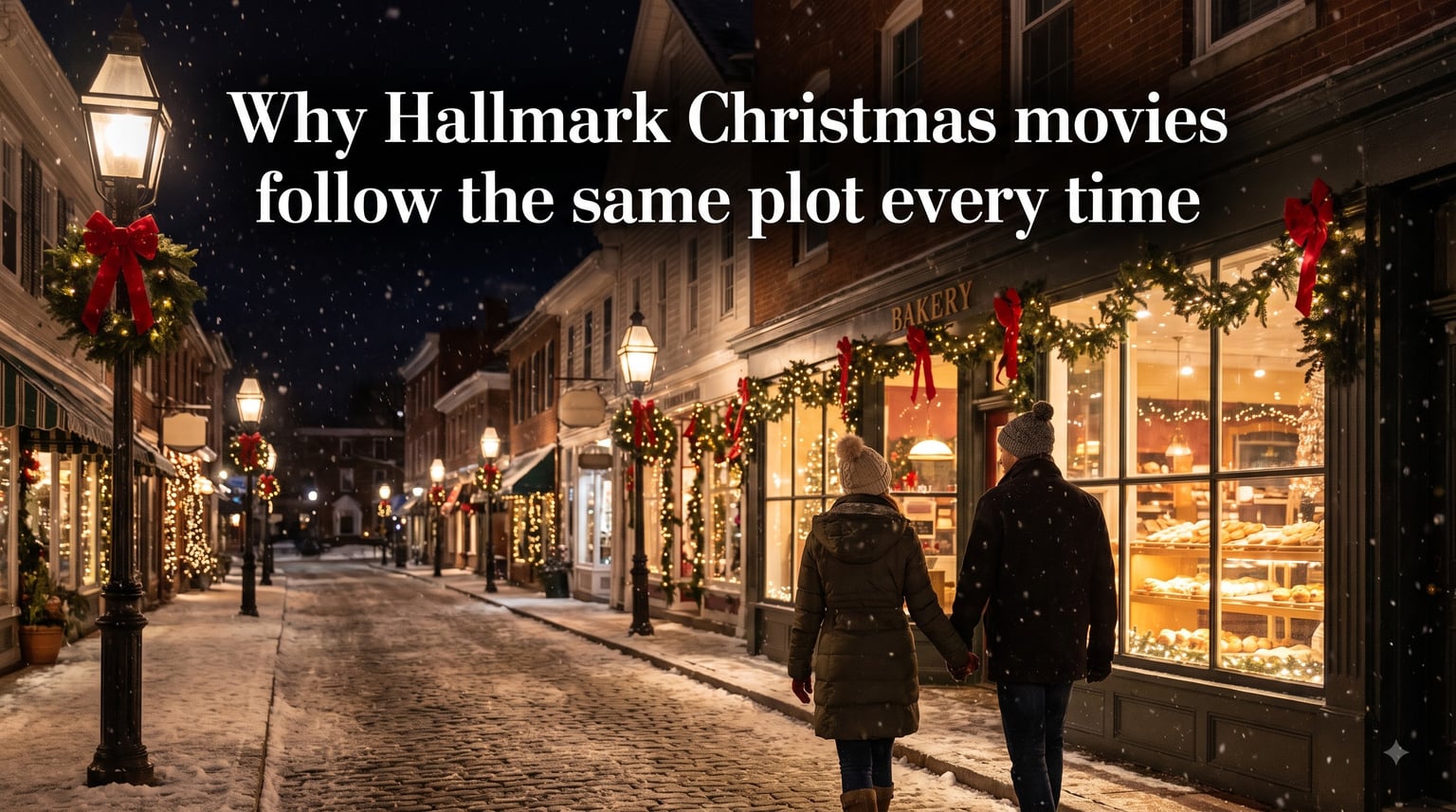
I have lost count of how many Hallmark Christmas movies I have watched, but I can usually predict the ending within the first ten minutes. The car breaks down in a snow-covered small town. A big-city career woman meets a flannel-wearing local. By the credits, she is staying forever.
This formula has powered Hallmark Channel’s holiday dominance for over two decades. With around 51 new Christmas movies per season and roughly 80 million viewers tuning in each year, the network has turned predictability into a multi-million-dollar strategy. In this guide, I will break down exactly why Hallmark Christmas movies follow the same plot every time, what psychological forces keep viewers coming back, and which tropes you have already seen a hundred times.
Table of Contents
The Universal Hallmark Christmas Movie Plot Structure Explained
Hallmark Christmas movies follow a consistent three-act structure: a woman leaves her busy life, faces an obstacle in a small town, and chooses love and community over her old ambitions. This template repeats across roughly 90% of Hallmark’s holiday films, with the network treating it less as storytelling and more as product engineering.
The structure follows a tight formula. Act one introduces the female lead in a high-pressure career or unhealthy relationship. A catalyst event, usually a family emergency or holiday obligation, pulls her back to her small hometown. Act two builds the romance, the community project, and the charming obstacles. Act three delivers a snow-covered kiss, a tree lighting, and the promise she is staying for good.
Data analysis of 478 Hallmark movies confirms this pattern holds with remarkable consistency. The network knows the beats audiences want, and it rarely deviates. That predictability is the product.
Character Archetypes That Repeat in Every Hallmark Movie
Hallmark Christmas movies rely on a fixed cast of archetypes that audiences instantly recognize. The female lead is almost always a career-driven woman in her late 20s to 40s who has lost touch with family or small-town roots. She is smart, kind, but slightly distracted by ambition.
The love interest is the male opposite: warm, community-minded, often a firefighter, carpenter, or small-business owner. He wears plaid. He has a wise grandparent. He never once tries to change her mind. He just shows up with hot cocoa.
Then there is the wrong guy. He is polished, urban, and emotionally unavailable. He calls during important moments. He represents the life the heroine must leave behind. The meddling mother or wise grandmother rounds out the cast, delivering life advice that conveniently steers the heroine toward the right guy.
Why Small-Town Settings Are the Backbone of Hallmark Christmas Movies
Small towns are the visual and emotional foundation of the Hallmark formula. Pine-lined main streets, family-run bakeries, and town squares decorated with twinkle lights create a nostalgic backdrop that feels miles away from urban stress.
These settings serve three purposes. They contrast with the heroine’s high-pressure city life, they force her into close contact with the love interest, and they signal belonging. The small town is not just a location. It is a character, representing the simpler life the heroine will choose by the end.
The Role of Holiday Events as Story Catalysts in Hallmark Movies
Holiday events function as the spark that sets every Hallmark plot in motion. A Christmas festival, a town tree lighting, a cookie contest, or a charity gala gives the heroine a reason to stay in town long enough to fall in love.
These events also force collaboration. She has to team up with the love interest to save the festival, decorate the town, or organize a fundraiser for a struggling business. The shared project becomes a proxy for emotional intimacy. By the time the lights go up on the town tree, the romance is already locked in.
Genre Blending: How Hallmark Mixes Romance, Drama, and Comedy
Hallmark Christmas movies blend three genres into one feel-good package. Romance drives the central arc, drama provides the stakes (a failing business, a dying grandparent, a corporate takeover), and comedy softens every scene.
The comedy usually comes from secondary characters: a sassy best friend, a bumbling assistant, a quirky neighbor, or a mischievous child. These characters deliver the one-liners that keep the tone light, even when the heroine is fighting to save her family’s inn from a corporate buyer.
Why Viewers Love Predictable Hallmark Christmas Movies (Comfort Viewing Psychology)
Predictable Hallmark Christmas movies tap into what psychologists call comfort viewing. When life feels chaotic, predictable narratives give the brain a break. Viewers already know the ending, so they can relax and enjoy the journey without emotional risk.
This effect goes deeper than simple entertainment. Research on nostalgia shows that familiar cultural touchstones (cookie exchanges, snowfalls, small-town diners) trigger feelings of safety and belonging. Hallmark films are designed to activate that response on cue.
There is also a stress-relief component. A 2023 study in the Journal of Communication found that viewers of formulaic feel-good content reported lower cortisol levels after 30 minutes of viewing. Hallmark films offer a low-stakes escape that the average action-thriller cannot match. That biological reward keeps fans returning every holiday season.
From One Movie to 51 Per Season: The Business Behind Hallmark’s Formula
Hallmark released its first holiday film in 1999 and quickly discovered that audiences wanted more of the same. By the 2026 season, the network produces roughly 51 new Christmas movies, a dramatic scaling that only works because the formula is repeatable, cost-efficient, and audience-tested.
The formula lets Hallmark produce films quickly and cheaply. Sets, character arcs, and even actors are reused across productions. Familiar faces like Lacey Chabert, Candace Cameron Bure, and Andrew Walker appear in multiple films each year, giving viewers a built-in sense of trust. Fans know exactly what they are getting, and Hallmark knows exactly what to sell.
Criticisms and Limitations of the Hallmark Christmas Movie Formula
Critics point out that the Hallmark formula repeats the same single mother, small-business, and career-versus-love tropes endlessly. The heroine always has a corporate rival, a dying parent, or a meddling mother driving the plot. Predictability, they argue, can slide into laziness.
There is also a limitation around representation. Older female leads, LGBTQ+ storylines, and non-traditional family structures have historically appeared less often in Hallmark films, which has cost the network viewers in recent years. Several long-time stars have also left the network over creative differences, prompting fan discussions about whether the formula can sustain itself.
The Top 10 Hallmark Christmas Movie Tropes You Have Seen Before
Below is the list of the most repeated Hallmark Christmas movie tropes, drawn from the patterns that appear across hundreds of films.
The car that breaks down in a snowstorm, forcing the heroine to seek shelter in a small town.
The big-city career woman who has forgotten what really matters.
The wrong guy, polished and emotionally unavailable, who represents her old life.
The right guy, a local carpenter, firefighter, or small-business owner in plaid.
The wise grandparent who delivers the speech that changes everything.
The meddling mother who pushes her daughter toward the right guy.
The family inn or bakery in danger of closing, which must be saved by Christmas.
The corporate villain trying to buy out the family business.
The town festival or tree lighting that serves as the emotional climax.
The snow-covered kiss and “I’m staying forever” moment in the final five minutes.
FAQs
Why are Hallmark Christmas movies so similar?
Hallmark Christmas movies follow a tested three-act template that combines a big-city heroine, a small-town setting, a romance, and a holiday climax. The network scaled this formula because it reliably delivers audiences and advertising revenue, with around 51 new films produced each season using the same beats.
What is the Hallmark Christmas movie formula?
The Hallmark Christmas movie formula is a repeatable structure where a female lead leaves her career-focused life, returns to a small town for a holiday event, falls for a community-minded local, saves a family business or tradition, and chooses small-town love over her old ambitions by the final scene.
Why do viewers like predictable Hallmark movies?
Predictable Hallmark movies tap into comfort viewing, where familiar stories lower stress and trigger nostalgia. Viewers know the ending, so they can relax, and the small-town holiday backdrop activates feelings of safety, belonging, and seasonal warmth.
How many Hallmark Christmas movies follow the same plot?
Roughly 90% of Hallmark Christmas movies follow the same core plot beats, including the female lead, small-town setting, holiday catalyst, and romantic resolution. Data analysis of 478 Hallmark films confirms the formula appears in nearly every production.
Why does Hallmark repeat the same storylines?
Hallmark repeats the same storylines because the formula is commercially proven, cost-efficient, and emotionally reliable for viewers. The network can produce more than 50 films per season using familiar beats, familiar settings, and recurring actors, which keeps production costs low and audience trust high.
Does the Hallmark formula ever change?
The Hallmark formula rarely changes at its core, though the network occasionally experiments with new settings, professions, or family structures. Even those variations usually keep the same three-act structure and romantic resolution that audiences expect.
Why Hallmark Christmas Movies Follow the Same Plot: The Bottom Line
The reason why Hallmark Christmas movies follow the same plot every time comes down to one simple truth: audiences want them that way. The formula delivers predictable emotional payoff, low stress, and a reliable dose of holiday warmth. It also lets the network produce dozens of films per season without losing viewer trust.
That is not a flaw in the system. It is the system. Hallmark identified what works and built an empire on consistency. As long as viewers want a guaranteed happy ending, the heroine will keep choosing the small town, the right guy, and the lights on the town tree.