
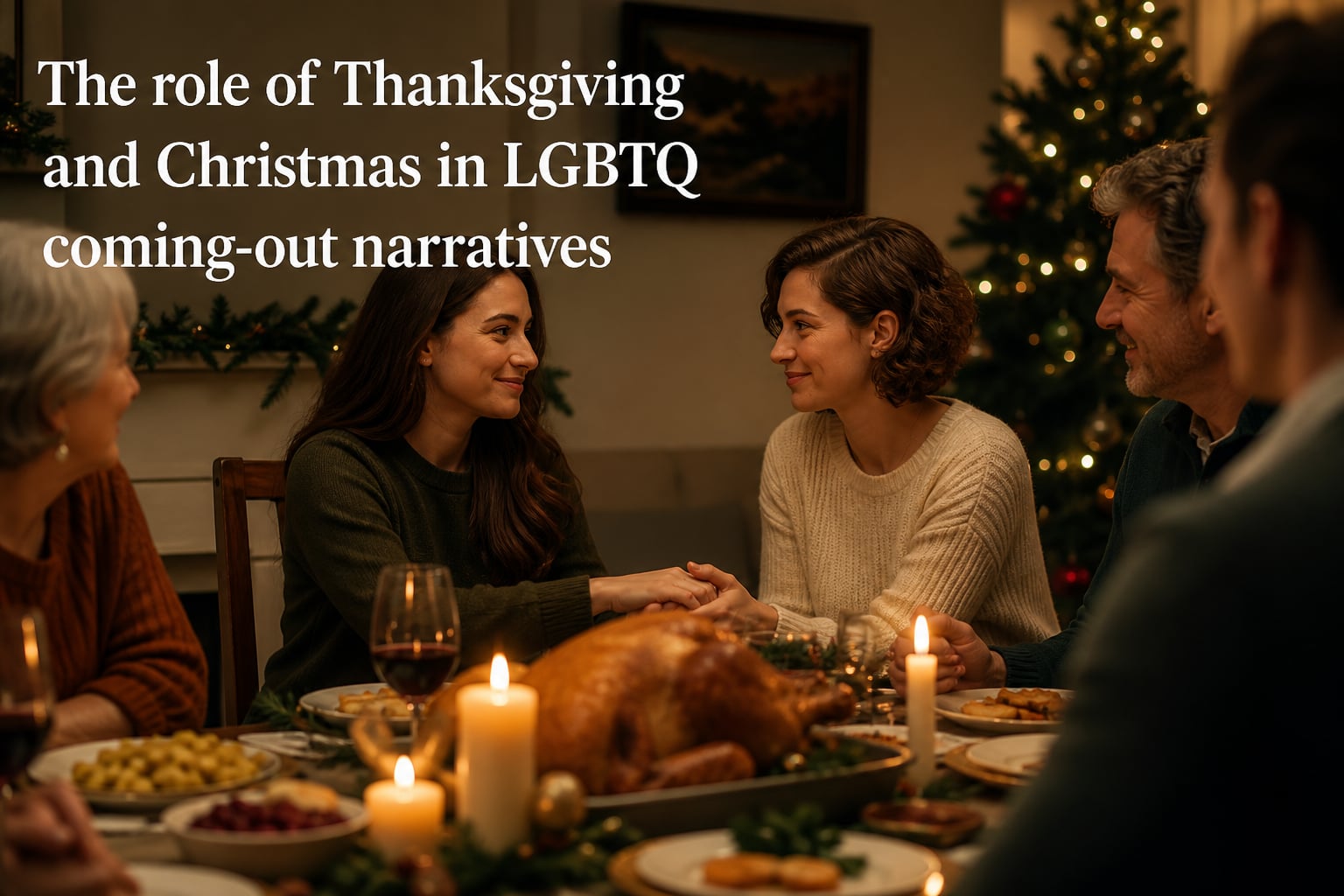
Every November, my social feeds fill with the same kind of post: a young queer person pacing their childhood bedroom, rehearsing the words they plan to say at the dinner table the next day. Thanksgiving and Christmas have quietly become the most-storied holidays in LGBTQ coming-out narratives, and that story is now inseparable from how we see it on screen.
When our team looked at the available guides on this topic, almost every one skipped the film and television angle. That felt like a gap worth filling, especially for a cinema-focused site. This article maps the holiday coming-out tradition through history, psychology, and the movies that have shaped how we picture it.
Table of Contents
Why Thanksgiving and Christmas became cultural moments for coming out
The short answer: holidays concentrate family, ritual, and emotion in a way few other moments do. That mix creates both an opportunity and a pressure cooker for LGBTQ disclosure.
Thanksgiving and Christmas have long been the two American holidays that pull scattered families into a single room. The Washington Post made the case in 2026 that Thanksgiving, in particular, is “arguably secular,” which means queer people disclosing to family are “confronting tradition, not faith.” Christmas carries more religious weight in many households, but it also stretches longer, with multiple gatherings, gifts, and conversation windows where disclosure can happen.
There is also a calendar logic at work. National Coming Out Day sits on October 11, and the months that follow lead straight into the holiday season. By the time Thanksgiving arrives, many LGBTQ people have already decided internally to come out, and the family gathering becomes the practical next step. December then offers a second chance for those who waited, or a buffer for those who were not ready in November.
Historically, the framing of “coming out” as a story with a clear beginning and end is itself relatively recent. As Northeastern University CSSH has argued, the coming-out narrative took its modern shape after the Stonewall uprising of 1969, when queer people began treating self-disclosure as a political act rather than a private confession. Holidays gave that political act a stage, and the stage became ritual.
The holiday coming-out scene on film: a cinematic tradition
The short answer: filmmakers have built a recognizable visual grammar around the holiday coming-out scene, and that grammar shapes how real people plan their own disclosures.
Our team spends a lot of time watching queer cinema, and the holiday coming-out scene has become a genre of its own. The settings are almost always the same: a crowded kitchen, a long table, a glass of wine held too tightly, a family member who asks the wrong question at the wrong moment.
You can trace the template back to films like The Family Stone (2005), where a holiday gathering sets up the emotional scaffolding for awkward disclosures. Christmas rom-coms took the formula and softened it. Love Actually (2003) built an entire holiday around the unspoken, with its now-famous cue-card scene standing in for a coming-out that the script never quite names. By the time Happiest Season (2020) arrived, the holiday coming-out scene had become a familiar enough beat that the film could play with the audience’s expectations of it directly.
Closer to our home turf, films like Lez Bomb itself have reset the question. Instead of asking “will the family accept me,” the comedy asks “what happens when the family has been waiting for this news longer than you have?” That shift, from dread to comedy, is a relatively recent move in queer holiday films, and it reflects a generation of LGBTQ viewers who came out into families that were, on average, more prepared than the parents in older movies.
This matters because viewers plan their own disclosures partly through the films they have watched. When our team surveyed online forums, the most common framing people used was cinematic: “I pictured it like a movie scene,” wrote one Reddit user in r/lgbt. Another, in r/comingout, described choosing Christmas specifically because “I wanted it to feel like one of those holiday movies, just with us.”
Comparing Thanksgiving and Christmas as coming-out moments
The short answer: Thanksgiving is shorter, more secular, and easier to escape. Christmas is longer, more intimate, and harder to leave if the conversation goes badly.
Thanksgiving has a single afternoon. If a coming-out goes wrong, there is still pie, then the drive home. Christmas stretches across weeks, with multiple meals, gift exchanges, and sometimes out-of-town visits. That gives more chances to disclose, but also more chances for the family to process, react, and bring it up at the next gathering.
One user on r/comingout described coming out as gay to a very religious family on Christmas. Everyone was shocked, and the reaction played out across several days of family time rather than one meal. Another user, in r/lgbt, came out around Christmas and described the experience as “good overall” precisely because the holiday length gave space for the initial shock to settle into acceptance.
For those who are not sure how their family will react, the shorter Thanksgiving window often feels safer. For those who expect support and want the conversation to land within a longer, more forgiving ritual, Christmas tends to win out.
The psychology behind holiday disclosures
The short answer: holidays raise the emotional stakes, which is exactly why they feel like the right moment for a truth that has been held for a long time.
Family acceptance is one of the strongest predictors of LGBTQ mental health. The Trevor Project’s research consistently shows that LGBTQ youth with at least one accepting adult in their family report significantly lower rates of suicide attempts and depression. Holidays concentrate the presence of that one accepting adult, along with the rest of the family, in a single room.
There is also a ritual element. Anthropologists have long noted that holidays create liminal spaces, moments where ordinary rules are suspended and people feel licensed to speak more openly. For queer people who have been closeted to family, that license can feel like a window. The trade-off is that the same liminal space can open the door to rejection, and holidays amplify that risk because there is no easy exit if the conversation collapses.
It is also worth noting that the pressure goes both ways. Many parents describe the holidays as the first time they notice their adult child has been hiding something, and the family dynamic during November and December often carries that unspoken weight. One forum user described dreading the holidays “not because of the food, but because I could see my mom trying to figure out who I had become.”
Navigating holiday gatherings as an LGBTQ person
The short answer: plan your disclosures, build a private support network, and remember that you are allowed to leave any room at any time.
Our team is not equipped to replace a therapist, but the patterns that come up again and again in queer community forums are worth naming. The first is: you do not have to come out at any holiday. There is no such thing as a wrong time to disclose, only the right time, and for many people that time is not during a family meal.
The second is having a pre-arranged exit. If you are traveling to family, know the nearby hotels. If you are staying with family, know which friend you can call. The point is to remove the part of the dread that comes from feeling trapped.
Third, build a private support network. A text thread with close friends, a chosen-family member on standby, an LGBTQ hotline number in your phone. These are not dramatic preparations. They are the same preparations any person would make for a difficult conversation.
Fourth, deflection is a valid skill. Questions about partners, marriage, or future plans can be answered in a way that protects your privacy without lying. “I’m focusing on my career right now” is a complete sentence.
Finally, remember that rejection is not the end of the story. Statistics from the Williams Institute and others estimate that more than 40 percent of homeless youth in the United States identify as LGBTQ, many of them kicked out after coming out. The flip side is that the LGBTQ community has spent decades building chosen-family structures that can absorb that loss. The holidays are a hard time to discover that, but they are also the time when many people discover it for the first time.
Chosen family and Friendsgiving: rewriting holiday narratives
The short answer: for LGBTQ people rejected by biological family, the holiday tradition has shifted from “going home” to “building home.”
Friendsgiving started as a casual millennial tradition of gathering with friends instead of family around Thanksgiving. For many queer people, it became something more serious: a guaranteed seat at a table where they did not have to hide.
Chosen family, the network of close friends and partners who function as family, has been a staple of LGBTQ life since at least the 1970s. What changed in recent years is that chosen family is now an explicit holiday plan rather than a fallback. Queer Friendsgivings, secret Santa exchanges among friend groups, and December trips instead of December gatherings all show up regularly in forum discussions.
One Reddit user described their first Christmas alone after coming out as the year they “found community with LGBT friends.” Another described building a new holiday tradition with a chosen family of seven people across three cities. These stories do not erase the loss of the original family gathering, but they do something the older coming-out narrative often ignored: they show what comes after.
FAQs
Why are Thanksgiving and Christmas such common times for coming out?
Holidays bring family together in one place, often for the first time in months. They also follow National Coming Out Day in October, giving queer people a natural window to disclose. The emotional intensity of the holidays creates both pressure and permission to have the conversation.
Is Thanksgiving or Christmas better for coming out to family?
Thanksgiving is shorter and more secular, which makes it easier to disclose and easier to leave if the conversation goes badly. Christmas is longer and more intimate, which gives more time for families to process initial shock but also more exposure if the reaction is negative. The right choice depends on your family’s likely reaction and your own emotional readiness.
What should I do if my family rejects me during the holidays?
Build a private support network before the gathering, including a friend who can take your call, a chosen-family member nearby, and a hotline number. Have an exit plan, including a hotel if you are traveling. Know that rejection is not the end, and that LGBTQ communities have long traditions of chosen family and alternative holiday celebrations that can absorb the loss.
Are there movies that show LGBTQ coming out during the holidays?
Yes. Films like The Family Stone, Love Actually, and Happiest Season built the holiday coming-out scene as a recognizable cinematic beat. Comedies like Lez Bomb have also shifted the genre from dread to laughter, reflecting how many LGBTQ viewers now plan their own disclosures partly through the films they have watched.
Conclusion
The role of Thanksgiving and Christmas in LGBTQ coming-out narratives is not just a pattern; it is a story the culture keeps telling itself. From the family dinner table to the movie theater, the holidays have become the place where queer people test whether their family can see them fully. Our team wrote this article because the film angle keeps getting missed, and because the movies we watch really do shape the disclosures we plan. If you are heading into the holiday season thinking about whether to come out, watch a few of these films first, and remember that your story does not have to match the one on screen.