
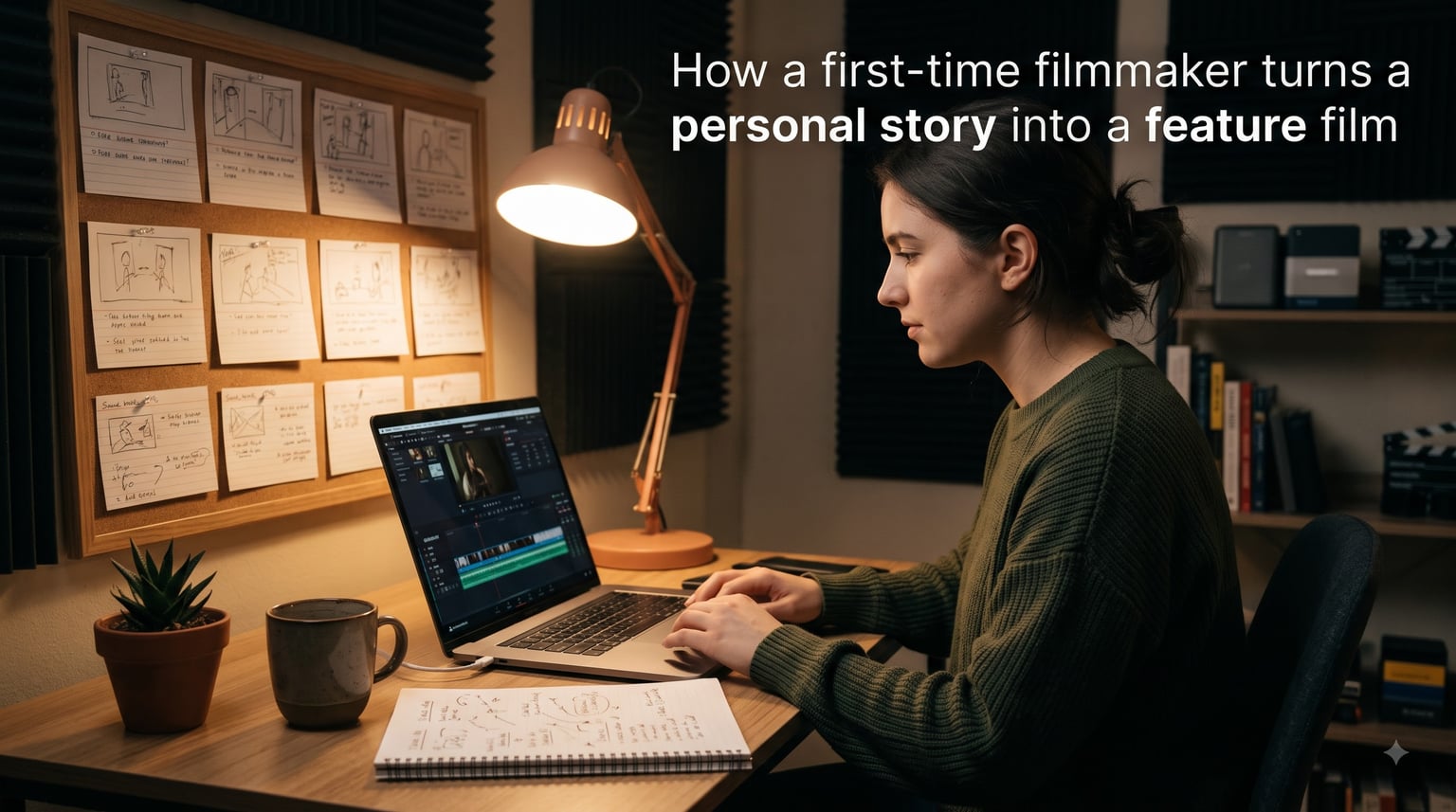
I sat in the edit suite at 2 a.m. with a half-finished scene about my own mother on the timeline. I had spent 18 months trying to turn one private memory into a feature film, and I still could not decide whether the ending should match what actually happened or what I needed to be true. That night, my mentor said something I now repeat to every first-time filmmaker I meet: the story is yours, but the film belongs to the audience. This guide is for the people in that 2 a.m. chair, working out how a first-time filmmaker turns a personal story into a feature film without losing themselves on the way.
Table of Contents
Finding the Story You Actually Need to Tell
Before you write a single page of script, you need to be sure which personal story deserves a feature-length commitment. A useful test I learned the hard way: the stories worth filming are the ones you keep returning to in conversation, even when nobody asks. If you have told the same core memory to friends, partners, or your therapist more than ten times, your subconscious has already voted.
Separate the story from the wound. A personal story turned into a film is not therapy, and treating it as such usually produces a film that feels like a long apology. Ask yourself what the story is really about at one level deeper than the events. If your breakup story keeps drawing you back, the deeper story might be about the cost of performing happiness in your family.
Then look for the universal in your specific experience. Festival programmers, my colleagues, and I have read hundreds of personal scripts and the ones that travel are not the most unusual. They are the ones whose specific details unlock a feeling the audience already carries. Keep what is yours, and rewrite what is only yours alone.
Turning Lived Memory Into a Screenplay
Memory is associative, nonlinear, and full of dead air. Screenplays are the opposite. Your job in this phase is to compress, restructure, and invent just enough scaffolding that an audience can enter your experience without getting lost in it.
Start by sketching the three-act shape of the memory before writing scenes. Where does the status quo end? What is the moment that changes everything? What does the new normal look like? Even two sentences per act on an index card will save you months. Many first-time filmmakers write beautifully and structure later, then realize their 110-page script is really a short film padded with their favorite anecdote.
Pick a clear protagonist, even when the story is yours. If you are the central figure, give yourself a different name and write the character in third person at first. That single trick creates distance and lets you make the cruel edits you cannot make on yourself. Real moments of dialogue almost never translate directly. You will dramatize, condense, and combine to find the scene that says what your memory actually meant.
Map the Beats That Only You Know
Write down five beats that an outsider could not invent. A cousin’s hand on your shoulder during a specific meal, the sound of the dishwasher at the moment a decision is made, a phrase your father used twice in his life. These details are your unfair advantage over the thousand other scripts about the same kind of event. Put them on the page early so the structure can grow around them.
Developing Characters From Real People (Including Yourself)
Turning real people into characters is the most delicate part of autobiographical filmmaking. You owe the truth something, but you also owe the film clarity.
Build composite characters when one real person is too contradictory or too private. Two difficult relatives can become one character who carries both of their defining traits. A composite is not a lie; it is a lens. The audience understands this implicitly because every novel and memoir does the same thing.
Give your antagonists their own goals before you give them dialogue. The reason personal films sometimes feel unfair is that the writer has not imagined the antagonist’s inner life. Spend a paragraph describing what your estranged brother wants, fears, and pretends not to know. The scene will write itself when you understand what he is defending.
Decide what to omit with the same care as what to include. The scenes you leave out are the scenes that make the film feel dignified. If a memory would embarrass someone who did not consent to being depicted, it does not belong in the cut. There are 87 other stories in that same wound.
The Emotional Journey of Making an Autobiographical Film
The part nobody warns you about is not the budget or the schedule. It is the second time you sit in the director’s chair and feel the original event come back, fully embodied, in front of the camera. Re-traumatization is real, and the filmmakers who finish their personal features are the ones who plan for it rather than tough it out.
Build a small, named support circle outside the production. Two friends, a therapist, or a peer filmmaker who has been through autobiographical work, people you can call when a scene triggers something. I keep a list in my phone labeled EMERGENCY BRAKES with three numbers I have permission to use without warning.
Separate the filmmaker you from the character on screen. When we rehearsed the kitchen scene in my own film, I told the actress playing my younger self to handle the breakdown while I sat across from her as the director. That single rule, never act and direct the same scene, saved my sleep for the rest of the shoot.
Plan a few days off between heavy scenes. A first-time filmmaker budgets for cameras, rarely for recovery. Put recovery in the calendar the same way you put in a location fee.
Pre-Production: Budgeting Reality Without Losing the Heart
The most common cause of death for a first-time filmmaker’s personal feature is not lack of talent. It is the schedule eating the budget in week three because nobody drew a hard line about money early.
Top-down budget from what you actually have. Start with the cash in the bank, the maximum credit line you can responsibly carry, and any confirmed grants or soft commitments. That number is your total. Build the schedule inside that number, not the other way around. If you are working with a $40,000 feature and you, that is plenty, as long as nobody pretends it is $400,000.
Schedule around real locations and your cast’s actual availability, not the other way around. The audience cannot tell that you filmed the restaurant scene in your friend’s apartment. They can tell that you reshot something three times because the lead had a different flight every week.
Identify the three scenes you absolutely cannot compromise. For most personal films, these are the central confrontation, the moment of quiet before the climax, and the final image. Build every other scene around protecting time and money for those three.
Production: Directing Yourself and the People Who Knew You Then
Production is where the script meets the humans. On a personal film, the humans are unusually close to the material, and that needs to be addressed out loud before the cameras roll.
Decide early if you will write, direct, and act. Most first-time filmmakers I admire chose two of those roles and brought in a trusted collaborator for the third. Triple duty is possible, but only with extensive rehearsal, locked coverage, and a first AD who genuinely runs the floor while you are in the scene.
Hold a clear pre-production conversation with everyone portrayed, real or fictional. Even if the character is renamed and the setting is fictional, the people who inspired the role often sense it. Share the script with them if the law of your jurisdiction and your relationship allows. Ask for their notes. Be ready to change things. The film you make with their consent will travel further than the one you make in spite of them.
Rehearse the emotional scenes twice as long as you think you need to. Personal material requires trust from the cast, and trust is built in repetition, not in spontaneity.
Post-Production and the Final Cut
Editing is the longest phase of an independent feature, often eight to twelve months for a debut. It is also the phase that turns your footage into the film.
Edit the film you made, not the one you wish you had shot. Every first-time filmmaker returns from production believing they missed a coverage angle, and most of them are right. Do not reshoot to fix the script. Cut around the missing beats using your strongest performances and your most specific images. The audience fills in what they do not see, especially with personal material they are already half-invested in.
Use two or three trusted first readers to test the emotional beats. Show a rough cut to someone who knew the original events and someone who did not. The first will tell you where the film is unfair, the second will tell you where the film is unclear. Both are necessary.
Invest seriously in sound and music. Personal stories carry a lot of internal weight, and at least half of that weight lands through the audio track. A well-placed score and cleanly recorded room tone will do more for your film than one more color grade pass.
Sharing the Film: Festival Strategy and Audience Release
How the film meets the world is part of the work. Decide the meeting early enough to inform your final mix and your poster.
Apply to festivals whose previous winners match your tone, not their prestige. A regional festival that loved three personal dramas last year will love yours. A massive international festival will take 14 minutes to scan your submission and pass.
Hold a private screening for the people you depicted before any public release. This is both ethical and practical. Most awkward post-screening relationships began with a public premiere that somebody learned about online.
Consider a streaming path if your story travels well digitally. Personal features with a strong hook often find an audience on curated platforms faster than on the festival circuit. Plan both, but build the cut to live forever, not for a single screening.
A First-Time Filmmaker’s Checklist Before You Shoot
Run through this list in the final week before principal photography. If you can answer yes to most of it, your personal feature is ready to be made.
- You can state the film’s central question in one sentence a stranger would find interesting.
- You have shown the script to at least one person outside your circle and received notes you acted on.
- You have written permission or active consent from anyone whose real story could be identified on screen.
- Your top-down budget fits inside the cash and credit you can lose without harm.
- Your shooting schedule includes at least two buffer days and named rest days after emotional scenes.
- You have named your support circle and told them when you will need them.
- You have locked locations for the three scenes you cannot compromise.
- You have decided whether you will appear on camera and written the plan accordingly.
- You have identified a post-production timeline you can survive financially.
- You have read your own ending and still want to make this film next week.
Frequently Asked Questions
How do you turn a personal story into a film?
You turn a personal story into a film by first identifying the emotional core of the memory, then writing a three-act structure around it that an outside audience can follow. Build composite characters, give the antagonist a goal of their own, and invent or compress details as needed so the experience becomes a story rather than a journal entry.
What qualifies as a first time filmmaker?
A first-time filmmaker is generally a director who has not yet completed and publicly released a feature-length film, usually defined as a narrative or documentary work running 40 minutes or longer in the U.S. market and 70 minutes or longer for international festival submission. Industry bodies and grants often extend the definition to include first-time producers and writers in similar positions.
What is the 60/30/10 rule in filmmaking?
The 60/30/10 rule in filmmaking is a guideline for visual composition and lighting that suggests 60 percent of the frame should be the dominant element, 30 percent a secondary element, and 10 percent an accent or contrast. On personal features, the same principle helps shape emotional balance across a scene so the audience always knows where to look and where to feel.
What is the 20 minute rule for movies?
The 20 minute rule is the well-known observation that audiences decide whether to stay with a film within the first 20 minutes of runtime. For a first-time filmmaker turning a personal story into a feature, the rule is a reminder to load the strongest, most specific hook of the personal material into the opening reel so viewers stay through the slower middle.
How long does it take to make a first feature film?
Most first-time filmmakers spend between 18 months and four years on a debut feature from first draft to public release, with development often taking a year, production two to eight weeks, and post-production another six to twelve months. Personal stories sometimes take longer because of consent conversations and the emotional pacing the material requires.
The Film Is Yours, Now Make It
How a first-time filmmaker turns a personal story into a feature film is ultimately a question about courage before craft. The craft is learnable through every step above, from identifying the right story to pacing the post-production timeline. The courage is the part you already brought to the work by deciding that your experience was worth a feature in the first place. Start with the next scene on your outline this week. Finish the cut before you chase a perfect one. The rest follows the artists who finish.