
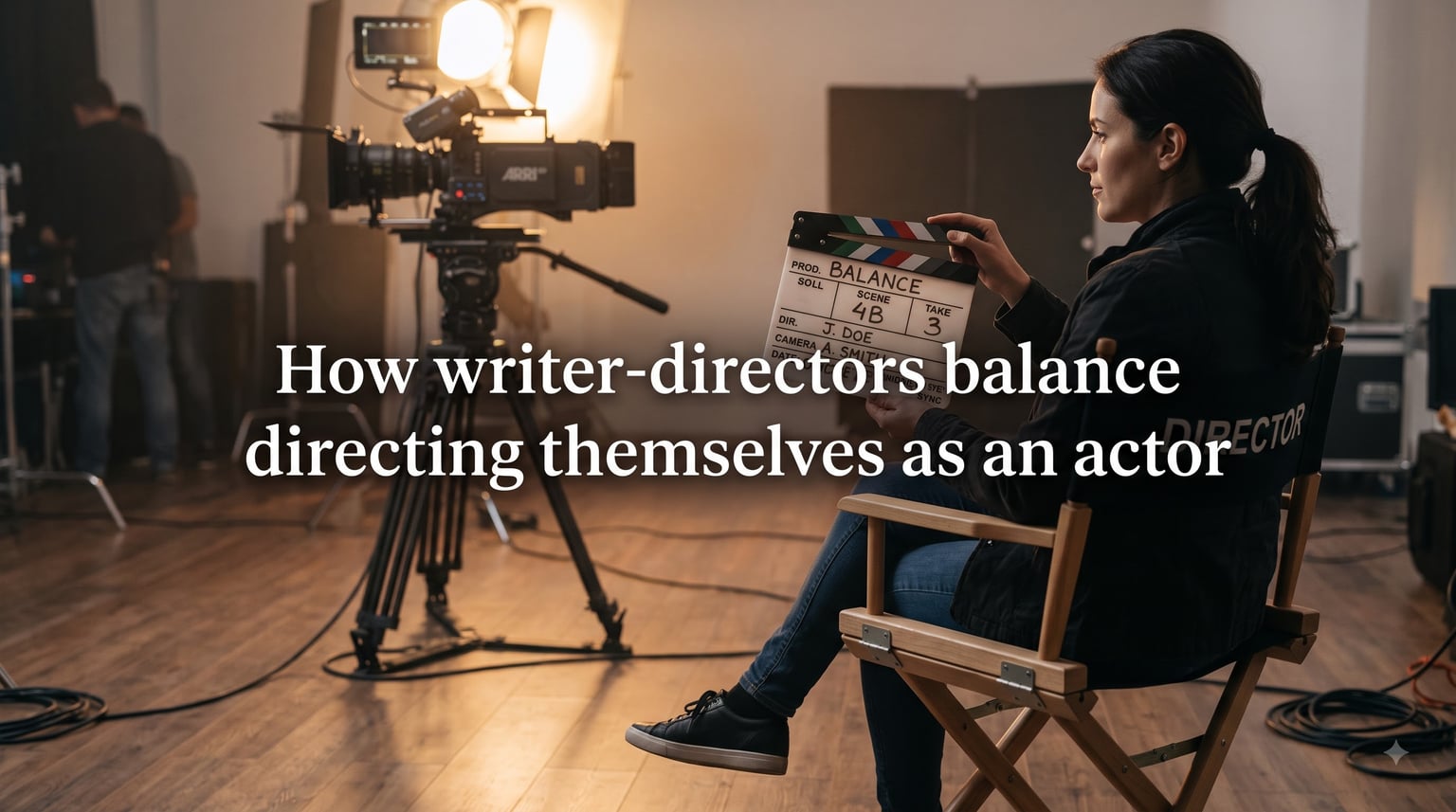
I have always been fascinated by filmmakers who write, direct, and star in their own projects. It feels almost impossible on paper. You have to hold the vision, manage a hundred crew members, deliver a performance, and judge whether that performance works, all in the same 12-hour day. Yet some of the most iconic films of the last 50 years came from this exact recipe.
This is the craft of the writer-director-actor: a hybrid role that blends creative authorship with on-camera vulnerability. In this guide, I walk through how writer-directors balance directing themselves as an actor, why they choose to do it, the specific challenges they face, and the techniques that make it work. Whether you are an indie filmmaker considering your own debut or just a curious cinephile, you will find practical strategies and real-world examples here.
Table of Contents
Why Writer-Directors Choose to Act in Their Own Films
Writer-directors act in their own films primarily to protect their creative vision. When you wrote the story, lived with the characters, and shaped every scene on the page, handing the lead role to someone else can feel like handing over your child.
Clint Eastwood has talked about this dynamic throughout his career. He often stars in his own westerns and dramas because no one else can fully realize the internal rhythm he envisioned on the page. Greta Gerwig stepped in front of the camera for portions of her early work because she needed to embody the emotional core while still directing.
The auteur tradition runs deep. From Orson Welles in Citizen Kane to modern filmmaker-actors, the dual role preserves interpretive freedom. You control the cuts, the coverage, and the take that ends up in the final film. No committee can soften a performance you delivered because the director inside you chose the angle.
For independent filmmakers especially, this can be financial as well as artistic. Casting a known actor costs money that an indie budget rarely has. Wearing both hats lets you bring the project to life without sacrificing the lead. It is a heavy lift, but the freedom is real.
Famous Writer-Directors Who Act in Their Own Films
Let me walk you through five filmmakers who have built reputations on this exact balancing act. Each approaches the dual role a little differently.
Clint Eastwood: The Veteran Multi-Hyphenate
Eastwood has been writing, directing, and starring since the late 1960s. From Play Misty for Me to Unforgiven and beyond, he treats the dual role as second nature. His secret is economy. He shoots fast, knows exactly what he wants, and trusts his crew to handle the rest while he performs.
Decades on set taught Eastwood to separate the two mindsets. He once described directing himself as simply knowing when to step behind the camera and when to step in front of it.
Greta Gerwig: The Modern Auteur
Gerwig directed Lady Bird, Little Women, and Barbie while also acting in many of her own earlier projects. Even when she is not the lead, she often performs small roles to stay connected to the actor’s point of view. She has spoken about how acting keeps her grounded in the language her cast uses every day.
Jordan Peele: From Comedy to Horror
Peele wrote and directed Get Out and Us but does not typically star in his films. He represents the opposite end of the spectrum: a writer-director who chooses to step away from acting entirely. Studying his approach is still useful because it shows that the writer-director does not have to perform to stay true to a vision.
Ben Affleck: The Blockbuster Auteur
Affleck built his modern career writing and directing Argo, The Town, and Gone Baby Gone while starring in each lead role. He has talked openly about the strain, calling directing yourself an exercise in patience and self-trust. He uses an experienced first AD and shoots strict coverage to give himself options in the edit.
Robert Rodriguez: The DIY Filmmaker
Rodriguez is famous for shooting entire features in his home studio with minimal crew. He wrote, directed, and starred in El Mariachi and many of his Spy Kids installments. His approach is to pre-plan every shot, then perform knowing the framework is already solid.
The Unique Challenges of Directing Yourself as an Actor
Even with the best preparation, the dual role creates real friction. Here are the challenges I hear about most often from filmmakers who have done it.
The Mindset Switch Problem
Directing requires you to be objective. Acting requires you to be vulnerable. Switching between these within minutes of each other is exhausting. You walk on set thinking about lens choices, then you are asked to cry on cue for a closeup.
Loss of Objectivity About Your Own Performance
This is the biggest issue raised on filmmaking forums. When you watch playback, you tend to judge yourself either too harshly or too kindly. Seth Rogen shared advice originally from James Franco in a Collider interview, telling Ike Barinholtz to keep it simple and not overthink the performance when you are also calling the shots.
Power Imbalance With Other Actors
You are the boss. You are also acting opposite your cast. That tension shows up in rehearsals, in coverage decisions, and in how feedback is delivered. Filmmaker Katie Aselton discussed this balance in a Reddit AMA, noting that the writer-director-star must stay humble so other actors feel safe enough to give honest performances.
Spreading Yourself Too Thin
Even on a short shoot day, the writer-director-actor is doing two jobs. Casting Networks highlighted this in their breakdown of the role, calling out how easy it is to lose track of small decisions while you are also focused on a complex scene.
Strategies and Techniques for Managing Both Roles
After studying dozens of interviews and behind-the-scenes footage, here is the practical list that comes up again and again.
1. Lean on Your First Assistant Director
An experienced AD is your best friend. While you are in front of the camera, the AD keeps the schedule, runs the set, and protects you from small distractions. Veteran filmmaker-actors like Ben Affleck credit most of their on-set smoothness to this single hire.
2. Rehearse and Pre-Visualize Before Shoot Day
By the time you step on set, you should already know where the camera sits, how the blocking flows, and roughly which lens you will use. Robert Rodriguez pre-stories entire films with storyboards so that the day becomes execution, not invention.
3. Cover Yourself Generously in Coverage
Because you cannot watch playback and act at the same time, shoot a full slate of angles. Wide, medium, closeup, and reverse. You will thank yourself in the editing room when you need a reaction shot and realize you never captured one.
4. Separate the Two Hats by Time of Day
Some writer-director-actors shoot their own coverage in the morning when they have maximum mental energy, then turn the camera over to a trusted second unit or cinematographer in the afternoon.
5. Stay Open to Interpretation in Performance
The biggest mistake is treating your character like a fixed asset. Eva Victor, in an interview about her debut feature, talked about the confidence it takes to step into a role you also wrote, then let the performance breathe on set. You wrote the words; you do not have to act them exactly the way you imagined them.
6. Use Line Notes, Not Line Readings
When you are both director and scene partner, telling the other actor exactly how to say the line feels heavy-handed. The Stareable blog on line notes recommends pointing out where the beat needs to land rather than prescribing the delivery.
Building Trust With Other Actors on Set
Trust is the currency of a healthy set. As the writer-director-actor, you hold more power than almost anyone in the room. That means you also hold more responsibility to create safety.
Start by listening during rehearsals. If a fellow actor suggests a beat that improves the scene, take it. You wrote the words, but the moment belongs to everyone in the room. Casting Networks calls this the privilege of bringing firm internal boundaries: you know what you will not compromise, but you leave room for the unexpected.
Be careful with feedback. Comments like “that felt off” land harder when they come from the boss and the scene partner. Offer choices instead of corrections. Ask questions instead of demanding a specific delivery. The moment you slip into micromanagement, the rest of the cast pulls back.
Hire collaborators you trust completely, then let them lead their departments. A great costume designer, a great DP, and a great sound recordist will quietly handle the details while you focus on the two jobs only you can do.
Mental Challenges and Mindset Shifts
The hardest part is often internal. Philip Seymour Hoffman once said, “film is about pitfalls, period.” Every project is a list of problems to solve. When you wear three hats, the list grows longer.
Self-doubt creeps in fast. Did I get that take? Was the reaction too subtle? Should I have given that other note? The only answer is to prepare thoroughly and then commit. Filmmaker-directors who succeed at this craft share one trait: deep trust in their own homework.
Vulnerability is the other mental weight. To act well, you have to expose the part of yourself that the character carries. Doing that while also managing a crew of 50 takes emotional stamina that pure actors rarely need.
Build rituals that ground you. A short morning walk, a quick script read, a phone call to a trusted friend. Tiny anchors keep the dual role sustainable across a full production schedule. Many filmmakers also bring a therapist or close creative partner on set, not as a crutch but as a steady voice when their own turns unreliable.
Frequently Asked Questions
How does a director direct themselves?
A writer-director who also acts typically relies on a trusted first assistant director to manage the set, pre-plans coverage and blocking before each day, and shoots multiple angles so performance choices can be made later in the edit. Many filmmaker-actors also separate the two mindsets by time of day, handling directorial decisions in the morning and stepping in front of the camera when the framework is already set.
Can a writer-direct themselves as an actor?
Yes, absolutely. Writers can both direct and star in their own films if they prepare thoroughly, build a strong support team, and stay open to interpretation in performance. The dual role is demanding but has produced some of the most iconic films of the last several decades, from Clint Eastwood westerns to modern indie debuts.
What are the challenges of directing your own performance?
The biggest challenges are switching mindsets between objective director and vulnerable actor, losing objectivity about your own take, creating power imbalance with the rest of the cast, and simply spreading yourself too thin across two jobs in a single day. Industry data shows the role works best when supported by an experienced AD and generous coverage.
Why do directors act in their own films?
Directors act in their own films to protect their creative vision, embody the emotional core of a personal project, or simply work within a tight indie budget. For auteur filmmakers, performing the lead role keeps the entire project unified under one interpretive eye from script to final cut.
Final Thoughts on the Writer-Director-Actor Balance
The dual role is one of the hardest crafts in filmmaking, but it is also one of the most rewarding. When you can balance directing yourself as an actor with grace, the finished film carries a unity that few collaborative projects can match.
Start with preparation, surround yourself with a small team you trust, and stay humble enough to let your cast surprise you. If 2026 is the year you finally step into this role, treat every rehearsal like a masterclass and every shoot day like the only chance you have, because for that performance, it really is.