
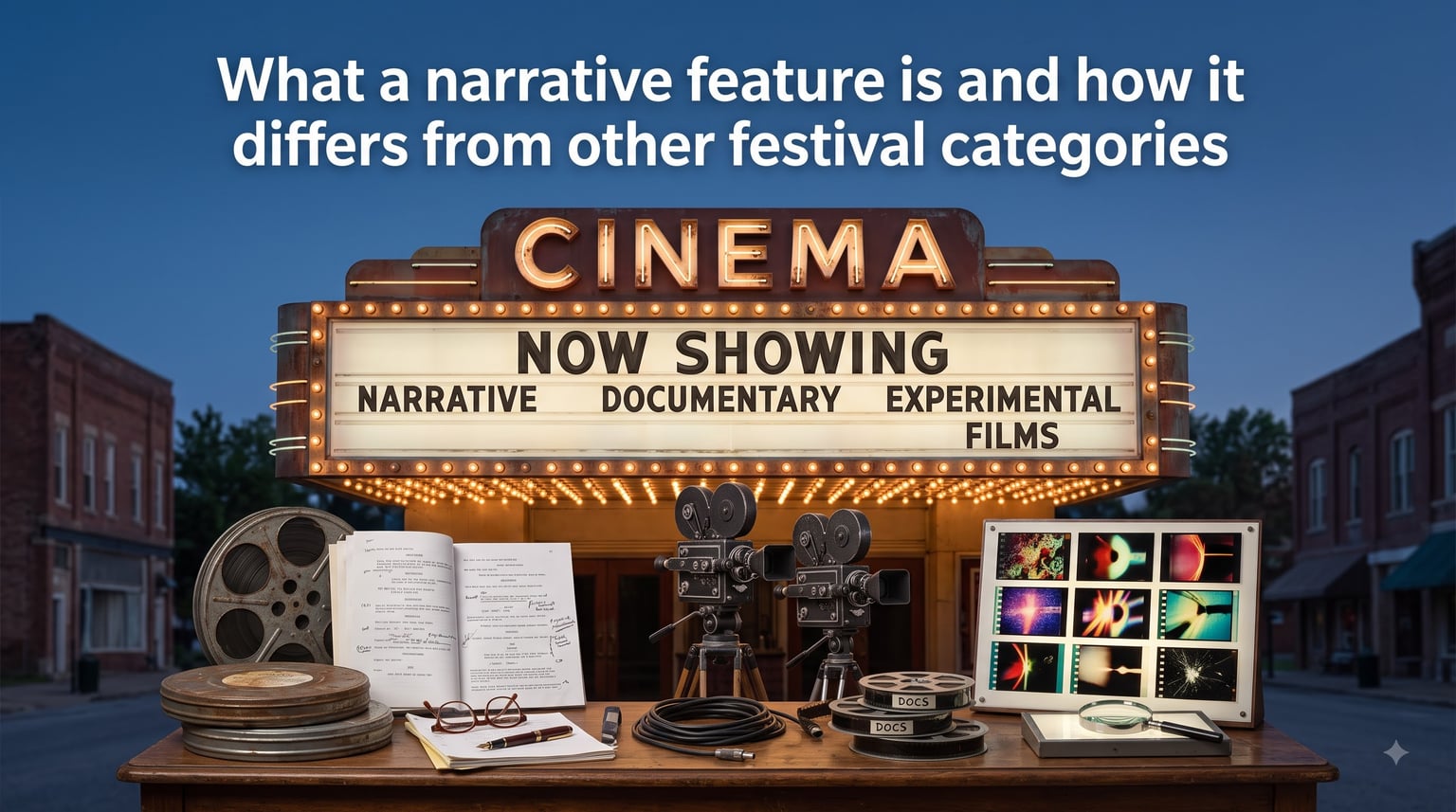
If you’ve ever scrolled through a film festival’s submission guidelines and felt confused by terms like “narrative feature,” “documentary feature,” and “experimental short,” you’re not alone. A narrative feature is a scripted, fictional film of feature length (usually 40 minutes or longer) that tells a coherent story built on cause and effect. Understanding how it differs from other festival categories helps filmmakers submit to the right program and helps viewers understand what they’re about to watch.
I’ve spent years following queer cinema through festivals, and the terminology trips up even seasoned film fans. This guide breaks down the key distinctions clearly, with practical advice for anyone trying to place a film or simply make sense of festival lineups.
Table of Contents
What Is a Narrative Feature Film?
A narrative feature is a motion picture built around an original or adapted screenplay, performed by actors, that follows a structured fictional story from beginning to end. The Academy of Motion Picture Arts and Sciences defines a feature film as one with a runtime over 40 minutes, and most major festivals use the same threshold.
Three traits separate a narrative feature from every other category. First, it is scripted, meaning the dialogue, action, and structure were written before cameras rolled. Second, it tells a fictional story with characters who may be entirely invented, even if inspired by real people. Third, the plot moves forward through cause and effect, where one event leads logically to the next, creating the arc audiences expect from cinema.
For the festival programmer at Sundance, Toronto, or Frameline, “narrative feature” signals a specific submission lane with its own rules, jury pool, and screening format.
Narrative Feature vs Documentary Feature
The documentary vs narrative distinction is the most common point of confusion for first-time festival submitters. Documentaries are non-fiction films about real people, real events, or real issues, while narrative features are scripted fictional stories.
Documentaries rely on archival footage, interviews, observational shooting, or a combination of these. The filmmaker captures what already exists rather than staging scenes. Narrative features, by contrast, employ actors reading from a screenplay under controlled production conditions.
Think about it this way. A documentary about a trans rights activist follows real footage of real protests and interviews with real organizers. A narrative feature about a trans rights activist uses actors to portray a fictional character navigating an invented storyline, even when inspired by true events. Films like Carol (2015) and Moonlight (2016) are narrative features, while The Death and Life of Marsha P. Johnson (2017) is a documentary.
Festival programmers place them in completely different categories because the craft, judging criteria, and audience expectations differ. A narrative jury weighs performance and screenplay, while a documentary jury weighs accuracy and impact.
Narrative Feature vs Experimental Film
An experimental film prioritizes form, sensation, or concept over traditional storytelling. Experimental films (with few exceptions) do not follow a linear, conventional story structure. Instead, they may use abstraction, dreamlike imagery, found footage, or deliberate disruption of narrative norms to provoke a particular feeling or idea.
A narrative feature always carries the audience through a beginning, middle, and end with identifiable characters facing clear conflicts. An experimental short or feature may have no dialogue, no plot, and no protagonist. It may run for 90 minutes or 7 minutes, and it may submit under categories specifically labeled “experimental” or “avant-garde.”
Take Maya Deren Meshes of the Afternoon versus Alfred Hitchcock’s Vertigo. Both manipulate time and perception, but Hitchcock’s film is narrative cinema with a structured mystery, while Deren’s is experimental cinema that invites interpretation rather than resolution. Many festival programmers see these as fundamentally different art forms.
This distinction matters especially in queer and independent cinema, where experimental work has long flourished as a vehicle for identity exploration beyond mainstream narrative constraints.
Feature Length vs Short Film: The Runtime Rule
The feature versus short distinction comes down to runtime, but the line moves slightly depending on the festival. The Academy, BAFTA, and most North American festivals use 40 minutes as the cutoff. Anything under 40 minutes is a short film; anything 40 minutes or longer qualifies as a feature.
This is where many filmmakers get tripped up. A 38-minute drama with full production value still belongs in the short film category, not the narrative feature category. Submitting to the wrong category can disqualify your entry entirely, since programmers sort submissions by runtime first and content second.
Short film festivals further subdivide by format. You’ll often see categories for narrative short, documentary short, animated short, and experimental short, each with its own runtime cap (usually under 40 minutes, sometimes under 20). A 15-minute scripted drama is a narrative short, not a narrative feature, no matter how polished it feels.
Key Characteristics of Narrative Features
Narrative features share a handful of structural traits that distinguish them across genres, from rom-coms to horror to historical drama. Understanding these helps you identify the form whether you’re watching a film, writing one, or programming a festival lineup.
Causality. Events flow from earlier events. A character’s choice in act one drives the conflict in act two. This cause-and-effect chain is the engine of narrative cinema.
Structure. Most narrative features follow the three-act structure, with setup, confrontation, and resolution. Even nonlinear films like Pulp Fiction preserve internal causality within rearranged timelines.
Character arcs. Protagonists change across the story. The transformation, whether subtle or dramatic, gives narrative features their emotional weight.
Narrative devices. Filmmakers use tools like foreshadowing, flashback, voiceover, and point-of-view shots to shape how the audience experiences the story. These devices reinforce the scripted nature of the work.
Together, these characteristics create what film scholars call “classical narrative cinema,” a form so dominant that audiences often mistake it for cinema itself. Recognizing the structure makes the exceptions (experimental work, essay films, hybrid documentaries) feel more meaningful by contrast.
Film Festival Category Comparison Table
Here’s how the four major festival categories stack up against each other across the criteria programmers actually use.
| Category | Length | Content | Format |
|---|---|---|---|
| Narrative Feature | 40+ minutes | Fictional scripted story | Actors, screenplay, cause and effect |
| Documentary Feature | 40+ minutes | Real people and events | Archival footage, interviews, observation |
| Narrative Short | Under 40 minutes | Fictional scripted story | Actors, screenplay, compact arc |
| Experimental | Any length | Non-traditional storytelling | Abstraction, form-focused, no linear plot |
Some festivals add an animated category (which can overlap with narrative, documentary, or experimental) and an episodic category for series pilots. Always check the specific call for entries before submitting, since terms like “domestic narrative feature” or “international documentary short” carry extra eligibility rules around country of origin.
Practical Guide: Choosing the Right Festival Category
Filmmakers often agonize over category selection, and the wrong choice can mean rejection or no screening at all. Here’s the framework I use when advising emerging directors on their submissions.
Start with runtime. Anything under 40 minutes belongs in a short category. Anything 40 minutes or longer is a feature, and your next decision is content.
Ask whether your film tells a fictional or non-fictional story. If you wrote a script with invented characters, it’s narrative. If you’re capturing real life with interviews or observation, it’s documentary. If you’re somewhere in between (a scripted dramatization of real events, or a personal essay with staged elements), read the festival’s hybrid or “other” category rules carefully.
Consider whether your film follows a linear story. If yes, it’s narrative or documentary. If you’ve deliberately broken linearity, dissolved character arcs, or replaced plot with mood, you’re likely in experimental territory.
Finally, read past winners in each category at your target festival. Most festivals publish previous lineups on their website. If your film looks and feels like last year’s narrative features, submit there. If it shares DNA with the experimental shorts, that’s your lane. Submitting to the right category also gives your film a fairer shot, since juries evaluate against peers, not against every submission in the festival.
History of Narrative Cinema
The narrative feature as we know it crystallized in the early 20th century, though its roots go back further. The Lumière brothers screened their earliest films in 1895, mostly documentary-style actualities of daily life. Georges Méliès, working alongside them, pioneered narrative fiction with films like A Trip to the Moon (1902), which used theatrical staging, sets, and scripted scenes to tell imaginative stories.
By the 1910s, feature-length narrative films had become the dominant commercial form. D.W. Griffith’s The Birth of a Nation (1915) ran over three hours and demonstrated the storytelling power (and troubling politics) of the format. The introduction of synchronized sound in 1927 with The Jazz Singer cemented narrative cinema’s cultural dominance for the next century.
Documentary and experimental traditions grew up alongside, and often in tension with, mainstream narrative. Filmmakers like Dziga Vertov challenged the form from the documentary side, while Maya Deren and Stan Brakhage pushed experimental cinema toward pure abstraction. Today’s festival categories exist partly to honor these distinct lineages.
Frequently Asked Questions
What is a narrative feature?
A narrative feature is a scripted, fictional film of 40 minutes or longer that tells a story through cause and effect, performed by actors working from a screenplay. It is the standard form of fiction cinema submitted to festivals in the narrative category.
What distinguishes narrative films from documentary films?
Narrative films are scripted, fictional stories told by actors. Documentaries are non-fiction works about real people, real events, or real issues, captured through interviews, archival footage, or direct observation. Both can be feature length, but their categories, juries, and audiences are separate.
What qualifies as an experimental short film?
An experimental short film under 40 minutes prioritizes form, abstraction, or concept over traditional storytelling. It may have no dialogue, no plot, and no protagonist, and often uses unconventional editing, imagery, or sound to explore ideas or sensations rather than tell a linear story.
What is the minimum runtime for a feature film?
The Academy of Motion Picture Arts and Sciences, BAFTA, and most major film festivals define a feature as any film running 40 minutes or longer. Anything under 40 minutes is classified as a short, regardless of production value or genre.
What is an example of a narrative feature?
Examples of narrative features include Carol (2015), Moonlight (2016), Portrait of a Lady on Fire (2019), and The Fabelmans (2022). These are scripted, fictional, actor-driven films with structured stories, distinguishing them from documentaries and experimental works.
What are the main categories in film festival awards?
Most film festivals divide submissions into narrative feature, documentary feature, narrative short, documentary short, animated short, and experimental categories. Some festivals add episodic, student, or hybrid categories. Each category has its own runtime, format, and eligibility rules.
Final Thoughts on Narrative Feature Categories
A narrative feature is simply a scripted, fictional film of feature length, but understanding how it sits alongside documentary, experimental, and short film categories helps you navigate both festival submissions and viewing lineups. The distinctions come down to script, story structure, and runtime, with a few edge cases around hybrid work and animated shorts.
For filmmakers, choosing the right category starts with measuring runtime, then asking whether your film tells a fictional story with a clear arc. For viewers, knowing the categories sharpens your expectations and helps you discover work that matches what you’re in the mood to see. If you’re planning a festival submission in 2026, check each festival’s specific rules, since minor eligibility differences can determine whether your film gets seen.