
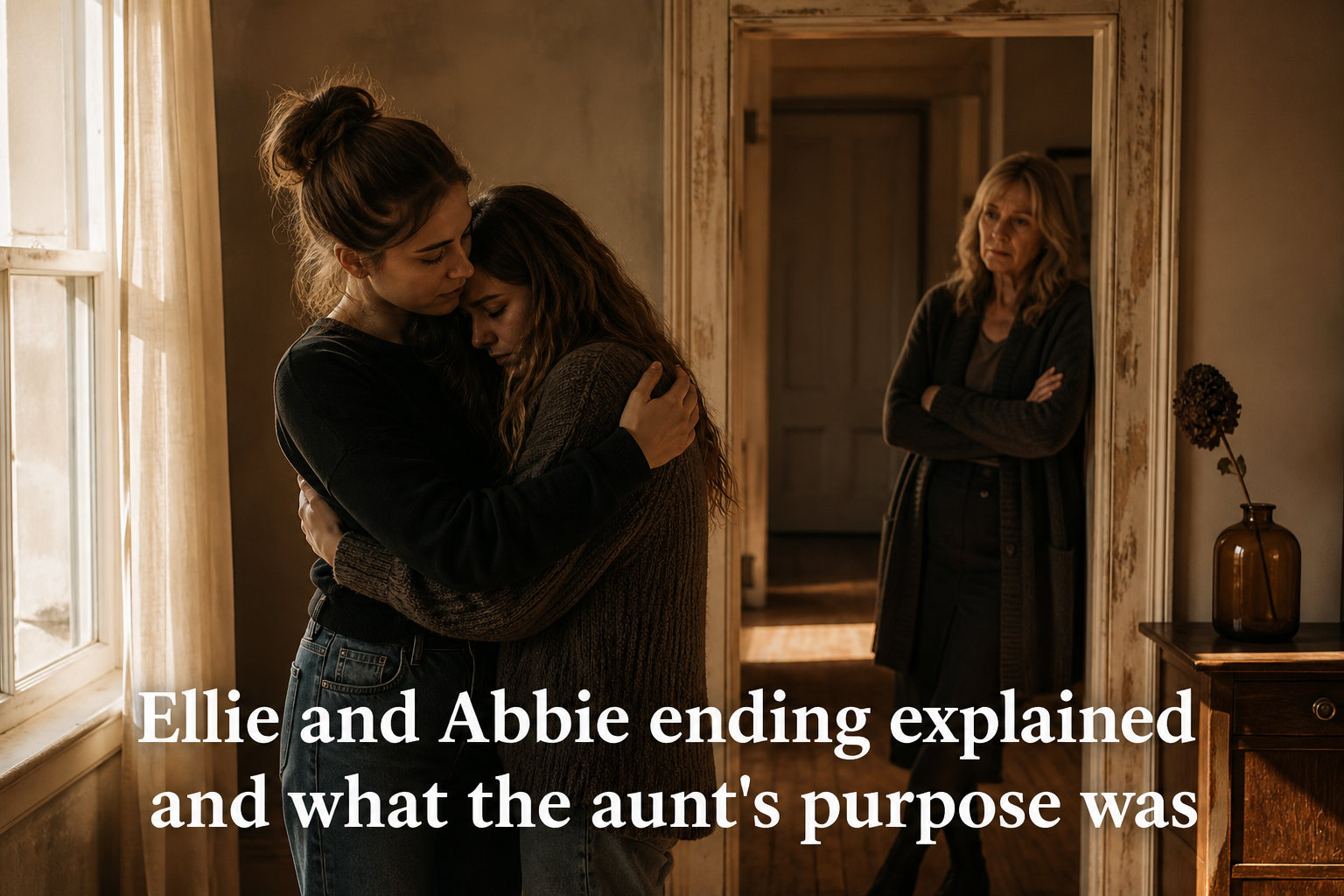
If you finished Ellie & Abbie (& Ellie’s Dead Aunt) and found yourself wondering what the ending meant, or why a dead aunt gets top billing alongside two teenage girls, you are not alone. The 2020 Australian film layers a sweet teen romance over a quieter story about family, grief, and how each generation of queer people passes wisdom to the next. The Ellie and Abbie ending explained properly requires understanding Aunt Tara’s role, and once you see what director Monica Zanetti was doing with the “fairy godmother” device, the whole film clicks into place. This guide breaks down the ending scene by scene, then digs into the deeper question of what the aunt’s purpose was in the story.
Table of Contents
What Is the Movie Ellie and Abbie About?
The film follows Ellie, a Sydney teenager navigating the terror of asking her crush, Abbie, to the school formal. What sounds like a standard teen rom-com premise gets a supernatural twist when Ellie’s deceased aunt Tara starts appearing to her, offering unsolicited dating advice and pushing her toward confidence she does not feel.
Tara died years before the film’s events, but her ghost attaches itself to Ellie at the exact moment Ellie needs courage most. The film, adapted from Zanetti’s own stage play, was crowdfunded and became the first Australian-made lesbian teen romantic comedy to reach wide release. It opened the Mardi Gras Film Festival in 2020, a milestone for a local film, and went on to win the AACTA Award for Best Independent Film.
So at its core, the movie is a coming-out story dressed up as a romantic comedy. But it is also a ghost story about inheritance, not of money or property, but of hard-won queer wisdom passed down through a family.
Who Is Aunt Tara and Why Does She Appear?
Aunt Tara is Ellie’s mother’s sister, a woman who died young and who the family rarely discusses openly. When Tara starts appearing to Ellie, she arrives with big energy, quick jokes, and a wardrobe stuck somewhere in the late 1980s. She calls herself Ellie’s “fairy godmother,” though her advice is often clumsy, dated, and more chaotic than helpful at first.
As the film unfolds, we learn Tara was a queer woman who came of age in Sydney during the 1980s. That era was brutal for LGBTQ+ people in Australia, marked by activism, police violence around the early Mardi Gras marches, and the devastation of the AIDS crisis. Tara lived through that fight, loved women at a time when doing so carried real danger, and carried her own unfinished business when she died.
She appears to Ellie now because Ellie is standing at the threshold Tara once crossed herself. The fear of asking a girl to the formal, the dread of family reactions, the uncertainty about identity, these are experiences Tara knows intimately. Her ghost shows up not because Ellie summoned her, but because the moment called for a guide who had been there before.
How the Ellie and Abbie Ending Plays Out Step by Step
The ending moves through several beats worth breaking down clearly, because the emotional payoff depends on how each piece lands.
Ellie commits to the formal. After spending much of the film paralyzed by anxiety, Ellie finally decides she will ask Abbie. Tara’s constant nudging, however imperfect, has worn down Ellie’s resistance. The decision itself is the first victory, and it belongs entirely to Ellie.
The family truth comes out. In the lead-up to the formal, Ellie’s mother finally tells her the full story of Tara. This is the scene the whole film has been building toward quietly. Ellie learns that Tara was queer, that she lived and loved during a dangerous era, and that her mother’s silence about Tara was not shame but unresolved grief. The revelation reframes everything Ellie thought she knew about her family.
Abbie says yes. Abbie agrees to attend the formal with Ellie. Their relationship, which has been tentative and sweet throughout, solidifies into something real. The film does not overplay this moment with grand declarations. It lets two teenagers be nervous and happy, which feels far more honest than a dramatic love confession.
The formal scene and the kiss. At the formal, Ellie and Abbie share a kiss. It is the culmination of the romantic arc, handled with the kind of warmth and normalcy that still feels rare in queer teen cinema. The film treats this as a joyful moment, not a tragic one, and that tonal choice matters enormously.
Abbie’s jodhpurs. Abbie arrives at the formal in riding gear, jodhpurs and riding boots, because she came straight from an equestrian commitment. Some viewers found this detail awkward or odd, but it is deliberately characterful. It signals that Abbie is her own person with her own life, not a romantic object who exists solely for Ellie’s story. She is messy and real and slightly late, and that is exactly the point.
Tara says goodbye. With Ellie safe, brave, and connected to both Abbie and her family’s history, Tara’s presence is no longer needed. She fades, her unfinished business complete. She did not just help Ellie get a date. She helped Ellie understand that she is part of a longer story, one that Tara herself helped write.
What Was Aunt Tara’s Real Purpose in the Story?
Here is where the Ellie and Abbie ending explained question meets its most overlooked layer. Multiple reviewers dismissed Tara as a gimmick, a comic device, or an underused character who delivers dated pep talks. That reading misses what she actually represents in the narrative.
Tara is the bridge between generations of queer experience. She embodies a truth that many LGBTQ+ people discover: someone walked this path before you, paid a price you will never fully see, and left behind a legacy that makes your life possible. Ellie can kiss a girl at her school formal in 2020 Sydney because women like Tara fought, marched, and survived in the 1980s.
The “fairy godmother” label is deliberately loaded. In fairy tales, the fairy godmother appears when the protagonist is stuck and grants what is needed to move forward. Tara does exactly this, but her gifts are not glass slippers. They are courage, family truth, and the knowledge that being queer is not a solitary condition but an inheritance.
This is why Tara’s advice often feels dated. She tells Ellie things that worked in a different era, because her frame of reference is the 1980s queer scene. The mismatch is not a writing flaw. It is the point. The world changed between Tara’s death and Ellie’s formal, and that change is itself the proof that Tara’s generation accomplished something. Her outdated advice is evidence of progress.
Tara also forces Ellie’s mother to confront grief she buried years ago. The ghost does not just serve Ellie. She serves the whole family by making silence impossible. Once Tara’s story is spoken aloud, healing can finally begin, and Ellie can grow up knowing she comes from a lineage of queer women rather than believing she is alone.
Themes the Ending Ties Together
The ending weaves together three threads the film develops throughout its runtime.
Coming out as communal, not solitary. Ellie’s journey is not just about telling people she likes girls. It is about discovering that her family already contains queer history. Coming out, in this film, means joining a story that started before you were born.
Family acceptance through honesty. Ellie’s mother does not reject her. She was already carrying queer love in her family history and had simply never found the words. The ending suggests that acceptance often waits behind silence, and that speaking the truth about those we lost can free the living.
Joy as resistance. The formal kiss is not presented as a political act, and that is what makes it political. Tara’s generation fought for survival. Ellie’s generation gets to fight for a school dance. The film honors both by showing that ordinary teenage joy is something earlier activists literally marched for.
What Critics and Viewers Say About the Ending
The Guardian gave the film four out of five stars, praising its warmth and authenticity. The AACTA win for Best Independent Film cemented its place in Australian cinema history, and its selection as the opening night film for the Mardi Gras Film Festival marked the first time an Australian feature held that slot in 27 years.
Some critics felt Tara was underutilized given her prominence in the title, and a few viewers found the jodhpurs formal entrance jarring. But the overwhelming response to the ending was positive, with audiences appreciating a queer teen film that chose joy over tragedy. In a genre historically dominated by heartbreak and loss, that choice alone feels significant.
FAQs
What is the movie Ellie and Abbie about?
Ellie u0026amp; Abbie (u0026amp; Ellie’s Dead Aunt) is a 2020 Australian LGBT romance comedy about a Sydney teenager named Ellie who wants to ask her classmate Abbie to the school formal. She is guided (and sometimes annoyed) by the ghost of her deceased aunt Tara, a queer woman who came of age in the 1980s and appears as a fairy godmother figure.
What happens at the end of Ellie and Abbie?
Ellie asks Abbie to the formal and Abbie accepts. Ellie’s mother reveals the full truth about Aunt Tara’s life as a queer woman. At the formal, Ellie and Abbie share a kiss, and Tara’s ghost departs knowing Ellie is safe, confident, and connected to her family’s queer history.
Why is Aunt Tara in Ellie and Abbie?
Aunt Tara appears because Ellie is at the same threshold Tara once crossed, facing the fear of coming out and pursuing a same-sex relationship. Tara serves as a guide who has been through it before, pushing Ellie toward courage while also forcing Ellie’s mother to confront buried family grief.
What does Aunt Tara represent?
Tara represents the generational passing of queer wisdom. She is the link between the 1980s LGBTQ+ rights era and Ellie’s modern world. Her fairy godmother role symbolizes how earlier generations of queer people fought and survived so that today’s teenagers can experience ordinary joy like a school formal.
Does Abbie go to the formal with Ellie?
Yes. Abbie agrees to attend the formal with Ellie. She arrives late, wearing jodhpurs and riding boots from a prior equestrian commitment, and the two share a kiss at the event, solidifying their relationship.
Is Ellie and Abbie a LGBTQ+ film?
Yes. Ellie u0026amp; Abbie (u0026amp; Ellie’s Dead Aunt) is explicitly a LGBTQ+ film. It was the first Australian-made lesbian teen romantic comedy to reach wide release, won the AACTA for Best Independent Film, and opened the Mardi Gras Film Festival in 2020.
Conclusion
Looking at the Ellie and Abbie ending explained and what the aunt’s purpose was, the film is doing more than delivering a cute romance. Aunt Tara matters because she represents the queer elders who walked before us. Her ghost is not a gimmick but a bridge between the activism of the 1980s and the ordinary teenage joy of 2026. When Tara fades at the formal, she leaves behind a girl who now knows she was never alone. That is the real ending, and it is worth more than any kiss.