
If you just finished watching Alice Wu’s The Half of It on Netflix and you are staring at the screen wondering what just happened between Ellie and Aster, you are not alone. The The Half of It ending has sparked countless Reddit threads, heated debates, and more than a few tears since the film premiered in 2020. I have read through those discussions, rewatched the final scenes more times than I care to admit, and dug into director Alice Wu’s own words to piece together exactly what the ending means.
You want to know whether Ellie Chu (Leah Lewis) and Aster Flores (Alexxis Lemire) end up together. You want to understand that train station kiss. And you probably want to know if Paul (Daniel Diemer) walks away with anyone either. This article breaks down every piece of the ending, the symbolism behind the soulmates myth, and why Alice Wu chose a path that leaves no couple standing at the end.
Table of Contents
Do Ellie and Aster End Up Together? The Quick Answer
No, Ellie and Aster do not end up together at the end of The Half of It — at least not in the traditional romantic-comedy sense. Ellie does work up the courage to kiss Aster at the train station, but then she immediately leaves Squahamish to attend Grinnell College. Aster does not fully return the kiss, but she does not reject it either. Ellie simply says, “I’ll see you in a couple of years,” leaving the door open for a future reunion without committing to one.
The key detail is that Aster is heading off to art school, and Ellie is heading to college in another state. Neither character is in a position to start a relationship right now. The The Half of It ending is deliberately open-ended, offering hope for the future rather than a neat romantic resolution.
The Kiss Scene Explained
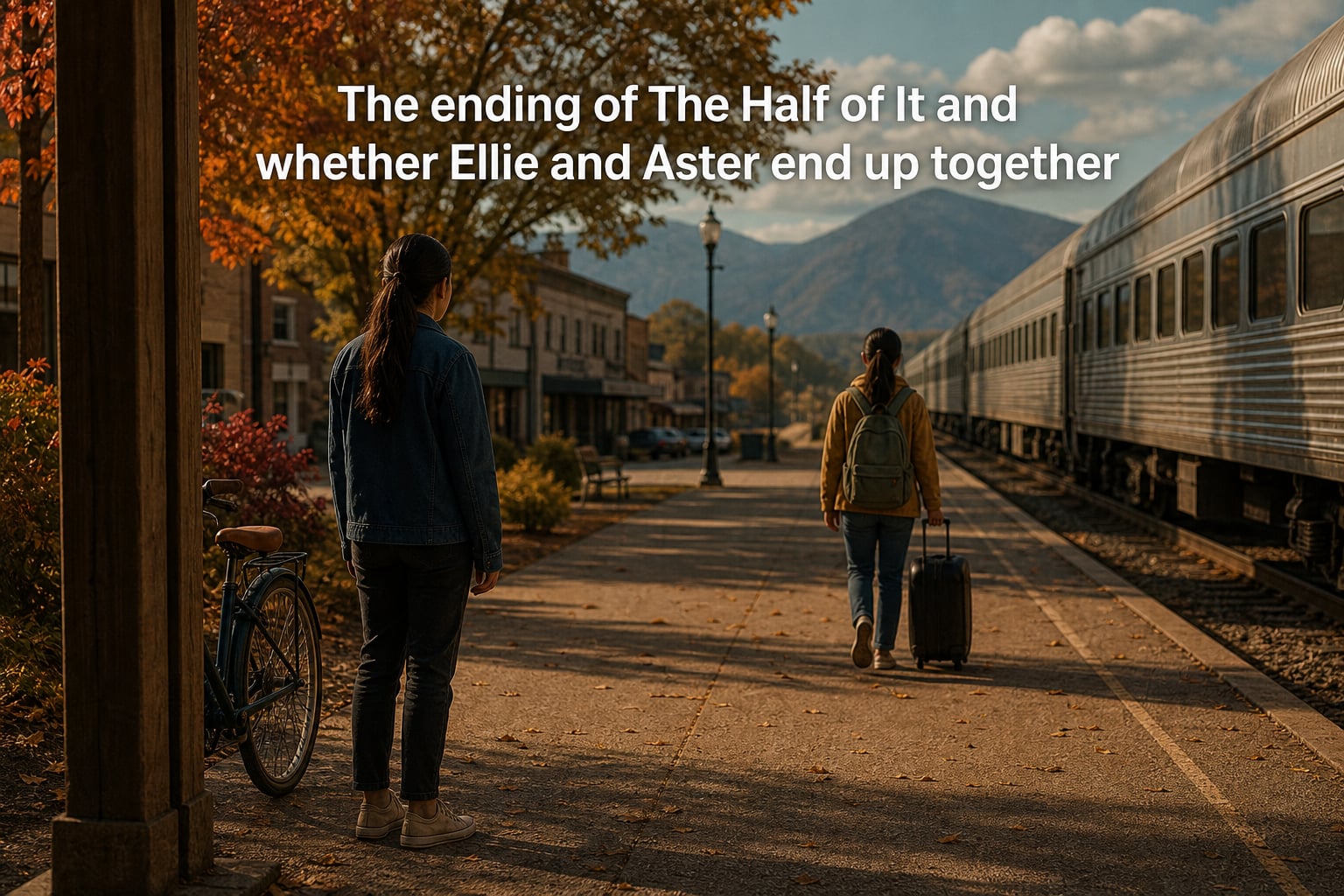
The kiss at the train station is the emotional climax of the entire film. After spending the whole movie hiding behind Paul’s letters and pretending she is not in love with Aster, Ellie finally acts on her feelings. She walks up to Aster, kisses her, and then steps back.
What makes this scene so powerful is Aster’s reaction. She does not kiss Ellie back with passion, but she also does not pull away in disgust or confusion. The moment sits in an ambiguous space — Aster’s face suggests she is processing something she may have suspected all along. Director Alice Wu has described this as the point where Aster begins to truly understand who was writing those letters.
Then Ellie delivers the line that defines the entire ending: “I’ll see you in a couple of years.” This is not a brush-off. It is an acknowledgment that both of them need time. Aster needs to figure out who she is outside of Squahamish and her conservative Christian upbringing. Ellie needs to experience the world beyond her small town. The kiss is a beginning, not a conclusion.
Many viewers on Reddit expressed frustration that Aster did not kiss Ellie back more definitively. But that ambiguity is exactly the point. Alice Wu did not want to give audiences a tidy resolution. She wanted to honor the reality that self-discovery takes time, especially for queer teenagers growing up in restrictive environments.
What Happens to Each Character at the End
Ellie Chu’s Ending
Ellie gets on the train and leaves Squahamish for Grinnell College. This is the moment she has been working toward the entire film, even though she spent most of the story convinced she would stay home forever to take care of her father. The The Half of It ending rewards Ellie with the freedom she never allowed herself to want.
Her arc is about learning that she deserves to want things for herself. Writing letters for Paul and falling for Aster forced Ellie to confront feelings she had buried. By the end, she is brave enough to kiss someone she loves and brave enough to leave the only home she has ever known.
Aster Flores’s Ending
Aster breaks off her engagement with Trig, the shallow popular boy she was supposed to marry, and enrolls in art school. Throughout the film, Aster is treated as a prize to be won — by Trig, by Paul, and even by Ellie in some ways. Her ending is about reclaiming her own identity.
Going to art school represents Aster choosing herself for the first time. She has spent years conforming to what Squahamish expects of a pastor’s daughter. Now she gets to discover who she actually is, both as an artist and as a person. Whether that includes exploring her feelings for Ellie is left to the future.
Paul Munsky’s Ending
Paul does not end up with Ellie, and he does not end up with Aster. But his ending is arguably the most heartwarming of the three. He chases the train on his bicycle, waving goodbye to Ellie, and the final shot of him running alongside the tracks shows a young man who has grown enormously.
Paul learned to write his own letters, to think beyond taco sausage, and to genuinely care about someone else’s happiness more than his own. His friendship with Ellie changed him. He is still in Squahamish, still working on his recipes, but he is no longer the same clueless jock we met at the beginning.
Why This Is Not a Traditional Happy Ending
Most romantic comedies end with the couple together. The Half of It deliberately refuses that formula. No one gets the girl. No one rides off into the sunset hand in hand. Alice Wu has said in interviews that the film was never about who ends up with whom — it was about the human condition, about connection, and about how loving someone changes you even if you do not end up together.
This is what makes the The Half of It ending so polarizing. Some viewers walk away feeling cheated. Others find it refreshingly honest. The reality is that most teenage relationships do not result in forever-love, and most queer teenagers do not get to kiss their crush and ride off into a perfect future. Wu chose realism over fantasy.
The film also draws a clear parallel to Cyrano de Bergerac, the classic play it is based on. In the original, Cyrano helps Christian woo Roxane while secretly loving her himself, and the story ends tragically. Wu updates this formula for a modern, gentler world — but she keeps the bittersweet core intact.
The Soulmates Myth and the Opening Animation
The opening animation of The Half of It tells the Greek myth from Plato’s Symposium, where Aristophanes explains that humans were originally whole beings with two heads, four arms, and four legs. Zeus split them in half, and ever since, each half has wandered the earth searching for its other half. That is the origin of love, according to the myth.
This animation is not just a stylish intro. It frames the entire film. Ellie recites this story in class early on, and it becomes the lens through which we understand every relationship in the movie. The idea of finding “the other half of yourself” applies to Ellie and Aster, but it also applies to Ellie and Paul’s friendship.
What is brilliant about the ending is that no one finds their “other half” in a romantic partner. Instead, each character finds wholeness within themselves. Ellie leaves for college. Aster goes to art school. Paul stays home but grows as a person. The The Half of It ending suggests that the real journey is not about finding someone else to complete you — it is about becoming complete on your own.
The Train Scene Symbolism
The final shot of Ellie on the train pulling away from Squahamish is loaded with meaning. Throughout the film, the train represents everything Ellie has been afraid of — leaving her father, leaving the familiar, stepping into the unknown. Her father has been buying her a train ticket to leave town for years, and she has never used it.
Now she is finally on that train. The camera lingers on her face as she watches Paul chase the train on his bike. The ping-pong table where they spent so many hours together is behind her. Squahamish is shrinking in the distance. Ellie is moving forward, literally and figuratively.
Trains in cinema often symbolize transition and the passage from one phase of life to another. For Ellie, this train is her coming-of-age moment. She is no longer the girl who hides behind letters and avoids her own feelings. She kissed Aster. She said goodbye to Paul. She is on her way to becoming whoever she is meant to be.
FAQs
Does Ellie end up with Aster in The Half of It?
No, Ellie and Aster do not end up together at the end of The Half of It. Ellie kisses Aster at the train station, but then leaves for Grinnell College. She tells Aster ‘I’ll see you in a couple of years,’ leaving the possibility of a future reunion open without confirming one.
Does The Half of It have a happy ending?
The Half of It has a bittersweet ending rather than a traditional happy one. No couple ends up together, but each character grows and moves toward a better version of themselves. Ellie leaves for college, Aster goes to art school, and Paul learns to express himself. Director Alice Wu has said the film is about personal growth, not romantic resolution.
Do Paul and Ellie end up together in The Half of It?
No, Paul and Ellie do not end up together romantically. Paul confesses his feelings and kisses Ellie, but she does not return his romantic interest. They do, however, maintain a deep friendship. The final scene of Paul chasing Ellie’s train on his bicycle symbolizes their enduring bond.
Is there a sequel to The Half of It?
As of 2026, there is no sequel to The Half of It. Netflix has not announced a follow-up film. Director Alice Wu has expressed openness to revisiting the characters but has not confirmed any plans. The open-ended conclusion leaves room for a potential sequel but also works as a standalone story.
The Ending Means Growth, Not Romance
The The Half of It ending asks us to accept that not every love story ends with two people together. Sometimes the bravest thing a person can do is kiss someone and then walk away, trusting that the future will sort out the rest. Ellie’s “I’ll see you in a couple of years” is not a promise — it is hope. And in a genre built on guaranteed happy endings, hope feels far more real.