
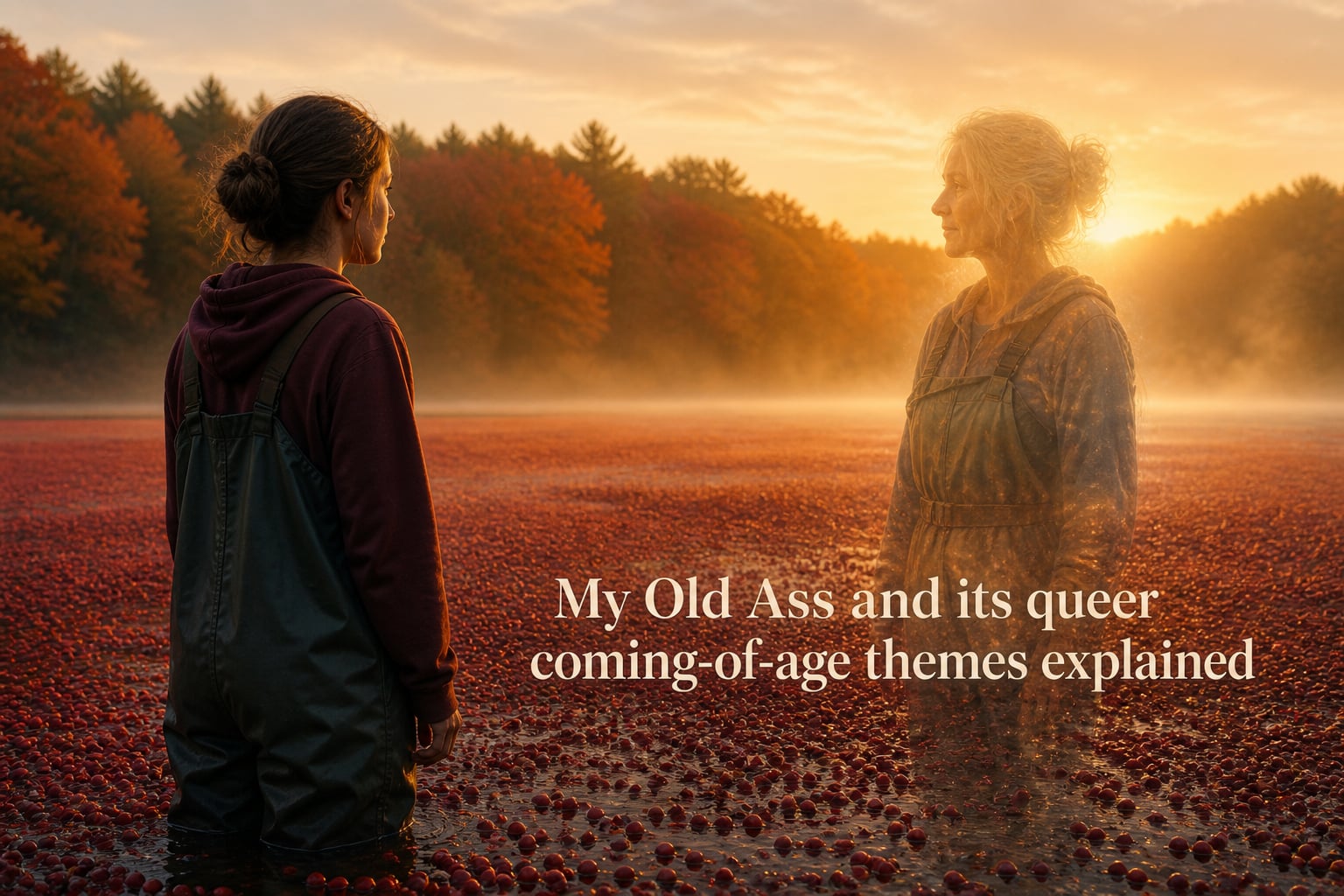
Megan Park’s My Old Ass arrived in 2024 as one of the most talked-about queer coming-of-age films of the year. Starring Maisy Stella as 18-year-old Elliott and Aubrey Plaza as her 39-year-old future self, the movie blends magical realism with a deeply personal story about identity, love, and self-acceptance. Our team spent time analyzing the film’s themes, reading through community discussions, and comparing it to the broader landscape of LGBTQ+ cinema to bring you this complete breakdown.
In this article, we explain the My Old Ass queer coming-of-age themes in full detail. We cover the plot, the bisexual representation debate, the mushroom trip metaphor, character arcs, critical reception, and how the film stacks up against other queer coming-of-age stories. Whether you loved the film, felt conflicted about it, or are deciding whether to watch, you will find clear answers here.
Table of Contents
What Is My Old Ass About? Plot Summary
My Old Ass follows Elliott Labrant, an 18-year-old girl working on her family’s cranberry farm in rural Canada. On the night of her 18th birthday, she takes mushrooms with her two best friends and encounters her 39-year-old future self, played by Aubrey Plaza. This older Elliott appears during the trip and stays accessible through phone calls after the experience ends.
Older Elliott delivers a single warning: stay away from a boy named Chad. This sets up the central tension of the film. Elliott, who has been exploring her queer identity and dating women, soon meets Chad when he comes to work on the cranberry farm for the summer. Despite the warning, she finds herself drawn to him.
The film’s premise uses a simple but effective magical realist device. Rather than sending a character physically through time, it creates a conversation between two versions of the same person. Older Elliott knows things younger Elliott does not, and younger Elliott must decide whether to heed that advice or make her own mistakes. The cranberry farm setting grounds the story in a specific, tactile world, far from the urban environments where most queer coming-of-age films take place.
Director Megan Park, who previously directed The Fallout, wrote the screenplay with a focus on the emotional texture of late adolescence. The film premiered at the 2024 Sundance Film Festival to strong reviews and was picked up by Amazon MGM Studios for distribution.
Queer Coming-of-Age Themes in My Old Ass
The My Old Ass queer coming-of-age themes revolve around a central question: how do you become yourself when you do not yet know who that is? The film uses its time-bending premise to explore identity not as a fixed destination but as an ongoing process of discovery. Elliott at 18 is certain she knows who she is. Elliott at 39 has a different perspective, shaped by years of living.
At the start of the film, Elliott identifies as a lesbian. She is confident, outspoken about her attraction to women, and her friends and family seem to accept this without much friction. When she begins developing feelings for Chad, the film enters more complicated territory. This is where the queer coming-of-age themes become the most nuanced and the most debated.
The film positions sexual identity as something that can evolve. Older Elliott does not tell younger Elliott that she was wrong about being a lesbian. Instead, her warning about Chad suggests that the relationship will bring pain. The implication is that Elliott’s journey involves more than whom she dates. It is about learning to hold multiple truths about herself at once.
Self-discovery in My Old Ass is framed through the lens of time. Meeting your future self is the ultimate metaphor for the queer experience of looking ahead and wondering whether you will recognize the person you become. Many queer people go through a version of this when they imagine their future selves, uncertain whether their identity will remain stable or shift over time. The film literalizes that internal conversation.
Bisexual Representation: What the Film Gets Right and Wrong
The discussion around bisexual representation in My Old Ass has been one of the most heated aspects of the film’s reception. This is a conversation worth having honestly, and our team looked closely at how both bisexual and lesbian viewers have responded.
For bisexual viewers, Elliott’s journey feels authentic. Many bi and pansexual people have experienced the confusion of being attracted to someone outside their usual pattern after identifying firmly with a specific label. The film captures the disorientation of that experience without making it the butt of a joke or resolving it too neatly. Elliott does not simply “become straight.” She grapples with what her attraction to Chad means for her sense of self.
For some lesbian viewers, the film raised concerns about bisexual erasure in reverse. The narrative where a character who identifies as a lesbian ends up with a man is a long-standing trope in film and television. It can reinforce the harmful idea that lesbian identity is just a phase or that the right man can “change” a woman’s orientation. Several Reddit threads on r/actuallesbians and r/LesbianActually expressed frustration that the film leaned into this pattern.
The honest assessment is that My Old Ass does not fully resolve this tension. The film wants to explore sexual fluidity, and Elliott’s feelings for Chad are presented as genuine. But the script does not give enough space for Elliott to name her identity explicitly as bisexual or pansexual on screen. That silence leaves room for interpretation, and some of that interpretation lands in uncomfortable territory for lesbian viewers who have seen this story play out too many times before.
What the film does get right is treating the confusion seriously. Elliott is not punished for her attraction to women, nor is she celebrated for “finding the right man.” The story sits in the messiness, which is closer to how real identity exploration works than most films dare to go.
Elliott’s Character Arc: From Identity to Acceptance
Maisy Stella carries the film with a performance that feels lived-in rather than performed. As younger Elliott, she captures the specific energy of a teenager who has figured out part of herself but not all of it. Her confidence about her sexuality at the start of the film is genuine, and watching that confidence get complicated is what makes her arc compelling.
Elliott begins the film preparing to leave for Toronto, where she plans to study and presumably live more openly as a queer person. The cranberry farm represents her childhood, her family, and a version of herself she is trying to outgrow. When Chad arrives and her feelings complicate her plans, she is forced to reckon with the possibility that she does not have herself figured out as completely as she thought.
The family dynamics on the farm add another layer. Elliott’s relationships with her mother, father, and brothers are drawn with specificity. Her mother, in particular, serves as a mirror for the kind of woman Elliott might become. The farm setting keeps the story grounded, and the generational tension between staying and leaving runs parallel to Elliott’s internal conflict about who she is.
Gen Z viewers have praised the film’s dialogue and characterization as authentic. The way Elliott and her friends talk, text, and interact feels true to the experience of teenagers in the 2020s rather than an adult writer’s approximation. This authenticity matters for queer representation because it signals that the film takes its young characters seriously rather than treating them as symbols.
The Mushroom Trip Metaphor: What It Means for Queer Youth
One of the most underexplored aspects of My Old Ass is what the mushroom trip represents for queer youth specifically. Our team dug into this because it is where the film’s magical realism and its identity themes intersect most directly.
The trip functions as an initiation ritual. Elliott takes mushrooms with friends on the cusp of adulthood and encounters a version of herself from two decades in the future. In many queer coming-of-age stories, there is a moment of rupture, a break from the person you were before. The mushroom trip is that rupture. It splits Elliott into before and after, and nothing she learns can be unlearned.
For queer youth, the idea of meeting your future self carries specific weight. Queer teenagers often struggle to imagine a future because they lack visible role models or because their present feels unstable. Older Elliott represents proof of survival. She is a woman in her late thirties who has built a life, who has relationships, who has perspective. Her existence is itself a form of reassurance.
The warning about Chad adds complexity. If the mushroom trip represents the queer experience of envisioning your future self, then the warning represents the fears that come with that vision. Older Elliott has been hurt, and she wants to spare her younger self that pain. But younger Elliott cannot learn the lesson without living through it. This mirrors a truth about growing up queer: no amount of advice from those who came before can replace the experience of making your own way.
The film does not resolve whether older Elliott’s warning was right. It leaves the question open, which is more honest than providing a clean answer.
How My Old Ass Compares to Other Queer Coming-of-Age Films
My Old Ass arrived during a rich period for queer coming-of-age cinema, and understanding where it fits helps clarify what makes it distinctive. Compared to films like Bottoms (2023), Blue Is the Warmest Colour (2013), Booksmart (2019), and Love, Simon (2018), Park’s film occupies a unique space.
Bottoms uses sharp comedy and satire to explore queer teenage desire. It is loud, confrontational, and proud of its absurdity. My Old Ass takes a quieter approach, using magical realism and emotional introspection rather than comedy as its engine. Where Bottoms shouts, My Old Ass whispers.
Blue Is the Warmest Colour offers a raw, sometimes painful depiction of first love between women. That film’s intensity and explicitness stand in contrast to My Old Ass, which keeps its romantic scenes softer and more impressionistic. Park’s film is less interested in the physical details of Elliott’s relationships and more interested in what those relationships reveal about her sense of self.
Booksmart shares My Old Ass‘s focus on female friendship and the anxiety of leaving adolescence behind. Both films center on a young woman trying to figure out who she is before she has to become someone new. But Booksmart keeps its queer elements as a subplot, while My Old Ass places them at the center.
What sets My Old Ass apart is its willingness to sit with ambiguity. Most queer coming-of-age films build toward a moment of clarity, a coming out scene, a declaration of identity, a decisive romantic choice. My Old Ass resists that structure. Elliott does not arrive at a tidy conclusion about who she is. The film ends with her still in process, which may frustrate some viewers but feels true to the actual experience of figuring yourself out.
Aubrey Plaza and the Dual Performance
Aubrey Plaza’s casting as older Elliott is one of the film’s smartest decisions. Plaza brings her signature dry wit and offbeat presence, but she also modulates her performance to feel like a genuine older version of Stella’s Elliott. The two actors share a quality of deadpan directness that makes the connection believable.
Older Elliott functions as both a mentor and a mirror. She has information younger Elliott needs, but she is also limited by her own perspective. She can only warn based on what she experienced, and her advice carries the weight of regret. Plaza conveys this weariness without making older Elliott a cautionary figure. She is a person who has lived and learned, not a ghost sent to scare her younger self straight.
Megan Park’s direction keeps the two Elliotts from overlapping too much on screen. Most of their interaction happens through phone calls after the initial mushroom trip encounter, which is a clever structural choice. It allows older Elliott to be a voice in younger Elliott’s head, literally and figuratively, without the film needing to explain the mechanics of how they communicate.
Critical Reception and Audience Reactions
My Old Ass premiered at Sundance in January 2024 to positive reviews. Critics praised Megan Park’s direction, Maisy Stella’s breakout performance, and the film’s emotional sincerity. The film holds strong scores on major review aggregators and appeared on several year-end best-of lists.
However, audience reactions have been more divided, particularly within queer communities. Reddit discussions on r/actuallesbians, r/LesbianActually, and r/movies reveal a wide range of responses. Some viewers found the film deeply moving and relatable, particularly those who have experienced shifts in their sexual identity. Others felt frustrated by what they saw as a familiar and unwelcome narrative pattern.
Older queer viewers noted a lack of nuance in how the film handles identity labels, while Gen Z viewers generally responded positively to the characterization and dialogue. Bisexual viewers appreciated seeing fluidity depicted without shame or sensationalism. The diversity of reactions speaks to how personal and politically charged queer representation remains.
What is clear from the reception is that My Old Ass sparked real conversation. Films that divide audiences often do so because they touch on something genuine. Whether viewers loved or criticized the film, most engaged with its themes seriously, which is itself a marker of meaningful representation.
FAQs
What is Aubrey Plaza most famous for?
Aubrey Plaza is best known for her role as April Ludgate on Parks and Recreation. She has also starred in Legion, The White Lotus season 2, and numerous indie films including Ingrid Goes West and Emily the Criminal.
Why is Elliot supposed to stay away from Chad?
Older Elliott warns her younger self to stay away from Chad because the relationship with him will ultimately cause emotional pain. Older Elliott has lived through the experience and carries the regret of it, so she tries to spare her younger self the heartbreak.
How can Chad see older Elliott?
During a late-film scene, Chad is able to see older Elliott during his own mushroom trip experience. The film suggests that the mushroom-induced connection to the future self is not unique to Elliott but can happen to anyone under the right conditions.
Is My Old Ass good queer representation?
The answer depends on who you ask. Bisexual viewers generally found Elliott’s journey authentic and relatable, while some lesbian viewers felt the film reinforced the harmful trope of a lesbian ending up with a man. The film treats identity exploration seriously but does not explicitly name Elliott as bisexual on screen, which leaves its representation open to interpretation.
Conclusion
My Old Ass uses its magical realist premise to explore the My Old Ass queer coming-of-age themes with sincerity and ambiguity. Elliott’s journey from confident teenager to questioning young adult mirrors the real experience of sexual identity discovery, even if the film does not fully satisfy every viewer’s desire for clear representation.
The film’s willingness to sit with uncertainty is both its greatest strength and the source of its most heated debates. It does not offer easy answers about who Elliott is or who she will become. Instead, it presents identity as a living process, shaped by time, experience, and the courage to keep discovering yourself.
If you are interested in queer cinema that takes risks and prioritizes emotional truth over narrative tidiness, My Old Ass is worth your time. Whether it succeeds as representation is a question each viewer will answer differently, and that conversation itself is part of what makes the film significant.