
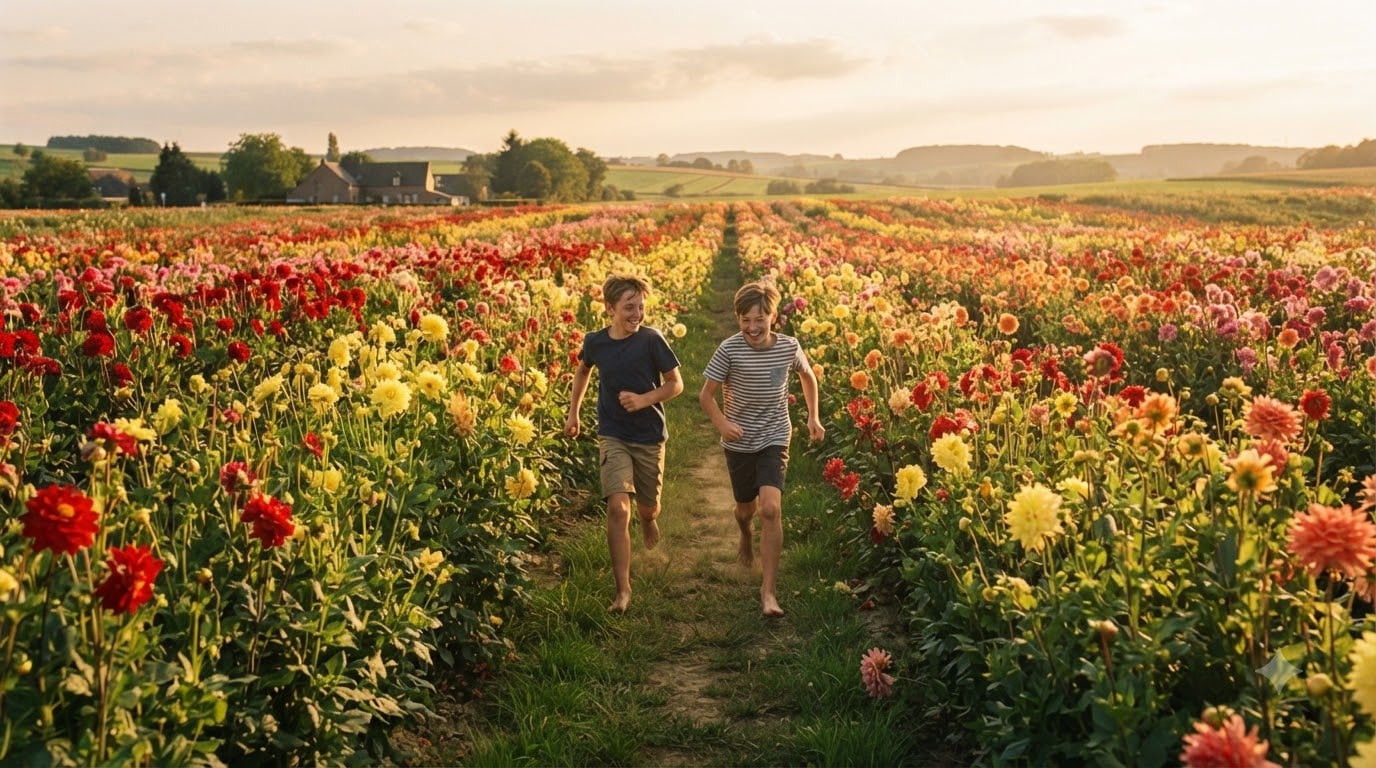
I watched Close (2022) in a small theater on a Sunday afternoon, and I left the room unable to speak for ten minutes. The film by Belgian director Lukas Dhont centers on two 13-year-old boys, Leo and Remi, whose tender friendship shatters under social pressure. The backdrop of their bond is a flower farm in the Belgian countryside, and I want to walk you through exactly what those flower fields mean.
In this guide, I’ll break down the symbolism of the flower fields in Close. We’ll cover the passage of time, the specific dahlia imagery, the harvest metaphors, the foreshadowing mowing scene, and the color symbolism woven through it all. This is the kind of analysis I wish I had read before my first viewing, because it rewards careful rewatching.
The symbolism of the flower fields in Close works on multiple levels at once. On the surface, they’re a beautiful Belgian countryside backdrop. Below that, they represent the passage of time, the fragility of childhood, and the cycles of growth and loss that mirror the boys’ friendship.
Table of Contents
What do the flower fields symbolize in Close?
The flower fields in Close symbolize the passage of time, inner change, childhood innocence, and the fragility of human bonds. The flowers bloom, wither, and are harvested in different seasons, and this natural cycle mirrors the emotional arc of Leo and Remi’s friendship.
Director Lukas Dhont uses the Belgian countryside flower farm as a poetic visual language. The fields are not just scenery. They are characters in their own way, reflecting the inner emotional states of the boys. When the boys are joyful, the flowers are vibrant and abundant. When the friendship fractures, the imagery shifts toward decay and destruction.
I find this approach especially powerful because flower symbolism in cinema often feels generic. Dhont’s choice to root everything in a working flower farm, with real bulbs being harvested, extracted, and replanted, gives the metaphor a documentary weight. The flowers are not abstract. They are a livelihood, and that fact makes every image of them feel anchored in something real.
The dahlia fields: a closer look at the specific flower symbolism
The flowers in Close are dahlias, and that specific flower carries its own symbolism that strengthens the film’s themes. Dahlias traditionally represent dignity, elegance, commitment, and a bond that lasts forever. In the Victorian flower language, giving a dahlia meant declaring “I am committed to you, mine to the end.”
That meaning hits hard when you remember what happens to Leo and Remi’s bond. The two boys sleep in the same bed, share meals at each other’s homes, and run through the dahlia fields together. Their friendship has the deep, committed quality that dahlias represent. The tragedy of the film is that this kind of bond is exactly what society refuses to let adolescents have.
Dahlias are also among the most visually dramatic flowers in cultivation. Their petals can be intricate, layered, and almost overwhelming in their detail. To me, this matches the emotional intensity of the boys’ early friendship. Dhont could have used daisies or wildflowers, but he chose dahlias, and I think the choice was deliberate. He wanted flowers that looked as intense and committed as the boys’ connection to each other.
The flower farm as emotional mirror for the boys
The flower farm in Close functions as a literal mirror of the boys’ emotional states. Dhont uses the working life of the farm, harvesting, extracting bulbs, and replanting, as a parallel to the emotional work of friendship, grief, and rebuilding.
When we first meet Leo and Remi, they are running freely through vibrant dahlia rows. The frames are wide, the colors saturated, and the boys feel weightless. They are surrounded by flowers in full bloom, and the imagery tells us this is a season of emotional abundance. Nothing is in question. The world is generous, and so is their friendship.
Later, as the boys drift apart after a schoolyard question, “Are you two in love?” the visual language shifts. The flowers are still there, but they no longer cradle the boys in the same way. Leo starts to perform masculinity. He plays hockey, distances himself from Remi, and lies about where he sleeps. The harvest imagery, which Dhont uses sparingly in the early scenes, starts to surface more and more. Bulbs are pulled from the soil. Flowers are gathered. The cycle is turning toward loss.
For me, the harvest metaphor is one of the most powerful in the film. Harvesting is not violent. It is necessary. But it ends something. When you extract a bulb, you take the plant from the ground that fed it. That is exactly what social pressure does to Leo and Remi. It pulls them out of the soil that was sustaining their friendship.
Seasonal imagery and the passage of time
The flower fields in Close follow the rhythm of the agricultural year, and each season carries emotional weight. Dhont does not use a literal timeline on screen, but the flowers tell us where we are in the boys’ lives.
Summer is the season of innocence. The dahlias are tall and full, and the boys run through them like they will never grow up. This is the part of the film that feels most like a memory, and Dhont’s cinematographer Frank van den Eeden shoots it with warm light and soft focus. It is the impressionist painting that critics often mention, and it works because the entire scene is filtered through nostalgia.
Autumn brings the harvest. The flowers are cut or dug up, and the rows of the farm start to look bare. This is when the friendship is under real strain. Leo avoids Remi. Remi tries to hold on. The boys are no longer running together. They are walking apart, and the empty rows of the farm show us what loss is starting to look like.
Winter never quite arrives on screen, but Remi dies before the next bloom. The film ends with Leo returning to the farm in a quieter, more muted season. The flowers are not gone. They are dormant. And so, in a way, is Leo. He is learning to live with the soil of a friendship that once bloomed so fully but has now been pulled from the ground.
Color symbolism in the flower fields: red and yellow
Viewers who watch Close carefully notice that the color palette shifts depending on which boy the camera is following. Red is associated with Remi, and yellow is associated with Leo. The flower fields participate in this color coding in ways that deepen the emotional stakes.
Remi, the more sensitive and musically gifted of the two, is often framed against warm reds. The flowers around him tend to carry red tones. When he plays piano, the lighting picks up soft amber hues. Red, in cinema, signals passion, interiority, and emotional depth. Remi lives inside his feelings. The red flowers around him are an external expression of that inner world.
Leo, who is more athletic and socially aware, is dressed in yellows and surrounded by yellow-toned fields. Yellow can signal sunlight, optimism, but also caution. Leo is the boy who reads the room, who knows what other boys expect, and who adjusts himself to fit. The yellow flowers mirror his performative brightness, the easy smile he puts on, even as something inside him is closing off.
The cruelest color choice in the film is the presence of red flowers in the scene right before Remi’s death. After losing his friend, Leo walks past a field of red flowers being mowed down at night. The red, Remi’s color, is being destroyed. The viewer understands, even before they know what has happened, that something connected to Remi has been cut off. We will return to this scene in detail because it is one of the most discussed pieces of foreshadowing in the film.
The mowing scene: a flower field foreshadowing tragedy
One of the most discussed moments in Close is the scene of a field of red flowers being mowed down at night. This scene appears early enough that some viewers miss what it foreshadows, but on rewatch, it lands like a punch. The red flowers are Remi’s color, and their violent destruction at the hands of a machine is a direct visual prophecy of Remi’s death.
Letterboxd reviewers and Reddit fans often cite this scene as the moment they realized the film was going to be devastating. The mowing happens off-screen for most of the shot, but we see the flowers fall, row by row, in a damp, dark field. Nothing about the scene is sentimental. It is methodical, industrial, and final. That is exactly how Remi’s death is portrayed once we learn what has happened.
Dhont uses the mowing scene to do something that is hard to pull off in cinema. He foreshadows grief without telling the audience what to feel. The first time you watch, the red flowers being cut down feels like a strange, almost ominous aside. The second time, after you know what happens to Remi, it becomes unbearable. The flowers were not destroyed by accident. They were always going to be destroyed. The friendship was always going to be cut down.
I think this is one of the smartest visual decisions in the film. So many coming-of-age movies tell you that something bad will happen. Close shows it to you, calmly, and trusts you to feel it later. The mowing scene is the flower field’s clearest symbolic statement: beauty is temporary, and the machinery of social pressure does not care what it cuts down.
How flowers represent the loss of childhood friendship
The flower fields in Close are finally a symbol of what is lost when childhood ends. The running-through-fields joy of Leo and Remi is the film’s emotional high point, and it is set against flowers in full bloom. When the friendship ends, the flowers are harvested, mowed, or left bare. The visual logic is clear, and it is heartbreaking.
This is a story about what happens when society refuses to let boys love each other. The flowers are not just decorative. They are the visual proof that something precious was real, and that the world did not protect it. Leo carries a kind of survivor’s guilt because he was the one who pulled away. He did the pulling, and the flowers went down with the friendship.
By the end of the film, Leo returns to the flower farm with Remi’s mother. The fields are still there, but the boys are not. Leo touches the soil. He picks a flower. He cannot bring his friend back, but he can witness what the friendship was. For me, that final return to the flower fields is the most hopeful moment in the film. It is not a happy ending. It is a continuation, and the flowers are still growing.
FAQs
Were Leo and Remi in love in Close?
The film deliberately leaves the exact nature of Leo and Remi’s bond open to interpretation. Their intimacy is profound, and critics read it as romantic love, queerplatonic love, or a deep childhood friendship that society refuses to let exist. The boys themselves do not have a word for what they share, and the tragedy is that the world insists on naming it before they can.
What do the flowers symbolize in the movie Close?
The flower fields in Lukas Dhont’s Close (2022) symbolize the passage of time, childhood innocence, the fragility of friendship, and the cycles of growth and loss. The dahlias bloom, are harvested, and are replanted, mirroring Leo and Remi’s emotional journey from carefree connection to grief and separation.
What happened to Remi in the movie Close?
Remi dies by suicide after his friendship with Leo collapses under social pressure. Their classmates tease them about being a couple, Leo distances himself, and Remi struggles to cope with the loss of the most important relationship in his life. His death is the devastating turning point of the film, and it is what forces Leo to confront the harm of his choices.
Is Close (2022) an LGBT film?
Close (2022) is widely read as an LGBTQ+ film, though Lukas Dhont has described it as a story about love and intimacy that does not need to be labeled. The relationship between Leo and Remi can be read as a queer boys’ love story, and the film’s emotional stakes come directly from how society pathologizes their closeness. It won the Grand Prix at Cannes and received an Academy Award nomination for Best International Feature Film.
What is the meaning of the movie Close (2022)?
Close (2022) is about how childhood friendships, especially those between boys, are policed and destroyed by social expectations around masculinity. Lukas Dhont uses the flower farm as a visual metaphor for the boys’ bond, showing how something as natural and beautiful as a dahlia in bloom can be uprooted by the pressure to conform. The film’s meaning is that love between children is fragile, and adults, peers, and the boys themselves often fail to protect it.
Why the flower fields make Close such a powerful film
The symbolism of the flower fields in Close is what elevates the film from a tragic coming-of-age story to a meditation on what we lose when we grow up. Without the dahlias, the film would still be devastating. With them, it becomes impossible to forget.
Lukas Dhont has said in interviews that he wanted the natural world to carry as much of the emotional storytelling as the dialogue. The flower farm is where that idea lives. Every shot of Leo and Remi in the fields is doing the work that words would have to do in a less visually confident film. The flowers bloom, the flowers are cut, the flowers return. The boys cannot.
If you have not seen Close yet, I would tell you to watch it twice. The first time, let it break you. The second time, pay attention to the flowers. Watch the dahlias. Watch the harvest. Watch the red row being mowed down in the dark. Once you see the symbolism of the flower fields in Close, you will not be able to look away from how carefully this film was built around the things that grow and the things that do not survive being pulled from the soil.