
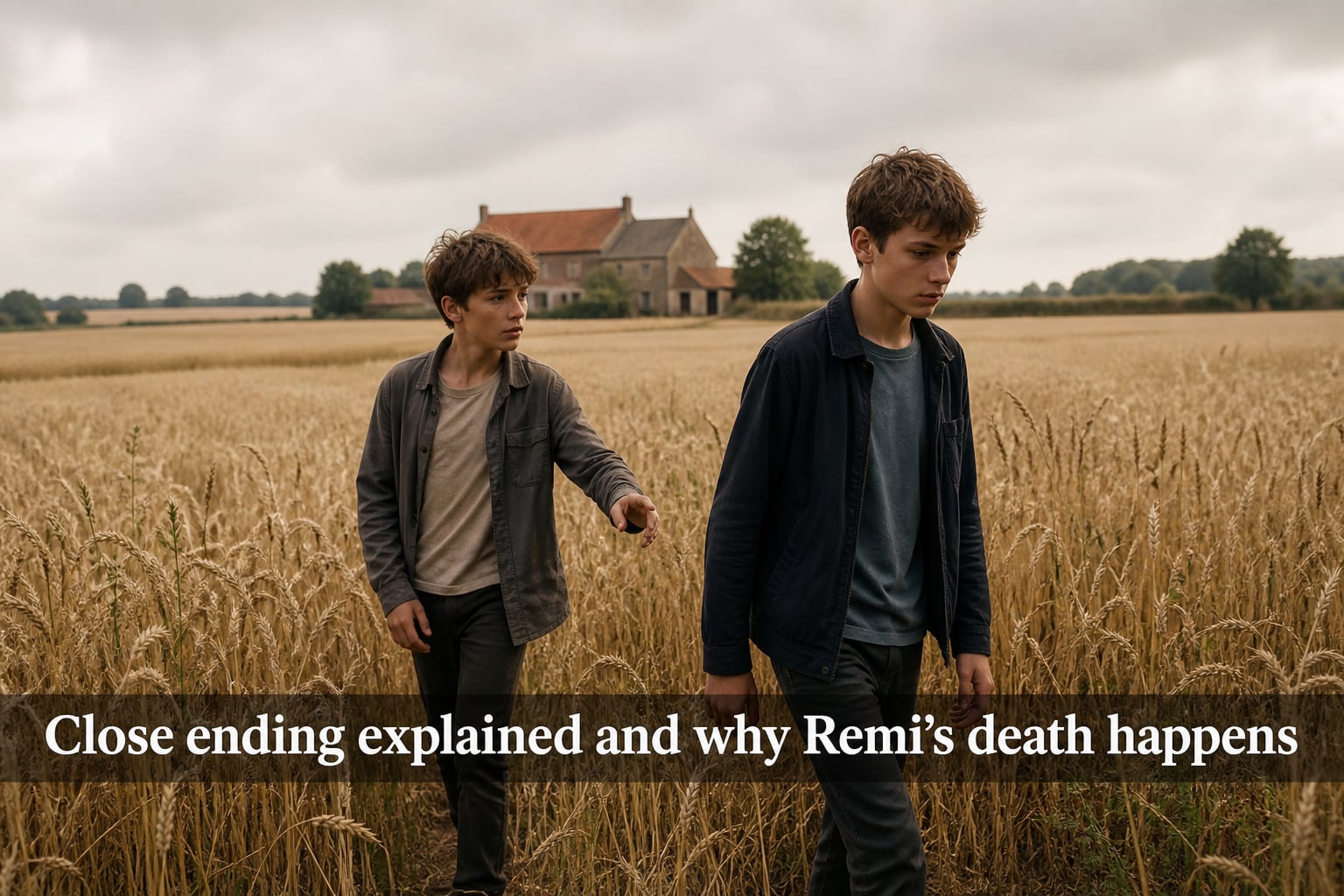
Remi kills himself in Close because the friendship he shared with Leo, his 13-year-old best friend, collapses under the weight of peer pressure and his own inability to process being labeled “different.”
His death happens off-screen after Leo begins distancing himself at school, leaving Remi isolated during a period when the bond between the two boys was his anchor. Close (2022), directed by Lukas Dhont, is a Belgian coming-of-age drama that turned this quiet tragedy into one of the most discussed films of the year. Below is a full breakdown of the ending, what leads to Remi’s death, and the meaning behind Dhont’s choices.
Table of Contents
Close (2022) Movie Overview: What the Film Is About
Close is a 2022 Belgian-French-Dutch coming-of-age drama written and directed by Lukas Dhont, who co-wrote the screenplay with Angelo Tijssens.
The film follows Leo (Eden Dambrine) and Remi (Gustav De Waele), two 13-year-old boys who share an unusually close, tender friendship in a quiet Belgian town. They sleep in the same bed, whisper secrets, run through fields of golden wheat, and dream of a future together on a remote island.
The story opens with their bond intact, then shatters when a classmate asks Leo whether he and Remi are “more than friends.” That single question sets in motion a series of small betrayals, and by the time the boys return from a school trip, Remi is dead. The rest of the film follows Leo as he tries to survive the wreckage of his own guilt.
Why Remi’s Death Happens in Close: The Core Explanation
Remi’s death happens because he loses the one person who made his world feel safe, and he cannot articulate or survive that loss.
Leo was not just Remi’s friend. He was his confidant, his mirror, his home. When Leo begins pulling away after a classmate’s pointed question about whether the two boys are a couple, Remi is left without a single anchor. Dhont has said in interviews that Remi was a child who wanted to disappear, a 13-year-old boy whose emotional vocabulary was not yet developed enough to ask for help.
Three forces converge to produce his death:
Sudden social rejection: Leo’s distancing makes Remi feel that the intimacy between them was wrong.
Emotional isolation: Remi has no other close friend or adult who notices his distress.
Pre-adolescent emotional capacity: At 13, Remi lacks the cognitive tools to seek help or even name what he is feeling.
The result is not a reasoned choice but a desperate act by a child who no longer sees a place for himself.
Leo and Remi’s Friendship: The Bond Before the Breaking Point
The friendship between Leo and Remi is the heart of the film, and Dhont films it with extraordinary tenderness.
In the opening scenes, the two boys share a bed, talk about the stars, and press their foreheads together in moments that feel both childlike and charged. Their families accept the bond, and Remi’s mother, Sophie (Léa Drucker), treats Leo almost as a second son.
What makes the bond feel unusual is its intimacy. They share clothes, secrets, fears, and a private language that the outside world does not fully understand. Critics have noted that this closeness is the film’s central promise, and its destruction is the film’s central tragedy.
The two boys also share a fascination with wildlife. They rescue a duckling and later care for a small lizard, symbols of the vulnerable, unspoken love they carry for each other.
How Leo Pushes Remi Away: The Moment Everything Changes
Leo pushes Remi away not out of malice but out of shame.
During a schoolyard conversation, a classmate asks Leo directly whether he and Remi are “more than friends.” The question catches Leo off guard. Even though he does not yet have the words for what he and Remi share, he senses that the bond does not fit the social scripts around him.
From that moment, Leo begins physically distancing himself from Remi. He refuses to walk home together, recoils when Remi touches him, and tells a classmate that Remi is “just” a friend. These are tiny, almost invisible acts of rejection, but to Remi they are catastrophic.
Leo later tells his mother he did it because he was afraid of being teased. What he does not understand yet is that the teasing he feared was real, and his fear was reasonable. But the cost of protecting himself is paid entirely by Remi.
Leo and Remi’s Emotional Fallout Before the Death
The rupture between the boys escalates quickly once Leo begins his retreat.
Remi repeatedly tries to repair the bond. He brings Leo a gift, waits for him at school, and finally asks Leo directly what he has done wrong. Leo cannot answer. He does not have the language for shame, attraction, fear, or self-protection, and so he defaults to silence.
The boys argue violently during a fight with older classmates, and the scene functions as the emotional climax of the first half. Remi runs home wounded, and Leo walks away. That walk away is the last time they see each other alive.
What Happens to Remi at the End of Close: The Off-Screen Death
Remi dies by suicide during the week-long school trip that follows the fight, and his death is never shown on screen.
The film cuts from Leo on the bus to a classroom several days later, where the teacher, visibly shaken, tells the students that Remi has killed himself. The classroom bursts into cries. Leo is frozen. He walks home in a daze, and the camera tracks him in a long, unbroken take through a tunnel that seems to close in around him.
By withholding the actual suicide, Dhont forces the audience to sit with the aftermath rather than the act itself. We see grief, shock, and the slow collapse of Leo’s inner world, but never the moment Remi took his own life. The technique is deliberate, and it is what makes Close so devastating for many viewers.
Leo’s Guilt and Grief After Remi’s Death
Leo’s guilt is the engine of the film’s second half.
He knows he pulled away. He knows Remi came to him for help. He knows he failed to answer. After the funeral, his behavior fractures. He withdraws from his parents, isolates himself at school, and carries a physical scar from the earlier fight that will not heal emotionally.
Sophie, Remi’s mother, eventually confronts Leo in a scene that is widely regarded as the emotional peak of the film. She asks him what he said to Remi, what he did, why her son is gone. Leo cannot speak. The camera holds on his face as the weight of his role in Remi’s death becomes undeniable.
By the end, Leo is not forgiven, not by Sophie and not by himself. But he is offered something gentler: the chance to remember Remi clearly, to speak his name, and to carry him forward.
Why Remi’s Suicide Was Off-Screen: Director Lukas Dhont’s Narrative Choice
Lukas Dhont chose to keep Remi’s suicide off-screen to center the survivor rather than the act.
In interviews, Dhont has explained that he did not want to depict the suicide itself because doing so would risk making it aesthetic, dramatic, or imitable. He wanted audiences to feel what is left behind, the silence, the empty chair, the unanswered questions, rather than the act itself.
He has also described the film as a story about grief and how a 13-year-old boy processes a loss he believes he caused. Showing the suicide would have shifted the film’s center of gravity. By keeping it hidden, Dhont keeps our eyes on Leo, on his mother, on Sophie, on the town’s quiet disbelief, on everything that suicide leaves in its wake.
The Meaning of ‘Close’: What the Title Tells Us About the Film
The title Close works on at least three levels.
First, it refers to the literal closeness between Leo and Remi, the way they sleep in the same bed, hold hands, share breath, and exist inside each other’s world. Second, it describes how close the boys come to being able to talk about what they feel, and how close they come to saving each other, only to fail at the last moment. Third, it evokes the closing in of grief, guilt, and silence that suffocates Leo after Remi’s death.
Some viewers have also noted that the title works as a quiet plea. The film asks its audience to stay close to difficult stories like this one, to refuse to look away from adolescent grief, queer intimacy, and the cost of shame.
Alternative Interpretations of Close (2022)
Different viewers read Close through different lenses, and the film is richer for it.
Queer reading: Many critics interpret Leo and Remi’s bond as a first, unspoken love. Their closeness is not framed as romantic in dialogue, but the cinematography, the shared bed, the forehead touches, and the devastating ending all point to a love story cut short.
Autism spectrum reading: A recurring discussion on forums such as Reddit centers on whether Remi displays traits consistent with being on the autism spectrum. Some viewers note his literal interpretation of social cues, his sensory sensitivity around the wheat fields, and his deep attachment to routines and animals as signs the film deliberately includes.
Universal friendship reading: Other viewers argue that the film works precisely because it does not label the bond. The tragedy is not about what the boys are to each other, but about how fragile any intense childhood friendship becomes under social pressure.
Themes in Close: Masculinity, Peer Pressure, and the Loss of Innocence
The central themes of Close cluster around the cost of conformity.
Masculinity and shame: Leo pulls away from Remi because he fears being seen as soft, romantic, or queer. His fear is shaped by a peer culture that punishes intimacy between boys. The film suggests this culture is itself a form of violence.
Peer pressure: A single question from a classmate is enough to detonate the friendship. Dhont is careful to show that the pressure comes from a child, not an adult, and that the harm comes precisely from its casualness.
Loss of innocence: Close is, on one level, a story about how children become aware of the rules that govern affection, and what happens when they cannot yet understand those rules.
Survivor’s guilt: The film is one of the most honest portrayals of childhood survivor’s guilt in recent cinema, showing how grief can become indistinguishable from self-punishment.
FAQs
Why did Remi die in Close?
Remi dies by suicide after his closest friendship collapses. When Leo begins distancing himself because of peer pressure and shame, Remi is left emotionally isolated with no one to turn to, and he takes his own life off-screen.
Does Remi kill himself in Close?
Yes. Remi kills himself during a school trip after Leo pushes him away. The suicide is never shown on screen; the audience learns of his death when a teacher informs the class.
What does the ending of Close mean?
The ending centers on Leo’s unresolved guilt after Remi’s death. It does not offer forgiveness or closure. Instead, it shows that grief this deep can be survived only by carrying it, not by solving it.
Was Remi on the autism spectrum in Close?
The film does not label Remi, but many viewers and critics have noted characteristics consistent with autism spectrum traits, including literal social interpretation, sensory sensitivity, and deep attachment to animals and routines.
Why does Leo feel guilty about Remi’s death?
Leo feels guilty because he knows he withdrew from Remi at the exact moment Remi needed him most. He refused to walk home together, avoided physical closeness, and could not answer when Remi asked what he had done wrong.
Final Thoughts on Close and Remi’s Death
Close is devastating because it refuses to offer a single reason for Remi’s death. The film holds every cause, peer pressure, shame, isolation, queer repression, the failure of adults to notice, and asks the audience to sit with the weight of all of them at once.
What stays with me after multiple viewings is not the tragedy itself but Dhont’s quiet insistence that we look at what is left behind. The empty bed. The unanswered question. The boy who walks through a tunnel that keeps closing in. That is the ending of Close, and it is the part that lingers long after the credits roll.