
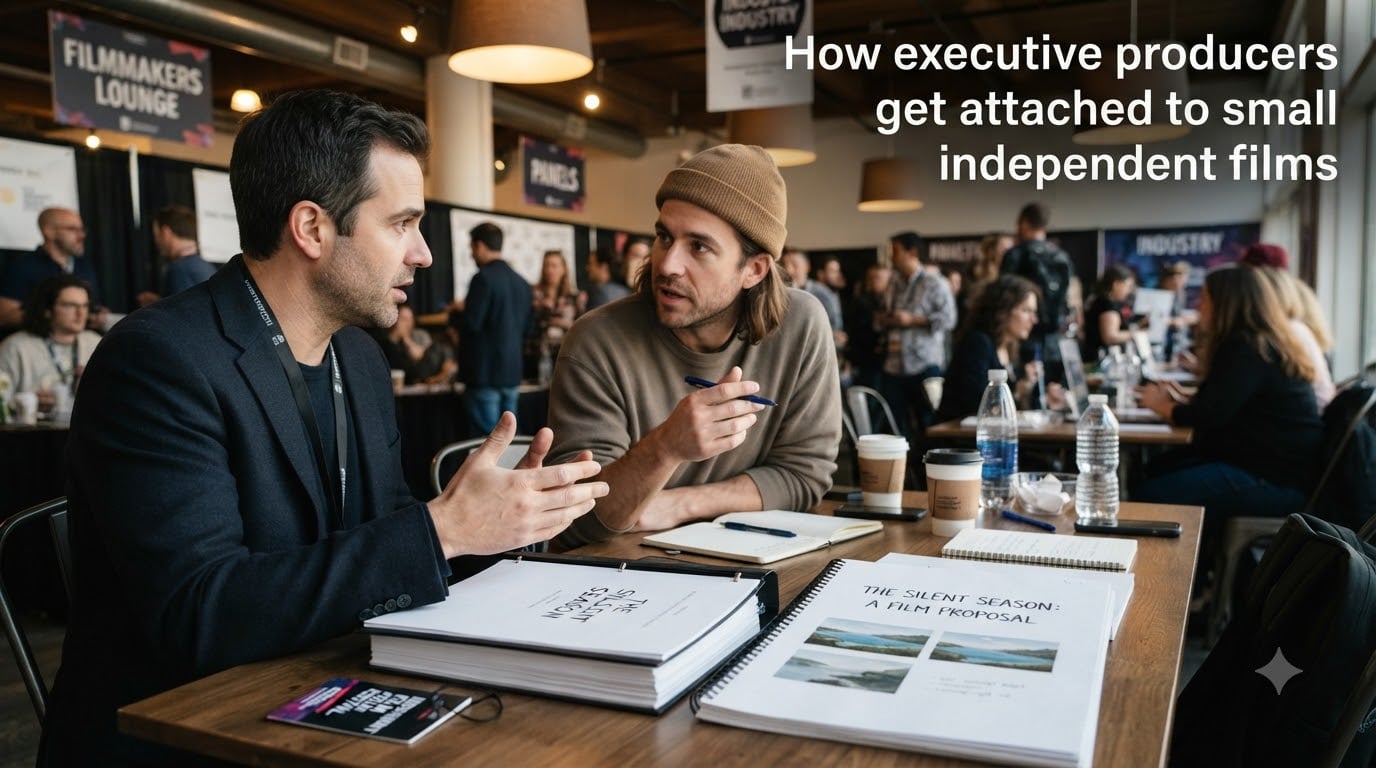
If you have ever wondered how executive producers get attached to small independent films, you are not alone. I have spent the last several years watching this part of the indie film world up close, and the answer is more structured than most filmmakers assume. There is a real process behind every EP credit you see scrolling through the end credits of a microbudget feature.
Executive producers tend to attach to projects through a combination of relationships, reputation, and the strength of the package they are shown. Understanding that mix is what separates filmmakers who land meaningful EP partnerships from those who spend years sending emails into the void. I will walk you through the entire arc, from how the role actually functions on a small indie to the specific moves that get an EP to say yes.
By the end of this guide, you will know exactly what an executive producer does on an independent film, the different types of EPs you might encounter, the criteria they use to evaluate projects, and the concrete steps you can take to get your film in front of the right one. Whether you are finishing your first short or trying to set up your second feature, this is the playbook our team has seen work.
Table of Contents
What Is an Executive Producer on an Independent Film?
An executive producer on an independent film is the person who supplies the financing, the industry leverage, or the strategic oversight that allows the project to move from script to screen. In the indie world, this role usually rolls three jobs into one credit: the executive producer puts up money, secures additional financing, or provides the relationships needed to attach cast, crew, distribution, or festival placement.
For a small production, the EP is often the reason a film exists at all. I have seen first-time directors get their scripts into festivals purely because a respected EP agreed to lend their name to the package. That name carries weight with investors, sales agents, and acquisition executives.
The role is intentionally flexible. Unlike a line producer who handles daily logistics, an executive producer typically works on a project for the entire arc of the production and beyond. Their involvement can span script development, casting, financing, post-production, and festival strategy.
The simplest way to think about it is this: the line producer manages the set, the producer manages the project, and the executive producer makes the project possible in the first place.
Executive Producer vs Producer vs Line Producer
Filmmakers often conflate these three titles, which causes problems when you start approaching the wrong people or offering the wrong credit. Each role has a clear scope on a small independent film, and knowing the difference matters.
Executive Producer: Provides financing, high-level oversight, industry connections, or strategic guidance. Often credited for making the project financeable. May not be on set every day.
Producer: Owns the overall production. Drives the creative and logistical vision, builds the package, secures the director and key cast, shepherds the film from development through delivery. Often hands-on throughout.
Line Producer: Runs the day-to-day operations. Manages the budget, schedules crew, handles union compliance, and keeps the shoot on time and on budget. The most operationally focused of the three.
On a one-million-dollar independent film, all three roles sometimes belong to the same person. On a fifty-thousand-dollar passion project, the producer is usually the director wearing every hat. Knowing which role you need to fill with outside help shapes who you approach and how you frame the opportunity.
Types of Executive Producers in Indie Film
Not all executive producers attach for the same reason. Over the past few years, our team has mapped the EP landscape and identified three broad categories. Each behaves differently, and each opens different doors for your film.
The Money EP: This is the executive producer who invests directly in the budget or who raises a significant portion of the financing. They are motivated by financial return, backend participation, tax credits, or strategic tax write-offs. They care most about the budget, the recoupment schedule, and the distribution plan.
The Oversight EP: This EP provides strategic guidance without necessarily writing the largest check. They are often credited as executive producers because their involvement protects the project, signals seriousness to other financiers, or shields the production from risk. They may oversee the business affairs and ensure the production stays in legal and financial compliance.
The Talent EP: This executive producer lends relationships and industry weight. They might attach a known actor, secure a distribution relationship, or use their reputation to get the project into a top-tier festival. Their credit is a signal to the marketplace that this film has been vetted by someone with track record.
In practice, the most effective executive producers blend two or even three of these categories. A money EP who also brings talent relationships tends to attach to projects faster because they solve multiple problems simultaneously for the filmmaker.
How Executive Producers Attach to Small Independent Films
This is the core process behind how executive producers get attached to small independent films. It usually follows a recognizable sequence, and filmmakers who understand the sequence can position themselves inside it.
Step 1: A Film or Project Reaches Readiness. Before any EP attaches, the project must be ready for outside involvement. That means a polished script, a director with a clear vision, a budget that holds together, and ideally some early materials such as a mood reel, pitch deck, or proof of concept. EPs who attach to half-baked projects rarely stay attached for long.
Step 2: A Trusted Introduction Happens. The single most common attachment mechanism is the warm introduction. A director the EP already works with, a producer the EP has backed before, or an attorney the EP respects sends a personal note. Cold outreach works, but warm intros close deals at a far higher rate.
Step 3: The EP Reviews the Package. Once an EP expresses interest, they want to see the script, the budget, the financing plan, the director’s previous work, and the distribution strategy. This is where your one-pager and your pitch deck either land the deal or get politely archived.
Step 4: Terms Are Negotiated. If the EP is interested, the conversation shifts to deal terms. How much money are they putting in? What credit do they receive? What backend do they earn? What approval rights do they have? On small indies, these negotiations are often handled informally, but the best filmmakers still put everything in writing.
Step 5: The EP Goes On. Once terms are agreed and the agreement is signed, the executive producer officially attaches to the project. Their name appears in the title card, the press materials, the festival submissions, and the eventual distribution deal. From this point on, they have skin in the game.
This five-step sequence is the dominant pattern, and our team has seen it play out on films at budgets ranging from sixty thousand dollars to ten million dollars.
What Executive Producers Look for in Indie Projects
Executive producers are selective. I have watched EPs turn down dozens of promising projects in a single quarter. Knowing what they evaluate is the difference between repeated rejections and a real conversation.
Strong Script: Every EP I have spoken with names the script as the first filter. A clearly defined story, a controlled budget envelope, and a credible director make scripts worth the next look. If your script is not there yet, the EP will not be either.
Director with a Point of View: EPs attach to directors, not just to projects. They want a director who has done the work, whether that means a short film, a festival credit, a strong reel, or clearly demonstrated craft. First-time directors can still attract EPs, but they need to show what they can do.
Budget Aligned with Goals: The budget has to make sense for the story and for the distribution path. An EP will ask whether your four-million-dollar indie has a realistic path to recoupment at the festival, sales, or streaming level. If the math does not work, the EP moves on.
Cast and Crew Attachments: The talent package matters. A recognized actor, a respected cinematographer, or an award-winning editor in the package dramatically increases the project’s value to an EP. This is why filmmakers spend years working on relationships, even before they have a feature ready.
Distribution Plan: EPs want to know how the film gets out into the world. Festival strategy, sales agent engagement, and streaming plans all matter. A project without a distribution path is a project the EP cannot evaluate for return.
Where to Find Executive Producers for Your Film
Finding executive producers is less mysterious than it sounds. They congregate in specific places, and knowing those places is half the battle.
Film Festivals and Markets: Sundance, Toronto, Berlin, and Cannes are obvious, but Independent Film Week in New York, the American Film Market, and regional festivals are where most real attachment conversations happen. The Film Markets attached to major festivals are designed for exactly this kind of meeting.
Industry Online Platforms: Stage 32, The Black List, and Slated connect producers with executive producers actively looking for projects. These platforms allow you to submit scripts, build profiles, and pitch directly to EPs who have set their search criteria.
Production Company Rosters: Many executive producers run or sit on the board of small production companies. Following these companies, subscribing to their announcements, and submitting through their official channels is a more reliable path than cold LinkedIn messages.
Attorney and Manager Networks: Entertainment lawyers, talent managers, and sales agents all know which EPs are looking for projects in which genres. Building a relationship with even one of these gatekeepers can multiply your outreach overnight.
Crowdfunding Backers: Sometimes the executive producer you need is already funding your film through Kickstarter or Seed and Spark. Backers who contribute meaningfully can be elevated to EP credit, both as recognition and as a way to formalize their involvement.
How to Approach and Pitch an Executive Producer
The approach matters as much as the project. I have watched strong projects fail because the pitch did not respect the executive producer’s time.
Start with a One-Pager. Before any meeting, send a clean one-page document that includes the logline, the director’s bio, the budget, the financing gap, and a clear ask. If the EP reads only one page, this is the page that has to land.
Build a Pitch Deck. The deck expands on the one-pager with visuals, comparable films, the director’s reel, and the casting attachments. Keep it to fifteen slides maximum. EPs review dozens of these a week; respect their time.
Lead with the Ask, Not the Backstory. Many filmmakers bury the ask in the third paragraph of their email. State upfront what you are raising, what credit the EP will receive, and what the response deadline looks like.
Follow Up Once. After the initial pitch, follow up once after seven to ten days with a short, polite email. If there is no response, move on. Pestering an EP is one of the fastest ways to lose credibility.
Always Have a Signed Agreement Ready. When an EP says yes, you want a paper-ready executive producer agreement on the table. Having your entertainment lawyer prepare a template ahead of time signals seriousness and accelerates close.
Pitching takes practice. Most filmmakers I work with run through their pitch dozens of times before the first real meeting. Rehearsal is what makes the conversation feel effortless rather than memorized.
Building Long-Term Relationships With Executive Producers
The single attachment is rarely the end of the story. The filmmakers who build lasting careers treat every EP relationship as the start of a longer collaboration.
Communicate regularly even when there is nothing to sell. Share festival news, share articles you found relevant, share wins from other projects you are producing. EPs remember the filmmakers who keep them in the loop without asking for anything.
Deliver what you promised. If the EP attached based on a fifteen-page lookbook and a sixty-day shoot, deliver exactly that. Reliability in the small things is what makes an EP willing to back your next project, even on a phone call.
Bring them into strategy early. The best EP relationships are collaborative. Ask for their input on casting, on festival strategy, on distribution. The more you treat them as a partner rather than a check, the more they invest in your success.
Reciprocate. If you have a relationship with a financier, an attorney, or a talent manager that could help your EP, make the introduction. Executive producers live on networks, and adding value to their network keeps you at the top of the list when their next project comes together.
Red Flags When Approaching an Executive Producer
Not every interested executive producer is a good partner. I have learned to watch for warning signs that suggest the attachment will become a liability rather than an asset.
An EP who demands creative control but offers no financing is rarely worth the credit. They can derail your film without taking real risk. Always negotiate clear scope of approval before signing.
An EP who insists on unreasonable backend percentages can leave the project impossible to finance. If their deal removes the producer’s ability to attract other investors, walk away and find a different partner.
An EP who refuses to sign a written agreement, or who wants handshake deals only, signals future disputes. Every attachment should be on paper.
An EP whose previous projects collapsed into litigation or who has a reputation for demanding credit changes after the fact is a liability. Always check the trade press and IMDb history before agreeing.
EP Deals and Compensation Basics for Indie Films
Compensation for executive producers on small independent films varies widely, but three structures appear most often.
Cash Investment for Equity: The EP invests a defined amount in exchange for a percentage of the film’s net proceeds. This is the most common structure for a money EP on indie projects.
Producer Fee: On larger projects, the EP receives a producer fee that is paid out of the budget, typically five to ten percent of their investment amount. The fee is paid before backend recoupment.
Credit-Only Deferral: On microbudget or passion projects, the EP may receive the credit and backend only, with no cash and no fee. This structure works when the EP is attaching for reputational reasons or to support a director they believe in.
Our team has seen negotiations across all three structures, and which one applies depends on the EP’s motivation and the filmmaker’s leverage. The deal you can negotiate is usually the deal that reflects how badly the EP wants your project.
FAQs
What is the typical fee for an executive producer on a 1M budget film?
On a one-million-dollar independent film, an executive producer typically invests cash in exchange for a percentage of the net proceeds and receives a producer fee of roughly five to ten percent of their investment. Some EPs work credit-only with backend participation, while others take an equity stake in the production company itself.
How do independent films get funded?
Independent films are usually funded through a mix of equity investment from executive producers and other financiers, tax credits and incentives from state or country programs, grants from foundations and arts funds, crowdfunding campaigns, presales to distribution partners, and deferrals from cast and crew who work for backend.
How to find executive producers for a short film?
To find executive producers for a short film, start with industry online platforms like Stage 32 and Slated, attend Independent Film Week and regional markets, ask entertainment lawyers and managers for introductions, and consider elevating significant crowdfunding backers to EP credit if their contribution justifies the title.
What does an executive producer do on an independent film?
On an independent film, an executive producer supplies financing, raises additional capital, secures talent or distribution relationships, provides strategic oversight, and lends industry credibility to the project. They often do not run daily operations but make the production financeable and marketable.
Final Thoughts on How Executive Producers Get Attached to Small Independent Films
Understanding how executive producers get attached to small independent films turns an opaque process into a repeatable one. The filmmakers who land meaningful EP partnerships prepare their projects, leverage warm introductions, and treat every pitch as the start of a long-term relationship rather than a single transaction.
If you take one thing from this guide, take this: the executive producer attaches because you have made their involvement worth it. Build the package, build the relationships, and you will find your project moving forward with the support it needs to reach the screen.