
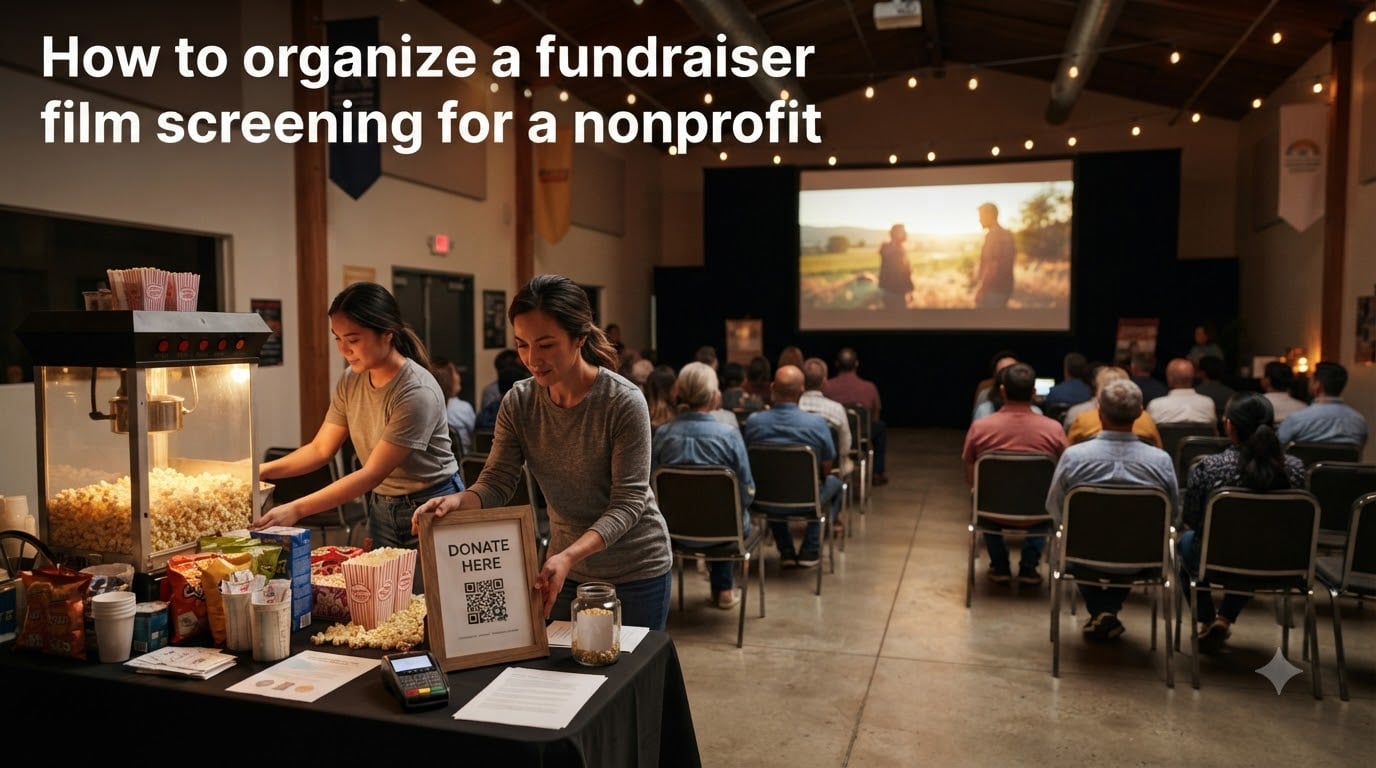
I’ve organized fundraiser film screenings for community organizations, arts nonprofits, and advocacy groups for nearly a decade, and I’m sharing the exact process that consistently raises $3,000 to $15,000 per event. This complete guide walks you through how to organize a fundraiser film screening for a nonprofit, from securing the legal licenses to running the projector on event night.
You’ll get a real timeline, the licensing paperwork explained in plain English, venue comparisons, ticket pricing strategies, and the profit-boosting add-ons that turn a simple movie night into your biggest fundraiser of the year.
Table of Contents
What Is a Fundraiser Film Screening and Why Does It Work?
A fundraiser film screening is a public movie event where ticket sales, concessions, sponsorships, and donations go directly to your nonprofit’s mission. Unlike a private home showing, you’re charging admission and inviting the community, which legally requires a public performance license.
These events work because films create emotional experiences that connect audiences to your cause. Our team has seen attendance spikes of 40% when the movie directly aligns with a nonprofit’s mission, like screening a climate documentary for an environmental group.
Beyond the money raised, you gain new email subscribers, social media followers, and potential recurring donors. One screening I helped run last spring brought in 87 new email addresses and 23 monthly donors in a single evening.
Film Licensing Requirements for Nonprofits
Yes, you absolutely need a license to show a movie at a nonprofit fundraiser. Under U.S. copyright law (Title 17), any public screening of a film outside the home requires written permission from the rights holder, and owning a DVD or having a Netflix subscription does not grant that right.
Skipping this step exposes your nonprofit to fines ranging from $750 to $30,000 per screening, and major studios actively monitor for unlicensed public events. Licensing is the single most important legal step when learning how to organize a fundraiser film screening for a nonprofit.
Copyright and Public Performance Rights
The “educational exception” only applies to face-to-face teaching in a classroom, not to fundraising events, even at a school. The “private viewing” exemption requires both a non-profit setting and a limited audience of close family or social acquaintances, which doesn’t apply to a ticketed fundraiser.
Public performance rights must be purchased separately from any physical DVD or streaming subscription. This is non-negotiable for any nonprofit showing a film to the general public.
How to Get a Movie License
Step 1: Decide on your film title and confirm the screening date.
Step 2: Contact the film’s distributor (most major films are licensed through one of three companies).
Step 3: Submit a license request with your venue capacity, expected attendance, and event date.
Step 4: Pay the licensing fee, which typically ranges from $300 to $1,200 depending on the film’s popularity and audience size.
Step 5: Receive written confirmation and keep it on file at the event. Studios occasionally send representatives to verify compliance.
Comparing Licensing Companies
Criterion Pictures USA handles most independent, foreign, and documentary films. Their catalog is deep and the licensing process takes 5 to 10 business days.
Swank Motion Pictures licenses most major studio releases including Disney, Warner Bros, and Universal films. Expect higher fees, often $500 to $1,500 for a single screening.
MPLC (Motion Picture Licensing Corporation) offers umbrella licenses that cover thousands of titles at once, which makes sense for organizations running multiple screenings each year.
For a one-time event, Criterion or Swank will be cheaper. For ongoing programming, MPLC’s annual license (starting around $300) often saves money.
How to Choose the Right Film for Your Screening
Choose a film that connects emotionally to your mission and is available through one of the licensing companies. The best fundraiser films have broad audience appeal, a runtime under two hours, and themes that open conversations about your cause.
For an arts nonprofit, a documentary about a famous artist draws crowds. For a literacy nonprofit, a coming-of-age story with strong reading themes works well. For advocacy organizations, politically relevant documentaries that spark dialogue after the credits roll are powerful.
Avoid films rated NC-17 or with extremely niche appeal. Stick to PG and PG-13 ratings when targeting family audiences, and verify the title is still available for licensing before you promote it.
Picking a Venue for Your Nonprofit Film Screening
The right venue depends on your budget, expected attendance, and audience profile. Indoor venues offer weather reliability and better sound, while outdoor venues cost less and create a memorable community atmosphere.
Indoor Venue Options
Local movie theaters often partner with nonprofits at reduced rates, sometimes offering the space for free in exchange for branding and a share of concessions. I helped coordinate a screening at an AMC that charged only the licensing fee and let us keep 100% of ticket sales.
Community centers, school auditoriums, and church sanctuaries offer affordable rentals between $200 and $800 per evening. These work well for audiences of 50 to 300 people and typically include basic A/V equipment.
Outdoor Screening Considerations
Parks, drive-in theaters, and parking lots reduce venue costs to nearly zero but require rental of an inflatable screen, professional projector, and sound system, which adds $1,000 to $3,000 to your budget.
Weather is the biggest risk. Plan a rain date or have a tent rental on standby. Outdoor events work best between May and September in most regions, starting 30 minutes after sunset.
Venue Selection Checklist
Confirm capacity for your expected attendance plus 20% buffer. Verify parking availability or public transit access. Test the sound system and projection quality in person. Check accessibility for wheelchairs and limited mobility. Ask about restrictions on outside food, alcohol, and decorations.
Make sure the venue has reliable Wi-Fi if you plan to use digital ticketing or QR code donations.
Setting Ticket Prices and Sales Strategy
Most nonprofit film screenings charge between $15 and $35 per ticket, with family packs of 4 tickets priced at $50 to $80. Pricing depends on your audience demographics, the film’s licensing cost, and your local market.
For upscale audiences in metro areas, $25 per ticket is standard. For school and church fundraisers, $10 to $15 keeps attendance strong. Always price above your per-attendee cost (licensing plus venue divided by capacity) to ensure profitability.
Offer tiered ticket options: General Admission, VIP with reserved seating and a drink voucher, and Family 4-Pack. VIP tickets typically sell at 2 to 3 times the general rate and improve your average revenue per attendee.
Sell tickets online through Eventbrite, Zeffy, or your own website to capture email addresses and reduce day-of cash handling. Online sales also help you forecast attendance for catering and seating.
Event Planning Timeline: 8 Weeks to Event Day
Follow this 8-week timeline to organize a fundraiser film screening for a nonprofit without missing critical details. I use this exact schedule for every event I coordinate, and it has never failed.
8 to 6 Weeks Before the Event
Form your event committee and assign roles: marketing lead, licensing coordinator, venue liaison, and day-of event manager. Set your budget and fundraising goal. Secure your film license and venue contract. Open ticket sales with an early-bird discount to gauge interest.
4 to 2 Weeks Before the Event
Lock in concessions, sponsorships, and any speaker or Q&A panelists. Print programs, signage, and donation envelopes. Brief volunteers on roles and run-through the event flow. Confirm A/V equipment rental or venue tech support.
1 Week Before the Event
Send a reminder email to ticket holders with logistics, parking, and dress code if relevant. Do a final headcount forecast for catering. Test the film file or Blu-ray on the actual venue equipment. Stock up on supplies: popcorn supplies, drinks, donation QR code displays.
Day of the Event
Arrive 3 hours before doors open for setup and tech check. Brief volunteers at the door on ticketing and seating. Set up donation stations with QR codes and text-to-give numbers. Open doors 30 minutes before showtime for refreshments and mingling. Run the screening, hold the Q&A, and wrap with a clear donation ask before guests leave.
Promotion and Marketing Your Movie Night Fundraiser
Start promotion 6 to 8 weeks before the event using a mix of email, social media, local press, and community partnerships. Films are visual, so invest in a great poster or graphic with the movie art, your nonprofit logo, and event details.
Email your list first. Past supporters, donors, and volunteers are your most reliable attendees. Send 3 emails: a save-the-date 6 weeks out, ticket launch 4 weeks out, and final reminder 1 week out.
On social media, run short video clips, behind-the-scenes prep content, and tagged posts from sponsors and partners. Local influencers and community pages can extend your reach for free if you offer them comp tickets.
Pitch local newspapers, radio stations, and community newsletters. A 30-second radio mention or a small feature in a weekly paper can add 50 to 100 attendees. Don’t overlook printed flyers at coffee shops, libraries, and partner businesses.
Maximizing Profits With Refreshments, Sponsorships, and Add-Ons
Ticket sales alone rarely cover costs, so the real fundraising happens at the event. Concessions typically generate $3 to $7 per attendee in pure profit. Popcorn, candy, and drinks cost pennies per serving but feel like a movie-night must.
Local sponsorships are gold. Approach businesses aligned with your mission and offer tiered packages: Bronze ($250, logo on flyer), Silver ($500, logo on screen before film), Gold ($1,000, verbal thanks plus signage). A $1,000 sponsorship requires only 1 minute of recognition.
Raffles, silent auctions, and merchandise booths add $500 to $3,000 per event. Solicit auction items from local businesses 4 weeks ahead, and set up a Square or PayPal reader for instant card payments.
Text-to-give and QR code donations during the emotional peaks of the film can raise $1,000 to $5,000 in a single evening. Display the donation code on screen before the film and during the Q&A.
Day-of Logistics and Running the Event
Arrive 3 hours early to test all equipment, set up signage, and walk through the event flow. Have one tech-savvy volunteer dedicated to the projector and sound. Print a run-of-show schedule with timestamps and share it with all volunteers.
Greet guests at the door with tickets, programs, and a friendly face. Open concessions immediately so people settle in. Start the film exactly on time and respect the advertised schedule.
Hold a 10 to 15 minute Q&A after the film, ideally with a subject matter expert, a beneficiary of your nonprofit’s work, or the filmmaker if reachable. Plan 3 to 5 discussion questions in advance.
Close with a 2-minute ask from your executive director or a beneficiary. Share a specific fundraising goal, show where the money goes, and display your QR code for instant donations.
Post-Event Follow-Up and Donor Stewardship
Send a thank-you email within 48 hours while the experience is fresh. Include a photo from the event, the total raised, and a link to donate again or sign up as a monthly supporter.
Personally call or hand-write notes to anyone who donated $100 or more. Tag attendees on social media with a thank-you post, and send a follow-up survey to learn what worked.
Schedule a debrief with your committee within 2 weeks. Document what worked, what didn’t, and start planning your next screening while the lessons are fresh.
Virtual and Hybrid Screening Options
Virtual screenings expanded during recent years and remain a strong option for reaching supporters who cannot attend in person. Platforms like Eventive, Vimeo OTT, and Covideo let you stream a licensed film to ticket holders in their homes during a defined window.
Hybrid events combine an in-person screening with a virtual watch party and live Q&A over Zoom. This format doubles your potential audience and lets you engage donors nationwide.
For virtual events, budget extra for platform fees (typically 5 to 10% of ticket revenue) and confirm your license covers online streaming, as not all licenses do.
Frequently Asked Questions
How do I get permission to screen a movie for fundraising?
You must purchase a public performance license from the film’s distributor. Contact Criterion Pictures, Swank Motion Pictures, or MPLC directly with your event details. Apply 4 to 6 weeks before your screening date to allow processing time. Owning a DVD or having a streaming subscription does not grant public screening rights.
How much does a movie license cost for a nonprofit fundraiser?
Movie licenses typically cost between $300 and $1,500 per screening, depending on the film’s popularity and audience size. Independent and documentary films run $300 to $600, while major studio releases often cost $500 to $1,500. MPLC annual umbrella licenses start around $300 and cover thousands of titles.
What movies work best for nonprofit fundraisers?
Films that connect emotionally to your mission work best. For arts nonprofits, documentaries about famous artists draw crowds. For advocacy groups, politically relevant films that spark dialogue after the credits are powerful. PG and PG-13 rated films with runtimes under two hours have the broadest audience appeal.
How many people should we expect at a movie fundraiser?
Expect 50 to 200 attendees for a first-time event, depending on promotion, venue, and community size. Strong email lists, social media reach, and local press coverage can push attendance above 200. Plan for 20% no-shows based on ticket sales.
Can I show a movie for free at my nonprofit fundraiser?
No, charging admission or accepting donations for entry still requires a public performance license. The licensing fee is separate from ticket revenue and must be paid regardless of whether you charge for tickets. The only exception is truly private, non-ticketed showings for a small group of family and close friends.
Final Thoughts on Running a Successful Fundraiser Film Screening
Learning how to organize a fundraiser film screening for a nonprofit comes down to three essentials: secure your license early, pick a film tied to your mission, and promote consistently for 6 to 8 weeks. The events that raise the most money always combine strong storytelling with clear donation pathways during the screening.
Start with one event, document what works, and build a recurring annual screening that your community looks forward to. Your next fundraiser film screening is the perfect chance to grow your donor base and fund your mission, all while giving your supporters a memorable night out.