
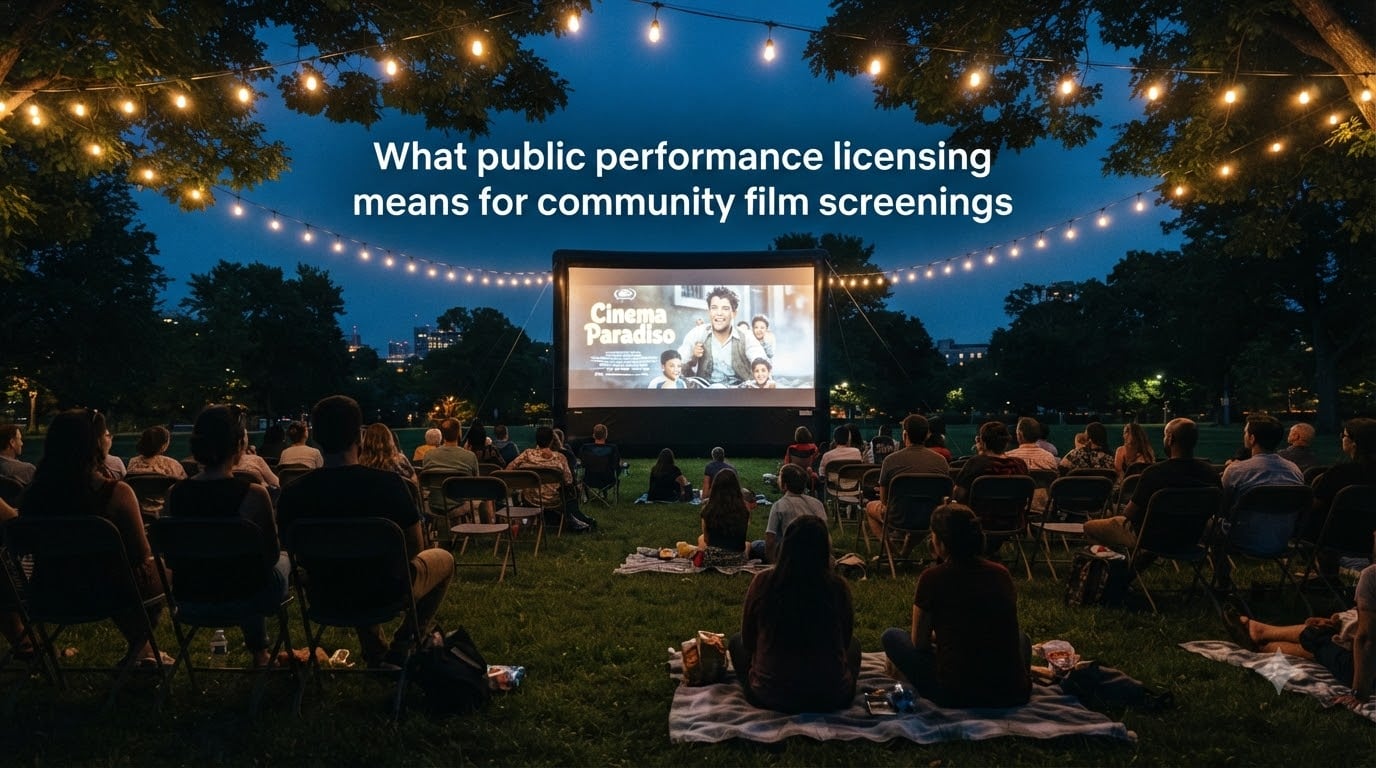
Planning a community movie night sounds simple until you discover the legal requirements behind showing a film to a group. The topic of public performance licensing confuses many organizers, from neighborhood HOAs to library program directors. I have spent years researching copyright compliance for community events, and the rules are more nuanced than most people realize.
In this guide, I will break down what public performance licensing means for community film screenings, why it matters, and exactly how to stay compliant. Whether you are organizing a free park screening, a library program, or a fundraiser movie night, understanding these requirements will protect your organization from costly legal trouble.
Public performance licensing is the legal framework that governs how copyrighted films can be shown outside private homes. It affects every organization that screens movies publicly, regardless of whether they charge admission or operate as a nonprofit. Let me walk you through everything you need to know.
Table of Contents
What Is Public Performance Licensing?
Public performance licensing is a legal authorization granted by copyright holders that allows organizations to exhibit copyrighted films to audiences outside private home settings. Under Title 17 of the United States Code, copyright holders retain exclusive rights to publicly perform their works, meaning any public exhibition requires their permission. This permission is granted through a licensing agreement.
When you buy a DVD or stream a movie on Netflix, you are purchasing the right to view that film in a private, domestic setting only. That purchase does not transfer any public exhibition rights. The license to show the film to an audience is a completely separate legal agreement.
This system exists to compensate the entire cast and crew who worked on a film. Every actor, director, sound engineer, and grip relies on performance royalties as part of their compensation structure. When an organization screens a film publicly without a license, it deprives those creators of earned income.
Two major licensing organizations handle the majority of public performance licenses in the United States: Swank Motion Pictures and the Motion Picture Licensing Corporation (MPLC). These companies act as intermediaries, negotiating blanket agreements with studios so community organizations do not have to track down individual copyright holders for each film.
Why Community Film Screenings Need a License
The Federal Copyright Act gives copyright holders exclusive rights to control how their works are publicly performed. This means that showing a movie to a group of people outside your immediate family and social circle, in a non-private setting, constitutes a public performance under the law.
Many community organizers assume that if they are not charging admission, no license is needed. This is one of the most common misconceptions I encounter. The law applies equally to free and ticketed events. Whether you charge five dollars at the door or let everyone in for free, the copyright requirement remains identical.
Another frequent assumption is that owning the DVD or digital copy grants screening rights. It does not. Personal purchase covers private viewing only. The physical media or digital file gives you no rights beyond watching it at home with family and close friends.
Nonprofit organizations sometimes believe their tax-exempt status exempts them from copyright law. It does not. Churches, libraries, schools, community centers, and charitable organizations all need public performance licenses to screen films publicly. The copyright statute makes no distinction between commercial and nonprofit exhibition when it comes to the licensing requirement itself.
What Counts as a Public Performance?
Understanding what constitutes a public performance is critical for compliance. The Copyright Act defines a public performance as one that occurs in a place open to the public or at any place where a substantial number of people outside a normal circle of family and social acquaintances are gathered.
This definition covers virtually every community screening scenario. A movie shown at a public park, a library meeting room, a church hall, a school auditorium, a community center, or even a private clubhouse with a large audience all qualify as public performances. The setting matters less than the gathering.
A private screening in your living room with close friends is not a public performance. But inviting your entire neighborhood association to watch a film in the community room changes the legal classification entirely. The key factor is whether the audience extends beyond a normal family and social circle.
Even events limited to members of an organization, such as an HOA residents-only movie night, typically require a license. Restricting attendance to a membership group does not make the screening private under copyright law. If the audience represents a substantial gathering outside a personal social circle, the performance is public.
Legal Exemptions and Exceptions
While public performance licensing requirements are broad, a few specific exemptions exist under copyright law. Understanding these exceptions helps community organizers determine whether their specific event qualifies for relief from standard licensing requirements.
The Face-to-Face Teaching Exemption
The most well-known exemption is the face-to-face teaching exception found in Section 110(1) of the Copyright Act. This allows educators to show films in a classroom setting, provided the screening is part of systematic instruction, takes place in a dedicated educational space, and is limited to enrolled students and instructors. This exemption does not apply to after-school movie nights, community education programs, or recreational screenings.
Fair Use Doctrine
The fair use doctrine allows limited use of copyrighted material for purposes such as criticism, commentary, news reporting, teaching, and research. Showing a short film clip during a lecture or film studies discussion may qualify as fair use. However, screening an entire film at a community event almost never qualifies, regardless of educational intent.
The So-Called 20-Minute Rule
Many community organizers ask about a rumored 20-minute rule that supposedly allows showing up to 20 minutes of a film without a license. I want to address this directly because the misinformation is widespread. There is no 20-minute exemption in United States copyright law for public film screenings.
This myth likely stems from a misunderstanding of fair use guidelines, which sometimes reference short portions of works in educational contexts. Fair use is determined case by case based on four factors: purpose, nature, amount, and market effect. Showing 20 uninterrupted minutes of a feature film at a community event would almost certainly fail the fair use test.
If your event involves showing any substantial portion of a copyrighted film publicly, you need a license. The length of the clip does not create a legal safe harbor. Treat the 20-minute rule as fiction, not policy.
Public Domain Films
Films in the public domain are not protected by copyright and can be screened freely without a license. However, identifying genuine public domain films requires careful research. Some films have entered the public domain due to expired copyrights, but many widely available lists contain errors. Additionally, while the film itself may be public domain, a specific restored version or musical score may still carry copyright protection. Verify status through reputable sources like the Library of Congress before relying on this exemption.
How to Obtain a Public Performance License
Obtaining a public performance license for a community film screening is more straightforward than most people expect. The process typically requires nothing more than an email or phone call to a licensing provider. Here is the step-by-step approach I recommend.
Step 1: Identify your film and event details. Before contacting a licensor, gather the film title, your organization name, event date, expected audience size, venue type, and whether you plan to charge admission. Having this information ready speeds up the licensing process considerably.
Step 2: Contact the appropriate licensing provider. For major studio films, Swank Motion Pictures and the Motion Picture Licensing Corporation are the primary sources. Swank handles single-event licenses for specific titles, while MPLC specializes in annual blanket license agreements covering multiple studios. For independent or documentary films, contact the distributor directly.
Step 3: Choose between a single-event or blanket license. A single-event license covers one specific film on one specific date. This option works well for one-time community movie nights. An annual blanket license, sometimes called an umbrella license, covers unlimited screenings of films from participating studios for an entire year. Organizations that host regular film programs benefit significantly from blanket agreements.
Step 4: Review and sign the license agreement. The agreement will specify permitted uses, marketing restrictions, audience limitations, and any conditions on admission charges. Read the terms carefully, particularly restrictions on how you can promote the event. Many studio licenses prohibit using the film title or studio name in certain promotional materials.
Step 5: Keep documentation on file. Retain a copy of your license agreement for your records. If questions arise about your screening, having the license documentation readily available demonstrates good-faith compliance.
Major Licensing Providers
Swank Motion Pictures is the largest provider of public performance licenses in the United States. They offer both single-event title licenses and annual blanket licenses, primarily serving libraries, schools, and community organizations. Their catalog includes most major studio releases.
The Motion Picture Licensing Corporation (MPLC) provides umbrella licenses that cover thousands of films from participating studios. Their annual blanket license is popular among organizations that screen films regularly throughout the year. MPLC serves businesses, government facilities, healthcare organizations, and community groups.
Movie Licensing USA, a division of Swank, focuses specifically on public libraries and K-12 schools. They offer annual blanket licenses tailored to these institutions.
For independent films, documentaries, and foreign cinema, contact the distributor or production company directly. Companies like Bullfrog Films, Women Make Movies, and Icarus Films handle educational and community screening rights for independent content.
Cost Considerations for Community Screenings
The cost of a public performance license varies based on several factors. Understanding the pricing structure helps community organizations budget effectively for their film events. From the research and community reports I have reviewed, here is what you can generally expect.
Single-event licenses for small community screenings typically range from $275 to $350 for audiences under 50 people. This covers one film shown on one date at one location. For larger audiences or higher-profile titles, single-event fees can climb to $500 or more. New releases and blockbuster films command premium rates.
Annual blanket licenses offer better value for organizations planning multiple screenings throughout the year. Pricing scales based on organization size and type. A small library or community center might pay a few hundred dollars annually, while larger organizations or those serving bigger populations face higher fees. MPLC and Swank provide custom quotes based on your specific situation.
Several factors influence the final license cost. Audience size is a primary driver, with larger events costing more. The specific film matters too, with new releases costing significantly more than older catalog titles. Whether you charge admission affects pricing for some license types. Your organization type and tax status may qualify you for discounted nonprofit or educational rates.
For organizations where licensing costs create financial strain, several strategies can help. Partner with local businesses or Friends of the Library groups to share expenses. Combine multiple events under a single annual blanket license to reduce per-screening costs. Consider fundraising specifically around the film event to offset the license fee. Some licensing providers offer payment plans or reduced rates for qualifying organizations.
Licensing costs can make small community events financially impractical in some cases. A neighborhood group planning a single free movie night for 30 residents may find the $275-plus license fee disproportionate to the event budget. This is a real challenge, and it is worth weighing against alternatives like public domain films or licensed streaming services that include public performance rights.
Best Practices for Community Film Events
Securing the license is only part of running a successful community film screening. Following industry best practices ensures your event stays compliant while delivering a great experience for attendees.
Marketing and Promotion Restrictions
Most public performance licenses include specific marketing restrictions that catch community organizers off guard. Many studio licenses prohibit advertising the film title outside the venue. This means you may be able to list the title on a schedule at the event location but cannot use it in external flyers, social media posts, or press releases.
Some licenses restrict using the studio name or film artwork in promotional materials. Always check your specific license agreement before creating marketing content. When in doubt, describe the event generically, such as “Family Movie Night,” and reveal the title only to attendees at the venue.
Rating Considerations
Choose films with ratings appropriate for your expected audience. For community events open to families, PG or G-rated films are the safest choices. PG-13 films may be acceptable depending on your audience composition, but communicate the rating clearly in event materials. R-rated films require careful consideration for community events, especially those that may attract minors.
Some licensing providers offer guidance on age-appropriate selections for community audiences. Consider surveying your community before selecting a film to ensure the choice matches audience expectations.
Technical Preparation
Technical quality affects the audience experience as much as the film choice. Invest in adequate projection and sound equipment that matches your venue size. Test all equipment before the event, including backup options for streaming or playback failures. For outdoor screenings, plan for weather contingencies and ensure visibility after sunset.
If you are streaming the film rather than playing a DVD, verify that your internet connection can sustain high-quality playback for the full duration. Buffering or quality drops during a community screening create a poor experience that reflects on your organization.
Partnerships and Fundraising
Community film events work well as partnership opportunities. Local businesses may sponsor screenings in exchange for recognition. Friends of the Library groups, community foundations, and local arts councils sometimes provide grants or cost-sharing for cultural programming. These partnerships can offset licensing costs while building community relationships.
If your event doubles as a fundraiser, understand the distinction between covering costs and generating profit. Some license types restrict commercial exploitation of the screening. Transparent communication about how proceeds are used builds trust with your audience and stays within most license terms.
FAQs
Do I need a public performance license for a free community event?
Yes. Free admission does not exempt you from public performance licensing requirements. The Federal Copyright Act requires a license for any public exhibition of a copyrighted film, regardless of whether admission is charged. Free community movie nights, library programs, and neighborhood gatherings all require proper licensing to comply with copyright law.
What is the 20 minute rule for movies?
There is no 20-minute rule in United States copyright law that allows public screening of a film clip without a license. This is a common misconception likely stemming from fair use guidelines for educational contexts. Fair use is evaluated case by case using four factors, and showing 20 minutes of a feature film at a community event would not qualify. Any substantial public exhibition of a copyrighted film requires a license, regardless of duration.
Can a nonprofit show a movie in public without a license?
No. Nonprofit status does not exempt an organization from copyright law. Libraries, schools, churches, charities, and community organizations all need public performance licenses to screen films publicly. The Copyright Act applies equally to nonprofit and commercial exhibitions. However, some licensing providers offer discounted rates for qualifying nonprofits and educational institutions.
Do I need a license to show a movie in public?
Yes. Any public exhibition of a copyrighted film requires a public performance license. This includes screenings at parks, libraries, community centers, churches, schools, HOA clubhouses, and similar venues. The license requirement applies whether or not you charge admission, regardless of audience size, and regardless of whether you own a personal copy of the film.
What happens if I show a movie without a license?
Showing a copyrighted film publicly without a license is copyright infringement under federal law. Civil penalties can reach up to $150,000 per work infringed. Criminal penalties for willful infringement can include fines and imprisonment up to five years. Copyright holders and licensing organizations actively monitor public screenings, and community events are not overlooked.
Conclusion
Understanding what public performance licensing means for community film screenings comes down to a few core principles. Copyright law protects filmmakers and requires any public exhibition to be properly licensed. Nonprofit status, free admission, and owning a personal copy do not override this requirement.
The good news is that obtaining a license is straightforward. Contact Swank, MPLC, or the film distributor directly, choose between a single-event or annual blanket license, and follow the terms of your agreement. Plan ahead, budget for the license fee, and explore partnerships to offset costs. And remember, there is no 20-minute rule. When in doubt, get a license.
By following these guidelines, your community film events will stay legally compliant while delivering memorable experiences for your audience. Start planning your next screening with confidence, knowing you have the knowledge to do it right.