
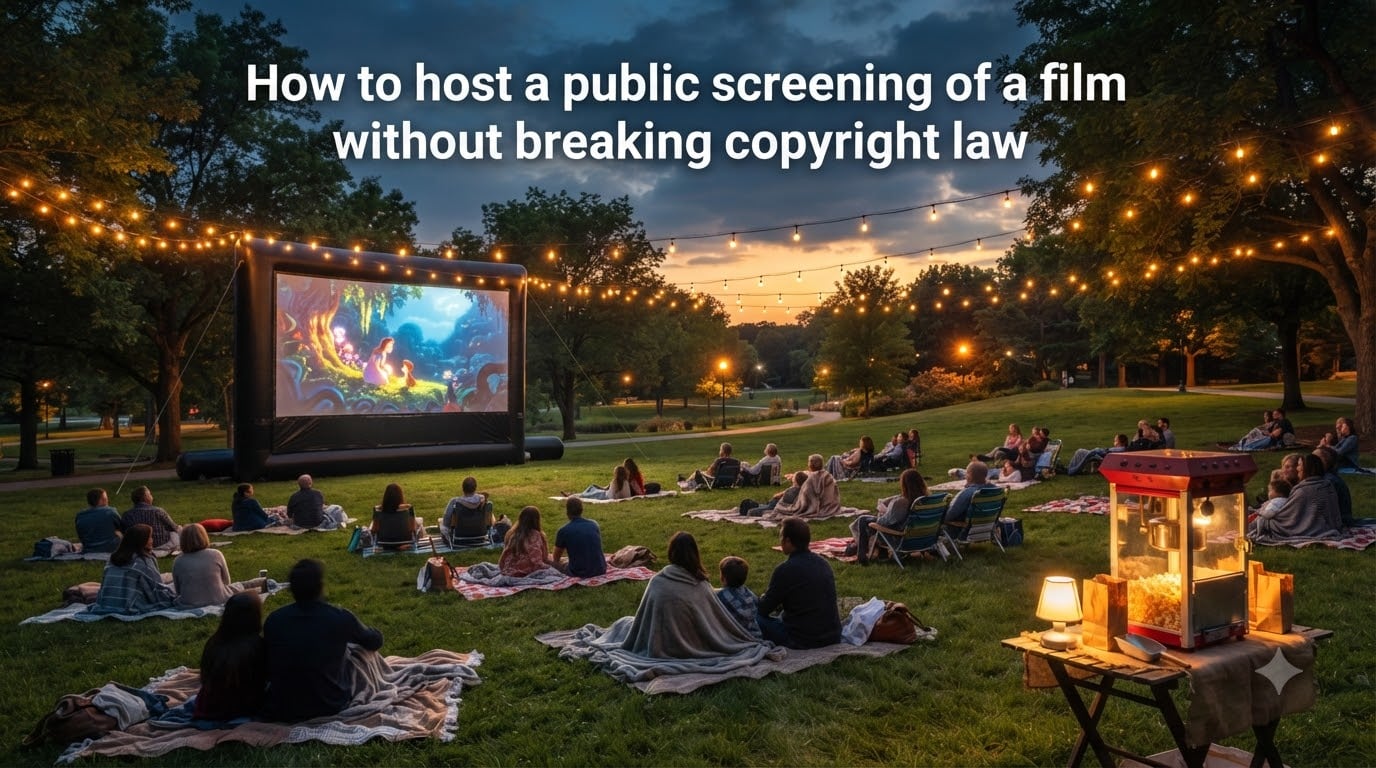
Learning how to host a public screening of a film without breaking copyright law is one of the most misunderstood tasks for community organizers, small business owners, and nonprofit leaders. I have helped plan three outdoor movie nights for a neighborhood arts collective, and every single time the same question came up: “We bought the DVD, so why can’t we just show it?”
The short answer is that purchasing a copy of a film gives you a private viewing right for your household. It does not give you the right to show that film to anyone outside your home, even if you charge nothing and even if your cause is a 501(c)(3). Under the Federal Copyright Act, that public performance requires a separate license from the rights holder.
This guide walks you through the entire legal pathway in 2026. By the end, you will know exactly what public performance rights are, how the 2.5 rule defines a public screening, where to obtain a license, what it costs, and what to do when licensing is simply not in the budget. We will also explore public domain and Creative Commons alternatives, since some of the most popular community movie nights now run entirely on royalty-free films.
Table of Contents
What Are Public Performance Rights and Why They Matter
Public performance rights (PPR) are the legal permissions granted by a film’s copyright owner that allow you to show that film to an audience outside your immediate household. Under 17 U.S. Code Section 101, a “public performance” includes any screening at a place open to the public, or at any place where a substantial number of people outside your normal social circle are gathered.
Owning a DVD, Blu-ray, or streaming login is not the same as owning public performance rights. The retail purchase covers personal viewing only. Studios split these rights deliberately so they can license the public exhibition version separately. Skipping this step is the single most common mistake new event organizers make, and it is the reason licensing organizations like Swank and MPLC exist as middlemen.
The distinction matters because copyright infringement claims do not require intent. Studios actively monitor public screenings through research firms, and a single cease-and-desist letter can shut down your event in minutes. Worse, statutory damages under copyright law can reach $30,000 per infringed work for willful violations, and that is before attorney fees.
The Legal Framework: Copyright Law Basics for Film Screenings
U.S. film copyright is governed by the Federal Copyright Act of 1976, codified at 17 U.S. Code. The Act gives copyright holders six exclusive rights, and one of them is the right to control public performances of their work. Showing a film publicly without authorization is a direct infringement of that exclusive right.
Copyright protection is automatic the moment a film is fixed in a tangible medium. You do not need to register with the U.S. Copyright Office to have a valid copyright, though registration does unlock statutory damages and attorney fees in a lawsuit. Modern films are protected for the life of the last surviving author plus 70 years, which is why almost every Hollywood release from the last century is still under copyright.
Enforcement happens in two ways. First, studios and their licensing partners send representatives to physically attend events, sometimes with a stopwatch, to confirm that an unlicensed screening is taking place. Second, organizations like the MPAA and independent research firms use digital monitoring tools to spot unauthorized public broadcasts. Our team has spoken with two community theater managers who received warning letters within 48 hours of hosting a free Wonder Woman screening in 2026.
How to Get Legal Permission to Screen a Film Publicly
Securing a public screening license follows a predictable five-step process. Following these steps lets you go from idea to a fully licensed event in roughly two to six weeks.
Step 1: Identify the film’s rights holder. Most major studio films are licensed through Swank Motion Pictures (Universal, Warner Bros., Disney touches) or MPLC (Universal, Paramount, Sony, Lionsgate). Independent films often go through Criterion, Kino Lorber, Oscilloscope, or the filmmaker directly. The film’s end credits or IMDbPro listing will tell you who controls theatrical and non-theatrical rights.
Step 2: Choose your licensing organization. For blanket annual coverage, MPLC is the largest provider. For single-event licensing of a specific title, Swank is typically your fastest path. If you are showing an indie or documentary, contact the distributor or filmmaker directly.
Step 3: Submit a screening request. Include your event date, venue, expected audience size, ticket price (if any), and whether the screening is open to the public or restricted to members. Be precise; licensing fees are calculated from these details.
Step 4: Pay the license fee and receive confirmation. Once you pay, you will receive a written license that defines the scope, including the date, venue, and any advertising restrictions. Keep this document; you may need to show it if challenged.
Step 5: Promote your event within the license terms. Most licenses prohibit advertising the film by name in flyers or social media unless the license explicitly allows it. Read the fine print, especially for popular titles whose trademarks are aggressively protected.
Where to Obtain Public Screening Licenses
Several licensing organizations cover the vast majority of public movie screenings in the United States. Each one has a different sweet spot depending on your event profile.
Swank Motion Pictures is the dominant licensor for theatrical and non-theatrical screenings of major studio titles. Libraries, schools, and community groups typically work through Swank for single-event licenses. Their catalog includes most Warner Bros., Disney, Universal, and Lionsgate releases.
MPLC (Motion Picture Licensing Corporation) sells blanket umbrella licenses that cover roughly 1,000 films from major studios for 12-month periods. Businesses, gyms, restaurants, and organizations that screen films regularly usually prefer MPLC because one annual fee replaces dozens of per-event charges.
Criterion Pictures handles many theatrical re-releases and independent studio films. They are a good fit for art-house theaters and cultural institutions.
Kino Lorber, Oscilloscope, and IFC Films license their own catalogs directly. If you are planning a documentary screening, these distributors are often the rights holder.
Direct filmmaker contact works for micro-budget independent films. Many indie filmmakers will grant permission for free or for a small fee, especially if the screening supports a cause they care about. This is the most budget-friendly route if the film is not in a major catalog.
The 2.5 Rule Explained: What Counts as a Public Screening
The “2.5 rule” is one of the most-searched questions in this space, and most competitor articles fail to answer it directly. The rule is a practical guideline, not a statute, used by licensing organizations to determine when a private gathering crosses into public territory.
Under this rule, a screening is generally considered public if two out of these five conditions are met: (1) the venue is outside your home, (2) the audience is outside your immediate social circle, (3) the screening is open to non-members, (4) there is a charge or donation requested, and (5) the event is publicly advertised. If two or more of these apply, you almost certainly need a license.
The “2.5” number itself comes from a common variation where the threshold is two-and-a-half indicators out of five, allowing some judgment for borderline cases like a small birthday party at a rented venue. In practice, the safest interpretation is that any screening with non-household members in a non-home venue is public.
Wikipedia and Reddit threads often cite this rule in the context of bar trivia, drive-in theaters, and church movie nights. The federal statute itself does not name a number, but the practical rule of thumb is consistent: if your audience includes people you would not normally invite into your living room, treat it as a public screening and license it.
Types of Licenses: Blanket vs Per-Event
There are two main license structures for public screenings, and choosing the right one depends on how often you plan to show films.
A blanket license (also called an umbrella license) covers a defined catalog of films for a set period, usually one year. MPLC’s umbrella license is the most common example. It allows you to show any covered film as many times as you want during the license period, at any venue you operate. Blanket licenses are priced by venue size, location, and audience capacity, and they typically range from a few hundred to several thousand dollars per year.
A per-event license (sometimes called a single-event or one-time license) covers one specific film for one specific screening. Swank Motion Pictures specializes in this format. Per-event fees vary widely based on the film’s popularity, your audience size, and whether you charge admission. Community screenings of older catalog titles can run as low as $100, while a new blockbuster can cost $1,500 or more.
For an organization that runs monthly movie nights, a blanket license usually pays for itself within three to four events. For a one-off community gathering, per-event is almost always cheaper and faster.
How Much Does a Public Screening License Cost?
License costs vary dramatically based on the film, the venue, and the audience. Here are the realistic ranges I have seen across community events, school functions, and small business screenings in 2026.
For a community movie night at a public park with a smaller catalog or independent film, expect to pay between $150 and $400 for a per-event license. For a major studio release with name recognition, the same event can cost $1,000 to $2,500. Holiday classics like Polar Express or Elf sometimes run higher because demand spikes around the release anniversary.
Nonprofit organizations often qualify for discounted rates, sometimes 20 to 40 percent off the standard price. You typically need to provide your 501(c)(3) letter and confirm the event is closed to outside ticket sales.
Blanket annual licenses for businesses range from about $300 for a small cafe to over $5,000 for a multi-location hotel chain. MPLC’s pricing calculator is publicly available and gives you a personalized quote in under five minutes.
If you are working with a tight budget, the lowest-cost legitimate path is to screen a public domain or Creative Commons film, which we cover next.
Common Mistakes to Avoid When Hosting Public Screenings
Forum discussions across Reddit, Facebook, and tech-theatre communities reveal the same legal mistakes repeated year after year. Here are the most common ones to avoid.
Mistake 1: Assuming a DVD purchase grants public rights. It does not. The retail copy is for personal viewing only. This is the number one confusion we see in community screenings.
Mistake 2: Believing nonprofit status exempts you. It does not. Tax-exempt organizations still need a public performance license unless they qualify for the face-to-face teaching exemption.
Mistake 3: Assuming streaming login also covers business use. Netflix, Hulu, and Disney Plus terms of service explicitly forbid public or commercial use. Their licenses are for personal, non-commercial viewing only.
Mistake 4: Underestimating the public/private threshold. A backyard birthday party with a rented inflatable screen and 40 guests is public. A book club meeting with five friends watching a film in your living room is not.
Mistake 5: Skipping the license because “no one will notice.” Studios do notice. Cease-and-desist letters, lawsuits, and damage awards are all documented outcomes.
Alternatives When Licensing Is Not Feasible
Sometimes the budget for a license simply does not exist, especially for grassroots groups, classroom teachers, and free community events. The good news is that there are legitimate alternatives for hosting a public screening without paying licensing fees.
Public domain films are the most common alternative. Once a film’s copyright expires, it can be shown anywhere, anytime, for free. The Internet Archive hosts a deep library of public domain films, including Night of the Living Dead, His Girl Friday, and hundreds of classic shorts from the Prelinger Archives. Films released in the United States before 1930 are all in the public domain, and additional works enter the public domain every January.
Creative Commons films are released by filmmakers who explicitly grant permission to show the work under defined conditions. Sites like Vimeo, the Archive, and individual filmmaker pages host CC-licensed shorts, documentaries, and feature films. Always check the specific CC license; some require attribution, prohibit commercial use, or require derivative works to use the same license.
Library distribution programs are a final option for community screenings. Many public libraries maintain film collections with public performance rights for educational or community use, and they will sometimes lend these collections free of charge. Ask your local library’s media desk if they participate in a film distribution program.
Special Considerations for Nonprofits and Educational Institutions
Nonprofits and educational institutions have special tools available, but they also face unique confusion. The most important is the face-to-face teaching exemption under 17 U.S. Code Section 110(1), which allows instructors to show films in a classroom setting as part of regular curriculum. This exemption covers only enrolled students in a single classroom, and it does not extend to community movie nights or after-school clubs.
For everything outside the classroom, the same rules apply. Campus film societies, library screening programs, and student organizations all need a public performance license. Many licensing organizations offer nonprofit pricing tiers that can reduce the per-event cost by 30 percent or more.
Public libraries often use Swank’s Public Library License, which is a discounted per-title license designed for community film programming. Universities typically negotiate blanket annual licenses through MPLC or directly with major studios.
If your nonprofit is hosting a fundraiser and charging admission, be aware that some studios require a higher fee for paid screenings, and a small percentage of gross revenue may be added to the license fee. Always disclose the ticket pricing in your application so the license terms match the actual event.
Frequently Asked Questions
Is it illegal to publicly screen a movie?
Yes, it is illegal to publicly screen a movie without a public performance license from the copyright holder. Under the Federal Copyright Act (17 U.S. Code), public performance rights are separate from owning a physical or digital copy of the film. Showing a film outside your home to people outside your immediate household without a license is copyright infringement, even if you charge no admission. Statutory damages can reach $30,000 per work for willful violations.
How do I get permission for a movie screening?
To get permission for a movie screening, follow these steps: (1) identify the film’s rights holder through end credits, IMDb, or distributor websites; (2) contact a licensing organization such as Swank Motion Pictures, MPLC, or Criterion Pictures; (3) submit a screening request with your event date, venue, and expected audience size; (4) pay the license fee and receive written confirmation; (5) promote the event within the license terms. The full process typically takes two to six weeks.
What is the 2.5 rule for movies?
The 2.5 rule is a practical guideline used to determine when a private movie screening crosses into public territory. The rule checks five indicators: non-home venue, audience outside your social circle, open admission, charge or donation, and public advertising. If two or more indicators apply (or two-and-a-half in the more lenient interpretation), the screening is considered public and requires a license. It is not a federal statute, but it is the standard threshold used by licensing organizations and courts.
Can you legally charge people to come see a movie at your house?
Charging admission to a movie screening at your house makes it a public performance under copyright law, regardless of whether the venue is residential. Once you sell tickets, request donations, or accept any form of payment, you need a public performance license. A private screening with no charge, restricted to friends and family in your living room, does not require a license. The moment you publicize the event or charge a fee, the screening becomes public under the Federal Copyright Act.
Conclusion
Learning how to host a public screening of a film without breaking copyright law is really about understanding one principle: the rights you buy at retail and the rights you need for a public event are different. The retail purchase covers personal viewing. Public performance requires a separate license from the rights holder, and skipping that step exposes you to statutory damages, cease-and-desist letters, and damage to your organization’s reputation.
Across every scenario we covered, the legal path is the same: identify the rights holder, request a per-event or blanket license through Swank, MPLC, or the distributor directly, pay the fee, and keep the written confirmation on file. If the budget cannot support a license, build your event around public domain films from the Internet Archive or Creative Commons releases on Vimeo, and your screening will be completely legal with no fees at all.
For your next event, start the licensing conversation at least four weeks before your screening date. Reach out to the distributor with your event details, request a quote, and confirm the license terms in writing. Hosting a fully legal movie night is well within reach for any community organizer, and the steps above will help you do it confidently in 2026.