
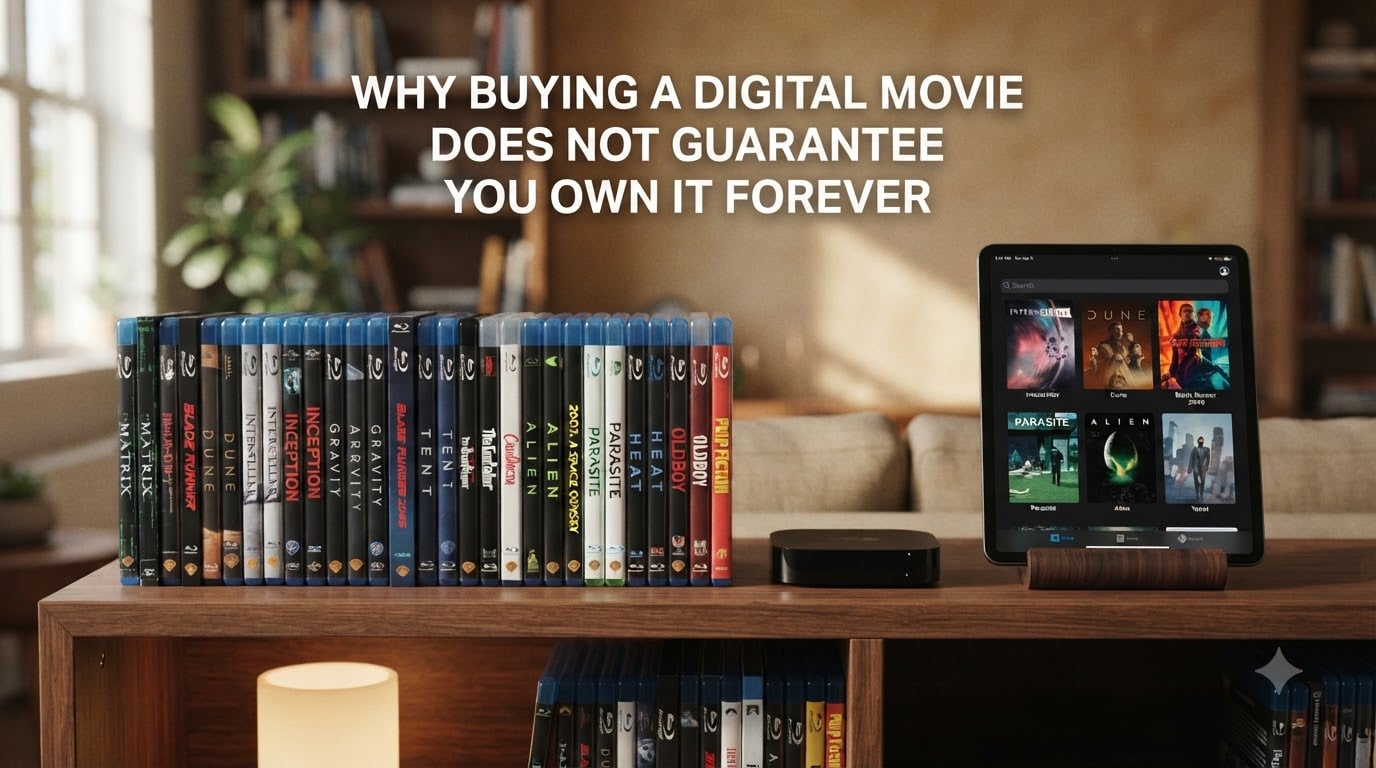
I lost 12 purchased movies last year when a major studio quietly pulled titles from a streaming service I had paid for. The movies were still in my library, but the “play” button did nothing. That experience taught me something important: when you buy a digital movie, you are not really buying a movie.
This guide explains why buying a digital movie does not guarantee you own it forever, what rights you actually receive, and how to protect your movie collection going forward. I dug into FTC consumer guidance, platform terms of service, and real user stories on Reddit to put this together for 2026.
Table of Contents
What Buying a Digital Movie Actually Gives You
A digital movie purchase is a license, not a purchase in the traditional sense. The Federal Trade Commission has been clear on this: when you click “buy” on a digital movie, you receive a non-exclusive, non-transferable license to access that content through a specific platform.
That license comes with strings attached. Most users never read the terms of service, but buried in that document is the key phrase: the content provider can revoke, modify, or terminate your access at any time. You do not own a file you can copy, share, or keep forever. You own temporary access that depends on three things staying true: the studio maintaining its licensing rights, the platform staying in business, and your account staying active.
The FTC published a consumer alert in April 2024 specifically warning that “it really depends” whether you actually own what you paid for digitally. That uncertainty is the entire problem with digital movie ownership.
Licensing Agreements Can Expire Without Warning
Studios license movies to platforms for specific windows of time. When those windows close, your access can disappear even if the platform is still operating. In 2024, Sony removed over 500 movies from digital retailers without much advance notice. Customers who had paid full price for those titles woke up to find their libraries suddenly thinner.
This is not a one-off event. Licensing deals expire, studios change distribution partners, and rights get re-bundled. The platform usually has no say in the matter because the studio controls the underlying content. Your contract is with the platform, but the platform’s contract is with the studio, and the studio’s priorities can shift overnight.
Movie studios are increasingly treating digital distribution as a short-term licensing opportunity rather than a sale. That shift is the primary reason your digital library is less stable than a shelf of Blu-rays.
Platforms Can Shut Down or Change Hands
Even if a license stays valid, the platform itself might disappear. Ultraviolet, once promoted as the universal digital movie locker, shut down in 2019. Users who had “purchased” movies through Ultraviolet lost access to everything they had bought, with no refund and no easy way to migrate their libraries.
Vudu has changed ownership multiple times, moving from Walmart to Fandango and now operating under NBCUniversal. Each transition created anxiety for users who worried their libraries would not survive the transfer. Reddit threads on r/vudu are filled with users asking whether their purchased movies will still play after the next ownership change.
MoviesAnywhere has tried to solve this by letting you link multiple retailer accounts into one library. It is a step forward, but it still depends on every linked platform staying operational. There is no guarantee that any specific digital locker will exist in 10 years.
Your Account Can Disappear Too
You can lose access to your digital movies even when nothing changes about the platform or the licenses. If your account gets terminated for a terms-of-service violation, if your payment method fails repeatedly, or if you lose access to the email address on file, your library can vanish with it.
Family sharing makes this even more fragile. If the primary account holder dies or simply stops paying, every linked family member loses access too. There is no inheritance mechanism for digital movie libraries the way there is for physical collections.
I have seen Reddit users describe the sinking feeling of logging in after a long absence and finding their libraries empty because of an account closure they did not know about.
How Major Platforms Handle Your Digital Movies
Not all platforms treat your purchases the same way. Here is how the major players in 2026 stack up.
Amazon (Prime Video): Amazon describes movie purchases as “lifetime access” as long as the title remains available. The key phrase is “remains available.” When Sony pulled those 500 titles, Amazon was required to honor its own policy, and many users did lose access. Amazon has historically been more stable than smaller platforms, but “lifetime” is conditional.
Apple TV (formerly iTunes): Apple has one of the stronger records for honoring purchases. Movies bought through iTunes have generally remained accessible even when studios have pulled titles elsewhere. Apple’s closed ecosystem gives it more control over the experience, though you are still subject to Apple’s terms.
Google Play Movies & TV: Google transitioned this service to Google TV, and some users reported friction during the migration. Google allows you to download purchased content for offline viewing in some cases, which adds a layer of protection, but the platform’s future is less certain than Amazon or Apple.
Vudu/MoviesAnywhere: Vudu’s multiple ownership changes have made it the riskiest major option, though MoviesAnywhere’s linking system offers some insurance. If you buy through MoviesAnywhere, your library follows you across linked platforms.
The lesson: no major platform gives you unconditional ownership. The differences are in how stable the platform is and how willing they are to fight for your access when licenses change.
How to Actually Protect Your Movie Collection
If you care about long-term access to your movies, here is what I actually recommend based on years of testing different approaches.
Buy physical media for movies you love. A Blu-ray or DVD is a physical object you own outright. It will play in 20 years if you have a working player. Special edition releases often include better picture and audio quality than the digital version, plus extras you cannot stream. For holiday classics and family favorites, physical is the safest bet.
Look for DRM-free options. Some independent studios sell movies as downloadable files without DRM restrictions. Sites like the Internet Archive and certain boutique labels offer legitimate DRM-free purchases. You can back these up to multiple drives and keep them forever.
Use MoviesAnywhere to link your libraries. If you buy digital, link your accounts through MoviesAnywhere. This does not protect you from licensing changes, but it does protect you from platform-specific failures.
Download purchases for offline viewing when possible. Some platforms let you download purchased movies to your device. This does not give you permanent ownership, but it does give you access even if your internet goes down or the platform has a temporary outage.
Stream instead of buying for casual viewing. If you only plan to watch a movie once or twice, renting or subscribing is often the better value. You avoid the disappointment of losing access to something you rarely rewatch.
Frequently Asked Questions
Do you really own a digital movie when you buy it?
No. When you buy a digital movie, you receive a limited license to access the content through a specific platform. You do not own a file you can copy or keep indefinitely. The platform, the studio, and your account status all affect whether you can still watch your purchase years later.
What happens to my purchased movies if the platform shuts down?
If the platform shuts down and your library does not migrate to another service, you typically lose access to everything you bought. Ultraviolet users lost all their purchased movies when that service shut down in 2019. Most platforms do not offer refunds when they close.
Can I get a refund if my purchased movie is removed?
Usually no. Most platforms’ terms of service explicitly state that purchased content is a license, not guaranteed permanent access. When studios pull titles, platforms rarely offer refunds because they did not choose to remove the content. Some platforms offer credit, but it is not guaranteed.
Is it better to buy physical or digital movies?
For movies you want to keep long-term, physical media (Blu-ray or DVD) gives you actual ownership. You can play it as long as you have a working device. Digital purchases offer convenience but come with the risk of losing access through licensing changes, platform shutdowns, or account issues. Many collectors now use both: digital for convenience, physical for favorites.
The Bottom Line on Digital Movie Ownership
Understanding why buying a digital movie does not guarantee you own it forever comes down to one word: license. Every “purchase” is really a conditional license that depends on the studio, the platform, and your account. None of those are guaranteed to stay stable forever.
For movies you truly care about, treat digital purchases as rentals with extra steps. Buy the Blu-ray, look for DRM-free options, and use streaming for everything else. Your future self will thank you when your favorite films are still playable in 2026 and beyond.