
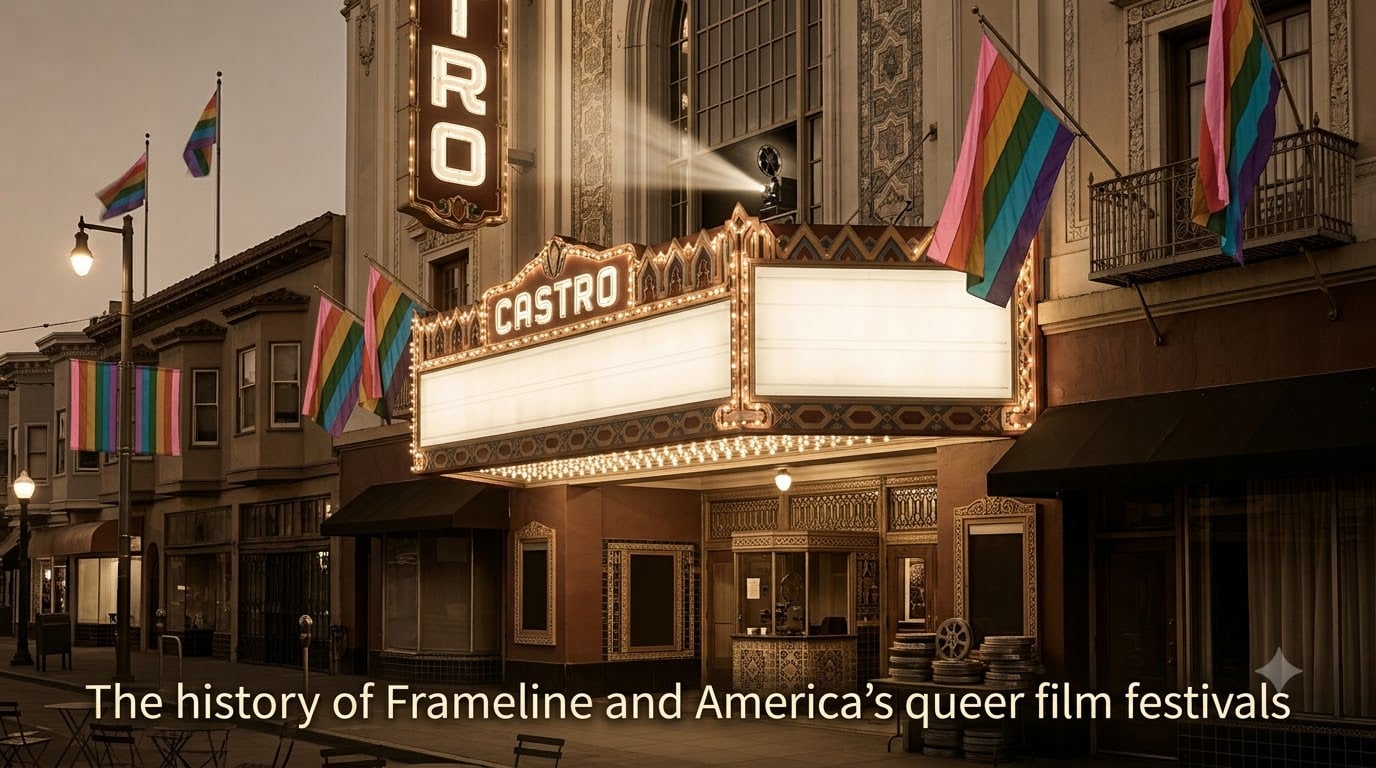
In 1977, a small group of friends gathered in a San Francisco living room to screen Super-8 films by and about LGBTQ people. That intimate gathering became Frameline, now the oldest, largest, and most widely recognized queer film festival in the world. The history of Frameline and America’s queer film festivals is a story of community, visibility, and the power of seeing your own life reflected on screen.
Nearly five decades later, Frameline draws between 60,000 and 80,000 attendees annually. It has grown from a handful of friends to a major cultural institution that has shaped how queer stories reach audiences. But Frameline did not build this movement alone. Across the United States, festivals like NewFest in New York, OutFest in Los Angeles, and Inside Out in Toronto joined the effort, creating a network that fundamentally changed queer cinema.
I have spent years studying how LGBTQ film festivals transformed both the film industry and queer community life. The story matters because these festivals were not just entertainment events. They were survival spaces. They were places where queer people could see themselves represented honestly at a time when mainstream Hollywood either ignored or caricatured them.
This guide covers the full arc of that history, from Frameline’s Super-8 origins to the modern festival landscape. You will meet the founders, walk through key milestones, and understand why these festivals remain essential in 2026.
Table of Contents
What Is Frameline? A Definitive Overview
Frameline is a San Francisco-based cultural organization that hosts the San Francisco International LGBTQ+ Film Festival each June. Founded in 1977, it holds the distinction of being the oldest continuously running queer film festival in the world. It is also the largest LGBTQ+ film exhibition event on the planet, with annual attendance regularly exceeding 60,000 people.
The name “Frameline” refers to both the organization and the festival itself. The festival screens feature films, documentaries, and short films created by and about LGBTQ+ people. Beyond the annual festival, Frameline operates year-round programs including filmmaker support, community screenings, and educational initiatives.
What sets Frameline apart from mainstream festivals is its mission. Every film selected centers queer, trans, and LGBTQ+ experiences. The festival serves as both an artistic showcase and a community gathering space. For many attendees, Frameline is where they first saw their identity treated with dignity on screen.
The organization also runs Frameline Distribution, which helped independent queer films reach theaters, universities, and community centers across the country during decades when no mainstream distributor would touch them. That distribution arm alone helped build the foundation of queer cinema as a recognizable category.
The 1977 Founding of Frameline: Humble Super-8 Beginnings
The first Frameline event had no red carpet, no corporate sponsors, and no press coverage. It was an informal gathering in a San Francisco apartment where friends watched Super-8 films together. The founders named it the Gay Film Festival of Super-8 Films, a title that captured both the format and the community focus.
That inaugural screening reflected the reality of queer filmmaking in the late 1970s. Super-8 was affordable and accessible, which mattered because mainstream studios had zero interest in LGBTQ stories. Independent queer filmmakers shot on whatever equipment they could get. These were truly underground films, made outside any established system.
San Francisco in 1977 was the perfect incubator. Harvey Milk was building his political movement. The Castro District had become a visible queer neighborhood. A thriving arts scene provided creative energy. The city’s community was hungry for cultural events that reflected their lives, and film filled that hunger.
The founding collective included several key figures who shaped the festival’s early direction. They operated as a volunteer-run organization with no paid staff for years. Everyone pitched in, from curating submissions to setting up projectors. This grassroots, community-centered ethos became part of Frameline’s DNA and remains visible in how the festival operates today.
By the early 1980s, the festival had outgrown living rooms and moved into actual theaters. The name evolved too. It became known as the San Francisco International Lesbian and Gay Film Festival before eventually adopting the Frameline name and expanding to the broader LGBTQ+ umbrella. Each name change reflected a growing understanding that the community was more diverse than any single label could capture.
The founders faced challenges that today’s festival organizers can barely imagine. Distributors refused to work with them. Some venues refused to host them. Funding was almost nonexistent. Yet they persisted because the community showed up. Year after year, audiences packed screenings and proved that queer cinema had an audience worth serving.
Key Milestones in Frameline’s Five-Decade History
Walking through Frameline’s history reveals how a grassroots film screening became a globally recognized institution. Each milestone tells a story of growth, adaptation, and community resilience.
1977: The first screening took place in a private home in San Francisco. A small group of friends watched Super-8 films made by queer filmmakers. This gathering planted the seed for what would become the world’s largest queer film festival.
Early 1980s: The festival moved into public theaters and began attracting hundreds of attendees. The format expanded beyond Super-8 to include 16mm and 35mm films. As word spread, filmmakers from outside San Francisco started submitting their work, making the festival genuinely national in scope.
Mid-1980s: The AIDS crisis devastated the queer community, but the festival became even more important. Filmmakers documented the crisis, the activism, and the personal losses. These films preserved history that mainstream media was ignoring. Frameline screenings became communal spaces for grief, anger, and resistance.
1987: The 10th anniversary marked Frameline’s arrival as a major cultural institution. Attendance had grown into the thousands. The festival began attracting filmmakers and industry professionals from across the country, establishing itself as the premier venue for queer cinema.
1990s: Frameline expanded its programming significantly. The organization launched Frameline Distribution to help independent queer films reach wider audiences. Filmmaker Q&A sessions, panel discussions, and industry networking events became regular features. Attendance continued climbing as the festival moved into larger venues.
2002: The 25th anniversary festival cemented Frameline’s international reputation. By this point, the festival was screening over 200 films across multiple venues. International filmmakers regularly attended, and several films that premiered at Frameline went on to secure mainstream distribution deals.
2010s: Digital filmmaking transformed the landscape. More queer films were being made than ever before, and Frameline became a key launchpad for emerging filmmakers. The festival also expanded its focus on transgender cinema, films by and about queer people of color, and international LGBTQ+ stories.
2017: The 40th anniversary brought retrospectives, special programming, and renewed attention to Frameline’s role in building queer cinema as a category. Major publications covered the milestone, and attendance reached new heights.
2026 and beyond: Frameline approaches its 50th anniversary having screened thousands of films and welcomed millions of attendees. The festival remains the flagship event in the global queer cinema calendar, drawing filmmakers and audiences from around the world to San Francisco each June.
Other Major American Queer Film Festivals
Frameline may be the oldest and largest, but it is part of a broader network of queer film festivals across the United States. Each emerged from local community needs and developed its own identity. Together, these festivals created an infrastructure that allowed queer cinema to flourish nationwide.
NewFest (New York City): Founded in 1988, NewFest is New York’s premier LGBTQ+ film festival. It grew out of the activist energy of 1980s New York and has become a major East Coast platform for queer cinema. NewFest screens feature films, documentaries, and shorts, with strong programming around films by transgender filmmakers and queer people of color. The festival typically runs in October and draws thousands of attendees.
Outfest (Los Angeles): Founded in 1982, Outfest is the leading queer film festival on the West Coast outside San Francisco. Based in Los Angeles, it has deep connections to the film industry, which gives it a unique position bridging independent queer cinema and Hollywood. Outfest also operates Outfest Fusion, focused on LGBTQ+ people of color, and the Outfest UCLA Legacy Project, which preserves queer film history.
Inside Out (Toronto): While technically Canadian, Inside Out is deeply connected to the North American queer film festival circuit. Founded in 1991, it is one of the largest LGBTQ+ film festivals in the world and a key venue for filmmakers from both Canada and the United States. Inside Out helped establish Toronto as a major center for queer cinema.
ImageOut (Rochester, NY): Founded in 1993, ImageOut serves upstate New York and provides LGBTQ+ film programming in a region often overlooked by coastal festivals. It has built a loyal community and remains an important venue for queer filmmakers seeking audiences beyond major cities.
Reeling (Chicago): Established in 1981, Reeling is one of the older queer film festivals in the country. It has served the Midwest LGBTQ+ community for over four decades and continues to screen a mix of local and international queer cinema.
aGLIFF (Austin): The Austin Gay and Lesbian International Film Festival, founded in 1987, brings LGBTQ+ cinema to Texas and the broader Southwest. It has been particularly important in providing visibility for queer filmmakers and audiences in conservative regions where LGBTQ+ cultural events are harder to find.
Other notable festivals: The landscape also includes Side by Side (Russia, though now operating in exile), BFI Flare (London), and numerous smaller regional festivals across America. The proliferation of these festivals means that queer filmmakers today have dozens of potential venues, a far cry from the 1970s when Frameline was nearly alone.
Notable Films and Filmmakers Showcased
Queer film festivals have launched careers and preserved films that might otherwise have disappeared. Many of the most important LGBTQ+ films of the past four decades had their first public screenings at festivals like Frameline, OutFest, and NewFest.
In the 1980s, documentaries about the AIDS crisis were central to festival programming. Films like “Silverlake Life: The View From Here” and “Common Threads: Stories from the Quilt” brought the epidemic to audiences in deeply personal ways. These films did more than document history. They mobilized communities and educated the public at a time when government response was catastrophically slow.
The 1990s saw the rise of New Queer Cinema, a movement of bold, stylistically inventive films by directors like Todd Haynes, Gregg Araki, and Rose Troche. Many of these filmmakers had early work screened at queer festivals before achieving broader recognition. Festivals provided the first audiences for films that mainstream distributors considered too niche or too provocative.
Documentary filmmaking has always been a strength of queer festivals. Films about trans experiences, queer history, and community activism have found their most receptive audiences at events like Frameline. Documentaries that mainstream outlets ignored found enthusiastic viewers and built word-of-mouth momentum that sometimes led to wider distribution.
More recently, festivals have championed films by and about transgender people, queer people of color, and LGBTQ+ communities outside North America and Europe. This expansion reflects the festivals’ commitment to representing the full diversity of queer experience rather than a narrow slice of it.
Cultural Impact and Community Significance
Why are queer film festivals important? The answer goes far beyond entertainment. These festivals have served as community lifelines, political tools, and cultural incubators throughout their history.
For decades, mainstream Hollywood treated LGBTQ+ characters as jokes, villains, or tragedies. Queer film festivals offered an alternative. They screened films where LGBTQ+ people were protagonists, not punchlines. Where queer love was celebrated, not punished. Where transgender people told their own stories instead of being caricatured by cisgender actors.
The community-centered nature of these festivals cannot be overstated. Forum discussions I have read from attendees describe the experience of watching a queer film in a theater full of other queer people as fundamentally different from watching alone at home. There is a shared emotional experience. Strangers laugh together, cry together, and discuss what they have seen afterward. This communal viewing creates bonds that streaming cannot replicate.
Filmmakers consistently credit queer festivals with launching their careers. Many directors whose work was rejected by mainstream festivals found their first real audiences at Frameline, NewFest, or OutFest. These festivals championed queer, trans, and nonbinary filmmakers when no one else would take their work seriously. That early support often made the difference between a filmmaking career and giving up.
The festivals also served political functions. During the AIDS crisis, they provided a platform for activism and education. During the fight for marriage equality, they showcased films that humanized LGBTQ+ families. During the current wave of anti-trans legislation, they screen films that center trans voices and experiences. The festivals have always been political, even when their programming was not explicitly so.
Economically, queer film festivals helped build an audience for LGBTQ+ cinema that mainstream distributors eventually noticed. Films that proved popular at festival circuits sometimes secured wider release. Streaming platforms now regularly acquire queer content, in part because decades of festival programming demonstrated that audiences existed and would show up.
The Future of Queer Film Festivals in America
Queer film festivals face new questions as the media landscape shifts. Streaming services now offer more LGBTQ+ content than ever before. Studios occasionally greenlight queer stories. Some observers have asked whether dedicated festivals remain necessary.
The answer from community members and filmmakers is a resounding yes. Streaming provides access, but it cannot replicate the communal experience. It cannot offer the filmmaker Q&A where a director explains their creative choices. It cannot provide the networking that helps emerging filmmakers find collaborators and mentors. It cannot create the sense of belonging that comes from watching a film about your identity surrounded by people who share it.
Festivals have adapted to the digital age rather than being replaced by it. Many now offer hybrid programming, with both in-person and virtual screening options. This has expanded access for people who cannot travel or who live in areas without local queer film events. Virtual screenings during recent years proved that online audiences are real and engaged.
The programming continues to evolve. Newer festivals and newer programming tracks focus on intersectional experiences, films by queer disabled filmmakers, Indigenous LGBTQ+ stories, and queer cinema from the Global South. The definition of queer cinema keeps expanding, and festivals are leading that expansion rather than following it.
Attendance remains strong across major festivals. Frameline continues drawing tens of thousands. NewFest and OutFest report robust ticket sales. Community interest in gathering to watch queer films together has not diminished. If anything, after years of isolation, the desire for shared cultural experiences has grown.
FAQs
What is Frameline?
Frameline is a San Francisco-based cultural organization founded in 1977 that hosts the San Francisco International LGBTQ+ Film Festival, the oldest and longest-running queer film festival in the world. It screens films by and about LGBTQ+ people and draws between 60,000 and 80,000 attendees annually.
When was Frameline founded?
Frameline was founded in 1977 in San Francisco. Its first event was an informal gathering called the Gay Film Festival of Super-8 Films, where friends screened Super-8 films by and about LGBTQ people in a private home.
What is the largest queer film festival in the world?
Frameline, which hosts the San Francisco International LGBTQ+ Film Festival, is the largest queer film festival in the world. It draws between 60,000 and 80,000 attendees each year and screens hundreds of films across multiple venues.
What are the major queer film festivals in America?
The major American queer film festivals include Frameline (San Francisco, founded 1977), OutFest (Los Angeles, founded 1982), NewFest (New York City, founded 1988), Reeling (Chicago, founded 1981), ImageOut (Rochester, founded 1993), and aGLIFF (Austin, founded 1987). Inside Out in Toronto is also a major North American festival.
Why are queer film festivals important?
Queer film festivals provide visibility and platforms for LGBTQ+ filmmakers and stories that mainstream festivals and studios historically ignored or misrepresented. They serve as community gathering spaces, political platforms, and cultural incubators that have shaped queer cinema for nearly five decades.
What was the first queer film festival?
Frameline, founded in 1977 in San Francisco, is recognized as the oldest continuously running LGBTQ+ film festival in the world. It began as the Gay Film Festival of Super-8 Films and has operated every year since its founding.
Conclusion: A Legacy Still Being Written
The history of Frameline and America’s queer film festivals is far more than an archive of screenings and attendance figures. It is the story of how a community built its own cultural infrastructure when no one else would. From a living room Super-8 screening in 1977 to a globally recognized institution drawing 80,000 people, Frameline proved that queer stories mattered and that audiences would show up for them.
The broader network of American queer film festivals, from OutFest to NewFest to Reeling, expanded that vision nationwide. Together, these festivals launched careers, preserved histories, mobilized communities, and changed how the film industry treats LGBTQ+ stories. Their influence extends far beyond the theaters where they screen films.
As Frameline approaches its 50th anniversary and the festival landscape continues to evolve, the core mission remains unchanged. Queer people deserve to see their lives on screen. They deserve to watch those films together. And they deserve spaces where their stories are the center, not the footnote. That belief, held by a handful of friends in 1977, built something that endures today.