
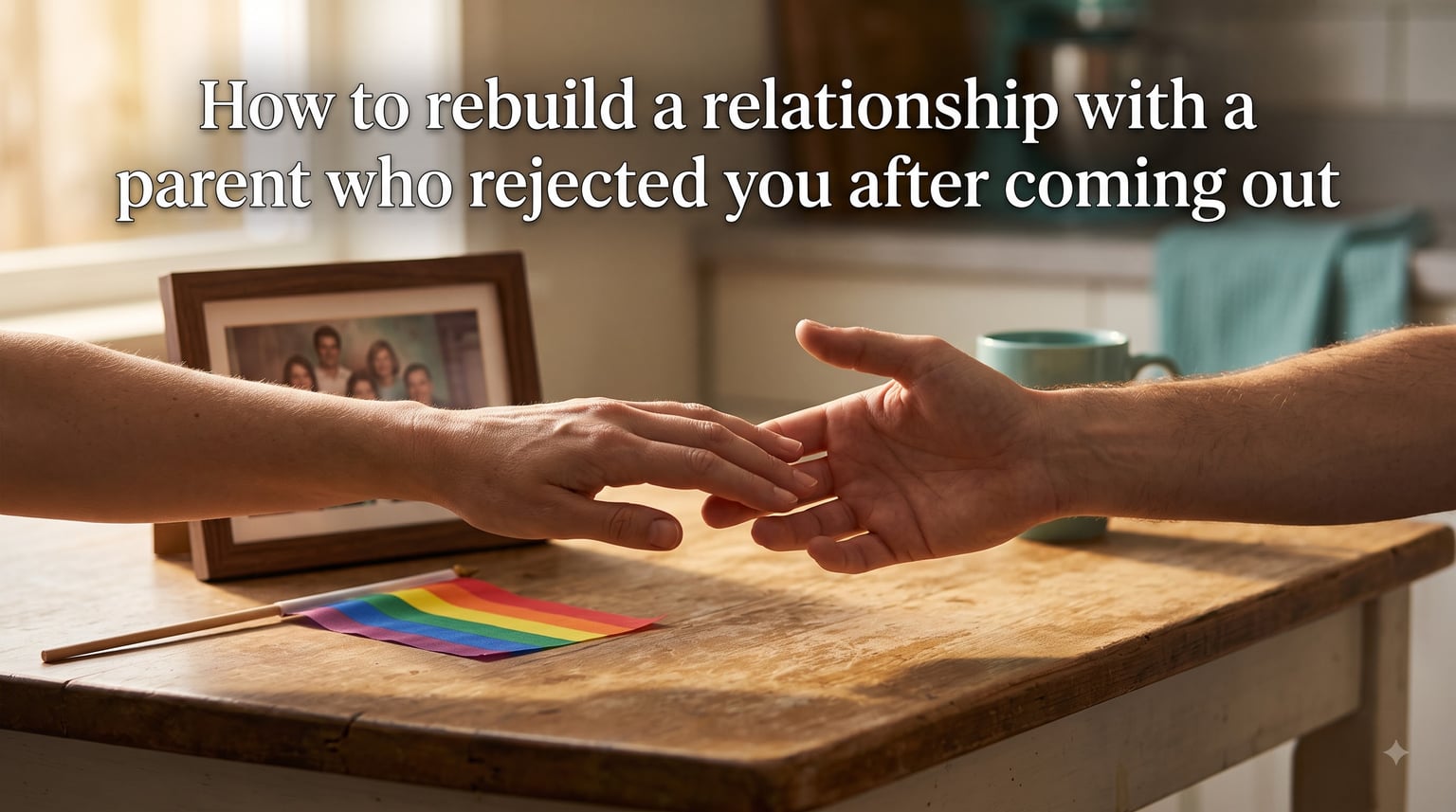
Coming out takes courage. Having a parent reject you after you have shared something that deeply personal is a kind of grief that most people around you may never fully understand. If you are reading this, you have probably been carrying that weight for weeks, months, or even years, and you are wondering whether there is a path back to something that resembles a relationship.
You are not alone in this experience. Research from the Family Acceptance Project at San Francisco State University found that LGBTQ+ young people who experience high levels of family rejection face significantly higher rates of depression, anxiety, and suicidal ideation compared to those whose families accept them. The numbers tell a story that many of us already know in our bones: family rejection after coming out is not just a difficult conversation. It is a life-altering event.
This guide walks through how to rebuild a relationship with a parent who rejected you after coming out, step by step. But just as importantly, it covers when reconciliation might not be the right path, how to protect yourself emotionally along the way, and how to build the support system you deserve regardless of the outcome.
Table of Contents
Understanding What Happens When a Parent Rejects You
Rejection from a parent after coming out is not a single event. It is an ongoing emotional reality that can reshape how you see yourself, your family, and your place in the world. Before you can think about rebuilding a relationship, it helps to understand what is actually happening inside you.
What many people describe as the wound of rejection in a relationship is really a combination of grief, broken attachment, and identity shock. You are mourning the parent you thought you had. You are processing the loss of a future where your family knew and loved the real you. And you may be questioning whether something fundamental about you is the problem.
It is not. Let me say that clearly: there is nothing broken about being who you are.
The clinical term for what many LGBTQ+ people experience here is minority stress. Dr. Ilan Meyer’s minority stress theory describes how chronic rejection, discrimination, and concealment of identity create persistent psychological pressure that builds over time. This is not just sadness or disappointment. It is a physiological stress response that can affect sleep, concentration, appetite, and your ability to trust others.
Rejection trauma can show up as hypervigilance in relationships, difficulty accepting love, or a reflexive expectation that people will leave once they know the real you. A study published in the journal Child Development found that LGBTQ+ adults who experienced family rejection were more than eight times more likely to report a suicide attempt and nearly six times more likely to report high levels of depression than those who experienced little or no rejection.
Understanding these responses matters because it reframes what you are going through. You are not overreacting. Your body and mind are responding to a real and significant loss, and that loss deserves to be processed before you decide what to do next.
Assess Where You Are Before Reaching Out
One of the biggest mistakes people make when trying to rebuild a relationship with a parent who rejected them after coming out is rushing toward reconciliation before they have done their own emotional work. The desire to fix things is natural, especially when the rejection comes from someone you love. But reaching out from a place of raw desperation rarely leads to the conversation you actually want.
Take some time to sit with these questions. You do not need perfect answers, just honesty with yourself.
What do I actually want from this relationship? Are you hoping for full acceptance, basic respect, or just enough peace to attend family gatherings without dread? Naming your goal matters. If you want unconditional love and your parent is capable of only grudging tolerance, that gap will keep hurting you unless you see it clearly.
Am I emotionally stable enough to handle another rejection? If your parent responds with the same rejection or something worse, can you absorb that blow without it destabilizing you? If the honest answer is no, that is valid information. It may mean waiting, building more support first, or working with a therapist before reaching out.
Am I trying to reconcile for me, or for someone else? Sometimes the pressure comes from siblings, extended family, or a partner who wants harmony. Other times it comes from a cultural or religious expectation that family bonds must always be preserved. Reconciliation driven by guilt or external pressure tends to produce fragile, resentful relationships.
What has changed since the rejection? Has your parent shown any signs of softening? Have they asked about you, expressed regret, or sought their own education? Or has there been silence? The landscape may have shifted, but you will not know unless you look at it honestly.
What are my non-negotiables? List the things you need to feel safe and respected in a relationship with this parent. That might include using your correct name and pronouns, not making derogatory comments about your identity, and not asking you to hide who you are around extended family. These are not unreasonable demands. They are the minimum terms for a healthy relationship.
How to Rebuild a Relationship With a Parent Who Rejected You After Coming Out: Step-by-Step
Here is the step-by-step approach to reconnection that our team has seen work, drawn from clinical literature, the experiences of LGBTQ+ community members, and family therapy research.
Step 1: Start with a low-stakes opening. Rather than launching into a heavy emotional conversation, test the waters. Send a brief message, a card on a holiday, or a photo of something neutral you both might enjoy. The goal is simply to establish that a channel of communication exists without demanding an immediate response.
Step 2: Name your intentions clearly. When you are ready for a more direct conversation, say something simple and honest. You might try: “I have been thinking about our relationship, and I would like to try reconnecting. I am not expecting everything to be fixed. I just want to see if there is a way forward.” Clarity reduces anxiety on both sides.
Step 3: Choose the right format. A face-to-face meeting may feel too intense for a first real conversation. A phone call or a letter gives both of you time to process. There is no wrong choice here. Pick the format that feels safest for you.
Step 4: Let your parent set some of the pace. You cannot control how fast they come around, if they do at all. Give them space to respond, ask questions, or sit with what you have shared. Some parents need time to move through their own reactions, especially if their rejection was rooted in fear, misinformation, or beliefs they have held for decades.
Step 5: Address the rejection directly, but on your terms. At some point, the elephant in the room needs to be acknowledged. You might say: “When you reacted the way you did after I came out, it hurt me deeply. I am willing to work on our relationship, but I need to know that you understand how much that hurt mattered.” You are not asking for a groveling apology. You are asking for acknowledgment.
Step 6: Provide resources if your parent is open to them. Organizations like PFLAG (formerly Parents, Families and Friends of Lesbians and Gays) offer support groups specifically for parents of LGBTQ+ people. Some parents are more willing to learn from peers than from their own children. Offering these resources can shift the dynamic from confrontation to collaboration.
Step 7: Accept progress in increments. Reconciliation is rarely a clean before-and-after story. It looks like two steps forward, one step back, a confusing sideways shuffle, and then maybe a real conversation. Celebrate small moments of connection without pretending they erase the hurt. A parent who uses your correct name for the first time has taken a real step, even if they still have a long way to go.
Step 8: Check in with yourself regularly. After each interaction, take a moment to assess how you feel. Did this conversation leave you feeling lighter or heavier? Did your parent respect the boundaries you set? Your emotional data is the most reliable compass you have.
Setting Boundaries That Protect Your Wellbeing
Boundaries are not walls. They are the terms under which you are willing to be in a relationship with someone. When you are rebuilding a relationship with a parent who rejected you after coming out, boundaries are what keep the process from damaging you further.
One of the most common and complicated situations LGBTQ+ people face is partial acceptance. This is when a parent says something like, “I love you no matter what,” but then refuses to use your pronouns, asks you not to bring your partner to family events, or makes passive-aggressive comments about your lifestyle. Partial acceptance can be more emotionally exhausting than outright rejection because it asks you to be grateful for crumbs while starving.
Here is how to handle it. First, name the specific behavior you need to change. Vagueness invites denial. Instead of “You need to be more accepting,” try: “I need you to use my correct name when we are together. If that does not happen, I will need to step back from our conversations.” That is a clear boundary with a stated consequence.
Second, follow through. A boundary without a consequence is just a wish. If you say you will leave the room when your parent makes derogatory comments, leave the room. Every single time. Consistency is what teaches people that your boundaries are real.
Third, distinguish between what is your responsibility and what is theirs. You are not responsible for your parent’s emotional journey. You cannot do their unlearning for them, and you cannot make them accept you through sheer force of love. What you can do is decide what level of involvement feels healthy for you and adjust as needed.
Finally, remember that boundaries can change over time. As a relationship improves, you may relax certain boundaries. If things deteriorate, you can tighten them again. Boundaries are not permanent verdicts. They are living agreements between you and your own wellbeing.
When Reconciliation May Not Be the Right Choice
This is the section most guides skip, and it may be the most important one you read.
Not every relationship can or should be repaired. Sometimes the healthiest thing you can do is accept that the relationship you want is not available from this particular person, at least not right now. That does not make you a failure. It makes you someone who values their own safety and dignity.
Here are some signs that reconciliation may not be safe or worth pursuing:
The rejection includes ongoing abuse. If your parent is verbally abusive, physically threatening, or uses your identity as a weapon against you, reconciliation is not the goal. Safety is. This includes emotional abuse like gaslighting, where they deny that the rejection ever happened or insist you are overreacting.
Nothing has changed. If months or years have passed and your parent shows zero interest in understanding your experience, has made no effort to educate themselves, and still treats your identity as a problem to be solved, you may be dealing with a fixed position rather than a temporary reaction.
The relationship is conditional on you hiding yourself. Some parents offer a version of reconciliation that comes with strings attached: do not talk about your relationship, do not bring your partner around, act straight at family gatherings. This is not reconciliation. It is emotional blackmail, and accepting it long-term can do serious psychological damage.
Your mental health is deteriorating. If every interaction with your parent leaves you spiraling into anxiety, depression, or self-doubt, your body is telling you something. Listen to it. No relationship is worth sacrificing your mental health for.
There is no acknowledgment of harm. A parent who cannot or will not acknowledge that their rejection caused you real pain is not ready for a genuine relationship. Reconciliation without acknowledgment is just performing normalcy for an audience of one.
If any of these signs resonate with you, consider speaking with an LGBTQ+-affirming therapist before making a decision. They can help you weigh whether continued contact is serving you or harming you, and they can support you through the grief of letting go if that is what you choose.
Choosing not to reconcile is not giving up. Sometimes it is the bravest possible act of self-love.
Cultural and Religious Factors in Family Rejection
For many LGBTQ+ people, family rejection is deeply intertwined with cultural traditions and religious beliefs. This layer of complexity deserves its own attention because it changes both the stakes and the strategies.
In many cultures, family identity is collective rather than individual. Coming out does not just affect your relationship with your parents. It can ripple through extended family networks, community standing, and even safety. A parent’s rejection may be rooted in genuine fear about what your identity means for the whole family within a tight-knit community.
Religious frameworks add another dimension. If your parent believes that your identity conflicts with their faith, they may experience your coming out as a spiritual crisis. This does not excuse rejection, but understanding the source can help you approach the conversation with more strategic empathy.
Organizations like Keshet (for Jewish LGBTQ+ individuals), Muslims for Progressive Values, the Q Christian Fellowship, and DignityUSA (for Catholic LGBTQ+ individuals) offer resources that bridge faith and LGBTQ+ identity. Sharing these with a parent who is struggling with the perceived conflict between their beliefs and their love for you can sometimes open a door that arguments cannot.
That said, cultural and religious barriers can also be immovable. If your parent’s community or belief system actively prohibits acceptance, you may be asking them to choose between you and everything they know. Some parents make that choice. Many cannot, or not quickly enough to meet your needs. Holding space for that complexity, while still protecting yourself, is one of the hardest balances to strike.
Building Your Chosen Family While You Wait
Regardless of where things stand with your parent, you need and deserve a support system right now. The concept of chosen family, a community of people who love and accept you unconditionally by choice rather than obligation, has been a lifeline for LGBTQ+ people for generations.
Chosen family is not a consolation prize for a failed relationship with your biological family. It is a different and equally valid form of family that many LGBTQ+ people build alongside or instead of their family of origin. Research has shown that strong social support from chosen family can buffer the mental health impacts of family rejection and significantly improve outcomes for LGBTQ+ people.
You can find your people through local LGBTQ+ community centers, online communities, support groups, activism, and mutual aid networks. The Trevor Project, SAGE, and CenterLink all maintain directories of LGBTQ+-affirming resources and community spaces. If you are in crisis, the Trevor Project’s 24/7 lifeline is available at 1-866-488-7386.
Frequently Asked Questions
How to heal after rejection?
Healing after rejection starts with allowing yourself to grieve the relationship you lost without rushing to fix it. Work with an LGBTQ+-affirming therapist, lean on chosen family for support, and give yourself permission to feel anger, sadness, and confusion without guilt. Healing is not linear, and setting boundaries around how much access the rejecting person has to your emotional life is a critical part of the process.
What is the wound of rejection in a relationship?
The wound of rejection in a relationship is the deep emotional injury that occurs when someone you love and depend on refuses to accept a core part of who you are. For LGBTQ+ people rejected by a parent, this wound often manifests as attachment trauma, difficulty trusting others, and internalized shame. It is not simply sadness but a rupture in the sense of being fundamentally lovable and safe.
How to heal from parental rejection?
Healing from parental rejection involves naming the loss, processing the grief, and building a support network that affirms your identity. Research from the Family Acceptance Project shows that LGBTQ+ people with strong social support recover more fully from family rejection. Professional therapy, community connection, and setting clear boundaries with the rejecting parent all contribute to long-term healing.
What to do when parents reject my partner?
When parents reject your partner, prioritize your partner’s wellbeing and your relationship with them. Have an honest conversation with your parents about why their acceptance matters to you, set boundaries around disrespectful behavior toward your partner, and decide together how to handle family events. You are not obligated to subject your partner to a hostile environment, and choosing to protect your relationship over maintaining a hurtful family dynamic is a valid and healthy decision.
Moving Forward With or Without Reconciliation
Learning how to rebuild a relationship with a parent who rejected you after coming out is not a linear process with a guaranteed outcome. Some parents come around. Some come around partially, in ways that are both beautiful and imperfect. And some never do, and you build a full, rich life with the family you choose.
What matters most is that you make these decisions from a place of self-respect rather than desperation. You deserve relationships where you are fully seen and fully loved. Whether that includes your parent of origin is something only time, honesty, and mutual effort can reveal.
If you take one thing from this guide, let it be this: your worth is not determined by your parent’s ability to accept you. You were whole before they rejected you, and you are whole now. The work ahead, whether it leads to reconciliation or to a peaceful letting go, is about building a life that reflects that truth.
Reach out to an LGBTQ+-affirming therapist if you can. Connect with community, even if it feels awkward at first. And be gentle with yourself. You are dealing with one of the most painful relationship situations a person can face, and you are doing it while living openly and honestly. That is something to be proud of.