
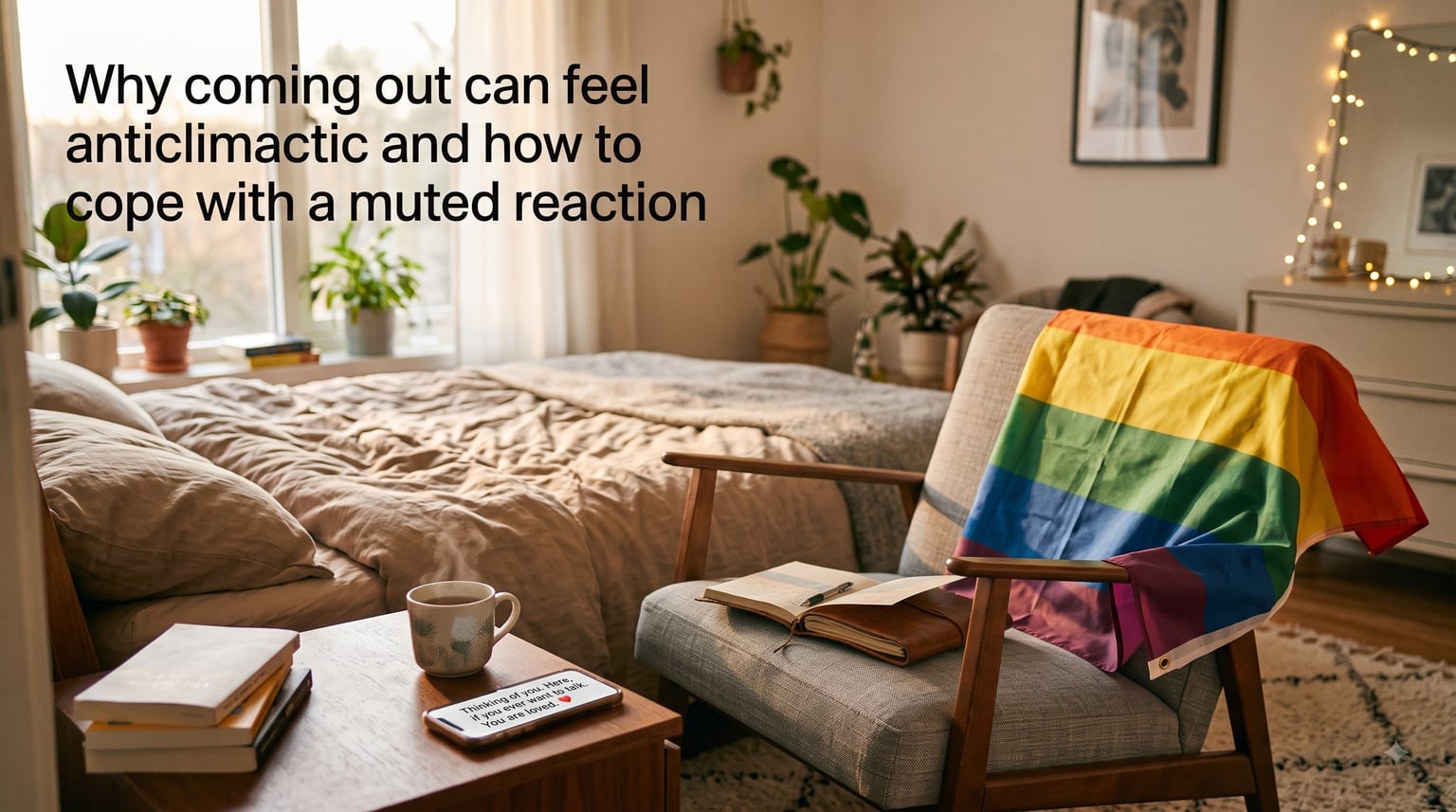
If you walked away from coming out feeling strangely empty, you are not broken and you are not alone. A coming out anticlimactic muted reaction is one of the most quietly painful experiences in LGBTQ+ life, and almost no one talks about it. You prepared for weeks, maybe years. You imagined the conversation a hundred times. Then the moment came, the person you trusted said something like “okay” or “I already knew,” and you stood there thinking, that’s it?
I have heard this story from friends, from readers, and from strangers in late-night Reddit threads. One person put it this way: “Coming out was surprisingly anticlimactic and a bit disappointing for me. Anyone else have a similar experience?” The replies poured in. People who had rehearsed speeches and got shrugs. People who expected tears and got a question about dinner. People who had been certain their family would reject them, and instead were met with a polite, almost bored, “we love you no matter what.”
It is the kind of hurt that feels strange to even name. Nothing bad happened. No one was cruel. You got what you wanted. So why does your chest hurt? This guide is for the version of you that is sitting with that exact question, the one who expected catharsis and got a quiet afternoon instead.
Table of Contents
Why Coming Out Can Feel Anticlimactic
An anticlimactic coming out happens when the reality of the moment does not match the story you built in your head. Most people imagine coming out as a scene from a movie. There is music, there are tears, there is a hug, there is a before-and-after line in your life. Real life rarely cooperates. Real people rarely cooperate. And the gap between the script and the actual moment is where the hurt lives.
The weight of the build-up
You probably spent a long time preparing for that conversation. You chose the words, picked the right moment, maybe practiced in the mirror or texted a friend a draft of what you would say. Coming out is often the most emotionally loaded thing you have ever done, and you carried that weight alone, for a long time, before anyone else even knew it was happening.
When the person on the other side responds with a quick “okay” or a calm “thanks for telling me,” it can feel like they missed the entire movie while you were the lead actor. They got the credits before you got the opening scene. Your buildup was months. Their response was six seconds.
Other people’s timelines are not yours
Coming out is not a single event for the people you tell. For you, it is the end of a long internal process. For them, it is a piece of new information they received over coffee. Their nervous system did not have years to prepare. Their face will not automatically reflect the magnitude of what it means to you.
This is one of the deepest sources of the muted reaction feeling. You are processing a decade. They are processing a sentence. That mismatch is not cruelty, but it can feel like indifference, and it can leave you oddly lonely in a room full of people who just told you they still love you.
When “I love you anyway” still feels hollow
Sometimes the muted reaction is wrapped in acceptance. Your mom says, “We love you no matter what.” Your best friend says, “Nothing changes.” On paper, this is everything you wanted. In your body, it can feel strangely deflating, like you finally jumped off the cliff and discovered the water was an inch deep.
The thing is, you were not asking to be tolerated. You were asking to be seen. Tolerance and celebration are not the same thing, and most of us only figure that out after we have come out. The flat acceptance that was supposed to feel like relief can feel like the opposite, a quiet confirmation that you are still, somehow, the version of yourself people politely work around.
The Emotional Labor of Coming Out
Before we go further into coping, we have to name something that almost nobody names. Coming out is emotional labor, real and heavy, and most of it is invisible.
You carried this for years
You spent years learning yourself, doubting yourself, hiding yourself, rehearsing explanations for yourself. You built an entire internal library of who you are and how you would defend it, all before you ever said a word out loud. That is not a small thing. That is enormous work.
They learned it in five minutes
The person you told got the highlight reel. They got the polished version, the version you spent weeks preparing. They got the final chapter of a book you have been writing since you were a kid. Of course their reaction feels small to you. You handed them a finished painting and they said “neat.”
You may still feel like you have to teach
After a muted reaction, many people feel a second wave of exhaustion: the realization that even after coming out, you may still be the one educating, explaining, softening edges for other people. This is one of the most common threads in community forums, and it is one of the most underestimated parts of the experience.
You came out hoping for a moment of relief. Instead, you got a moment, and then the slow realization that the work is not over. That is not ingratitude. That is a real emotional cost, and it deserves to be acknowledged.
Muted Reaction vs Hostile Reaction: Knowing the Difference
It helps to be honest about what kind of reaction you actually got. Not every flat response is the same thing, and lumping them together can make the healing harder.
What a muted reaction actually looks like
A muted reaction usually sounds like one of these: “I already knew.” “Cool.” “Thanks for telling me.” “So, what do you want for dinner?” “We love you.” None of these are hostile. None of these are rejections. They are simply responses that did not match the gravity of the moment for you.
Muted reactions often come from people who are overwhelmed, people who are privately processing, or people who honestly did not realize how much this meant to you. The hurt here is real, but the relationship is usually intact.
When a flat response is something more
Sometimes a flat response is masking something uglier. If the response includes silent treatment that lasts for weeks, avoidance disguised as casualness, sudden withdrawal of affection, or pressure to “go back to how things were,” that is not a muted reaction. That is avoidance, and it deserves a different response, one that probably involves setting firmer boundaries and protecting yourself.
If your safety is at risk, your first priority is not processing feelings. It is getting to a place where you are safe. Hotlines, friends, and local LGBTQ+ organizations exist for exactly this. The rest of this guide assumes you are safe and just feeling disappointed, because that is its own real grief, and it deserves its own space.
How to Cope With a Muted Reaction to Coming Out
Now the part you actually came here for. Coping with a muted reaction to coming out is not about pretending you are fine, and it is not about convincing yourself you should be grateful. It is about tending to the part of you that did not get what it needed.
Let yourself feel the disappointment
The first step is to stop arguing with your own feelings. You are allowed to feel disappointed that a moment you built up in your head did not land the way you wanted. You are allowed to feel sad that your family did not cry happy tears, or that your friend did not ask a single follow-up question, or that the conversation moved on in thirty seconds flat.
Disappointment is not ingratitude. It is information. It is telling you something mattered and did not get the response it deserved. Sit with it for a little while. Journal about it. Tell a friend who will not try to talk you out of it.
Talk to people who already get it
One of the fastest ways to recover from a muted reaction is to find someone who will match your energy. That is often another queer person who has been through their own version of this. You do not need to explain why it hurt. They will simply nod and say, “Yeah, that is the worst.”
Online communities like Reddit’s r/lgbt, r/comingout, and r/askgaybros (or whatever sub fits your specific identity) are full of these conversations. You will find people describing the exact flat response you got. You will feel less alone in minutes.
Give people time without erasing your own needs
Some people need a few days or weeks to catch up with the magnitude of what you shared. A muted reaction is not always a final verdict. People process differently, and some of them process slowly, privately, in the shower, in the car, in long conversations with a friend you will never hear about.
You can hold space for that growth while still acknowledging your own hurt. Those two things are not in conflict. You are allowed to wish someone had reacted better AND to leave the door open for them to come back to it later.
Mark the moment for yourself
If the world did not give you a moment, give yourself one. Buy yourself something small. Write yourself a letter from the version of you who was terrified before coming out, telling the after-you how proud you are. Go somewhere meaningful alone. Eat your favorite meal. Watch the movie you wanted to watch the night of, the one you did not get to because the conversation felt too heavy to follow.
This is not silly. This is how you reclaim a moment that was supposed to be yours. If no one threw you a party, throw yourself one.
Reach out to affirming resources
If you are in the US, the Trevor Project (1-866-488-7386) has a 24/7 hotline and an extensive online handbook specifically for coming out experiences. If you are in the UK, organizations like Stonewall, LGBT Foundation, and Switchboard (0330 330 0630) offer support. If you are elsewhere, a quick search for your local LGBTQ+ center will usually turn up at least one free resource within driving distance.
You do not have to be in crisis to call. You can call because you are sad. You can call because something good happened and you need someone to be loud about it with you.
Finding Validation After Coming Out
The opposite of a muted reaction is not just a louder reaction. It is the slow, ongoing experience of being in rooms where your identity is not a headline. It is being around people who do not need you to explain yourself because they already get it.
Affirming spaces and community
Look for LGBTQ+ community groups in your city, your campus, your workplace if it has one, or online. Pride centers, queer book clubs, gaming servers, hiking groups, board game nights. Whatever you are into, there is almost certainly a queer version of it. The first one you try might not click. Try another.
Therapy that specializes in LGBTQ+ identity
If the post-coming out emotional low is sticking around for weeks or months, therapy with someone who specializes in LGBTQ+ identity work can help. This is not because something is wrong with you. It is because identity integration is real psychological work, and having someone trained to walk through it with you is genuinely useful.
Directories like Psychology Today’s LGBTQ+ filter, the Gay and Lesbian Medical Association provider list, or your local LGBTQ+ center can usually point you to affirming therapists in your area.
Online communities that get it
If in-person community feels like too much right now, online is fine. Subreddits, Discord servers, Tumblr, Instagram, TikTok. There is a whole internet of people who have been exactly where you are and who will tell you, with zero hesitation, that the flat reaction was not a reflection of your worth.
When Reactions Change Over Time
One last thing worth holding onto. Many muted reactions are not final verdicts. They are first drafts.
People grow into acceptance
Some people need time, distance, and quiet to find their way into real acceptance rather than immediate, surface-level tolerance. The parent who said “okay” and changed the subject three months ago might be the same parent who quietly shows up at Pride this year wearing a t-shirt you gave them.
Growth is slow and weird and rarely announces itself. Do not assume the first reaction is the last one.
Some need time to process their own feelings
Your coming out can also be a small grief for the people who love you. They might be mourning an image of you they held for years, even as they accept who you actually are. That is their work to do, but knowing it can help you read their early flatness with a little more compassion, and a little less self-blame.
You do not have to wait for them to finish. You are allowed to live your life in full color while they catch up.
FAQs
Why do I feel worse after coming out?
Feeling worse after coming out is a common experience that often comes from a gap between your internal buildup and the actual response you got. If the reaction felt muted, your nervous system may still be looking for the validation it prepared for, and the absence of that moment can leave you feeling flat, disappointed, or strangely low.
Is it normal to feel sad after coming out?
Yes. Even when coming out goes well, many people feel sad afterward. You have just finished a long, emotionally loaded process, and the people you told often respond in ways that do not match the magnitude of what you shared. That gap is real, and the sadness it creates is a normal response, not a sign that something is wrong with you.
How do you deal with a nonchalant reaction to coming out?
Deal with a nonchalant reaction by first allowing yourself to feel disappointed, then reaching out to people who already understand your experience, like other LGBTQ+ friends or affirming communities. Give the person some time to process, but also be honest with yourself about whether their response was simply muted or whether it crossed into avoidance or silent treatment.
What to do after coming out when no one reacts?
If no one reacts after you come out, give yourself the moment you did not get. Mark it privately, talk to someone who already gets it, and seek out affirming spaces like the Trevor Project, local LGBTQ+ centers, or online communities. Your worth was never going to be decided by someone else’s reaction, but it is also fair to admit that a flat response hurts, and that hurt deserves care.
Moving Forward After a Muted Reaction
If your coming out was anticlimactic and left you feeling unseen, here is the truth I want you to take with you. The flat response you got is not the end of the story. It is the first draft of someone else’s reaction to a piece of news they are still catching up to. Your identity is not smaller because someone else reacted to it small. Your courage is not less real because no one clapped.
What you did took nerve. What you did took years. What you did is the reason future you gets to walk into rooms already known, already yourself, already home. That is not nothing. That is everything, even when it felt, in the moment, like nothing at all.
If you take one thing from this guide, let it be permission. Permission to feel disappointed. Permission to ask for the reaction you wanted, even retroactively. Permission to find your people in whatever corner of the world they happen to live. Permission to be loudly, obviously, unapologetically yourself, even if the first person you told did not know how to be loud about it with you.
You came out. You did the brave thing. The rest, including the part where someone finally reacts the way you needed, is coming. I promise it is coming.