
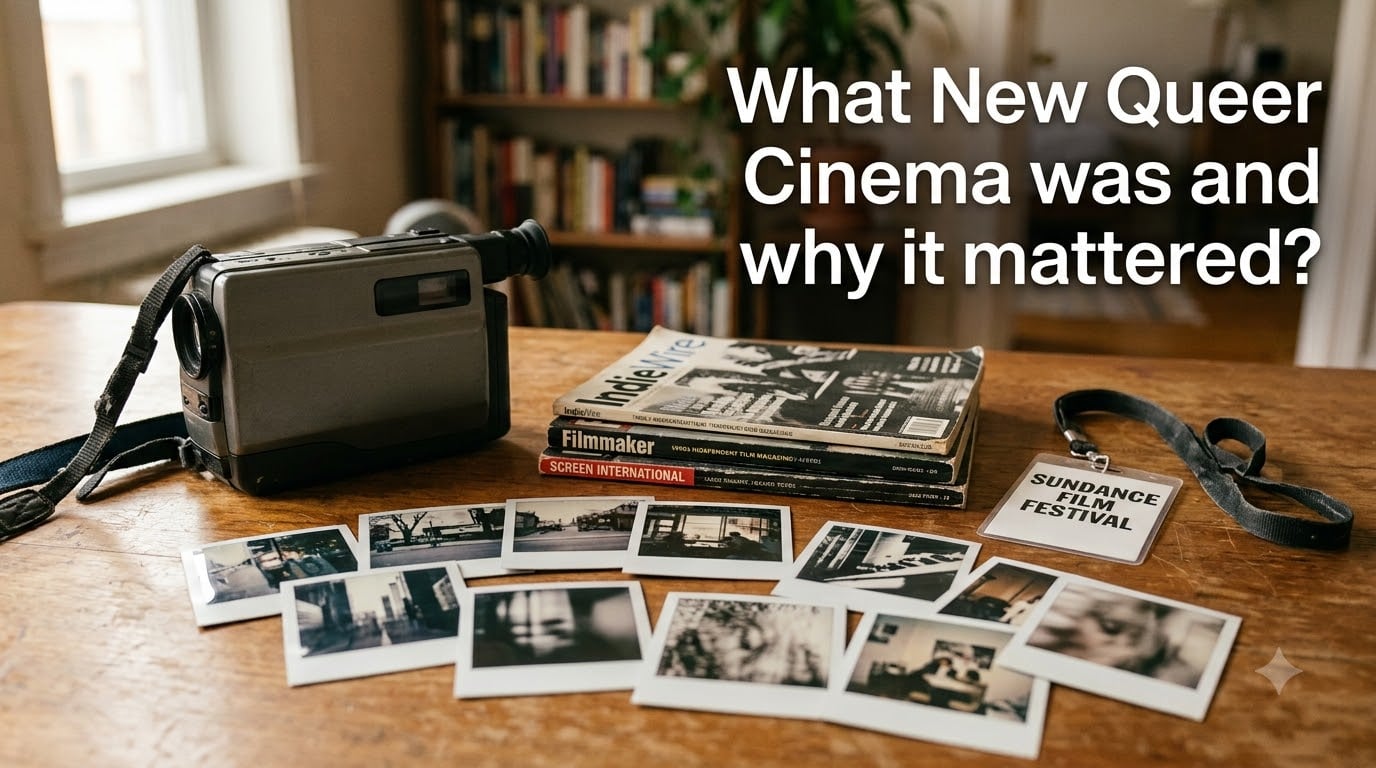
New Queer Cinema is a term coined by critic B. Ruby Rich in 1992 to describe a movement in queer-themed independent filmmaking that erupted in the early 1990s. In the pages of Sight and Sound, Rich named a wave of low-budget, politically urgent films that refused to apologize for their sexuality and refused to play by Hollywood’s rules.
I first came across the movement while researching a piece on independent film history, and the more I watched, the clearer its importance became. These were films made in living rooms, on camcorders, and at the height of the AIDS crisis, when being visible could be a radical act. This guide explains what New Queer Cinema was, where it came from, and why it still shapes how queer stories get told on screen.
Table of Contents
Where Did New Queer Cinema Begin?
New Queer Cinema began in the late 1980s and early 1990s, in the shadow of the AIDS crisis and a conservative political climate that treated queer lives as disposable. Reagan-era silence, the slow government response to HIV, and escalating hate crimes created a generation of filmmakers who felt they had to document, mourn, and fight back through their work.
The cultural ground had shifted by the late 1980s. AIDS activism groups like ACT UP had shown what direct confrontation could accomplish, and queer theorists were reclaiming the word “queer” as a badge of resistance rather than a slur. Independent film had also become cheaper and more accessible. Affordable digital video and camcorder technology meant filmmakers no longer needed studio backing to tell their own stories.
By 1991 and 1992, a recognizable cluster of films started appearing at festivals like Sundance, Toronto, and the New York Film Festival. Critics noticed a shared sensibility across these projects: a refusal to closet characters, a willingness to mix documentary and fiction, and a confrontational tone that treated queer desire as ordinary rather than tragic. That shared sensibility was about to get a name.
Who Coined the Term New Queer Cinema?
The term New Queer Cinema was coined by B. Ruby Rich, a film critic and academic, in her spring 1992 essay for Sight and Sound magazine. Rich later expanded her thinking in the 1994 special issue of the journal Camera Obscura and in the 1997 essay collection “Queer Cinema: The Director’s Cut.”
Rich did not invent the films themselves. She recognized a pattern that filmmakers were already producing. Her writing gave critics, scholars, and eventually the industry a vocabulary to talk about a movement that had no marketing budget and no studio publicist behind it. Naming the movement made it easier to teach, easier to program at festivals, and easier to defend when mainstream outlets dismissed the work as niche or unwatchable.
The word “queer” was deliberate. Earlier movements like New German Cinema had borrowed their names from national film waves, but “queer” did something different. It was reclaimed language, intentionally provocative, and it signaled that the filmmakers were not asking for acceptance on straight terms. They were insisting on their own terms.
What Defined the Movement Aesthetically?
New Queer Cinema was defined aesthetically by its DIY ethos, its embrace of camcorder technology, and its willingness to mix genres and break narrative conventions. Where Hollywood queer films of the era often ended in tragedy or assimilation, these films often refused closure, defied genre expectations, and put unapologetic sexuality front and center.
Three stylistic traits show up again and again in the movement’s films:
Camcorder realism: Handheld digital video gave the films an immediate, sometimes raw look that contrasted with polished studio pictures. The visible limitations of the format became a feature, not a bug.
Genre subversion: Filmmakers twisted familiar forms like the road movie, the teen picture, the romance, and the historical drama to question the assumptions those forms carried.
Documentary impulse: Many works blurred the line between fiction and documentary, treating real communities, real grief, and real activism as inseparable from storytelling.
Low budgets were the rule, not the exception. Some of the movement’s most important films were made for tens of thousands of dollars, shot on weekends, and finished in basements. That scarcity forced creativity. It also meant the filmmakers owed nothing to investors and could take political risks that studios would never approve.
Key Films of the New Queer Cinema Movement
The key films of the New Queer Cinema movement span documentary, narrative fiction, and hybrid forms, all sharing a willingness to put queer lives on screen without apology. Six films in particular define the era and still shape how queer cinema gets discussed today.
Paris is Burning (1990, dir. Jennie Livingston). This documentary captured the New York ball culture scene of the late 1980s, following houses, categories, and voguing as sites of community, creativity, and survival. It introduced audiences to figures like Venus Xtravaganza and Dorian Corey and is still referenced in discussions of race, gender, and class within queer culture.
Poison (1991, dir. Todd Haynes). Todd Haynes’s first feature won the Sundance Grand Jury Prize and helped ignite the whole movement. The film weaves three interlocking stories, including a fictionalized account of a child murderer, and treats queerness as something inseparable from shame, desire, and the body politic.
The Watermelon Woman (1996, dir. Cheryl Dunye). Often cited as the first feature film directed by a Black lesbian, Cheryl Dunye’s mockumentary follows a video store clerk researching a forgotten 1930s actress. The film is funny, rigorous, and quietly radical in the way it insists on Black queer history as a legitimate field of inquiry.
Totally F***ed Up (1993, dir. Gregg Araki). Part of Gregg Araki’s “Teen Apocalypse Trilogy,” this film followed a group of young queer men in Los Angeles as they searched for love, friendship, and meaning in a world that seemed determined to ignore them. Its fragmented, confessional style influenced a generation of indie filmmakers.
My Own Private Idaho (1991, dir. Gus Van Sant). Although Van Sant’s work spanned both studio and independent projects, this road movie starring River Phoenix and Keanu Reeves brought New Queer Cinema aesthetics into wider circulation. The film mixed Shakespearean structure with street-level realism and made the movement visible to audiences who had never seen a Sundance program.
Edward II (1991, dir. Derek Jarman). British filmmaker Derek Jarman reimagined Christopher Marlowe’s Elizabethan tragedy as an angry, queer love story set against police raids, tabloid vilification, and the emerging AIDS crisis. Jarman’s punk sensibility made clear that New Queer Cinema was an international phenomenon, not just an American one.
The Living End (1992, dir. Gregg Araki). Araki’s road movie about two HIV-positive men on the run announced the movement’s confrontational politics. The film was banned from several television outlets because of its content, which only amplified its reputation among independent film fans.
Directors Who Shaped the Movement
The directors who shaped New Queer Cinema brought different backgrounds and aesthetics to the movement, but shared a willingness to take risks that studios would not. Their combined work defines what people mean when they talk about the wave.
Gregg Araki became known for his Teen Apocalypse Trilogy, including Totally F***ed Up, The Living End, and The Doom Generation. His films mixed Gen X detachment with punk provocation and made queerness feel urgent, angry, and contemporary.
Todd Haynes started with Poison and went on to make Safe, Velvet Goldmine, and eventually Carol and May December. He brought a high-concept, formally inventive approach to queer storytelling that influenced art-house cinema for decades.
Jennie Livingston directed Paris is Burning, the documentary that introduced ball culture to mainstream audiences and remains essential viewing on race, gender performance, and queer community.
Isaac Julien made Looking for Langston (1989) and Young Soul Rebels (1991), both rooted in Black queer history and aesthetics. His work showed that New Queer Cinema was as much about reclaiming lost histories as it was about inventing new forms.
Derek Jarman brought decades of British avant-garde experience to Edward II, The Garden, and Wittgenstein. His openly political, often angry films connected New Queer Cinema to an older queer experimental tradition.
Cheryl Dunye emerged with The Watermelon Woman and a body of short films that insisted on Black lesbian representation as central, not peripheral. Her work expanded the conversation around who counted as a queer filmmaker.
Together, these directors proved that queer filmmaking could be rigorous, formally adventurous, and historically engaged. They also opened doors for the filmmakers who followed.
Why New Queer Cinema Mattered
New Queer Cinema mattered because it gave queer audiences the first sustained body of films that refused to treat their lives as pathology, tragedy, or background detail. Before the movement, queer characters on screen usually died, disappeared, or were punished for who they were. These films offered something different, even when their stories were painful.
The AIDS crisis made the stakes brutally clear. Filmmakers like Derek Jarman, Todd Haynes, and Marlon Riggs (whose 1989 documentary Tongues Untied was a movement precursor) were responding to friends and lovers getting sick while governments looked away. Cinema was one of the few tools available to document what was happening and to insist that queer lives were worth mourning.
The movement also mattered because it made room at the center of queer storytelling for people who had been pushed to the margins. Paris is Burning centered Black and Latino trans women. The Watermelon Woman centered a Black lesbian protagonist. Looking for Langston centered Black gay desire. New Queer Cinema did not solve the problem of representation, but it expanded who could appear on screen and who could tell the story.
There is also a political dimension that often gets overlooked. New Queer Cinema emerged at a moment when mainstream gay politics was increasingly focused on assimilation, marriage, and military service. The movement pushed back, arguing that queer people should not have to disappear into straight institutions to be accepted. That tension between assimilation and radical difference is still alive in queer culture today.
The Legacy and Lasting Influence
The legacy of New Queer Cinema is visible in nearly every corner of contemporary queer media. The independent film festivals that once launched the movement still program new queer work, and many of the directors associated with the wave are now household names, including Todd Haynes and Gus Van Sant.
Streaming platforms have changed how queer stories get funded and distributed, but the influence runs deep. Films like Moonlight, Portrait of a Lady on Fire, and Tangerine all carry visible traces of the movement’s aesthetic and political choices. So do television shows like Pose, which explicitly revived ball culture for a new generation.
The movement also shaped how queer film history gets taught. Courses on queer cinema, queer theory, and media studies almost always include Rich’s essays and at least one of the canonical films. That academic anchoring gave the movement staying power beyond any single moment of cultural attention.
What might be most important, though, is the permission the movement gave to later filmmakers. Watching a 1991 Todd Haynes film or a 1993 Gregg Araki film, you can feel a generation of artists saying, “You can do this too.” That permission echoes in queer cinema from 2026, even when the budgets are bigger and the cameras are sharper.
FAQs
What is New Queer Cinema?
New Queer Cinema is a term coined by critic B. Ruby Rich in 1992 to describe a movement in queer-themed independent filmmaking that emerged in the early 1990s. The movement is characterized by its unapologetic queer representation, experimental aesthetics, DIY production methods, and direct response to the AIDS crisis.
What films are associated with New Queer Cinema?
Key films include Paris is Burning (1990), Poison (1991), My Own Private Idaho (1991), Edward II (1991), The Living End (1992), Totally F***ed Up (1993), and The Watermelon Woman (1996). These films range from documentary to fiction and helped define the movement’s aesthetic and political priorities.
Who coined the term New Queer Cinema?
Film critic and academic B. Ruby Rich coined the term New Queer Cinema in her spring 1992 essay for Sight and Sound magazine. She expanded on the idea in the 1994 Camera Obscura special issue and in the 1997 collection Queer Cinema: The Director’s Cut.
When did New Queer Cinema start?
New Queer Cinema began in the late 1980s and early 1990s, with the cluster of films that defined the movement appearing at festivals between roughly 1990 and 1993. The term itself was coined in 1992 and quickly became the standard label for the wave.
What is the legacy of New Queer Cinema?
The legacy of New Queer Cinema includes the integration of queer filmmakers into the art-house mainstream, the persistence of the movement’s films in academic curricula, and the continued influence of its aesthetics and politics on contemporary queer cinema and television. It also established a template for treating queer lives as worthy of serious, sustained cinematic attention.
Final Thoughts on a Transformative Movement
New Queer Cinema was a short, sharp moment in film history that changed what queer stories could look like on screen. Between roughly 1990 and 1996, a small group of filmmakers made work that refused assimilation, refused shame, and insisted on queer lives as worthy of art. Critics like B. Ruby Rich gave that work a name, festivals gave it a platform, and queer audiences around the world gave it a future.
Watching these films today, you can still feel the urgency. The cameras are cheap, the lighting is uneven, and the budgets are almost invisible, but the filmmakers are saying something that mainstream cinema would not say for another twenty years. That is why New Queer Cinema mattered, and that is why it still matters in 2026.