
If you just watched the Passages 2023 film ending and feel confused about what happens to Tomas, you’re not alone. I watched this Ira Sachs drama twice before I felt confident breaking down the final scenes.
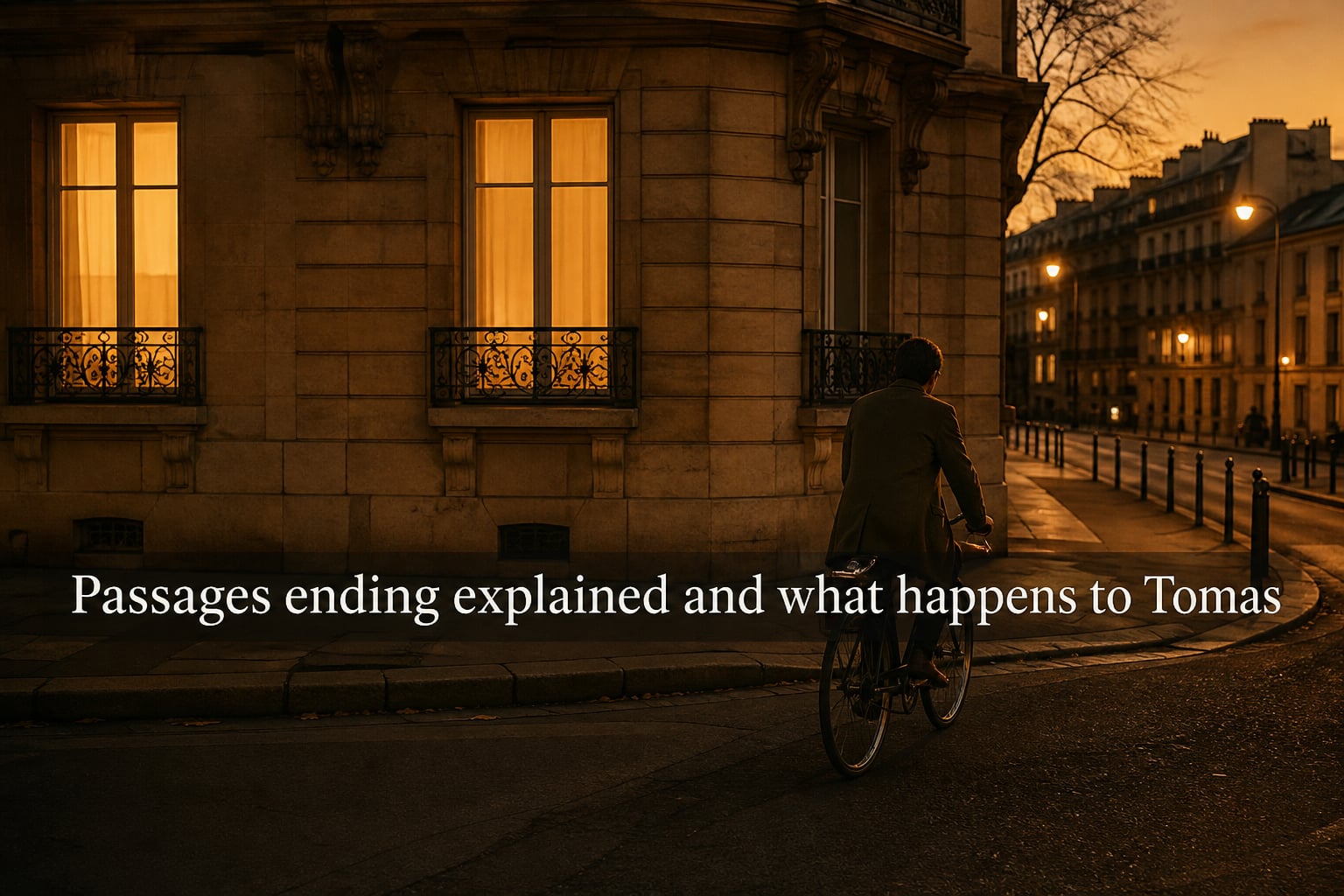
Here is the short answer: at the end of Passages, Tomas ends up completely alone. He loses both Martin and Agathe after his relentless selfishness destroys both relationships. The film closes with Tomas riding his bicycle through Paris, a quiet image that suggests nothing has really changed.
In this breakdown, I’ll walk through the full Passages ending, explain what the bicycle scene symbolizes, and tackle the question Reddit users keep debating: does Tomas actually learn anything from the chaos he creates?
Table of Contents
What Is Passages About?
Passages is a 2023 romantic drama directed by Ira Sachs and starring Franz Rogowski, Ben Whishaw, and Adele Exarchopoulos. The film follows Tomas, a German filmmaker living in Paris, whose impulsive one-night stand with Agathe, a French schoolteacher, sets off a chain reaction that destroys his 10-year relationship with Martin.
Ira Sachs co-wrote the screenplay with Mauricio Zacharias, and the film premiered at the Sundance Film Festival in January 2023 before its theatrical run through MUBI. Sachs has described it as a love triangle story, but at its core, it is a character study of a man who cannot stop consuming people.
The cast anchors everything. Franz Rogowski plays Tomas with a fidgety, hungry energy that makes his charm and cruelty feel inseparable. Ben Whishaw brings quiet devastation as Martin, and Adele Exarchopoulos plays Agathe with a softness that slowly hardens.
Passages Ending Explained: What Happens to Tomas
Tomas ends up alone. That is the final outcome of the Passages 2023 ending, and it is delivered without sentimentality or redemption. After months of bouncing between Martin and Agathe, alternating between declarations of love and cold dismissals, Tomas drives both partners away for good.
The final act unfolds in stages. First, Tomas marries Agathe in a small civil ceremony, then immediately picks up a stranger at the reception. This is the moment the relationship fractures beyond repair. Agathe confronts him, and Tomas responds with the same hollow charm that has worked on everyone until now. Only this time, it does not work.
Martin, meanwhile, has found his own quiet strength. He begins a relationship with a younger man and starts writing again. When Tomas returns to Martin one final time, asking to come back, Martin simply says no. There is no screaming match, no dramatic door slam. Martin has simply moved on.
Tomas is left with nothing. The marriage is over. Martin has closed the door. And in the final moments of Passages, Tomas walks out of his apartment, gets on his bicycle, and rides through the streets of Paris alone.
I found this ending striking because it refuses to punish Tomas with violence or melodrama. There is no car crash, no last-minute confession. He simply loses everything because he treated love like a possession rather than a partnership.
The Final Bicycle Scene and What It Means
The closing image of Tomas riding his bicycle through Paris is one of the most discussed elements of Passages. There is no dialogue, no destination, just movement.
Many viewers interpret this as a sign of freedom. Tomas is finally unburdened, no longer tied to either partner, free to start fresh. I think that reading is too generous. Sachs frames the bicycle ride as a continuation, not a transformation. Tomas is doing the same thing he has done the entire film, cycling between desires, never stopping long enough to actually face himself.
Reddit threads on r/TrueFilm echo this take. One user described the bicycle as a symbol of Tomas’s compulsive pattern: always moving, never arriving. The fact that the camera follows him but never shows where he is going reinforces the sense that his future is just more of the same.
For me, the bicycle scene is the film’s quiet verdict. Tomas survives, but he does not grow. He is still the same man who walked into the film, only now without the two people who saw something in him worth loving.
Agathe’s Abortion and Why It Matters
One of the most debated subplots in Passages is Agathe’s decision to have an abortion. Tomas finds out about the pregnancy and tells Agathe he supports whatever she chooses. He also tells her he does not want the child, but framed it as her decision.
Agathe chooses to terminate the pregnancy, and the scene is played with clinical precision. No melodrama, no music swelling underneath. Just a quiet procedure and a quiet aftermath.
Why does this matter for the ending? Because it reveals the asymmetry of Tomas and Agathe’s relationship. Tomas treats the pregnancy as an inconvenience, something to be discussed and dismissed. Agathe carries the physical and emotional weight alone.
The abortion also marks the moment Agathe stops romanticizing Tomas. She begins to see that his charm is a shield, and underneath it is a man who refuses to take responsibility for anything. By the end of the film, she is the one who ends the marriage, not Tomas.
Does Tomas Learn Anything?
This is the question that divides Passages viewers, and I have spent real time thinking about it.
The short answer is no. Tomas does not learn anything from the destruction he causes. He does not apologize in any meaningful way. He does not reckon with the harm he has done. He simply continues, which is exactly what the bicycle ending suggests.
Forum discussions frame Tomas as a “sexually fluid narcissist,” and that label fits uncomfortably well. He is not evil. He is charismatic, talented, and capable of real tenderness in bursts. But every relationship he enters becomes a mirror for himself. Martin and Agathe are not partners to him. They are audiences.
Ira Sachs has said in interviews that he wanted to make a film about a person who is impossible to love fully and who makes love impossible for others. Tomas is that person. The ending is not hopeful or tragic. It is simply honest.
Critical Reception and Awards
Passages was widely praised by critics. It holds a 94% critics score on Rotten Tomatoes, and Roger Ebert’s review gave it 3.5 out of 4 stars, calling it a “human-scaled drama” powered by Rogowski’s extraordinary performance.
The film premiered at Sundance in January 2023 and screened at the Berlin International Film Festival, where it won the Teddy Award for Best LGBTQ-themed film. It also received strong reviews at Cannes and was named one of the best films of 2023 by several major outlets.
For viewers wondering whether the film’s difficult subject matter is worth sitting with, the critical consensus is clear: yes. The performances, especially Rogowski’s, anchor the story even when the protagonist is unlikable.
Frequently Asked Questions
What happens at the end of the 2023 film Passages?
At the end of Passages, Tomas ends up completely alone. He loses both Martin and Agathe after his manipulative behavior destroys both relationships. The final scene shows Tomas riding his bicycle through Paris by himself, suggesting he has learned nothing and will continue the same destructive pattern.
What is the critical reception of the 2023 film Passages?
Passages received strong critical acclaim, holding a 94% score on Rotten Tomatoes and a 3.5/4 rating from Roger Ebert. The film won the Teddy Award at the Berlin International Film Festival for Best LGBTQ-themed film and was named one of the best films of 2023 by multiple outlets.
Is Passages worth watching?
Yes, Passages is worth watching for viewers who appreciate character-driven dramas and strong performances. Franz Rogowski’s portrayal of Tomas anchors the film, even when the character is difficult to like. The film is a thoughtful, if uncomfortable, study of narcissism and romantic destruction.
Is Passages appropriate for children?
No, Passages is not appropriate for children. The film earned an NC-17 rating in the United States due to explicit sexual content. It contains graphic scenes of intimacy, themes of infidelity, and an abortion subplot, making it suitable only for mature adult viewers.
Final Thoughts on the Passages Ending
The Passages 2023 film ending explained in simple terms is this: Tomas gets exactly what he earned. He wanted both Martin and Agathe on his own terms, and when he could not have that, he lost both. The bicycle ride at the end is not redemption. It is continuation.
If you have not seen Passages yet, I recommend watching it knowing that the film will not offer Tomas a lesson or a moment of clarity. The power of Passages is in what it refuses to do. It does not punish him. It does not redeem him. It simply shows what happens when a person treats love like a revolving door.
For viewers still processing the Passages ending, my suggestion is to rewatch the bicycle scene and pay attention to Tomas’s face. There is no joy there. There is no peace. There is only the same restless hunger that started the whole story.