
If you just finished watching Francis Lee’s 2020 film Ammonite and found yourself staring at the screen wondering what that final shot meant, you are not alone. The Ammonite ending explained properly requires understanding the film’s layered symbolism, the real history behind its characters, and the deliberate ambiguity that director Francis Lee chose over a tidy resolution. This guide breaks down every element of the Ammonite ending and the meaning of the final museum scene so you can understand what the film is really saying about love, legacy, and the spaces between people.
Kate Winslet stars as Mary Anning, the real-life fossil hunter who lived in Lyme Regis along England’s Jurassic Coast. Saoirse Ronan plays Charlotte Murchison, a geologist’s wife sent to convalesce under Mary’s care. What begins as a reluctant hosting arrangement becomes a quiet, intense romance, one of the most talked-about sapphic period dramas in recent years.
But the film does not hand viewers a clear happy ending. Instead it closes on an image loaded with meaning, and the interpretation of that image is what makes Ammonite linger in your mind long after the credits roll.
Table of Contents
What Happens in the Final Museum Scene
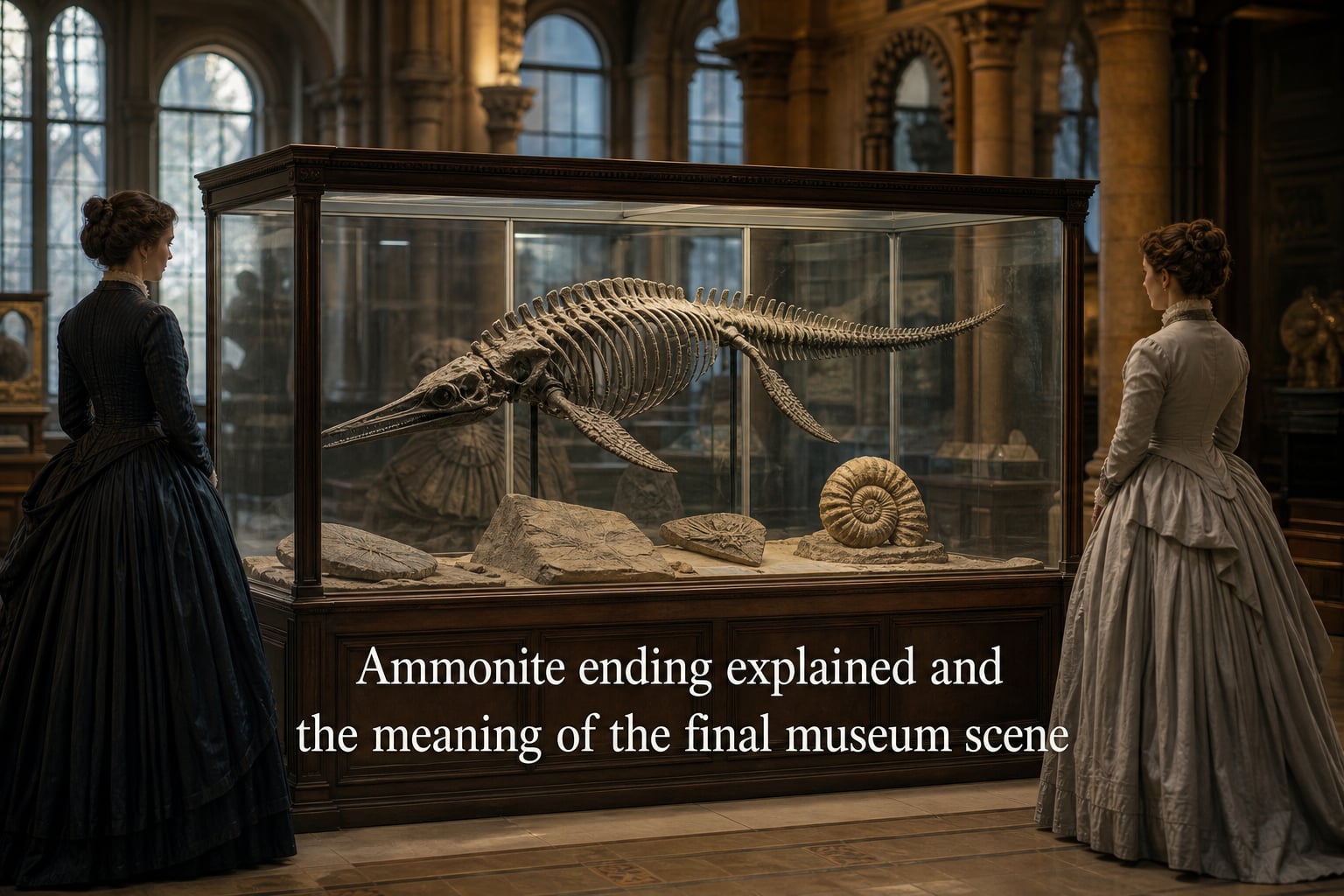
The final scene of Ammonite takes place inside the British Museum. Charlotte has written to Mary, asking her to come to London so they can discuss living together. Mary makes the journey, entering the museum’s grand fossil hall, and finds Charlotte already waiting.
Between them stands a large glass display case containing Mary’s first major discovery, the ichthyosaurus skeleton she unearthed as a young woman. The two women stand on opposite sides of the case. They do not speak. They simply look at each other through the glass, their faces illuminated by the light filtering through the case and the fossil inside it.
The camera holds on this image. Charlotte’s expression is open, hopeful, waiting for an answer. Mary’s face is harder to read, guarded but not closed off. The film cuts to black before either woman moves or speaks.
That silence is the ending. There is no embrace, no explicit yes or no, no tearful reconciliation or final parting. The Ammonite final scene meaning lives entirely in what the two women do not say, and in the object that separates them.
Ammonite Ending Explained: What It Means for Mary and Charlotte
The Ammonite ending explained at its core is about the possibility of connection existing without certainty. Francis Lee structures the final scene so that both outcomes, reunion and separation, remain equally present. Charlotte has made her offer. Mary has come all the way to London, which itself is an answer of sorts. If she had no interest in Charlotte’s proposal, she would not have made the trip.
But Mary cannot bring herself to cross the final distance. Throughout the film, we see that Mary has spent her entire life behind walls of a different kind. She was excluded from the scientific establishment that benefited from her discoveries. She watched men take credit for her work. She lived in near-poverty while her fossils sat in museum cases she was never invited to study. The museum itself is a monument to that exclusion.
So when Mary stands in the British Museum looking through a glass case at her own fossil, she is standing inside a system that displayed her labor but never her name. Charlotte offers her a way out of that isolation, a life of companionship and warmth. But Mary’s hesitation in the final scene carries the weight of everything she has survived. She has learned to survive alone.
The ending is neither happy nor tragic. It is honest about how difficult it is for someone who has been hurt by the world to accept love when it finally arrives. The door is open. Whether Mary walks through it is left to the viewer.
Many viewers and critics have noted that this ambiguity is itself a kind of victory for a queer love story. Too many films in this genre end in death or tragedy. Ammonite refuses both. It gives its characters a chance, and trusts the audience to sit with not knowing.
The Fossil Symbolism: What the Ichthyosaurus Represents
The ichthyosaurus at the center of the final scene is the film’s most important symbol, and it carries multiple layers of meaning. When Mary looks at this fossil, she is looking at several things at once.
First, the fossil represents Mary’s own legacy. She discovered this specimen as a child. It launched her career and changed paleontology forever. Yet here it sits in a museum case with no plaque bearing her name, catalogued and owned by an institution that never treated her as an equal. The fossil is Mary’s genius, preserved and displayed by others, credited to others.
Second, the fossil represents what it means to be frozen in time. An ammonite or an ichthyosaurus is a living thing turned to stone. It is preserved perfectly but it is dead. It cannot grow or change. Mary has, in a sense, become like her own fossils. She has preserved herself against the world by hardening, by closing off, by refusing to let anyone in after Elizabeth. Charlotte threatens to thaw that hard exterior, and the final scene shows Mary caught between the safety of being stone and the risk of being alive.
Third, the fossil represents deep time and patience. Fossils are formed over millions of years through pressure and transformation. The love between Mary and Charlotte has its own kind of geological pressure, built slowly through the film’s quiet, deliberate pacing. The fossil suggests that what is real and lasting does not announce itself. It simply endures.
One detail that deepens this Ammonite fossil symbolism is the name of the film itself. Ammonites are extinct marine creatures whose spiral shells symbolize continuity and resurrection in some traditions. They are fossils that tell a story of something that was once alive and vibrant, now preserved as evidence that it existed at all. That description fits Mary Anning’s life and her love with Charlotte perfectly.
The Glass Case: A Barrier and a Mirror
The glass display case in the British Museum scene does double duty as both a literal and metaphorical element. On the surface, it physically separates Mary and Charlotte. They cannot touch. They can only see each other through the glass. This barrier mirrors every obstacle that has kept them apart throughout the film: class difference, Charlotte’s marriage, Mary’s emotional walls, and the social constraints of 1840s England.
But glass is also reflective. When Mary looks through the case at Charlotte, she also sees a faint reflection of herself. The case becomes a mirror in which Mary confronts her own image, her own choices, and her own fear. She sees who she has been, alone and self-reliant, and she sees who she could become if she allows Charlotte back into her life.
This dual function of the glass, barrier and mirror, is what makes the Ammonite glass case scene so visually powerful. Francis Lee frames the shot so that the fossil, Mary’s reflection, and Charlotte’s face all occupy the same visual plane. Past, present, and possible future overlap in a single image.
Redditors discussing the film in the official spoiler thread noted that the two women “studying each other openly through the glass” is the first time in the film that both characters look at each other without pretense. There is no work to do, no illness to manage, no husband to account for. There is only the truth of what they feel, separated by a surface they could, if they chose, walk around.
The Letter’s Significance: What Charlotte’s Husband Wrote
Understanding the ending requires understanding the letter that sets the final scene in motion. Earlier in the film, Charlotte’s husband Roderick Murchison writes to Mary. He had been the one who originally brought Charlotte to Lyme Regis, leaving her in Mary’s care while he traveled. His letter, arriving after the central romantic relationship has already developed and then fractured, is essentially an apology and an explanation.
The letter acknowledges that Roderick failed as a husband. More importantly for the story’s structure, it signals that Charlotte’s marriage is effectively over in everything but name. This is what gives Charlotte the freedom to invite Mary to live with her. The letter from Charlotte’s husband represents the removal of the primary external obstacle to their relationship.
But here is the film’s sharpest insight. With the external obstacle gone, the only thing standing between Mary and Charlotte is Mary herself. The letter clears the path, and Mary still hesitates. That is what the final scene is really about. It is not about whether society will let them be together. It is about whether Mary can overcome a lifetime of self-protection and choose to be vulnerable.
Many forum discussions flagged this as a frustration point. Viewers wanted the external barrier removed to lead to a clean reunion. Francis Lee’s choice to make Mary’s internal resistance the final obstacle is what elevates the film above a standard romance. It turns a love story into a character study.
Elizabeth Philpot’s Role in Mary’s Story
One element of Ammonite that deserves more attention is the character of Elizabeth Philpot, played by Fiona Shaw. Elizabeth is Mary’s friend, former romantic partner, and lifelong companion in Lyme Regis. Their relationship is one of the film’s quietest and most important threads.
Elizabeth and Mary were once involved romantically. By the time the film begins, that romantic relationship has ended, but Elizabeth still lives with Mary and helps manage her fossil shop. The dynamic between them is one of deep familiarity mixed with unresolved pain. Elizabeth watches Mary fall for Charlotte with a complicated mix of resignation and quiet hurt.
Elizabeth functions as both a warning and a mirror. She shows Mary what a life of quiet, accepted solitude looks like. She also represents what Mary could lose if she opens herself to love again and it fails. When Mary eventually leaves Elizabeth behind to pursue her feelings for Charlotte, she is repeating a pattern of choosing passion over the steady companionship she already has.
This is why Elizabeth’s presence matters so much to the ending. Mary has already had one great love that did not last in the way she wanted. The final museum scene gains much of its emotional weight from knowing that Mary has been here before, standing at the edge of vulnerability, and that the last time it did not end the way she hoped.
Who is Elizabeth to Mary in Ammonite? She is Mary’s past, her cautionary tale, and the proof that Mary is capable of deep love. She is also the person Mary might return to if she cannot bring herself to choose Charlotte.
The Real Mary Anning: Historical Context
Mary Anning was a real person, and the film’s emotional weight depends heavily on knowing her true story. Born in 1799 in Lyme Regis, Mary was a working-class woman who became one of the most important fossil hunters in the history of paleontology. She discovered the first correctly identified ichthyosaurus skeleton when she was around twelve years old, along with the first complete plesiosaurus and the first pterosaur found outside Germany.
Despite her extraordinary contributions, Mary was systematically excluded from the scientific community of her time. She could not join the Geological Society of London because she was a woman. Male geologists published papers based on her specimens, named species after themselves, and rarely credited her. She spent much of her life in financial difficulty despite her fossils sitting in museum collections that drew crowds and advanced scientific understanding.
This historical reality infuses every frame of the film. When Mary stands in the British Museum at the end, she is standing in a building that houses her life’s work, work that was taken from her without recognition. The museum is not a neutral space for her. It is a monument to her erasure.
As for the romantic relationship between Mary Anning and Charlotte Murchison, there is no historical evidence that it occurred. Francis Lee has been open about this. The film is a fiction built around real historical figures, and the romance is an imaginative exploration of what might have been possible in the gaps the historical record leaves blank. This is at the center of the controversy surrounding the film, with some historians and critics arguing that inventing a queer romance for a real historical figure is a disservice to her memory.
Lee’s counterargument, expressed in interviews, is that history has always erased queer relationships. The absence of evidence, he argues, does not mean the absence of experience. The film asks viewers to sit with that tension between historical record and historical imagination.
Do Mary and Charlotte End Up Together?
This is the question every viewer wants answered, and the honest response is that the film refuses to answer it definitively. Do Mary and Charlotte end up together in Ammonite? The film provides evidence for both possibilities and lets you choose.
Arguments for reunion point to the fact that Mary traveled to London, that she sought Charlotte out, and that her expression in the final shot, while guarded, is not closed. She is looking at Charlotte with something that resembles longing. Charlotte has removed every external obstacle. The path is clear. All Mary has to do is walk around the glass case.
Arguments for separation point to Mary’s entire character arc. She has been hurt by the world and by love. She has watched her work be stolen and her name be forgotten. Trusting someone with her heart, even Charlotte, may be more than she can give. The film’s final image captures her at the moment of decision, and that moment may be permanent.
What makes this ambiguity powerful rather than frustrating is that it is earned. The film does not withhold an answer out of cowardice or indecision. It withholds an answer because the question itself is the point. Can a person who has been taught that the world will not value them learn to value what someone else offers? The film believes that question is more interesting than any resolution.
FAQs
Were body doubles used in the Ammonite movie?
Kate Winslet and Saoirse Ronan have both confirmed in interviews that they did not use body doubles for the intimate scenes in Ammonite. Winslet emphasized that director Francis Lee created a safe, carefully choreographed environment on set, and both actors felt comfortable performing the scenes themselves. The intimacy was deliberately understated and focused on emotional truth rather than explicit display.
What is the age gap in Ammonite?
In the film, Mary Anning is portrayed as being in her forties while Charlotte Murchison is in her twenties, creating an age gap of roughly twenty years between the two characters. This gap is reflected in their dynamic, with Mary serving as a mentor figure and Charlotte as someone rediscovering herself. Historically, Mary Anning was born in 1799 and Charlotte Murchison in 1788, meaning Charlotte was actually older, but the film chose to alter this for narrative purposes.
What is the controversy surrounding the movie Ammonite?
The main controversy surrounding Ammonite centers on its depiction of a romantic relationship between Mary Anning and Charlotte Murchison. There is no historical evidence that the two women were romantically involved, leading some historians and critics to argue that the film fabricates a queer romance for a real historical figure. Director Francis Lee defended the choice by noting that historical records routinely erased LGBTQ relationships, and that the film is an exploration of possibility rather than a claim of documented fact.
Conclusion
The Ammonite ending explained comes down to a single truth: the final museum scene is about a woman standing at the crossroads between the safety of solitude and the risk of love. The fossil, the glass case, and the silence between Mary and Charlotte all point to the same idea. What we preserve and what we choose to keep alive are not always the same thing. Mary Anning spent her life preserving the past. The ending asks whether she can also preserve a future. Francis Lee gives us the question and trusts us to live with not having the answer, and that trust is what makes the film’s final shot one of the most quietly devastating images in recent cinema.