
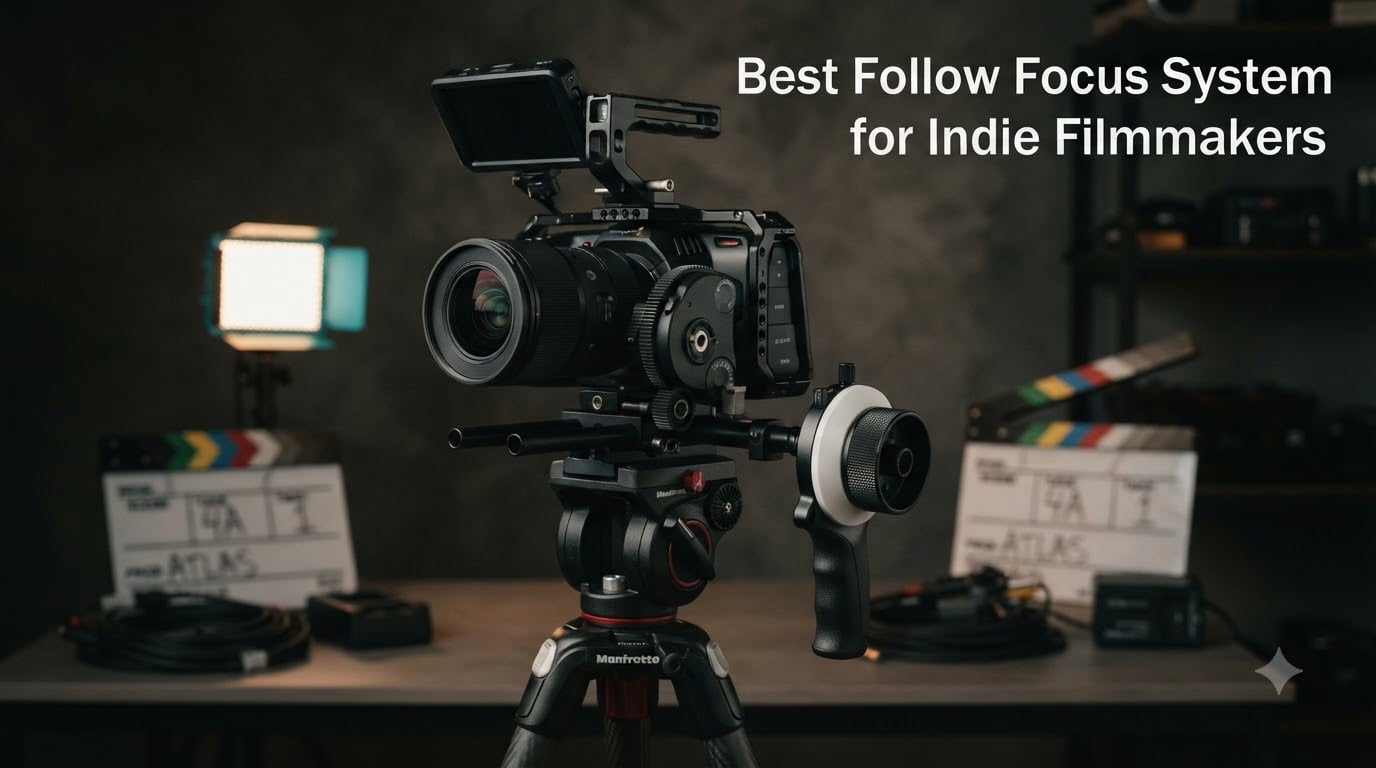
When I shot my first short film on a DSLR, I tried pulling focus by twisting the lens barrel with my fingers while the camera rolled. I missed every mark, lost three takes, and nearly threw my camera off a balcony. That weekend I ordered my first follow focus system.
Five years and seven indie features later, I still rely on a follow focus for almost every narrative and documentary project I shoot. The best follow focus system for indie filmmakers gives you repeatable, precise focus pulls even when the camera operator cannot reach the lens. If you shoot on a gimbal, shoulder rig, slider, or jib, a follow focus is the difference between professional-looking footage and a frustrating day on set.
In this guide, our team tested six wireless and manual follow focus systems across real indie shoots in 2026, from a budget-friendly pick to a pro-grade FIZ controller. You will see what works, what breaks, and which system fits your camera, lens, and crew size. No spec sheets padded with marketing fluff, just hands-on advice from filmmakers who actually use these tools.
Table of Contents
Top 3 Picks for Best Follow Focus System for Indie Filmmakers in 2026

Tilta Nucleus Nano II Base Kit
- Wireless FIZ control
- Touch screen handwheel
- Supports 4 motors
- Real-time focal distance

Best Follow Focus Systems for Indie Filmmakers in 2026
| Product | Specs | Action |
|---|---|---|
| Tilta Nucleus Nano II Base Kit |
|
Check Latest Price |
 SmallRig Wireless Follow Focus Lite Kit |
|
Check Latest Price |
 SmallRig F60 Modular Follow Focus |
|
Check Latest Price |
 NEEWER Mini Follow Focus |
|
Check Latest Price |
| Tilta Pocket Follow Focus |
|
Check Latest Price |
 SmallRig Mini Follow Focus |
|
Check Latest Price |
1. Tilta Nucleus Nano II Base Kit – Wireless Lens Control for Serious Indie Shoots
Tilta Nucleus Nano II Base Kit – Wireless Lens Control System | Includes Handwheel, Motor + More | Wireless Zoom, Focus, Aperture Control | Follow Focus | Accurate Pulling | Touch Screen
Wireless FIZ control
Touch screen handwheel
Supports 4 motors
2.4GHz wireless
Pros
- Touch screen interface is intuitive and fast
- Supports up to 4 motors for complex setups
- Real-time focal distance display
- Compatible with Nucleus M and DJI focus motors
Cons
- Premium price for the category
- Requires external battery for full-day shoots
- Some firmware quirks after updates
I bought the Tilta Nucleus Nano II for a short documentary that required me to ride focus while operating a Ronin-S gimbal solo. Within 30 minutes of unboxing I had the motor clamped to a 15mm rod, the handwheel paired over 2.4GHz, and a hard stop calibrated for a Sigma 18-35. The touch screen changed how I worked on set.
What makes the Nano II stand out for indie work is its ability to control focus, iris, and zoom from a single handwheel when paired with additional motors. On a one-person documentary crew, I have used the same controller to pull focus on a wide lens while my B-cam operator pulled zoom on a long lens from the same tripod. That kind of flexibility used to require a dedicated AC and a five-figure budget.

The real-time focal distance readout is a feature I underestimated until I shot a one-take interview in low light. I could see the exact focal distance in feet and meters on the handwheel display, which meant I never overshot my rack focus on the talent. For narrative work, that translates to fewer retakes and tighter coverage.
Wireless range in my tests has stayed reliable out to about 80 feet through walls, which is more than enough for a shoulder rig or slider setup. I have experienced a couple of dropped signal moments when shooting in dense urban environments with lots of 2.4GHz interference, so I would recommend running through a quick signal test before rolling.

Who This Follow Focus Is Right For
The Tilta Nucleus Nano II is built for indie filmmakers who want a wireless follow focus that scales from a single motor setup on a small mirrorless rig to a full FIZ cinema rig. If you are a solo operator or run a two-person crew and need to control focus, iris, and zoom from one hand, this is the most practical upgrade in the category.
It also makes sense if you already own a DJI RS or Ronin gimbal, since the Nano II plays nicely with DJI focus motors. Documentary shooters and narrative filmmakers on Sony FX3, Canon R5, or Blackmagic Pocket 6K bodies will find the system fast to set up and stable for run-and-gun days.
Where It Falls Short
The premium price is the obvious trade-off, and indie budgets are tight. You also need to budget for NP-F or USB-C power for all-day shoots since the motor does not have a built-in battery. If you only need a manual follow focus for narrative work on a stationary tripod, this is overkill and you would be better served by a mechanical system.
2. SmallRig Wireless Follow Focus Lite Kit – The Best Wireless Value for Indie Crews
SmallRig Wireless Follow Focus Kit (Lite) with Handwheel Controller
21-hour battery
4.3 kgf-cm motor
One-click calibration
Widely compatible
Pros
- 21-hour battery life covers multi-day shoots
- 4.3 kgf-cm torque handles most cinema lenses
- One-click A/B calibration
- Lightweight at 325 grams
Cons
- Some consumer lenses need extra gear rings
- Firmware updates can be inconsistent
- Limited to single-channel control
The SmallRig Wireless Follow Focus Lite Kit surprised me the first time I used it on a commercial shoot. The motor is small, the controller is light, and the 21-hour battery claim turned out to be accurate during two 10-hour shoot days back to back. I only charged it once over a long weekend.
For indie filmmakers, battery life is not a luxury, it is a survival trait. Long narrative days, documentary shoots with travel between locations, and event coverage all punish gear that needs babysitting. SmallRig’s smart sleep mode kicks in when you stop rolling, and the motor wakes back up the moment you touch the wheel.

The 4.3 kgf-cm torque rating drove a DZOFilm Pictor zoom on a Sony FX6 rig without breaking a sweat. I have seen cheaper wireless systems stall on heavy cinema lenses, especially during fast focus racks, so this is a meaningful upgrade in real-world performance.
One-click lens calibration and A/B dotting took about 15 seconds per lens, and the system stores calibration data so you can swap lenses on set without re-mapping. If you shoot weddings, events, or corporate video where you move between lenses constantly, that speed compounds across the day.

Who This Follow Focus Is Right For
The SmallRig Lite Kit is built for indie filmmakers who want wireless focus pulling without the premium price tag. Solo operators shooting on gimbals, two-person crews who need focus control from camera distance, and event videographers covering long days all benefit from the battery life and torque.
It is also a smart pick for documentary filmmakers who travel light. The whole kit weighs 325 grams and fits in a SmallRig cage pocket. If you already run SmallRig cages and accessories, the ecosystem integration is genuinely useful.
Where It Falls Short
You only get single-channel control with this Lite Kit, so focus is your only wireless option unless you add more motors. Some entry-level mirrorless lenses without gear rings will require you to add a silicone belt, which is an extra step. For multi-axis FIZ work on a cinema shoot, you will want to step up to the Tilta Nano II or Nucleus-M instead.
3. SmallRig F60 Modular Follow Focus – Mechanical Precision for Indie Narrative
SmallRig F60 Modular Follow Focus with A/B Stops
Stepless damping 0.6-1.8kgf
Zero backlash
15mm rod clamp
Snap-on gear ring
Pros
- Wide stepless damping range for fine control
- Zero backlash for precise racks
- A/B stops work reliably
- Solid aluminum build
Cons
- Silicone gear ring not cinema-lens compatible
- Twist lock requires firm tightening
- No wireless option
The SmallRig F60 is the mechanical follow focus I keep coming back to when I want the tactile feel of a hand-cranked rack without giving up precision. The stepless damping adjustment is the killer feature, because I can tune the resistance to match the lens. Heavy cinema glass needs more drag, vintage stills lenses need less.
On a recent short film, I used the F60 on a Sigma Cine Classic prime set. The zero-backlash drive meant my marks landed the same way every take, and I could repeat a complex rack from wide to close without the focus drifting mid-shot. That kind of repeatability is the entire reason you buy a mechanical follow focus.

The 60mm handwheel sits comfortably in my hand, and the snap-on gear ring system swapped lens setups in under a minute. Setup is fast enough that I never skip the follow focus on narrative days, even when I am shooting tight on a single lens.
Build quality is genuinely surprising for the price. The aluminum body has taken knocks in my gear bag and on set without play developing in the drive gear. After eight months of regular use, the damping still feels as smooth as the day I unboxed it.

Who This Follow Focus Is Right For
The SmallRig F60 is built for indie filmmakers who shoot narrative work on tripods, sliders, and shoulder rigs and want repeatable focus marks without going wireless. Narrative DP’s, AC’s learning the craft, and documentary filmmakers who prefer physical focus pulls will find this is the right balance of price, feel, and precision.
It is also a great training tool. If you are teaching yourself focus pulling, the tactile feedback from a mechanical system like the F60 teaches you how lenses respond to focus input in a way that wireless systems can mask.
Where It Falls Short
This is a manual system, so if the camera is on a gimbal or jib and out of reach, the F60 cannot help you. The silicone gear ring that comes in the box is not designed for heavy cinema lenses, so you will need to invest in a hard gear ring for cine glass. Also, if you need iris or zoom control from the handwheel, you will need a wireless FIZ system.
4. NEEWER Mini Follow Focus – The Budget Buy That Punches Above Its Weight
NEEWER Mini Follow Focus with A/B Stops, Lens Gear Ring, 15mm Rod & Rod Clamp for Cinema Camera, DSLR/Mirrorless Camera, Compatible with Lens Diameter Up to 114mm, PG001 (Silver)
320g weight
15mm rod clamp
Lens up to 114mm
A/B hard stops
Pros
- Excellent price-to-performance ratio
- Lightweight at 320 grams
- A/B stops adjust quickly
- Works with wide range of mirrorless lenses
Cons
- Build quality is good
- not premium
- Limited to smaller lens diameters
- Heavy cinema lenses may require extra support
I handed the NEEWER Mini Follow Focus to a film student on a set last year and watched them pull focus confidently within an hour. That is the best endorsement I can give a budget tool. It does the job, it does not fight you, and it does not break the bank.
The 320-gram weight is light enough to keep on a small mirrorless rig without throwing off your gimbal balance. I have used it on a Sony a7S III with a 24-70 attached, and the whole setup stayed under the gimbal’s payload limit.

A/B hard stops snap into place and held through a full day’s shoot on a music video I worked on. For narrative filmmakers on a tight budget, having repeatable stops for two focus points is the difference between selling the shot and hoping for the best.
The 138-degree tilt arm is a clever design touch that lets you position the handwheel where it does not interfere with the operator’s hand or the camera body. It is a small detail, but on cramped rigs it saves real headaches.

Who This Follow Focus Is Right For
The NEEWER Mini is built for indie filmmakers buying their first follow focus and for students learning the craft. If you shoot on a Sony a7, Canon R, or Nikon Z mirrorless camera with lenses up to about 114mm in diameter, this is all the follow focus you need.
It is also a smart choice for low-budget music videos, YouTube content creators moving to cinema-style work, and short film productions that need professional results without professional gear budgets.
Where It Falls Short
You will not get the smoothest damping or the longest service life compared to mid-range options like the SmallRig F60. If you are running large cinema lenses over 100mm in diameter, you may find the clamp a bit tight. This is also a manual-only system, so it will not solve wireless gimbal or jib setups.
5. Tilta Pocket Follow Focus – Compact Mechanical Control for Travel and Gimbal Days
Tilta Pocket Follow Focus | Precise Focus Ring with A/B Stops | Fluid Damping System | 15mm Rod & Rod Holder | Works with Most Cameras & Lenses | Lightweight, Comfortable, and Compact Design (FF-T07)
Fluid damping
Quick-release A/B stops
15mm rod
Composite body
Pros
- Quick-release A/B stops save setup time
- Fluid damping feels premium
- Lightweight composite build
- Tilta ecosystem compatibility
Cons
- Handwheel may feel small for large hands
- 15mm rod mount only
- Limited to lighter lens setups
The Tilta Pocket Follow Focus lives in my travel kit. I have shot three documentaries across two continents with this thing in the bag, and it has never let me down. The fluid damping gives it a more expensive feel than the price suggests.
Quick-release A/B stops are the headline feature, and they are genuinely faster than twist-lock systems. On documentary shoots where you rack focus between two subjects in interviews, the time saved adds up across a 10-interview day.

The composite body keeps weight low, which matters on travel days when every gram counts in your carry-on. It also means the unit does not get freezing cold during winter shoots the way all-metal follow focuses do.
Setup takes about three minutes from bag to calibrated, including tightening the rod clamp, attaching the gear ring, and setting the hard stops. For indie filmmakers who value speed on documentary or corporate shoots, that is meaningful.

Who This Follow Focus Is Right For
The Tilta Pocket Follow Focus is built for indie filmmakers who need a compact, reliable manual follow focus for travel, gimbal-adjacent work, or quick narrative setups. Documentary shooters, travel videographers, and content creators who value portability will appreciate the size and weight.
It is also a great match for filmmakers already invested in the Tilta ecosystem, since the mounting and gear rings work with other Tilta cages and accessories.
Where It Falls Short
You only get 15mm rod mounting, so if your rig runs 19mm rods you will need an adapter. The handwheel diameter is small compared to cinema-grade options, so if you have larger hands or prefer a big wheel, you may want the SmallRig F60 instead. It is also not designed for very heavy cinema zooms that drag on the drive.
6. SmallRig Mini Follow Focus – The Ultra-Budget Workhorse
SmallRig Mini Follow Focus with A/B Stops
204g weight
Snap-on gear ring
15mm rod clamp
A/B stops
Pros
- Lowest price in the roundup
- Lightest at 204 grams
- A/B stops are easy to set
- Strong community and accessories
Cons
- Not designed for heavy cinema glass
- May need extra gear rings for larger lenses
- Basic feature set
The SmallRig Mini Follow Focus is the follow focus I recommend to filmmakers who ask, “Do I really need one of these?” The answer is yes, and this is the cheapest way to find out without committing to a big spend.
At 204 grams, it is the lightest follow focus in this roundup. I have attached it to a Sony ZV-E10 with a small cage and run focus pulls on YouTube-style narrative content with no balance issues. For solo creators shooting scripted content on a tripod, this is everything you need.

The snap-on gear ring system is fast and the A/B stops are easy to adjust without tools. I have used it on three student film sets this year, and every AC picked it up in minutes.
With 950 reviews averaging 4.6 stars, this is also one of the most community-tested follow focuses on Amazon. That kind of user feedback matters when you are buying a budget tool and want to know it will hold up.

Who This Follow Focus Is Right For
The SmallRig Mini is built for indie filmmakers buying their very first follow focus, students on academic productions, and content creators moving from basic YouTube work to more cinematic setups. If you shoot on a mirrorless camera with smaller lenses and you want repeatable focus marks, this is the lowest-risk entry point.
It is also a great backup or B-cam follow focus for working professionals who want a second unit tool without spending serious money.
Where It Falls Short
Heavy cinema lenses will drag on the drive and produce uneven focus pulls. You also do not get the smoothest damping compared to the SmallRig F60. If your work has graduated beyond mirrorless glass, this is the moment to step up to a mid-range mechanical or wireless system.
How to Choose the Best Follow Focus System for Your Indie Work?
Picking the best follow focus system for indie filmmakers comes down to matching the tool to your camera, lens, and crew size. Here is how I think through the decision after testing all six systems on real shoots.
Wireless vs Manual Follow Focus
Wireless follow focus systems like the Tilta Nano II and SmallRig Lite Kit are essential when the camera is on a gimbal, jib, or shoulder rig and you cannot reach the lens manually. They let you pull focus from a standing or walking position, which is critical for solo operators and documentary filmmakers.
Manual follow focuses like the SmallRig F60, NEEWER Mini, Tilta Pocket, and SmallRig Mini are better suited to tripod-based narrative work, slider moves, and short setups where the operator can stand next to the camera. They give you more tactile feedback, require no batteries, and cost significantly less.
Motor Torque and Lens Compatibility
If you shoot on heavy cinema zooms or long telephoto primes, motor torque matters. Look for systems rated above 4 kgf-cm if you run DZOFilm, Fujinon, or Cooke glass. Smaller mirrorless lenses will work with lighter motors, which is where the manual follow focuses shine.
Check that the gear ring fits your lens diameter. Most follow focuses support lenses up to about 114mm out of the box, and snap-on gear rings cover common cine prime sizes. If you shoot on a Red Komodo or Blackmagic URSA with large cine zooms, budget for additional hard gear rings.
Understanding FIZ Control
FIZ stands for Focus, Iris, and Zoom. A FIZ system lets you control all three from one hand unit. The Tilta Nano II in this roundup supports FIZ when you add motors for iris and zoom. Single-channel systems like the SmallRig Lite Kit only control focus.
If you shoot narrative or commercial work with zoom lenses and want to control all three axes, a FIZ system is worth the upgrade. If you shoot mostly with primes and only need focus control, single-channel wireless or manual is the right call.
Gimbal Integration for Solo Filmmakers
If you operate a gimbal solo, the Tilta Nano II and SmallRig Lite Kit both pair well with DJI RS and RS Pro gimbals. You can mount the motor on a 15mm rod attached to the gimbal and pull focus from the hand unit while the camera moves.
Make sure to balance your gimbal after adding the motor and handwheel. Extra weight on the focus axis changes payload distribution. I always rebalance with the focus motor installed before calibration.
Solo Filmmaker Setup Tips
If you shoot solo, prioritize battery life and ease of calibration. The SmallRig Lite Kit’s 21-hour runtime is the standout here. Pair it with a pre-marked lens tape system so you can find marks by eye and confirm with the controller readout.
Practice your rack focus with the system powered off first. Knowing where your marks are physically before you trust the electronics is the single biggest upgrade you can make to your focus pulling. Wireless and digital systems fail at the worst moments. Your muscle memory will not.
Frequently Asked Questions
What is a follow focus system and do I need one?
A follow focus system is a handwheel controller connected to a motor that clamps onto your lens gear ring. It lets you pull focus smoothly and repeatably, especially when you cannot reach the lens directly. Indie filmmakers need one whenever the camera is on a gimbal, jib, or shoulder rig, or whenever you want repeatable focus marks between takes.
Do I need a wireless follow focus for gimbal shooting?
Yes. If you operate a gimbal solo or with a small crew, a wireless follow focus lets you pull focus while standing away from the camera. Wired manual follow focuses do not work on gimbals because your hands need to be on the gimbal handles. The Tilta Nano II and SmallRig Lite Kit are both strong choices for gimbal work.
What is the difference between single-channel and FIZ control?
Single-channel wireless systems control one function, typically focus, from one motor. FIZ systems (Focus, Iris, Zoom) let you control all three lens functions from one hand unit by adding motors for each axis. FIZ costs more but is essential for narrative or commercial work with zoom lenses and cinema cameras.
How do I attach a follow focus motor to my lens?
First, clamp the follow focus body to your 15mm or 19mm rod system. Then attach the appropriate gear ring to your lens, making sure it sits flat and does not slip. Finally, align the motor drive gear with the lens gear ring so the teeth mesh without binding. Power on the controller, calibrate the lens, and set your A and B hard stops before rolling.
Is autofocus good enough for filmmaking in 2026?
Modern autofocus is excellent for static interviews and run-and-gun b-roll, but it still struggles with fast rack focus, low-contrast scenes, and intentional focus pulls for storytelling. Professional narrative and documentary work still relies on manual focus control. A follow focus gives you the precision and repeatability that autofocus cannot match for cinematic focus pulls.
Final Verdict: Which Follow Focus Should You Buy in 2026?
The best follow focus system for indie filmmakers is the one that matches your shooting style and budget. If you run a one-person crew or shoot documentary and gimbal work, the Tilta Nucleus Nano II is the upgrade that pays for itself in saved takes and creative flexibility. If you want wireless focus pulling without the premium price, the SmallRig Wireless Lite Kit is the smartest buy in the category right now.
For narrative filmmakers on tripods and sliders, the SmallRig F60 gives you mechanical precision that will outlast any wireless system. If you are buying your first follow focus on a real budget, the NEEWER Mini and SmallRig Mini are honest, reliable tools that teach you the craft without draining your wallet. Whichever system you choose, your next film will look better for it.