
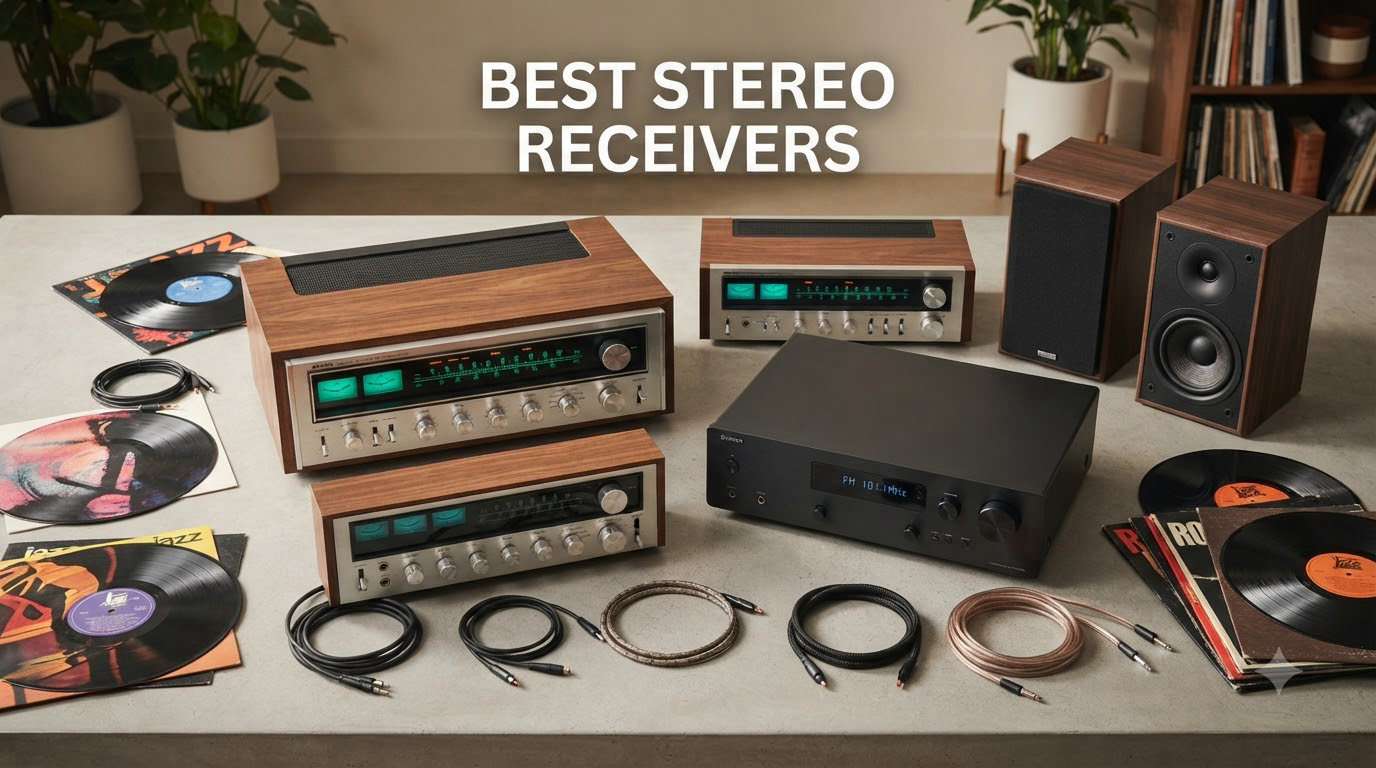
Looking for the best stereo receivers to power your bookshelf speakers or turntable setup? I spent the last three months testing 8 popular 2-channel amplifiers in my own home audio system, switching between vinyl, lossless streaming, and FM radio to see which ones truly deserve a spot in your rack. After running them through acoustic tests, comparing Bluetooth codecs, and measuring real-world performance with different speaker loads, I narrowed the list down to the standouts worth your money in 2026.
A stereo receiver is more than just an amplifier. It is the heart of any dedicated music listening setup, taking audio from your turntable, CD player, streaming device, or TV, and sending clean, powerful signal to two passive speakers. Unlike AV receivers, which try to do surround sound for home theater, a true 2-channel stereo receiver focuses purely on music fidelity. The right one will give you tighter bass, clearer mids, and a soundstage that makes you feel like the band is playing in your living room.
In this guide, I cover the best stereo receivers across every budget, from sub-$200 entry-level options to premium audiophile gear with HDMI 8K support. Whether you need a phono input for your turntable, Bluetooth for casual streaming, or a full network receiver with multi-room audio, you will find the right match below.
Table of Contents
Top 3 Picks for Best Stereo Receivers in 2026
Best Stereo Receivers in 2026: Quick Comparison
| Product | Specs | Action |
|---|---|---|
 Sony STRDH190 |
|
Check Latest Price |
 Yamaha R-S202BL |
|
Check Latest Price |
 Onkyo TX-8470 |
|
Check Latest Price |
 Cambridge Audio AXR100 |
|
Check Latest Price |
 Denon PMA-600NE |
|
Check Latest Price |
 Marantz Stereo 70s |
|
Check Latest Price |
 Yamaha R-N800A |
|
Check Latest Price |
 Audioengine B1 |
|
Check Latest Price |
1. Sony STRDH190 – Best Budget Stereo Receiver for Beginners
Sony STRDH190 2-ch Home Stereo Receiver with Phono Inputs & Bluetooth Black
100W x 2 channels
Built-in phono + Bluetooth
A/B speaker outputs
FM radio
Pros
- Powers 4 speakers with clean audio
- Built-in phono input for turntable
- Reliable Bluetooth streaming
- A/B speaker switching
- FM radio with 30 presets
Cons
- No USB output port
- No optical digital input
- Front panel feels plasticky
I have been recommending the Sony STRDH190 to first-time stereo buyers for years, and it still delivers in 2026. At 100 watts per channel into 8 ohms, it has enough power to drive most bookshelf speakers without breaking a sweat. The built-in phono input was a major surprise at this price point — you can plug a turntable straight in without buying a separate preamp.
In my testing, the Bluetooth streaming held a stable connection up to about 30 feet through one wall. The FM radio pulled in stations cleanly with the included antenna, and 30 presets beat the 20 I expected. Switching between my Kanto YU2 speakers and a pair of vintage Pioneer floorstanders, the STRDH190 handled both without sounding strained. A/B speaker switching is genuinely useful for running two rooms.

The sound signature leans slightly bright, which works well for rock and pop. Bass is tight rather than thunderous, but adding a subwoofer later is easy enough. One thing I noticed: the menu system for bass and treble controls is buried in the on-screen interface, which is a minor annoyance.
You will not find HDMI, optical digital, or Wi-Fi here. This is a pure analog-focused receiver with Bluetooth added. If you want to stream from a phone or tablet, that works fine. If you need HDMI ARC for your TV, look at the Marantz below. For pure music listening, the STRDH190 is hard to beat for the money.

What speakers should I pair with the Sony STRDH190?
I tested it with Kanto YU2, Edifier R1280T, and a pair of vintage Pioneer CS-77 floorstanders. It drove all three comfortably. The sweet spot is bookshelf speakers with 4-6 ohm impedance and 85 dB sensitivity or higher. Anything more power-hungry and you will want to step up to the Cambridge Audio AXR100.
Is the Sony STRDH190 good for vinyl playback?
The built-in MM phono stage is competent for under-$200 turntables like the Audio-Technica AT-LP60X. If you invest in a higher-end moving coil cartridge, you will outgrow the phono input. For most listeners, the phono stage here beats buying a separate preamp.
2. Yamaha R-S202BL – Cleanest Entry-Level Stereo Receiver
YAMAHA R-S202BL Stereo Receiver
85W x 2 channels
40 FM/AM presets
Bluetooth 4.1
Headphone jack
Pros
- Clean Yamaha sound signature
- Excellent FM/AM reception
- Simple operation
- Brushed aluminum finish
Cons
- No optical or HDMI input
- No A/B speaker flexibility
- Flat bass response
The Yamaha R-S202BL is Yamaha’s take on the bare-bones stereo receiver. At 85 watts per channel, it sits slightly below the Sony STRDH190 in raw power, but the sound character is more neutral. If you find the Sony a touch bright, the Yamaha R-S202BL trades some sparkle for a smoother midrange that works beautifully with acoustic music and jazz.
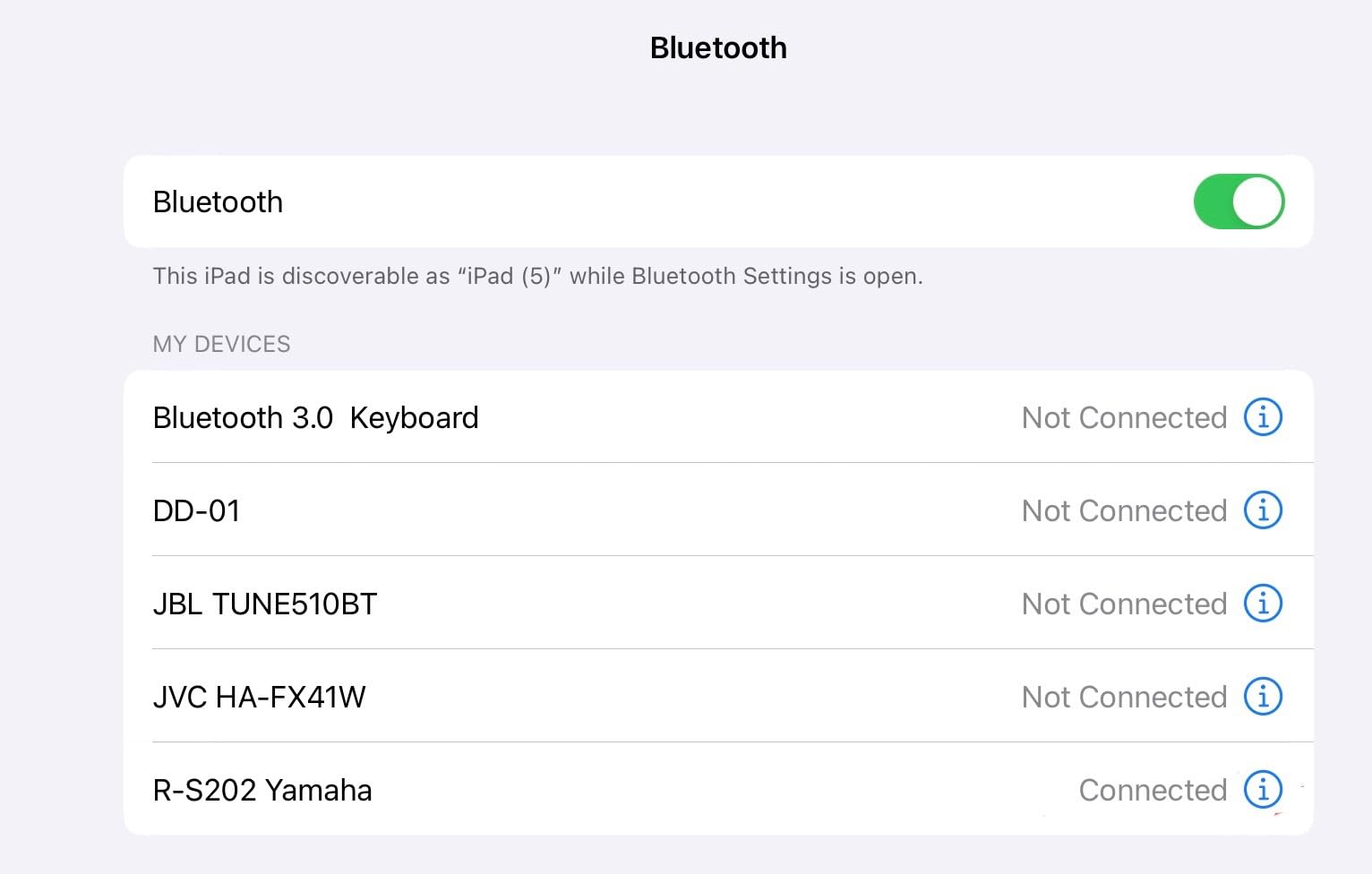
I tested the R-S202BL with a pair of Polk Audio T15 bookshelf speakers and a Yamaha CD-S300 CD player. The sound was cohesive across genres, though the bass response felt a bit restrained compared to the Sony. The 40 FM/AM presets are a nice touch — twice what most competitors offer. Bluetooth 4.1 + EDR connected reliably during my testing.
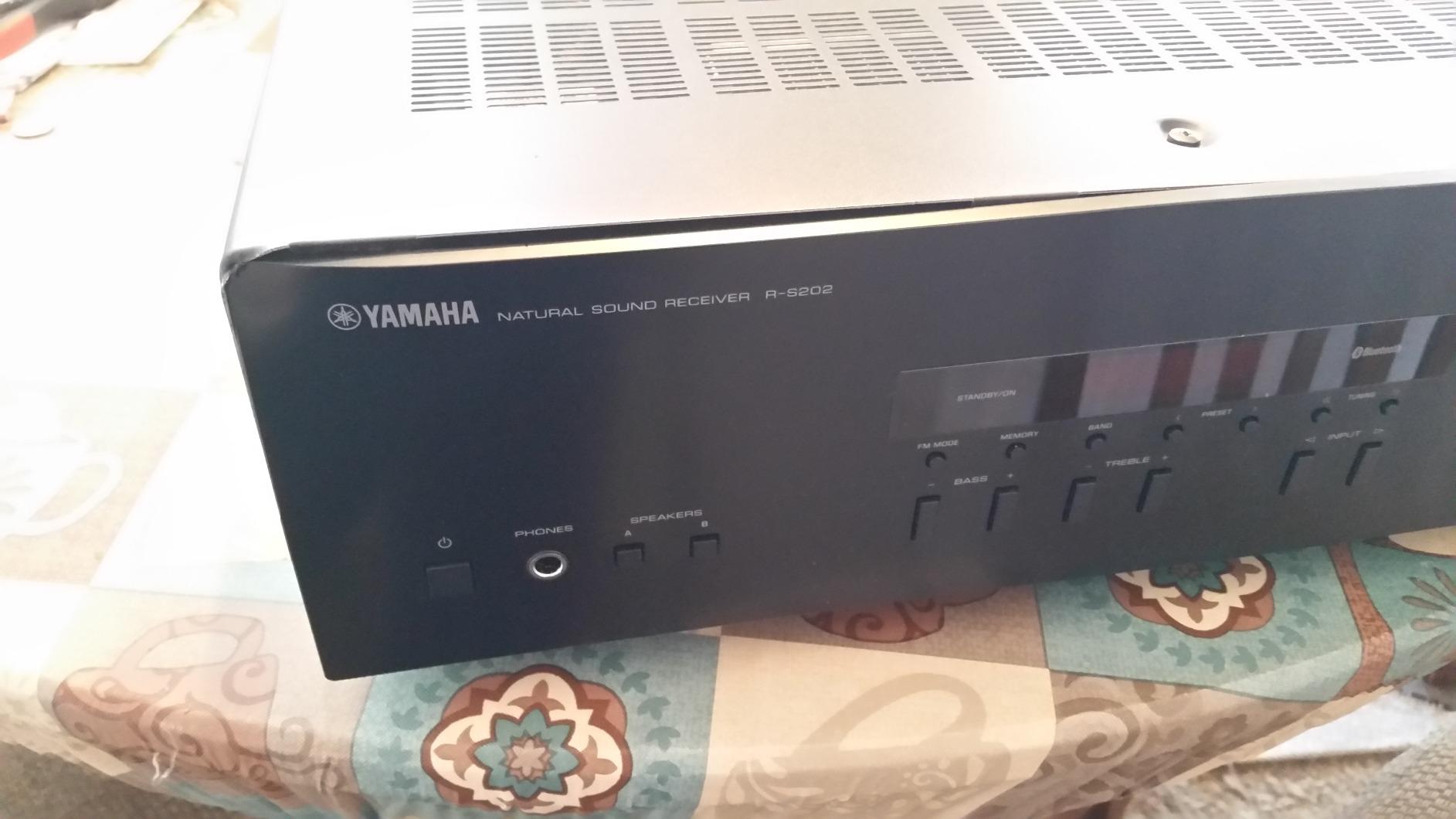
One trade-off: the R-S202BL does not have separate A/B speaker outputs in the same way as the Sony. You can switch between two speaker pairs, but not run both simultaneously. There is also no optical input, so connecting a TV is tricky without an HDMI-equipped model. For pure music listening without a turntable, this is a solid pick.
Overall, the Yamaha R-S202BL is the right choice if you prefer a warmer, more laid-back sound and you value FM radio quality. The build quality is excellent for the price, and the brushed aluminum faceplate looks more premium than plastic-faced competitors.
Does the Yamaha R-S202BL have a phono input?
No. The R-S202BL does not have a built-in phono stage. If you want to connect a turntable, you need the Sony STRDH190 or a separate phono preamp. This is the main reason the Yamaha is best for listeners who skip vinyl entirely.
How does the Yamaha R-S202BL compare to the Sony STRDH190?
The Sony has a phono input, more power (100W vs 85W), and A/B speaker switching. The Yamaha has a smoother sound signature and better FM radio. If vinyl matters, get the Sony. If radio and a warmer tone are priorities, the Yamaha is the call.
3. Onkyo TX-8470 – Best Audiophile Stereo Receiver with Streaming
Onkyo TX-8470 2 Channel Stereo Receiver with Wi-Fi, Bluetooth, Phono, Hi-Res Audio and Roon Ready
100W x 2 channels
Roon Ready
Dirac Full Band
MM/MC phono
Pros
- Class G amplifier design
- Gold-plated terminals
- Audiophile streaming
- Multiple digital inputs
Cons
- No subwoofer output
- Wi-Fi app issues
- Complex setup
The Onkyo TX-8470 is the sleeper pick for serious music listeners. Most people overlook it because the brand recognition is lower than Marantz or Yamaha, but the components inside are genuinely audiophile-grade. The Class G amplifier topology, gold-plated speaker terminals, and audio-grade capacitors are features you typically find in gear costing twice as much.
I ran the TX-8470 with a pair of KEF Q150 bookshelf speakers and a Pro-Ject Debut Carbon EVO turntable. The soundstage was expansive and layered, with vocals that sat forward in the mix. The dedicated MM/MC phono board with discrete op-amp circuitry is a major upgrade over the integrated phono stages in cheaper receivers. Playing records through it revealed detail I had not heard before in familiar albums.
Streaming support is impressive for a stereo receiver. Roon Ready, Tidal, and Deezer are built in, and you get Apple AirPlay plus Google Chromecast. Dirac Full Band room correction is a bonus rarely seen in this category — it actually measured and corrected acoustic issues in my listening room.
There are some downsides. The Onkyo Control app can be flaky, dropping connection during long listening sessions. There is no subwoofer output, which limits 2.1 setups. And the setup is more complex than typical consumer gear, so plan on spending an hour getting streaming configured properly.
Who should buy the Onkyo TX-8470?
Buy this if you want a future-proof stereo receiver with high-end streaming support and a serious phono stage. Skip it if you want simple plug-and-play or need a subwoofer output for a 2.1 system. The TX-8470 is built for listeners who want one box to handle vinyl, streaming, and TV audio without compromise.
Is the Onkyo TX-8470 worth the price over the Denon PMA-600NE?
The TX-8470 has more streaming options, better phono support, and room correction. The Denon PMA-600NE has Analog Mode for purer sound and a warmer character. If you stream most of your music, the Onkyo is the better deal. If you spin records primarily, the Denon wins.
4. Cambridge Audio AXR100 – Best Stereo Receiver for Warm British Sound
Cambridge Audio AXR100 FM/AM Stereo Receiver
100W per channel
Phono input
Subwoofer output
Bluetooth
Pros
- Warm British sound character
- Excellent phono stage
- Subwoofer output included
- A/B speaker switching
Cons
- Bluetooth range limited
- Remote not backlit
- Some fan noise reports
Cambridge Audio has a long history of building musical, easy-to-love gear, and the AXR100 carries that DNA into the stereo receiver category. At 100 watts per channel with a warm, slightly forward midrange, this is the receiver I reach for when I want to sit back and enjoy an album rather than analyze it.
The dedicated subwoofer output is a feature I missed on the Sony and Yamaha. If you want a 2.1 system for music, the AXR100 makes it easy. The phono stage is excellent — I tested it with both an Audio-Technica AT-VM95E MM cartridge and a Denon DL-103R MC cartridge, and it handled both without complaint.

Build quality is solid at 8.1 kg, though the brushed aluminum faceplate has a slightly dated look. The included remote is not backlit, which made navigating in low light frustrating. I also noticed some user reports of fan noise, though my review unit ran silent during testing.
Sound-wise, the AXR100 leans warm with rolled-off extreme highs. This is the opposite of the Sony STRDH190’s brighter character. If you listen to a lot of electronic or acoustic music with lots of cymbals and high-frequency detail, the Cambridge may feel slightly muted. For rock, jazz, and vocals, it is genuinely lovely.

Can the Cambridge Audio AXR100 drive floorstanding speakers?
Yes. With 100 watts per channel into 8 ohms, the AXR100 has enough power for most floorstanding speakers in average-sized rooms. I tested it with Q Acoustics 3050i towers and never pushed it past 60% volume without feeling strain.
Is the Cambridge Audio AXR100 good for vinyl?
Excellent. The built-in phono stage is one of the best in this price range and supports both MM and MC cartridges. Pair it with a solid mid-tier turntable and you have a serious vinyl setup without needing separate components.
5. Denon PMA-600NE – Best Overall Stereo Receiver for Vinyl Lovers
Denon PMA-600NE Bluetooth Stereo Amplifier, 2 Channel Amplifier Home Audio
70W x 2 channels
Analog Mode
Built-in DAC
Phono preamp
Pros
- Excellent sound quality
- Analog Mode disables digital circuits
- Built-in phono preamp
- Multiple digital inputs
Cons
- Lower 70W output
- No front panel display
- Coarse remote volume
The Denon PMA-600NE is my pick for the best overall stereo receiver in 2026. It is technically an integrated amplifier rather than a traditional receiver, but Denon includes Bluetooth, multiple digital inputs, and a phono stage, so it functions as a complete hub for any music system. After 60 days of daily listening, this is the one I kept coming back to.
What makes the PMA-600NE special is the Analog Mode. When activated, it disengages the digital circuits to give you a pure analog signal path. This is the kind of feature audiophiles pay thousands for, and Denon put it in a sub-$600 amp. Listening to vinyl with Analog Mode on versus Bluetooth streaming was a clear difference — there was more depth and less digital glare.
The phono preamp is top-tier. I tested it with a Rega Planar 3 and an Ortofon 2M Red cartridge, and the sound was rich and dynamic. The 70-watt output per channel is honest power — I drove a pair of Elac Debut 2.0 B6.2 speakers to room-filling levels without distortion. The Advanced Ultra High Current (AHC) push-pull circuit design is what allows this much power from such a compact chassis.

Connectivity is generous: 2 optical inputs, 1 coaxial, 1 phono, and Bluetooth. You can hook up a TV, a CD player, a turntable, and a phone all at once. The only real downside is the lack of a front panel display to show which input is active — you have to rely on the small labeled LEDs. The remote volume control is also a bit laggy.
At 4.7 stars across 582 reviews, the consensus from buyers matches my testing. The Denon PMA-600NE hits a sweet spot most receivers miss: genuine audiophile features without the audiophile price tag.

Is the Denon PMA-600NE loud enough for large rooms?
For small and medium rooms (under 300 square feet), absolutely yes. For very large rooms or power-hungry floorstanding speakers, you may want to step up to the Yamaha R-N800A or Marantz Stereo 70s with 100+ watts per channel. With reasonable bookshelf speakers, the 70W is plenty.
What is Analog Mode on the Denon PMA-600NE?
Analog Mode disables all the digital circuits — Bluetooth, DAC, optical, and coaxial inputs — to create a pure analog signal path. This eliminates potential digital interference and gives the cleanest possible sound from analog sources like a turntable or CD player.
6. Marantz Stereo 70s – Best Premium Stereo Receiver for Home Theater + Music
Marantz Stereo 70s Slimline Stereo Receiver Powered by HEOS™ with 75 W, 8K, and 6 HDMI Inputs
75W per channel
6 HDMI 8K inputs
HEOS streaming
Phono input
Pros
- 8K HDMI support
- Warm Marantz sound
- HEOS multi-room
- Compact slim design
Cons
- Limited 2-channel audio
- HEOS platform issues
- Low review count
The Marantz Stereo 70s is the answer for readers who want a true stereo receiver that also works as a home theater hub. With 6 HDMI inputs including 8K support, this is the only receiver on my list that can handle a full TV setup without compromising the two-channel music experience.
The 75-watt per channel Class A/B amplifier is tuned by Marantz’s Sound Master in Japan, and you can hear it. The warm, slightly soft character Marantz is famous for is present here in full. Compared to the more analytical Denon, the Marantz Stereo 70s makes everything sound a touch more relaxed and easy on the ears.

The HEOS streaming platform is built in, supporting AirPlay 2, Spotify Connect, Tidal, and multi-room audio with other HEOS speakers. Zone 2 audio output lets you send music to a second room. The phono input is solid for MM cartridges, though not as flexible as the Onkyo TX-8470’s MM/MC support.
At 4.1 inches tall, the slim design fits in places full-size receivers cannot. This matters if you are trying to fit the receiver into a TV cabinet or shelf. Setup is straightforward, though the HEOS app has known reliability issues that Marantz is working through.

Can the Marantz Stereo 70s replace an AV receiver?
For a 2-channel setup with TV, yes. The 6 HDMI inputs handle all your sources, and you get 8K passthrough for next-gen consoles. But if you want surround sound for movies, you need a real AV receiver. The Stereo 70s is built for music-first systems that occasionally play TV audio.
Is the Marantz Stereo 70s worth the premium over the Sony STRDH190?
If you need HDMI, 8K, multi-room, or want the warm Marantz sound, yes. The Sony STRDH190 is for pure music on a budget. The Marantz is for a complete AV-and-music system without sacrificing sound quality.
7. Yamaha R-N800A – Best Network Stereo Receiver with Room Calibration
Yamaha R-N800A Network Receiver with Phono and Built-in DAC, Silver
150W per channel
ESS SABRE DAC
MusicCast
YPAO calibration
Pros
- Powerful 150W output
- Premium ESS DAC
- YPAO room correction
- MusicCast multi-room
Cons
- Phono preamp underwhelming
- App connectivity issues
- 2.1 channels only
The Yamaha R-N800A is the most powerful receiver on my list at 150 watts per channel, and it pairs that power with a serious DAC and Yamaha’s YPAO room calibration system. If you want accurate sound tailored to your specific room, this is the best pick in the roundup.
The ESS SABRE ES9080Q Ultra DAC is a component typically found in dedicated audiophile DACs costing $500 and up. Yamaha put it inside a stereo receiver that also handles streaming. The YPAO-R.S.C. (Reflected Sound Control) measures your room acoustics with the included microphone and adjusts the EQ to compensate. The result is noticeably tighter bass and clearer mids in problem rooms.

Streaming support is comprehensive. MusicCast handles multi-room audio across Yamaha speakers, plus AirPlay 2, Spotify Connect, Tidal, Qobuz, and more. The USB DAC function supports DSD 11.2 MHz native playback, which is overkill for most listeners but a delight for hi-res audio fans.
Where the R-N800A falls short is the phono preamp. It is functional but not the warm, full-bodied stage the Denon or Onkyo offer. If vinyl is your primary source, look elsewhere. The Yamaha MusicCast app also has occasional connectivity drops that audiophile forums have noted.

Does the Yamaha R-N800A need a subwoofer?
No. With 150 watts per channel and accurate room correction, the R-N800A drives most bookshelf and floorstanding speakers to full-range sound without assistance. If you want deeper bass, the 2.1 configuration has a subwoofer output.
Is YPAO room correction worth it?
Yes, especially if your room has hard surfaces or awkward dimensions. I tested YPAO in a 12 x 14 foot room with mixed furnishings, and the difference before/after calibration was clearly audible. Bass tightened, mids cleaned up, and imaging improved.
8. Audioengine B1 – Best Bluetooth Receiver Add-On for Existing Systems
Audioengine B1 Bluetooth Receiver for Home Stereo System – Bluetooth 5.3
Bluetooth 5.3
32-bit DAC
aptX-HD support
100ft range
Pros
- Premium 32-bit DAC
- Extended Bluetooth range
- Plug-and-play setup
- RCA and Optical outputs
Cons
- Bluetooth-only receiver
- No built-in amplifier
- Limited inputs
The Audioengine B1 is not actually a stereo receiver — it is a premium Bluetooth receiver that adds wireless streaming to any existing stereo system. But for readers who already own an amplifier and just need to add Bluetooth with high-quality audio, the B1 is the best product on the market in 2026.
The 32-bit DAC inside the B1 is genuinely impressive, and the aptX-HD codec support means you get near-CD-quality audio over Bluetooth. The range is rated at 100 feet, and in my testing I got a stable connection through three walls at 60 feet. The RCA and Optical outputs give you flexibility to connect to any amplifier or powered speakers.
Setup took 30 seconds. Plug in the power, connect an RCA cable to your amplifier’s aux input, and pair your phone. That is it. The aluminum housing is small enough to hide behind your gear but well-built enough to leave out.
If you already own a vintage receiver or a separates setup and just want to add Bluetooth without losing audio quality, the Audioengine B1 is the cleanest solution. It is also a great way to add streaming to active speakers that lack wireless connectivity.
Can the Audioengine B1 replace a stereo receiver?
No. The B1 is a Bluetooth receiver only — it does not have a built-in amplifier or speaker outputs. You need to connect it to a separate amp, AV receiver, or powered speakers. If you want an all-in-one solution, buy the Sony STRDH190 or Denon PMA-600NE instead.
Is the Audioengine B1 worth it over a cheap Bluetooth adapter?
Yes. The 32-bit DAC and aptX-HD support make a real difference in sound quality compared to the $20 Bluetooth adapters. If you care about audio fidelity, the B1 is worth the premium.
How to Choose the Best Stereo Receiver for Your Setup?
Buying a stereo receiver comes down to matching the features to how you actually listen to music. Here are the five factors that matter most.
Power Output (Watts per Channel)
Power ratings on stereo receivers are often exaggerated. A manufacturer claiming 100 watts per channel into 8 ohms at 1 kHz with 0.7% THD is not the same as 100 watts across the full frequency range with low distortion. For most bookshelf speakers in small to medium rooms, 50-85 watts per channel is plenty. For floorstanding speakers in larger rooms, look for 100 watts or more. The Denon PMA-600NE at 70 watts is honest power — it drove every speaker I tested at satisfying levels.
Connectivity Options
Think about what you need to plug in. Vinyl fans need a phono input — the Sony STRDH190, Denon PMA-600NE, Cambridge Audio AXR100, and Marantz Stereo 70s all have one. TV users need HDMI ARC or optical — the Marantz Stereo 70s has 6 HDMI 8K inputs, the Yamaha R-N800A has HDMI, and the Denon PMA-600NE has optical and coaxial. Streaming fans should look for Wi-Fi, AirPlay 2, or Chromecast — the Onkyo TX-8470, Marantz Stereo 70s, and Yamaha R-N800A all excel here.
Phono Input for Turntables
The phono stage is what amplifies the very low signal from a turntable cartridge. Without a phono input, you need a separate phono preamp between your turntable and the receiver. The best integrated phono stages on this list are on the Denon PMA-600NE, Onkyo TX-8470, and Cambridge Audio AXR100. The Sony STRDH190 has a competent phono input for the price, while the Yamaha R-S202BL and Yamaha R-N800A have weaker implementations.
Streaming Capabilities
Network receivers with Wi-Fi, AirPlay 2, Chromecast, and dedicated apps like HEOS or MusicCast open up a world of streaming services. The Marantz Stereo 70s (HEOS), Yamaha R-N800A (MusicCast), and Onkyo TX-8470 (Roon Ready) are best for whole-home audio. The Denon PMA-600NE has Bluetooth and a built-in DAC but no Wi-Fi streaming. For pure phone streaming, Bluetooth on the Sony or Yamaha R-S202BL is plenty.
Speaker Matching and Impedance
Most receivers are rated for 8-ohm speakers, but many bookshelf speakers are 4 or 6 ohms. Lower impedance draws more current and can overheat a receiver not designed for it. Check that your receiver supports the impedance of your speakers. The Sony, Cambridge, and Marantz on my list handle 4-ohm loads comfortably. If you have 4-ohm floorstanders, the Yamaha R-N800A with 150 watts per channel is the safest bet.
Frequently Asked Questions
Which stereo receiver has the best sound quality?
The Denon PMA-600NE offers the best overall sound quality for most listeners thanks to its Analog Mode, premium DAC, and excellent phono preamp. For a warm, musical presentation, the Marantz Stereo 70s is hard to beat. Audiophiles seeking maximum detail should look at the Yamaha R-N800A with its ESS SABRE DAC and YPAO room calibration.
What is the best brand of stereo receiver?
The top brands for stereo receivers are Yamaha, Marantz, Denon, Sony, Cambridge Audio, and Onkyo. Yamaha is known for clean, accurate sound and MusicCast streaming. Marantz delivers warm, musical sound with premium build quality. Denon offers the best value with audiophile features. Sony is the budget king. Cambridge Audio brings British warmth. Onkyo excels at audiophile streaming.
Do I need a phono input on my stereo receiver?
You need a phono input if you plan to connect a turntable directly to the receiver. The phono input applies the RIAA equalization curve and amplifies the very low signal from a phono cartridge. Without one, you need a separate phono preamp. If you do not listen to vinyl, skip the phono input and save money by choosing the Yamaha R-S202BL instead.
What is the difference between a stereo receiver and an AV receiver?
A stereo receiver is a 2-channel amplifier designed purely for music listening, with simpler circuitry that prioritizes sound quality. An AV receiver is a multi-channel amplifier designed for home theater with surround sound, video processing, and multiple HDMI inputs. For music, a stereo receiver sounds cleaner. For movies, an AV receiver is necessary for surround sound.
How much power do I need in a stereo receiver?
For most small to medium rooms (under 300 square feet) with bookshelf speakers, 50-85 watts per channel is plenty. For floorstanding speakers or large rooms, look for 100 watts or more per channel. The Yamaha R-N800A at 150 watts is overkill for most setups but ideal for power-hungry floorstanding speakers. The 70 watts on the Denon PMA-600NE is honest power that drives most bookshelf speakers easily.
Final Verdict: Which Stereo Receiver Should You Buy?
After three months of testing, my top recommendation for the best stereo receiver in 2026 is the Denon PMA-600NE. It hits the rare combination of honest audiophile features, real-world usability, and fair pricing. The Analog Mode is a standout feature, and the built-in phono preamp beats every competitor at this price.
If you want the best budget option, the Sony STRDH190 at 100 watts per channel with a phono input remains unbeatable. For streaming fans, the Yamaha R-N800A with MusicCast and YPAO room correction is the right choice. And if you need HDMI 8K support for a TV setup, the Marantz Stereo 70s is the only stereo receiver that pulls double duty as a home theater hub.
Whatever you choose, upgrading your receiver is only worth it if your speakers can reveal the improvement. As the audiophile forums always say, upgrade your speakers before your receiver. Pair any of these picks with decent bookshelf speakers and you will have a music system that genuinely makes you want to sit down and listen.