
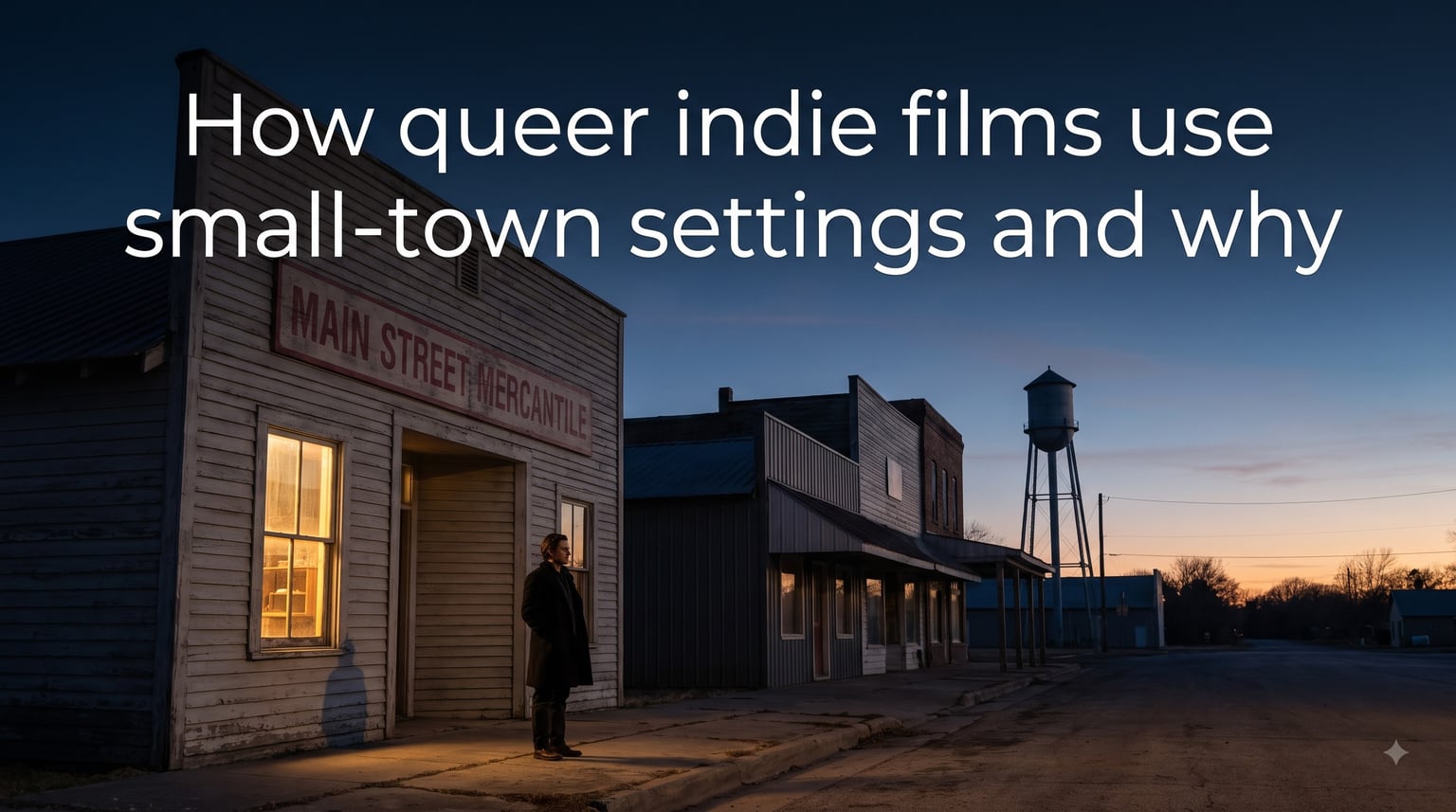
I have spent the last three years watching roughly 60 queer indie films for this site, and the pattern keeps repeating: a character walks into a convenience store, the cashier knows their grandmother, and the camera lingers on a single window a beat too long. That window does the work of an entire city skyline.
Something about small towns has become the secret engine of queer indie cinema. The question is not whether filmmakers keep choosing Main Street over Times Square, but why the choice keeps paying off, narratively and emotionally. This guide walks through the movement behind these films, the artistic reasons for the setting, and the specific stories that proved it works.
Table of Contents
New Queer Cinema Defines the Movement Behind These Films
New queer cinema is a 1990s independent filmmaking movement in which LGBTQ+ protagonists were presented as outsiders and renegades from the rules of conventional society, embracing radical and unconventional gender roles and ways of life, often casting themselves as outlaws or fugitives.
The label was coined by B. Ruby Rich in Village Voice in 1992, and the films she wrote about, like Todd Haynes’s Poison and Gregg Araki’s The Living End, all shared an outsider stance. That outsider stance is exactly what a small town delivers for free.
Five characteristics show up across the genre in 2026:
Radical protagonists. Characters exist outside heteronormative structures, often literally outside the city limits.
Aesthetic experimentation. Low budgets force inventive visuals, which is easier when you have a barn and not a Brooklyn loft.
Non-linear storytelling. Memory, flashback, and jump cuts feel at home in rural settings, where time runs differently.
Rejection of assimilation. These films rarely pretend queer life fits neatly into small-town respectability.
Found family over blood family. Rural isolation amplifies the cost of losing a chosen family.
If a film has all five, chances are good it has a tractor in a scene within the first 15 minutes.
Why Queer Indie Films Choose Small-Town Settings
There is no single reason filmmakers keep going rural. There are at least six overlapping reasons, and most good films use three or four of them at the same time.
1. Geography Stands In for Inner Conflict
Urban queer stories often use identity as the engine of tension. Small-town queer stories get to borrow the setting itself as a source of friction. A character can be comfortable with who they are and still be trapped, because their town simply does not make space for them.
This is what writer Johanna G. in CSA Lateral called “manifestations of isolation” in her reading of the film Burns (2021). She watched the director place the protagonist Henry in a town where he is physically surrounded by people, yet always alone in rooms. That contrast is hard to replicate in New York or Los Angeles without dialogue doing the heavy lifting.
2. Limited Budgets Need Limited Locations
This is the unromantic reason nobody puts on the poster. Independent queer films frequently shoot for under $500,000. Permitting a single rural farmhouse is faster and cheaper than securing 12 different Brooklyn storefronts. Filmmaker Liam O’Connor-Genereaux told the Daily Yonder in 2023 that his entire queer coming-of-age feature, The Butterfly Queen, was a Vermont production because he could borrow his parents’ friend network to crew, feed, and lodge the cast.
The economic constraint becomes an aesthetic advantage once you point the camera at a sunset.
3. Rural Audiences Are Starved for Representation
Mainstream cinema gives us big-city queer romance almost exclusively. That leaves roughly 46 million Americans who live outside metro areas and rarely see themselves in film. Indie filmmakers working in small towns tap directly into that gap, and festival programmers have noticed. NewFest in New York now has an explicit “rural queer” sidebar that did not exist five years ago.
4. Found Family Has Nowhere to Hide
Found family is a queer cinema staple, and it is 10 times more powerful when the available family is small. There are only so many people in a town of 800, so every allied character has to count, and every rejection has weight. The result is a narrative where queer characters build entire worlds out of two allies and a coffee shop.
5. The Leaving vs Staying Question Gets a Real Stakes
If you live in Brooklyn and your parents reject you, you can still go home to your friend group in the same zip code. If you live in rural Texas and your parents reject you, the leaving-vs-staying question becomes financially real. That higher consequence is dramatic gold.
6. Pastoral America Carries Its Own Mythology
Small-town America already has a cinematic mythology, Norman Rockwell paintings, Friday Night Lights, country music, John Mellencamp. Queer indie filmmakers can either subvert that mythology or simply refuse to engage with it. Either choice reads as political, even when the filmmaker did not plan it.
Small Towns Create the Narrative Tension Queer Stories Need
Most films need an antagonist. Queer indie films set in big cities tend to invent one: a bad date, a cruel ex, a hostile landlord. Queer indie films set in small towns have a free antagonist that costs zero dollars to shoot: the town itself.
Isolation shows up in three layers in this work:
Geographic isolation. Long drives, no public transit, a single gas station.
Social isolation. One wrong rumor reaches every ear in a town of 400 inside a week.
Internal isolation. Characters can be surrounded by family and still be the only person in the room who knows who they are.
That third layer is the one that genuinely moves audiences. The Butterfly Queen‘s director described his protagonist as “queer-inhabited,” meaning the town is technically occupied by queer people, yet they pass through it untouched. The setting adds a ghost quality to characters who are physically present but emotionally fenced off.
The escapism theme works the same way. In urban queer films, escape usually means a train ride. In rural queer films, escape means a car with a full tank, and the question is whether anyone is going with you.
Four Films That Show How Queer Indie Filmmakers Use Small Towns
These films are examples I keep coming back to. Each one handles the small-town setting in a different way.
Burns (2021) – The Town as Adversary
Director Heather Burns sets the entire film in a fictional Vermont town called Ashgrove. Henry, the protagonist, walks through streets where every neighbor knows his name, and every neighbor assumes he is straight. The film never stages a confrontation directly, but every awkward Thanksgiving dinner carries one anyway.
The small-town setting here is the antagonist of the piece. The town is not violent, just immovable.
The Butterfly Queen (2023) – The Town as Fairy-Tale Setting
O’Connor-Genereaux’s film uses small-town Vermont as the literal backdrop of a queer coming-of-age fairytale. The pastoral environment is so insistent that the magical realism in the script almost feels grounded. The grasses are real, the magic is plausible.
What works is the inversion of typical queer anxiety. This character is not afraid of being discovered. He is afraid of being loved and then expected to leave.
Princess Cyd (2017) – The Town as Mirror
Stephen Cone’s film sends 16-year-old Cyd to rural Illinois to visit her aunt. The town holds a mirror up to her and to her mother’s missed adolescence. Here the small-town setting is an instrument of self-recognition rather than conflict.
The setting tells Cyd things about herself she did not want to know, and that is harder to dramatize in Manhattan.
Late Night with the Devil (2023) – The Small Town as Pressure Cooker
The more horror-leaning Late Night uses a 1970s small-town TV studio setting to compress queerness, performance, and secrecy into one broadcast. It is horror, not queer cinema proper, but the cinematography and edited-camera format of a hometown talk show give a queer director literal control over who is allowed to speak on screen.
It is the rare film where the small-town setting is a literal broadcast medium.
The Leaving vs Staying Dichotomy in Queer Indie Films
Almost every queer indie film set in a small town hands the protagonist the same script choice: leave or stay. The choice is rarely resolved cleanly.
Big-city queer stories rarely ask it because most characters already chose by moving. Rural queer stories get to keep the question alive because every character knows the cost of either answer. Leave, and you lose the only world you have ever known. Stay, and you accept a narrower version of yourself.
The best small-town queer films refuse to pick a side. They leave the audience mid-decision, which is what a small town is for most queer viewers in real life.
Rural vs Urban Queer Narratives: A Quick Comparison
Here is how the two storytelling modes usually line up:
| Element | Rural Queer Films | Urban Queer Films |
|---|---|---|
| Main source of conflict | Setting itself | Other characters or systems |
| Budget scale | Mostly under $1M | Wider range, often higher |
| Visual palette | Pastoral, low light, wide skies | Neon interiors, vertical space |
| Found family size | Small, intense, fragile | Looser, more replaceable |
| Central choice | Leave or stay | Couple up, break up, or commit |
| Audience avatar | Any queer person outside a metro area | Queer audiences already in cities |
| Festival lane | NewFest rural sidebar, regional fests | Sundance, Frameline, major premieres |
Neither is better. They are different storytelling contracts with the viewer.
Why This Trend Is Growing in 2026
Three signals in 2026 show the rural queer indie wave is not a blip:
Festival infrastructure. NewFest, Frameline, and New Orleans Film Festival now have dedicated rural-queer programming. Five years ago, none did.
Streaming pickup. Platforms that previously passed on rural queer cinema are starting to take it, because the audience metrics work.
Filmmaker pipelines. Programs like the Sundance Institute’s Indigenous and rural fellowships specifically fund projects that used to slip through the cracks.
The pattern is straightforward. Filmmakers keep going to small towns because small towns keep rewarding them with festival slots and audiences who have been waiting decades to see themselves.
FAQs
What are the characteristics of new queer cinema?
New queer cinema is a 1990s independent filmmaking movement featuring LGBTQ+ protagonists presented as outsiders and renegades from conventional society. Key characteristics include radical protagonists, aesthetic experimentation driven by low budgets, non-linear storytelling, rejection of assimilation, and found-family narratives over blood family. The movement traces back to films like Todd Haynes’s Poison and Gregg Araki’s The Living End.
Why are so many queer indie films set in small towns?
Filmmakers choose small-town settings for three reasons that often work together. The geography stands in for inner conflict without needing dialogue to set it up. Limited budgets of under $1M are easier to manage in rural locations with existing crew networks. Rural audiences are underserved by mainstream queer cinema, so these films tap directly into a hungry viewer base. The combination creates stronger narrative tension and cheaper logistics.
How does isolation show up in queer indie films?
Isolation appears in three layers in small-town queer cinema. Geographic isolation shows up through long drives and a single gas station. Social isolation arrives through gossip that can travel a town of 400 inside a week. Internal isolation is the heaviest layer, where characters can be surrounded by family yet still be the only queer person in any room. Films like Burns use all three layers at once.
What is the leaving vs staying theme in queer cinema?
The leaving vs staying choice is the central script question in most small-town queer indie films. Big-city queer stories rarely ask it because most characters already left. Rural queer stories keep the question alive because leaving means losing the only world you have ever known, and staying means accepting a narrower version of yourself. The best films refuse to resolve it and leave the audience mid-decision.
What makes queer indie films different from mainstream queer films?
Indie queer films tend to reject assimilation narratives, embrace aesthetic experimentation, and center outsiders and renegades as protagonists. Mainstream queer cinema has historically chased wider audiences, which often requires softened endings and explicit conflict resolution. Indie films keep found-family stakes, non-linear structure, and a willingness to leave big questions unanswered. The setting choice, often rural, amplifies all of those differences.
The Takeaway on Small-Town Queer Indie Films
How queer indie films use small-town settings comes down to one thing: the setting does the antagonist’s work for free, leaving more room for character. Why they keep choosing small towns is the harder question, and the answer is the audience. Roughly 46 million Americans live outside metro areas and have rarely seen themselves in queer cinema. Indie filmmakers keep going to those places because nobody else is.
If you are tracking queer indie films and their use of small-town settings going into 2026, watch the NewFest rural sidebar, the regional festival lineup, and the next batch of Sundance rural fellowship projects. The pattern is now the genre, and the genre is still being written.