
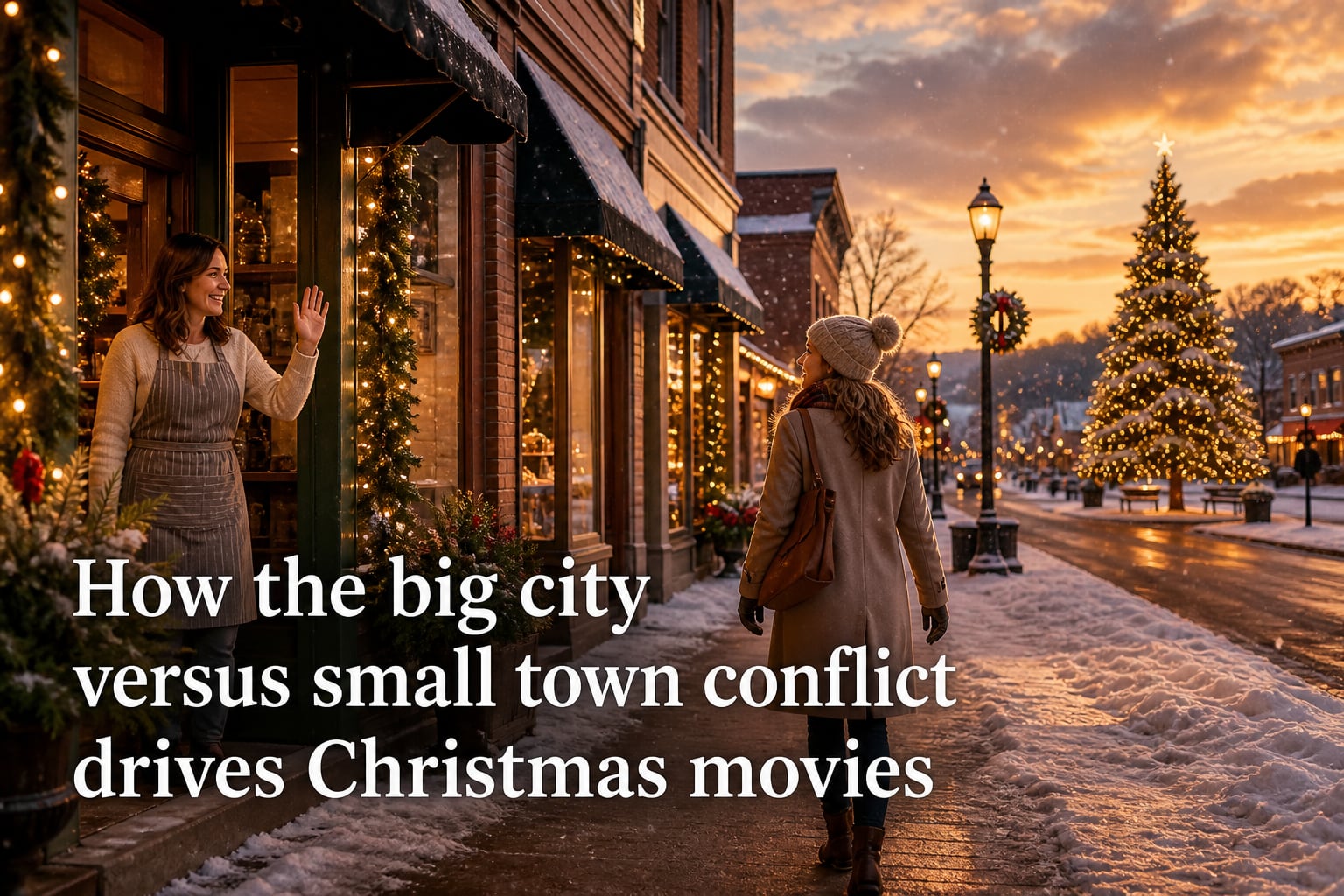
Every December I find myself curled up with the same kind of movie. A successful woman in a sharp blazer stands on a Manhattan rooftop, phone pressed to her ear, looking tired. Cut to snow-dusted main street, twinkle lights, a flannel-wearing widower who runs a toy shop. Two hours later, my cynical heroine is kissing someone under mistletoe and asking how she ever lived without a town Christmas tree.
That arc is the heartbeat of the big city versus small town conflict in Christmas movies. It drives the plot, the romance, and the emotional pull that keeps millions of us pressing play on the same story year after year. I have spent more cozy nights than I will admit tracking how this single urban-rural showdown fuels the entire holiday rom-com engine, and what I found surprised me.
Table of Contents
What Is the Big City vs Small Town Conflict in Christmas Movies?
The big city versus small town conflict in Christmas movies is a narrative trope where a driven urban professional leaves behind a stressful metropolitan life, travels to a tight-knit rural community, and rediscovers love, purpose, and Christmas spirit through small-town relationships.
This conflict powers the genre. The city represents ambition, anonymity, and burnout. The small town represents belonging, tradition, and warmth. Every Hallmark Christmas movie, most Lifetime holiday films, and a growing list of Netflix titles hang their entire story on this axis. Bloomberg’s CityLab famously asked, “Why do Christmas movies hate cities so much?” and the answer keeps playing out on screen each holiday season.
How Big Cities Are Portrayed in Christmas Movies
Big cities in Christmas movies get an almost universally rough treatment. They serve as a foil to the warmth waiting in the fictional small towns our heroines eventually discover.
Career Pressure and Loneliness at the Top
City heroines are nearly always portrayed as successful yet hollow. They land promotions that strain their personal lives. They ghost on family dinners. They stand at window-high office towers watching snow fall between skyscrapers, feeling cold despite the central heating. The message is clear: the corner office is a lonely place to spend Christmas Eve.
Materialism Over Meaning
Big city scenes lean heavily on stock imagery of cold commerce. Crowded sidewalks, taxis honking, generic chain storefronts, and phones buzzing with nonstop work emails. The cities in these films rarely show community squares, block parties, or the incidental kindness the small-town version of the movie delivers in the next scene.
Emotional Distance From Family
Many plots begin with a phone call from a distant parent, an estranged sibling, or a reminder of roots the protagonist has outgrown. The city becomes shorthand for a life that forgot what matters. By the time she boards the train to a small town, audiences already understand her journey as a return to something she never knew she had lost.
How Small Towns Are Portrayed in Christmas Movies
Small towns in Christmas movies are pure wish fulfillment. They show up as places where neighbors know your name, where the mayor knows every shop owner, and where a single Christmas tree lighting marks the start of the season for the whole community.
Main Streets and Locally Owned Shops
Walkable main streets are a recurring visual. Independent bookstores sit beside bakeries beside toy stores. Every storefront has hand-painted signage, wreaths on the door, and warm window light. This appeals to viewers who feel the squeeze of big-box retail and want a setting that still feels human-scaled.
Community Rituals and Christmas Spirit
Every Christmas town has a tree lighting, a holiday parade, a charity bake sale, and at least one public square filled with carolers. The rituals anchor the community and pull the protagonist into activities she once dismissed as small-town hokey. By the climactic scene, she is the one leading the singalong.
Genuine Romance and Slow-Paced Connection
The love interests always have local roots. A lumberjack, a former big-city chef who now runs the only diner, a children’s book author who inherited the family inn. They are present in a way the city never lets anyone be. The romance works because it is built through conversation, kindness, and small daily choices, not through dating app swipes.
The Christmas Movie Formula: How the Conflict Drives the Plot
The conflict is not just a backdrop. It drives the actual story beats of nearly every holiday rom-com, and once you see the formula, you cannot stop spotting it.
Step 1: Establish the City Life
The opening scene establishes a high-powered woman doing a high-pressure job. She is rarely mean, just disconnected. Within five minutes, we see her miss a call from her mother or ignore a holiday invitation. The setup tells us everything we need to know about why she will eventually leave.
Step 2: Send Her to the Small Town
An inciting incident pushes her out of the city. A work project, a family obligation, a wedding, an inheritance of a charming inn. Whatever the pretext, the narrative uses it to drop her into a community where she must slow down and engage.
Step 3: The Romance and Townfolk
She meets the love interest, often while being publicly wrong about something. Townsfolk invite her to dinners. Children ask for her help with pageants. Old rivals challenge her. She begins to soften and find meaning in the ordinariness she once dismissed.
Step 4: The Crisis That Pulls Her Back
Around the midpoint, a work emergency or emotional test makes her rush back to the city. The conflict resurfaces in full. She is forced to choose between her old fast-track life and the slower, warmer path she has begun to love.
Step 5: The Return and the Choice
By the final act, she returns to the small town, usually with some grand gesture. She picks love, community, and the version of herself she never knew existed in the city. The credits roll on a kiss under twinkle lights, and every conflict resolves.
Why Audiences Connect With This Trope
The conflict resonates because many viewers live a version of the city life these movies critique. We sit in traffic. We scroll through endless work chats. We barely know our neighbors.
Escapism and Nostalgia
The small towns on screen promise something most urban viewers long for without naming it. Real face-to-face community. Walkable streets. Time to make a snowman instead of attending a Zoom call. The trope gives us a two-hour mental vacation every December.
The Strong Towns Urbanism Appeal
Urban planners notice the same patterns. Authors writing about the Strong Towns movement point out that small towns in Christmas movies look the way many of us wish our suburbs could feel: human-scaled, locally owned, full of public gathering spaces. The movies are quietly proposing a vision of urbanism that feels warm rather than transactional.
Feminist and Counter Perspectives
Critics also push back. Feminist analyses question whether the trope romanticizes a woman giving up her hard-won career for a man she just met. Some argue the movies dismiss urban life unfairly. Both readings are valid, and they are part of why the conflict keeps sparking conversation.
How Streaming Has Changed the Big City vs Small Town Formula
The trope has not faded. It has scaled. Streaming platforms realized viewers wanted the formula, and they produced more of it.
Netflix and the Saturation Era
Netflix doubled down on holiday rom-coms, dropping dozens of new titles every November. The basic urban-rural showdown still anchors plots, but production values rose. Real city skylines and small-town locations from Vancouver to Romania became the new standard.
Hallmark+ and Loyalty
Hallmark launched Hallmark+ to give its most loyal viewers a year-round stream of the formula. The conflict remains. So do the predictable happy endings that regular viewers count on.
Subgenre Twists
Streaming has also broadened the trope. Some films flip the protagonist’s gender. Some keep the city-vs-country structure but add same-sex leads, blended families, or career pivots that fit modern audiences. The bones of the conflict stay the same, but the skin reflects real change.
Frequently Asked Questions
Where do most Christmas movies take place?
Most Christmas movies take place in small, fictional towns featuring walkable main streets, locally owned shops, and a town square where community events unfold. Films like those on Hallmark and Lifetime use these picturesque settings as an escape from the high-pressure city environments their heroines leave behind.
Do small towns like in Hallmark movies really exist?
Yes, real towns inspired many Hallmark movie locations. Hallmark often films in places like Hope, British Columbia, and various towns in Vermont and Georgia. While the movies exaggerate the charm and the sense of community for storytelling purposes, small towns with strong local businesses, holiday traditions, and tight-knit residents do exist throughout North America.
Why do Christmas movies always set in small towns?
Christmas movies use small town settings for several key reasons. They signal slower pacing, authentic community, and easy-to-spot Christmas spirit through town squares, parades, and family-run businesses. Small towns also create natural barriers that slow down the protagonist and force deeper conversations with the love interest and townspeople.
What is the appeal of the small-town Christmas romance?
The appeal lies in escapism and emotional warmth. Audiences who feel isolated by city living get to imagine a life where everyone knows their name and kindness happens daily. The slow-burn romance in a snowy small-town setting provides comfort, predictability, and a hopeful ending that makes holiday viewing feel like a warm tradition.
Final Thoughts on the Big City vs Small Town Christmas Movie Trope
The big city versus small town conflict in Christmas movies is more than a setup. It is the genre’s emotional engine. It gives us permission to imagine a slower life, kinder neighbors, and a love worth more than the next promotion. Whether you watch Hallmark, Lifetime, or Netflix, you are watching the same quiet wish for a community we can feel at home in. This December, I will keep pressing play, and I am not even a little sorry about it.