
Every December, millions of viewers settle in with hot cocoa to watch a familiar story unfold. A stressed-out city professional travels to a quaint small town, meets a charming local, and rediscovers the meaning of Christmas. The formula is predictable, the endings are happy, and we keep coming back for more.
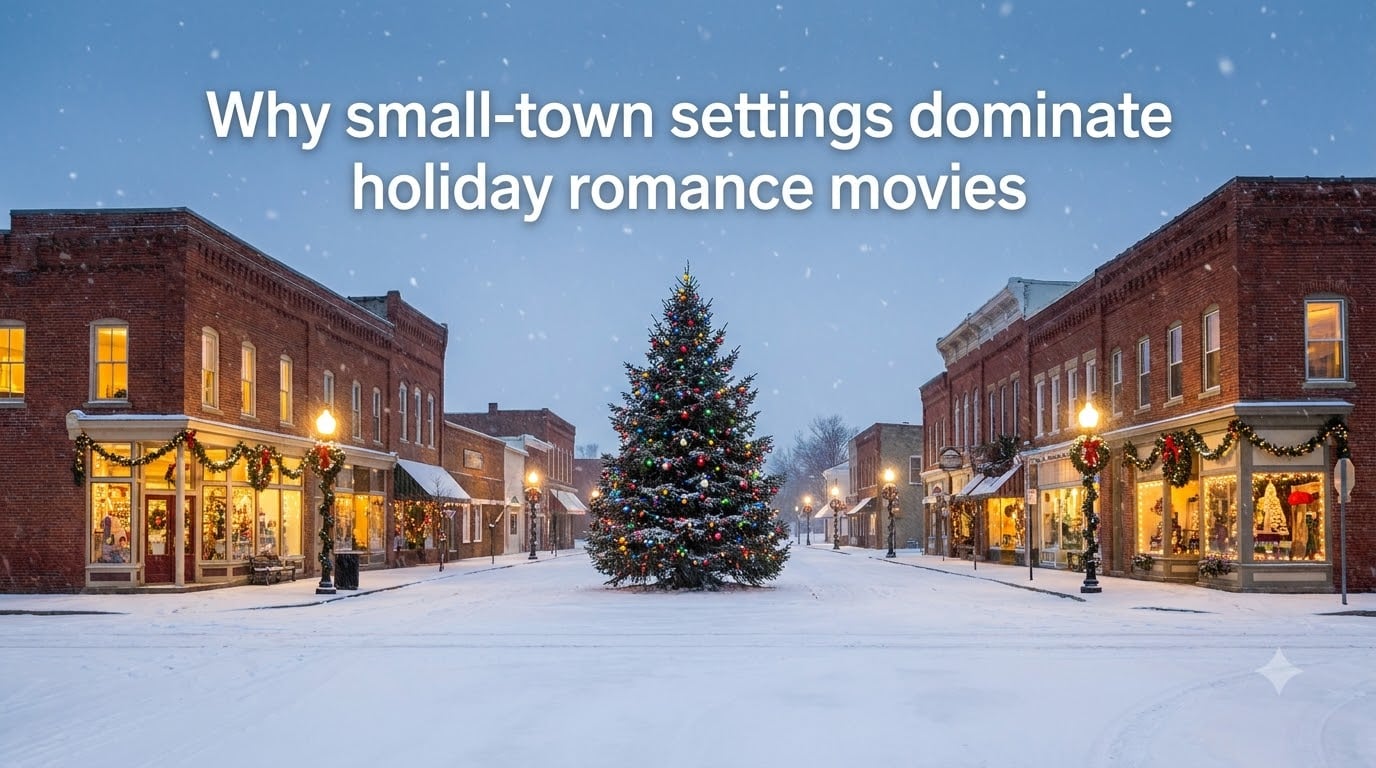
But have you ever stopped to wonder why small-town settings dominate holiday romance movies so completely? In 2026 alone, networks like Hallmark, Lifetime, and Netflix released well over a hundred new holiday romances, and the vast majority share the same fictional geography: a snow-dusted Main Street, a cozy bakery, a town square with a giant tree, and neighbors who actually know each other’s names.
This is not an accident. The small-town setting in holiday romance movies serves specific narrative, psychological, and cultural functions that no other backdrop can replicate. It creates the perfect container for romance, nostalgia, community, and personal transformation all at once.
In this guide, our team breaks down exactly why small-town settings dominate holiday romance movies. We will explore the Hallmark formula, the urban planning angle that most critics miss, the psychology behind our craving for these stories, and whether towns like these actually exist in real life.
Table of Contents
Why Small-Town Settings Dominate Holiday Romance Movies
Small-town settings dominate holiday romance movies because they provide the ideal narrative environment for everything the genre needs to succeed: intimacy, community, nostalgia, escapism, and personal transformation. A small town lets two characters keep running into each other naturally. It surrounds them with neighbors who care. It strips away the anonymity and ambition of city life so the protagonist can rediscover what actually matters.
From a production standpoint, small-town settings are also cheaper to film and easier to control. A single town square set can serve as the backdrop for dozens of movies. The cozy visual aesthetic translates beautifully on screen. And audiences instantly recognize the shorthand: snow-covered streets mean comfort, warmth, and belonging.
Put simply, the small town is not just a backdrop in these films. It is practically a character itself, and it does more narrative work than any city skyline ever could.
The Hallmark Formula Explained
You cannot talk about why small-town settings dominate holiday romance movies without talking about the Hallmark formula. Hallmark Channel did not invent the small-town Christmas romance, but they perfected it into a repeatable blueprint that competitors now follow.
The formula goes something like this. A successful but unhappy city woman returns to her hometown (or visits a small town for work) during the holiday season. She encounters an old flame, a handsome local business owner, or a charming stranger who somehow has unlimited free time despite owning the entire town. Through a series of festive activities like tree lighting, ice skating, and cookie baking, she reconnects with her true self.
Along the way, a corporate antagonist or big-city obligation threatens to pull her back. The climax forces a choice between ambition and connection. She always chooses connection.
This formula works because it taps into something deeply relatable. Many viewers feel the tension between career pressure and personal fulfillment. Watching someone choose love, family, and community over a promotion is a fantasy that resonates across demographics.
The small town is essential to the formula because it represents the alternative. Without the small-town setting, there is no contrast. There is no place for the protagonist to escape to and rediscover herself.
City vs Small-Town Values: The Central Conflict
At the heart of nearly every holiday romance is a values clash between the big city and the small town. The city represents ambition, efficiency, career success, and often emotional isolation. The small town represents community, tradition, slowness, and genuine human connection.
This contrast is what makes the romance believable. In the city, the protagonist has no time for love. Everyone is busy, transactions are impersonal, and relationships feel transactional. In the small town, time slows down. People linger over coffee. The baker remembers your order. The hardware store owner knows your family history.
The romance blooms precisely because the environment allows it. In a city setting, two busy professionals might swipe past each other on a dating app. In a small town, fate keeps pushing them together at the same tree lighting ceremony, the same diner, and the same holiday festival.
Reddit users on r/HallmarkMovies frequently point out that you almost never see a holiday romance where someone goes to the big city to find love. The genre is fundamentally about leaving the city behind, not embracing it. The small town is the destination, not the departure point.
Nostalgia and Escape: Why We Crave These Settings
If you want to understand what makes holiday romantic comedies so appealing, look at nostalgia. These films offer viewers a portal to a version of America that may have never fully existed but feels like it should have. Main Streets are thriving. Independent bookstores survive. The local diner is the social hub. Everyone shows up for the holiday pageant.
This nostalgia functions as a form of escapism, and that escapism is the point. Holiday romance movies are comfort viewing. They are the cinematic equivalent of a weighted blanket. Viewers who are stressed about work, family obligations, financial pressure, or loneliness can disappear into a world where problems are solvable, neighbors are kind, and love always wins.
The craving is especially strong during the holidays themselves. The holiday season carries enormous emotional weight. It amplifies both joy and grief. People who feel lonely during the holidays find solace in fictional communities where everyone belongs and no one spends Christmas alone.
Even viewers who are aware of the formula find satisfaction in it. Horror movie fans on Reddit regularly admit to binging Hallmark Christmas films despite never watching romance otherwise. The predictability is the feature, not the bug.
The Community Theme in Holiday Romances
Community is the engine that powers holiday romance movies. Without it, the small-town setting would feel hollow. The genre understands that romance does not happen in a vacuum. It happens inside a web of relationships, traditions, and shared experiences.
This is why every small-town holiday movie features the same community touchstones: a tree lighting ceremony, a holiday festival, a charity event, a school pageant, a bake sale. These events are not just window dressing. They are the mechanism through which the two leads connect, the supporting characters rally around them, and the town itself becomes invested in the outcome.
Sociologists call the value these settings represent social capital, which is the network of relationships and mutual trust that holds a community together. Holiday romance movies depict communities rich in social capital, where people show up for each other, lend a hand, and celebrate together.
For many viewers, this representation of community is itself the fantasy. Studies consistently show that Americans are lonelier than ever, with social isolation on the rise across age groups. The small-town holiday romance offers a vision of belonging that feels increasingly out of reach in modern life.
That emotional hunger is exactly why the genre keeps growing. Networks are not making these movies despite their formula. They are making them because the formula answers a real, widespread cultural need.
The Urban Planning Perspective: Walkability and Strong Towns
Here is an angle most critics miss. Urban planners actually envy the towns depicted in holiday romance movies. The fictional communities in these films possess walkability, active public spaces, low car traffic, and vibrant mixed-use Main Streets that real-world planners spend careers trying to create.
The Strong Towns movement, which advocates for financially resilient, human-scaled communities, could use these movie towns as case studies. Everything is within walking distance. The bakery, the bookshop, the inn, and the town square are all on one street. People gather in public spaces rather than retreating to private backyards or commuting through drive-throughs.
This is not accidental. The walkability and proximity are what make the romance possible. The two leads keep bumping into each other because the town is designed for foot traffic and spontaneous encounters. In a car-dependent suburb, they would never meet.
The contrast with real urban planning is striking. Most American towns built after 1950 prioritized cars over pedestrians, separated commercial and residential zones, and eliminated the very mixed-use density that makes small-town movie settings feel so alive. The holiday romance small town is, in many ways, a longing for a style of community design that America largely abandoned.
That is part of its power. The setting does not just evoke nostalgia for a time period. It evokes nostalgia for a way of building places that put human connection first.
Regional Settings: Why the Midwest and New England Dominate
If you watch enough holiday romance movies, you will notice a geographic pattern. The fictional towns are almost always in the Midwest or New England. You rarely see a holiday romance set in suburban Phoenix or coastal Florida.
The reason is partly visual. The Midwest and New England offer snow, historic architecture, town commons, covered bridges, and dense Main Streets that read as classic Americana on camera. These regions also carry strong cultural associations with tradition, family farms, and old-fashioned values.
In reality, most of these movies are not filmed in the Midwest or New England at all. Canada, particularly British Columbia and Ontario, stands in for fictional American small towns because of tax incentives and reliable snow. The towns you see on screen are often real Canadian communities dressed up to look like Vermont or Colorado.
The Reality Behind Small-Town Movie Settings
So, do small towns like in Hallmark movies really exist? The honest answer is: sort of, but not exactly as depicted.
Real small towns across America do have genuine community bonds, holiday traditions, and local businesses that residents cherish. Towns like Frankenmuth in Michigan, Leavenworth in Washington, and Stowe in Vermont lean into their Christmas-movie aesthetic and attract visitors who want that experience. Some communities genuinely do host tree lightings, holiday parades, and festivals that look straight out of a film.
However, the movie version streamlines reality. Real small towns also face economic challenges, population decline, limited job opportunities, and infrastructure struggles that never appear on screen. The films present an idealized version that preserves the warmth and strips away the hardship.
That idealization is not a flaw from the viewer’s perspective. It is the entire appeal. These movies sell a fantasy of community perfection, and audiences buy it willingly every November and December.
The Psychology Behind the Appeal
The psychological comfort of small-town holiday romances deserves more attention than it gets. These films function as emotional regulation tools. Their predictability reduces anxiety. Their happy endings release dopamine. Their cozy aesthetics activate parasympathetic relaxation responses.
Psychologists who study media and emotion note that comfort viewing serves a real purpose. When the world feels chaotic, returning to a story where you already know the outcome provides a sense of control and safety. Holiday romance movies deliver exactly that, packaged in warmth, music, and twinkling lights.
The small-town setting amplifies this effect. Research on environmental psychology shows that humans respond positively to environments that feel safe, contained, and socially connected. The small-town movie set triggers those responses even though the viewer knows it is fictional.
There is also a parasocial element. Regular viewers develop attachments to recurring actors, character types, and even fictional towns. Hallmark recycles the same performers across movies, creating a familiar roster that feels like an extended family. The small town becomes a place viewers return to year after year, the way others return to a childhood home.
This explains why some viewers watch dozens of these movies every season. They are not seeking novelty. They are seeking the emotional equivalent of coming home.
Cultural Criticism and Defenses of the Genre
The dominance of small-town settings in holiday romance is not without critics. Some cultural commentators argue that these films promote a conservative, idealized vision of America that erases urban diversity, modern career ambition, and nontraditional family structures. Others note that the formula almost always shows a woman leaving her career for love, which can read as regressive.
However, defenders push back against this reading. A feminist defense of the genre argues that choosing community and connection over corporate grind is not anti-feminist. It is a valid critique of a work culture that burns women out. The heroine is not giving up her agency. She is exercising it by choosing a life that actually fulfills her.
The debate itself reflects larger cultural tensions about what a good life looks like. Holiday romance movies take a clear position: connection over ambition, community over isolation, presence over productivity. Whether you agree with that position or not, the films clearly resonate with millions of viewers who feel something is missing from modern life.
FAQs
Do small towns like in Hallmark movies really exist?
Yes, but not exactly as depicted. Real towns like Frankenmuth in Michigan, Leavenworth in Washington, and Stowe in Vermont capture the holiday-movie aesthetic with charming Main Streets and Christmas traditions. However, movie towns streamline reality by removing economic struggles and everyday challenges, presenting an idealized version of community life.
What makes holiday romantic comedies so appealing?
Holiday rom-coms appeal through nostalgia, predictable happy endings, cozy aesthetics, and emotional comfort. They offer escapism from modern stress, depict communities rich in social connection, and provide the satisfaction of watching characters choose love and belonging over career pressure. Their formulaic nature is a feature that reduces anxiety and delivers reliable comfort viewing.
Why are so many Christmas movies set in the Midwest?
The Midwest and New England dominate because they offer snow, historic architecture, town commons, and visual associations with classic Americana. In reality, most films are shot in Canada for tax incentives and reliable winter weather, with Canadian towns dressed to look like Vermont, Colorado, or small-town America.
Why do Christmas movies always involve a small town or community?
Small-town settings provide the narrative intimacy that romance requires. Characters keep encountering each other naturally in walkable, tight-knit communities. The town itself drives the plot through festivals, traditions, and communal events. Without the small town, there is no contrast with city life and no space for the protagonist to slow down and rediscover connection.
What are those Christmas romance movies called?
These films are commonly called Hallmark Christmas movies, holiday rom-coms, made-for-TV Christmas romances, or simply holiday romance movies. The genre exploded with the Hallmark Channel and has expanded to Lifetime, Netflix, Great American Family, and streaming platforms producing dozens of new titles each holiday season.
Conclusion
Understanding why small-town settings dominate holiday romance movies means understanding what audiences are really craving. These films are not just about romance. They are about belonging, community, nostalgia, and the fantasy of a life where human connection comes first.
The small town works because it creates the perfect conditions for all of that to unfold. It is walkable, intimate, festive, and warm. It contrasts sharply with the loneliness and ambition of city life. And it gives viewers something many of them feel is missing from their own lives: a place where everyone knows your name and no one spends the holidays alone.
As long as that cultural hunger persists, small-town settings will keep dominating holiday romance movies. The formula endures because it answers a real need, and that need is not going away anytime soon.