
Pedro Almodovar’s Parallel Mothers (2021) is one of those films that stays with you long after the credits roll. Starring Penelope Cruz as Janis and Milena Smit as Ana, the movie weaves together a deeply personal story about motherhood with Spain’s unresolved trauma from the Franco era. If you finished the film and found yourself wondering what just happened, you are not alone. Reddit threads from r/movies and other film communities show that many viewers felt the same way.
The confusion usually comes from one specific challenge: the film asks you to follow two storylines at once. One is an intimate drama about two women connected by a secret involving their newborns. The other is a political reckoning with mass graves from the Spanish Civil War. Almodovar never spells out how these two threads connect, and that is exactly what trips people up.
In this guide, I break down the Parallel Mothers ending explained in plain language. I cover what happens in the final scene, what it means when the villagers lie down in the grave, and how the personal story mirrors Spain’s historical memory crisis. Whether you watched the film once or five times, this breakdown will give you the context you might have missed.
Table of Contents
Parallel Mothers Plot Summary: The Two Storylines
To understand the ending, you need to understand the setup. The film follows two women who meet in a hospital room and give birth on the same day. Janis (Penelope Cruz) is a confident, older photographer in her late thirties. Ana (Milena Smit) is a frightened teenager, barely an adult, who is terrified of giving birth and of the man who fathered her child.
The two women bond during their shared hospital stay. Janis names her daughter Cecilia. Ana names her daughter Anita. After they leave the hospital, their paths diverge, but the connection between them is far from over.
Here is where the personal storyline takes a dark turn. Janis begins to suspect that the hospital accidentally swapped the babies. She takes a DNA test, which confirms that Cecilia is not her biological daughter. Anita, the child being raised by Ana, is actually Janis’s biological baby. And Cecilia, the child Janis has been raising, is Ana’s biological daughter.
Rather than telling Ana immediately, Janis stays silent. She has fallen in love with Cecilia and cannot bear to lose her. This decision becomes the moral weight the film carries for its entire second act. Janis knows the truth, profits from the lie, and must eventually face what she has done.
Running parallel to this domestic drama is a very different story. Janis has been working with Arturo, a forensic anthropologist, to locate and exhume a mass grave in her home village. Her great-grandfather was among the men rounded up and executed by Falangist forces during the Spanish Civil War, then buried in an unmarked trench. Janis wants to find his remains and give him a proper burial. This historical memory plotline is not a subplot. It is the emotional and political spine of the entire film.
Parallel Mothers Ending Explained: What Actually Happens
The ending of Parallel Mothers resolves both storylines in a way that ties personal truth-telling to historical truth-telling. Here is exactly what happens.
Janis finally confesses to Ana that their babies were swapped at birth. She admits she has known for months and chose to stay silent because she loved raising Cecilia. Ana is devastated and furious, and rightfully so. The revelation fractures their relationship. Ana takes Cecilia back and cuts Janis out of her life.
But the film does not end there. Ana eventually returns, drawn back not just by the children’s bond but by her own need to process what happened. She and Janis reach a fragile understanding. The two women agree to share in raising both children, accepting that their lives are permanently intertwined. The lie has been exposed, and the truth, however painful, has set something right.
Simultaneously, the exhumation of the mass grave finally begins. Arturo and his team open the trench where Janis’s great-grandfather and other victims were dumped after their execution. The remains are carefully uncovered, documented, and prepared for identification. For Janis, this is the culmination of years of effort.
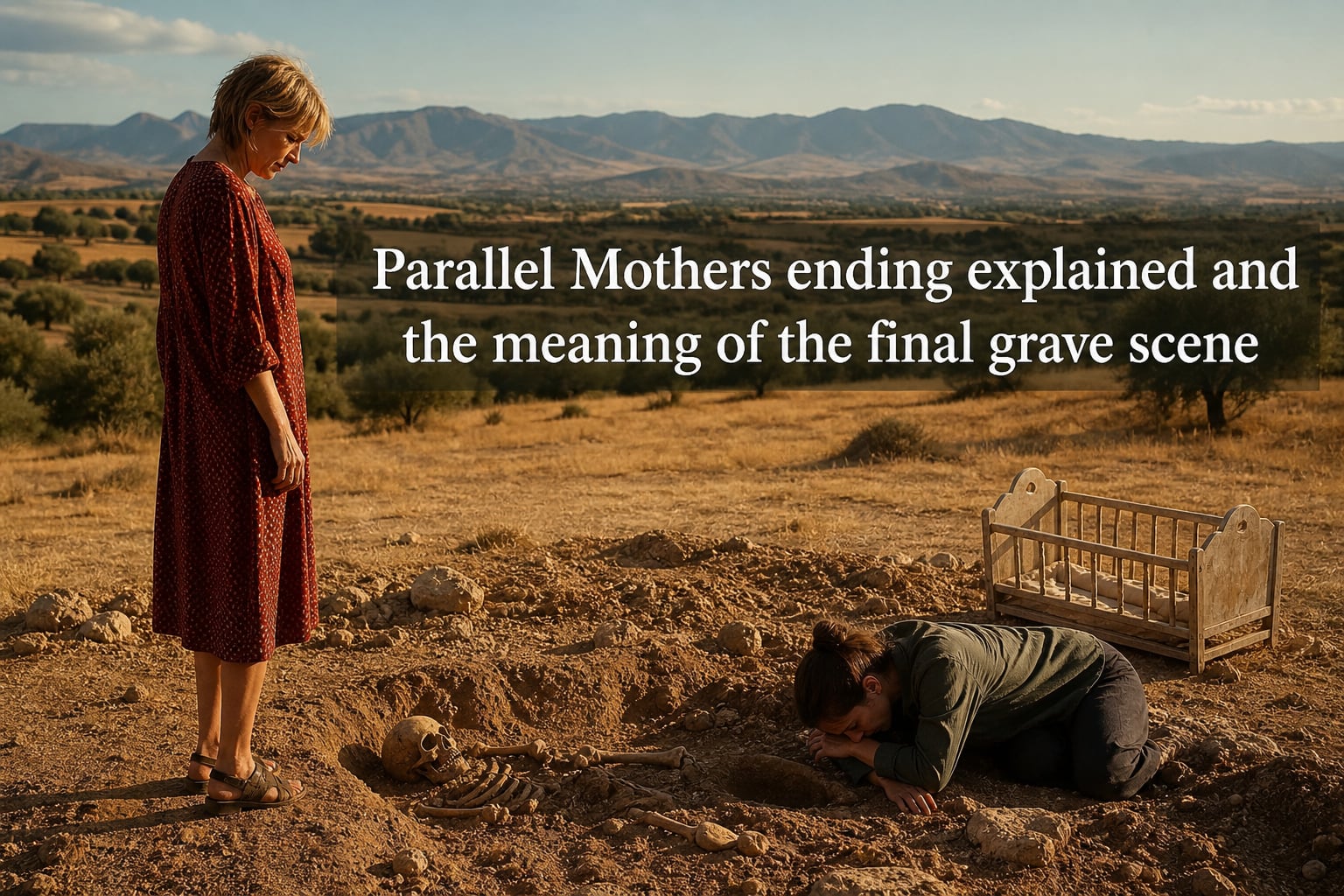
The final scene brings everything together. Janis, Ana, and other villagers gather at the exhumation site. The skeletal remains of the executed men lie exposed in the narrow trench. And then something unexpected happens. The living descendants climb down into the grave and lie down beside the bones of their ancestors.
That is where the film ends. No dialogue. No voiceover explaining the symbolism. Just the image of the living resting alongside the dead, followed by a close-up of an eye. For many viewers, this is the moment that raises the most questions, and it is the scene I will unpack in the next section.
The Final Grave Scene: What It Means When the Villagers Lie Down
The final grave scene is the most talked-about moment in Parallel Mothers, and it is the scene the film’s title points toward. After the mass grave is opened, the descendants of the executed men climb down into the trench and lie beside the exposed skeletons. It is quiet, deliberate, and deeply moving.
So what does it mean? There are several layers to unpack, and each one connects to the film’s larger themes.
A literal act of remembrance. These families have spent decades not knowing where their loved ones were buried. The pacto del olvido, Spain’s unofficial pact of forgetting after Franco’s death, meant the state did nothing to find or identify these victims. By lying beside the remains, the descendants are doing what the government refused to do. They are acknowledging the dead. They are saying: you are not forgotten, and you are not alone.
A reversal of the burial. When these men were killed, they were thrown into a trench and covered over. The act was designed to erase them, to make them disappear. The descendants lying in the grave reverses that erasure. It brings the living into physical contact with the dead, turning an act of violence into an act of tenderness.
The parallel between cradles and graves. This is the connection that gives the film its power. Throughout Parallel Mothers, birth and death are mirrored. Janis brings a new life into the world while fighting to recover lives that were taken. The grave scene shows that both acts, birthing and burying, are acts of care. The film argues that the same instinct that drives a mother to hold her newborn drives a descendant to lie beside her executed great-grandfather.
A communal act, not an individual one. Janis does not lie in the grave alone. The entire community of descendants joins her. This matters because historical memory in Spain has always been a collective struggle. The Association for the Recovery of Historical Memory (ARMH) and other groups have fought for decades, often against government resistance, to excavate these sites. The scene honors that collective effort.
The final image, a close-up of an eye, adds one more layer. Throughout the film, Almodovar uses eyes and looking as recurring motifs. The eye in the final shot is about witness. It says: we have seen this, and now you have seen it too. The audience is being asked to bear witness alongside the characters.
Cradles and Graves: The Central Symbolism
The phrase “cradles and graves” comes from The New Yorker‘s analysis of the film, and it captures Almodovar’s central metaphor perfectly. Parallel Mothers is built on the idea that birth and death are not opposites. They are parallel acts, connected by the same human impulse to hold, protect, and remember.
Think about the film’s structure. Janis gives birth in a hospital room. Later, she watches a mass grave being opened. In both scenes, bodies that were hidden, a baby in the womb, skeletons in the earth, are brought into the light. Both acts require labor, patience, and courage. Both result in something that was concealed being revealed.
This is why the baby swap matters thematically, not just dramatically. Janis hides the truth about which child belongs to whom, just as Spain hid the truth about what happened to its disappeared citizens. When she finally confesses, she is doing on a personal level what the exhumation does on a political level. She is uncovering a buried truth.
Almodovar also draws a visual parallel. The hospital scenes are shot in warm, bright colors. The exhumation scenes are shot in earth tones. But the emotional register is the same. Both involve women doing difficult, necessary work to bring something hidden into the open. The cinematography invites you to feel the connection rather than intellectualize it.
This symbolism is also deeply personal for Almodovar himself. He was born in a small village in La Mancha and grew up surrounded by the silences of the Franco era. Parallel Mothers was his first film to directly address the mass graves of the Spanish Civil War, and he has said in interviews that the historical memory movement is one of the most important issues in Spain today. The cradles-and-graves metaphor is not just an artistic choice. It is a political statement.
The Spanish Civil War and the Pacto del Olvido
If you are not familiar with Spanish history, some of the political context in Parallel Mothers may go over your head. Here is what you need to know to fully understand the film.
During the Spanish Civil War (1936 to 1939), fascist forces led by General Francisco Franco fought against the democratically elected Republican government. Franco’s side, supported by the Falangist movement, executed tens of thousands of people suspected of opposing them. These victims were buried in unmarked mass graves scattered across the country. Estimates suggest there are more than 2,000 such graves in Spain, containing over 100,000 bodies.
After Franco died in 1975, Spain transitioned to democracy. But the transition came with an unofficial bargain known as the pacto del olvido, the pact of forgetting. Both sides agreed to sweep the past under the rug. There would be no truth commission, no trials, no official effort to find or identify the disappeared. The mass graves were left untouched.
This pact was a political compromise meant to prevent a return to violence. But for the families of the victims, it meant decades of additional suffering. They knew their relatives had been killed and dumped somewhere nearby, but the state refused to help them find the remains. Grassroots organizations like the ARMH, founded in 2000, began doing the work the government would not, locating graves, organizing exhumations, and using forensic anthropology to identify remains.
In 2007, the Spanish government passed the Law of Historical Memory, which formally condemned the Franco regime and promised support for exhumation efforts. But implementation has been slow and inconsistent. By the time Parallel Mothers was released in 2021, thousands of graves remained unexcavated.
This is the backdrop against which Janis’s story unfolds. When she asks Arturo to help find her great-grandfather, she is participating in a struggle that has defined Spanish civic life for decades. The film is not exaggerating. The exhumations are real, ongoing, and deeply controversial. Almodovar is putting one of Spain’s most sensitive political issues on screen and asking audiences to look at it directly.
The Antigone Parallel: Women as Justice Seekers
One of the most overlooked aspects of Parallel Mothers is its connection to Antigone, the ancient Greek tragedy by Sophocles. In that play, Antigone defies the state to bury her brother, who has been denied a proper funeral. She insists that the dead deserve burial and remembrance, even when the government forbids it.
Janis is a modern Antigone. She defies the pacto del olvido, the state’s unwritten rule that the past should stay buried, to find her great-grandfather’s remains. She works with a forensic anthropologist, raises money, and pushes through bureaucratic resistance. Like Antigone, she is driven by a moral conviction that the dead cannot simply be forgotten.
This parallel is not accidental. Almodovar has long been interested in the ways women serve as the keepers of memory and the agents of justice. In Parallel Mothers, it is Janis, not a government agency, who initiates the exhumation. It is women who gather at the graveside. It is women who must confront both personal and historical betrayals.
The Antigone parallel also extends to Ana. After Janis confesses the baby swap, Ana becomes the one who insists on truth and accountability. She demands that the wrong be acknowledged and corrected, even though doing so causes enormous pain. In the world of this film, women are the ones who dig up buried secrets, whether those secrets are family lies or mass graves.
This is one of the reasons the final scene resonates so powerfully. When the villagers lie down in the grave, they are performing an Antigone-like act. They are claiming the right to remember, to bury their dead with dignity, and to insist that the past matters even when the state would rather it disappear.
What Does “Parallel” Really Mean in Parallel Mothers?
The title Parallel Mothers operates on multiple levels, and understanding each one helps the ending click into place. Viewers on Reddit and other forums frequently ask about the connection between the two storylines. The word “parallel” is the key.
The most obvious meaning is literal. Two mothers give birth on the same day, in the same hospital room, in parallel beds. Their lives run side by side from that moment forward. But the parallel goes deeper than shared timing.
The two storylines, the baby swap and the mass grave exhumation, are structurally parallel. Both involve a truth that has been buried. Both require someone to do the painful work of uncovering it. Both involve women taking responsibility for setting things right. The personal betrayal Janis commits by hiding the baby swap mirrors the political betrayal of the pacto del olvido. In both cases, someone decided it was easier to leave the truth underground.
There is also a temporal parallel. The film cuts between the present-day drama of Janis and Ana and the decades-old atrocity of the Civil War executions. These two timelines run parallel throughout the film, gradually converging in the final scene. By the end, the personal and the historical are no longer separate stories. They are the same story about what happens when truth is suppressed and what it costs to bring it back.
The parallel between motherhood and memory is the deepest layer. A mother creates life and is responsible for nurturing it. A society that remembers its history is responsible for acknowledging its dead. Janis fails as a mother when she hides the truth about the baby swap. Spain fails as a society when it hides the truth about the mass graves. The film’s argument is that both failures come from the same impulse, the desire to avoid uncomfortable truths, and that both require the same remedy, the courage to face what has been buried.
This is why the ending works even though it resolves nothing politically. The mass grave is opened, but Spain’s broader historical memory crisis is far from solved. What changes is personal. Janis tells the truth. The community gathers. The dead are acknowledged. The film suggests that every act of truth-telling, no matter how small, is a step toward justice.
FAQs
What is the ending of Parallel Mothers?
The ending of Parallel Mothers resolves both the personal and historical storylines. Janis confesses to Ana that their babies were swapped at birth. Ana takes back her biological daughter, and the two women eventually reach a fragile agreement to share in raising both children. Simultaneously, the mass grave containing Janis’s great-grandfather and other Civil War victims is finally exhumed. The film ends with the descendants lying down beside the uncovered remains, a quiet act of remembrance and solidarity with the dead.
Is Parallel Mothers based on a true story?
Parallel Mothers is a work of fiction, but its historical context is entirely real. The mass graves from the Spanish Civil War, the pacto del olvido that left them unexcavated, and the grassroots exhumation movement led by organizations like the ARMH are all factual. Pedro Almodovar wrote the fictional characters of Janis and Ana to dramatize Spain’s ongoing historical memory crisis.
How old is Ana in Parallel Mothers?
Ana is a teenager in Parallel Mothers, still in her late teens. The film establishes her youth through her inexperience, her fear during childbirth, and her vulnerability compared to the older, more confident Janis. Milena Smit was in her early twenties when she played the role.
Why does everyone lie in the grave at the end of Parallel Mothers?
The descendants lie in the grave as an act of remembrance and solidarity. For decades, the Spanish government did nothing to find or identify the victims buried in mass graves. By physically lying beside the remains, the families are doing what the state refused to do, acknowledging the dead and refusing to let them remain forgotten. The act also mirrors the film’s central metaphor: the same impulse that drives a mother to hold her newborn drives a descendant to lie beside an executed ancestor.
What is the pacto del olvido mentioned in the film?
The pacto del olvido, or pact of forgetting, was an unofficial political agreement after Franco’s death in 1975. Both sides of Spain’s political spectrum agreed to ignore the crimes of the Civil War and the dictatorship to enable a peaceful transition to democracy. There would be no truth commission, no trials, and no official effort to locate mass graves. As a result, an estimated 100,000-plus bodies remained in unmarked graves for decades, and families were left to search for their loved ones on their own.
Final Thoughts on the Parallel Mothers Ending
The Parallel Mothers ending explained comes down to one simple but powerful idea: the truth cannot stay buried forever. Whether it is a family secret about swapped babies or a mass grave containing victims of a fascist regime, Almodovar argues that buried truths will always find their way to the surface. And when they do, someone has to be brave enough to face them.
The final grave scene is the film’s thesis statement in visual form. The living lying beside the dead is an act of radical remembrance. It says that caring for the dead is no different from caring for the living, and that a society that refuses to acknowledge its past cannot fully move forward from it. The women in this film, Janis, Ana, and the unnamed villagers at the graveside, are the ones doing that work because no one else will.
If this breakdown deepened your appreciation for the film, I would recommend exploring more of Almodovar’s work. Talk to Her (2002) and Volver (2006) also explore themes of women, silence, and buried truths. For the real-world context behind Parallel Mothers, the documentary The Silence of Others (2018) covers the ongoing fight by victims’ families to uncover Franco-era mass graves. Both will give you an even richer understanding of what Almodovar was reaching for in this film.
The beauty of Parallel Mothers is that it does not separate the political from the personal. It shows that every act of remembrance, whether in a hospital room or at a graveside, is an act of love. And that is what makes the ending so quietly devastating.