
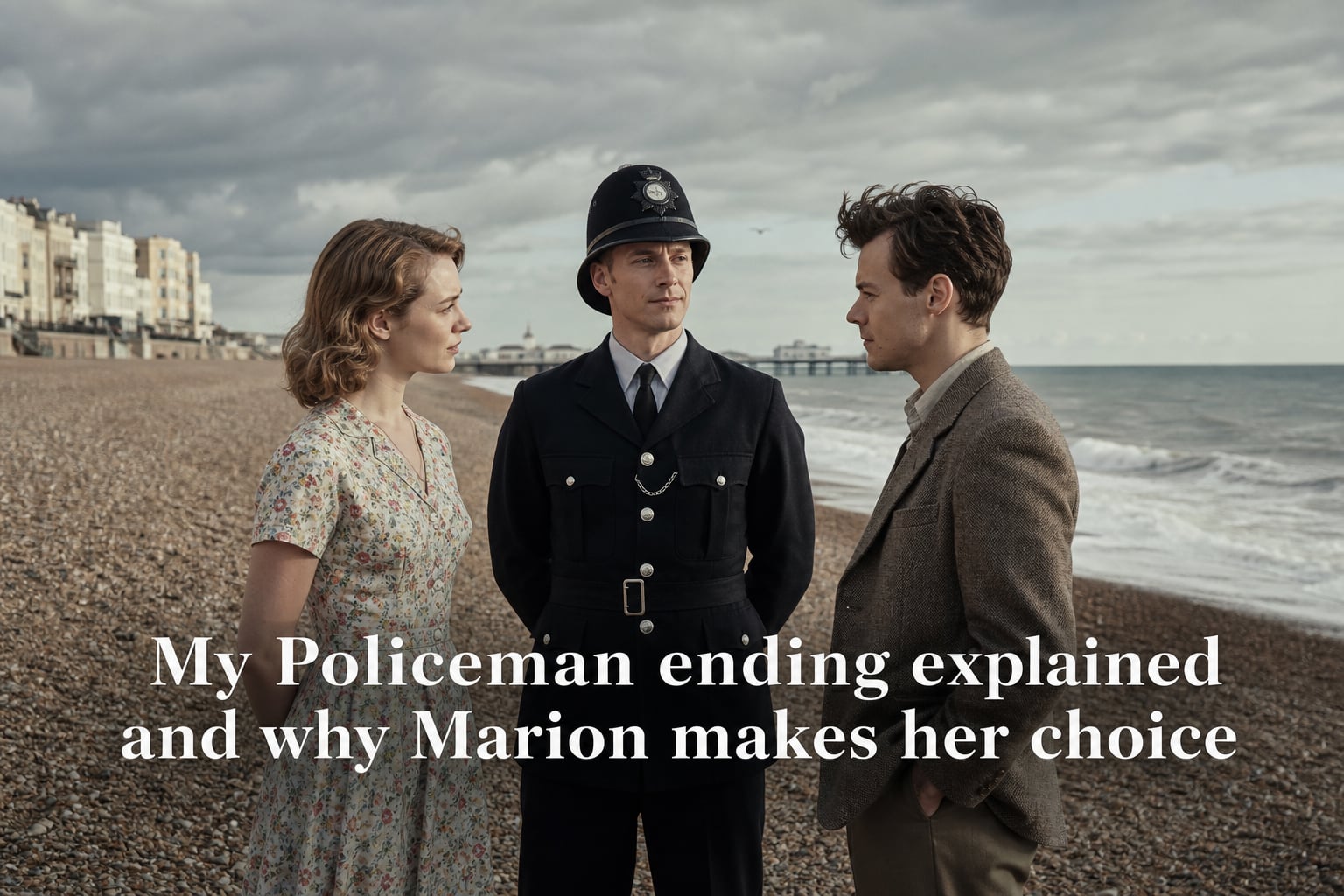
My Policeman is one of those films that lingers long after the credits roll. The 2022 Amazon Prime Video release, based on Bethan Roberts’ novel and starring Harry Styles, Emma Corrin, and David Dawson, tells a love story stretched across forty years of secrecy, guilt, and missed chances. When the final scene fades to black, most viewers share the same reaction: wait, why did Marion do that?
If you finished the film still piecing together what drove Marion Burgess to walk out on Tom after decades of marriage, you are not alone. In this My Policeman ending explained breakdown, I will walk through every key moment from both timelines, decode why Marion makes her choice, and clarify what happens between Tom and Patrick after she leaves. Spoilers ahead, obviously.
Table of Contents
My Policeman Ending Explained: The Quick Answer
Marion leaves Tom because caring for an ailing Patrick Hazlewood forces her to confront a truth she buried for forty years: Tom never truly loved her the way he loved Patrick. Her decision is not sudden revenge. It is an act of release for all three of them.
By writing a confession manuscript about how she reported Patrick to the police in the 1950s and reading it aloud, Marion finally owns her role in destroying Tom’s happiness. She then walks away so that Tom and Patrick can have the relationship society denied them decades earlier. The ending is bittersweet — Marion loses her marriage, but Tom gets a second chance at love before Patrick’s health fails completely.
Who Are Tom, Marion, and Patrick?
Tom Burgess is a Brighton policeman in 1950s England, a man who has known he is attracted to men but lives in a society where homosexuality is a criminal offence. He marries Marion Taylor, a schoolteacher who genuinely loves him, even as she suspects something is unfinished in their relationship. Patrick Hazlewood is a museum curator who becomes Tom’s lover while also building a friendship with Marion.
The three form an uneasy triangle. Patrick introduces Tom to a world of art, museums, and quiet intimacy. Marion, unaware at first of the affair, becomes close to Patrick herself. The tension between what each character knows, what they suspect, and what they refuse to say drives the entire story toward its devastating climax.
What Happens in the 1950s Timeline?
The younger timeline follows Tom and Marion’s courtship and marriage. Tom meets Patrick through the museum, and their connection is immediate and physical in a way Tom’s relationship with Marion never becomes. Patrick and Tom travel together, including a trip to Venice that becomes the emotional peak of their affair.
Marion grows suspicious. She notices Tom’s absences, his closeness with Patrick, and the way Patrick occupies a space in Tom’s life she cannot reach. The Venice trip is the breaking point — Marion realizes Patrick and Tom’s bond goes far deeper than friendship.
Rather than confront Tom directly, Marion takes a step that will define the next forty years. She writes a letter to Patrick’s employer and reports him to the police. In 1950s England, this is not a private grievance. It is a criminal accusation that can destroy a man’s life.
Why Marion Reported Patrick to the Police
This is the question that divides audiences. Marion’s decision to report Patrick is not born from pure malice, but from a toxic combination of jealousy, hurt, and the internalized homophobia of her era. She has spent years feeling second-best in her own marriage.
Marion believes Patrick has stolen her husband. In her mind, reporting him is a way to remove the obstacle between her and the marriage she thought she had. She likely tells herself she is protecting Tom from a dangerous secret that could land him in prison too.
The reality is crueller. Patrick loses his job, faces legal consequences, and his health deteriorates under the stress. Tom, consumed by guilt and fear, never visits Patrick. He stays with Marion, but their marriage becomes a shell — two people sharing a house while living in separate emotional prisons.
The 1999 Timeline: Patrick Returns
The film jumps forward forty years. Patrick, now elderly, has suffered a serious stroke that leaves him needing full-time care. Marion, who has lived with the weight of her secret for decades, brings Patrick into their home and becomes his caretaker. Tom is furious.
Tom resents Marion for allowing Patrick back into their lives. He avoids Patrick, refuses to help with his care, and lashes out at the disruption to his quiet routine. But underneath the anger, something older and deeper is breaking open. Patrick’s presence is a constant reminder of everything Tom lost — the love he surrendered, the man he abandoned, and the lie he lived for forty years.
Marion’s daily care of Patrick is her penance. She feeds him, reads to him, and tends to his needs while Tom watches from a distance. The arrangement is unsustainable, and everyone in that house knows it.
Why Tom Cried at the Store Seeing the Gay Couple
One of the most discussed scenes in the film is Tom’s emotional breakdown at a shop. While out running errands, Tom sees two men — a gay couple — shopping together openly, holding hands, behaving as a normal pair in love. He begins to weep.
For Tom, this moment is a collision of past and present. In the 1950s, the love he shared with Patrick had to stay hidden. A gesture as simple as holding hands could have led to arrest, imprisonment, and total social ruin. Seeing two men in 1999 living freely throws forty years of repression into sharp relief.
Tom is not just grieving Patrick. He is grieving the life they could have had if they had been born a few decades later. The tears are for every suppressed moment, every lie, and every year he spent choosing safety over honesty. This scene often hits viewers hardest because it makes the film’s historical stakes viscerally personal.
Marion’s Confession Manuscript and Her Choice to Leave
Here is the heart of the entire film. Marion has been writing a manuscript — a confession. In it, she details what she did in the 1950s: how she reported Patrick, how she knew the consequences, and how she lived with that secret while watching Tom drift further away from her every year.
When Marion reads the confession aloud, she is not asking for forgiveness. She is finally telling the truth. The act of writing and sharing it is her way of breaking the silence that poisoned all three of their lives. Forum discussions and reader reactions consistently identify this confession as the emotional core of Bethan Roberts’ story.
So why does Marion make her choice to leave? Several forces converge at once. Caring for Patrick day after day forces her to see the man whose life she helped destroy up close. She watches Tom soften around Patrick, and she recognizes a tenderness Tom never showed her. The confession crystallizes what she has always known: she was never the person Tom truly wanted.
Marion leaves because staying would mean continuing to live a lie. Her departure is simultaneously a punishment for herself, a gift to Tom, and the closest thing to freedom any of them can claim. By walking away, she gives Tom permission to love Patrick openly in the time they have left.
What Happens After Marion Leaves?
After Marion’s departure, the ice between Tom and Patrick finally cracks. Tom begins to care for Patrick directly — feeding him, spending time with him, and allowing the affection he suppressed for forty years to surface. The two old men share quiet, tender moments that the younger versions of themselves were never permitted to have.
The film does not promise a happy ending in any conventional sense. Patrick’s health continues to decline, and the future is uncertain. But the final scenes carry a sense of belated peace. Tom and Patrick are together, honestly and openly, for whatever time remains.
Marion’s ending is more ambiguous. She drives away from the house she shared with Tom, heading toward an uncertain life on her own. There is no scene of her finding new love or resolving her grief. The film leaves her in motion, suggesting that her journey toward self-reckoning has only just begun.
Historical Context: 1950s UK Homosexuality Laws
To understand why Tom, Marion, and Patrick made the choices they did, you need to understand the world they lived in. In 1950s England, male homosexual acts were criminal offences punishable by imprisonment. Police actively enforced these laws, and convictions destroyed careers, families, and reputations.
The Sexual Offences Act 1967 partially decriminalised homosexuality in England and Wales — but only for men over 21, and only in private. For Tom and Patrick in the 1950s, no such protection existed. Their love was literally illegal, and Patrick’s prosecution after Marion’s report was not unusual. Many men faced the same fate.
Marion was not just reporting a personal rival. She was invoking the machinery of a state that criminalised the relationship she resented. This is what makes her confession so heavy. She weaponised a brutal legal system against a man whose only crime was loving her husband.
This historical backdrop also explains why Tom never visited Patrick. Visiting a man whose arrest he was connected to would have drawn attention to Tom’s own sexuality. Fear kept him away for forty years — fear of prison, fear of exposure, fear of losing the fragile normalcy his marriage provided.
My Policeman Book vs Movie: Key Differences
The film streamlines Bethan Roberts’ novel in several ways. In the book, the story is told through alternating first-person accounts — Marion’s narration and Patrick’s journal entries. This dual perspective gives readers direct access to both characters’ inner worlds, which the film can only approximate through performance and visual storytelling.
The novel goes deeper into Marion’s psychology, tracing her journey from hopeful young bride to embittered wife to a woman confronting her own cruelty. Readers of the book often feel they understand Marion’s motivations more fully because her voice is present throughout. The film asks Emma Corrin and Gina McKee (older Marion) to convey that same arc with less explicit interior monologue.
Patrick’s character also gains more dimension in the book. His journal entries reveal his awareness of the danger he faces, his genuine affection for Marion even as he loves Tom, and his despair after the arrest. The film captures his warmth but compresses his inner life for runtime.
Despite these differences, the core of the story — Marion’s confession and her choice to leave — remains consistent across both versions. That choice is the structural and emotional spine of the entire narrative.
FAQs
Did Tom actually love Marion?
Tom cared for Marion and tried to build a life with her, but his deepest romantic and physical love was always for Patrick. Their marriage was real in its daily intimacy, but it was built on a foundation Tom could never fully give her. The film and book both suggest Tom loved Marion as a companion, not as the great love of his life.
What happened at the end of My Policeman?
Marion reads her confession manuscript revealing she reported Patrick in the 1950s, then leaves Tom so he and Patrick can finally be together. Tom begins caring for Patrick openly, and the two share tender moments as Patrick’s health declines. Marion drives away toward an uncertain future, having unburdened herself of a forty-year secret.
Why did Marion leave Tom at the end of My Policeman?
Marion leaves because caring for Patrick forced her to accept that Tom’s true love was always Patrick, not her. Her confession manuscript made her confront her own role in destroying their relationship. By leaving, she released all three of them from the lie they had lived for forty years.
Why did Tom refuse to see Patrick for 40 years?
Tom stayed away from Patrick out of fear. Visiting Patrick after his arrest would have drawn attention to Tom’s own sexuality at a time when homosexuality was criminalised. Guilt and the threat of exposure kept Tom trapped in his marriage and away from the man he loved.
Is My Policeman based on a true story?
The novel by Bethan Roberts was inspired by the real-life relationship between author E. M. Forster, his longtime friend Bob Buckingham, and Buckingham’s wife May. The characters and plot are fictionalised, but the emotional dynamics draw from that historical love triangle.
Is My Policeman about a throuple?
Not exactly. While Tom, Marion, and Patrick form a triangle of intimacy, it is not a consensual three-way relationship. Tom and Patrick are lovers, Tom and Marion are married, and Marion and Patrick are friends. Marion does not know about the affair for much of the story, so the dynamic is built on secrecy rather than shared agreement.
Final Thoughts on My Policeman’s Ending
My Policeman is not a film with a clean resolution. Nobody rides off into the sunset. Patrick is dying, Tom is decades late in claiming his love, and Marion walks into an unknown future carrying the weight of what she did. But the ending earns its quiet devastation by showing how repression damages everyone it touches — not just those forced into hiding, but the people around them who also lose their chance at honesty.
The reason this story resonates is that Marion’s choice to leave is simultaneously an act of love, guilt, and liberation. She does not leave because she stops caring. She leaves because she finally understands that holding on is what caused the damage in the first place. In a story about why Marion makes her choice, the answer is painful and clear: she leaves because staying was the lie.
If this breakdown helped you understand the ending, the film rewards a second watch with even more layers. Pay attention to the swimming scenes — Tom’s time in the water is his only real escape from a world that never let him be himself. That small detail says more about My Policeman’s core theme than any line of dialogue could.