
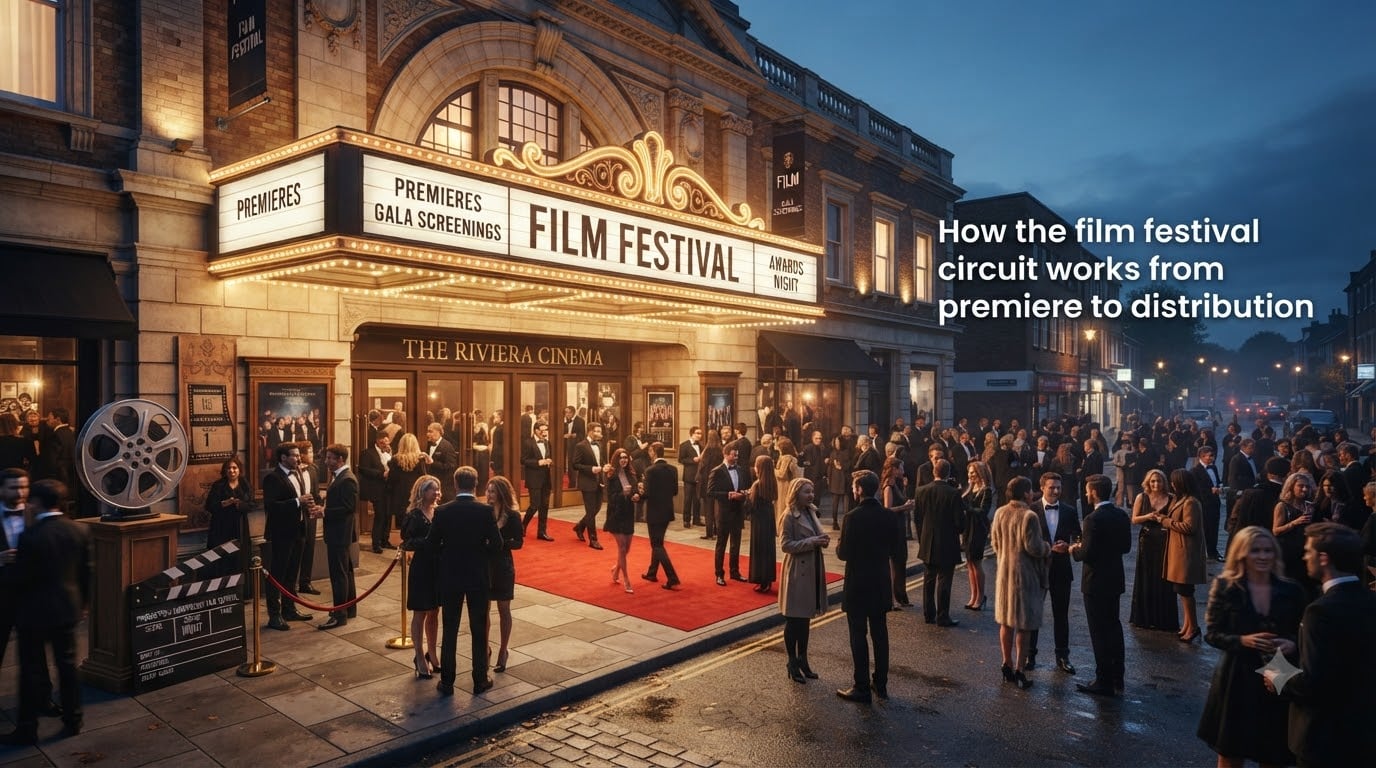
The film festival circuit is the journey an independent film takes from its first public screening through dozens of festivals, market screenings, and eventually to distribution. I have spent years following this path with indie projects, including conversations with filmmakers behind films like Lez Bomb, and I can tell you the process is more structured than it looks from the outside.
This guide walks through every stage, from picking a world premiere venue to closing a streaming or theatrical deal. If you have ever wondered how a film goes from a finished cut to a Netflix release or a regional cinema run, the answers lie in the festival circuit.
Understanding how the film festival circuit works from premiere to distribution gives you a serious edge whether you are a filmmaker planning your first submission, a producer weighing distribution options, or a film fan curious about what happens behind the scenes at Sundance, Cannes, and Toronto.
Table of Contents
What Is the Film Festival Circuit?
The film festival circuit is the connected network of film festivals and film markets that screen, promote, and trade independent films worldwide. It is how most indie films find their first audiences, attract critical attention, and land distribution deals.
Think of it as a multi-stop tour for a film. A movie might premiere at Sundance in January, then screen at SXSW in March, hit Cannes in May, and play smaller regional festivals through the fall. Each stop builds momentum, press coverage, and industry relationships that eventually translate into a release deal.
The circuit has three core functions. First, it gives filmmakers validation through awards and reviews from established critics and juries. Second, it builds an audience before the film is widely available, creating word-of-mouth that distributors crave. Third, it creates a live marketplace where distributors, sales agents, and buyers discover new films in person, often before they are available to the public.
For independent filmmakers without studio backing, the festival circuit is often the only realistic path to theatrical or streaming distribution. Studios have their own pipelines. Indie filmmakers need the circuit.
Understanding Premiere Status in Film Festivals
Premiere status is the term festivals use to describe whether your film has screened publicly before. Most major festivals require a specific premiere status, and getting this right is one of the most common stumbling blocks for first-time submitters.
The main types of premiere status are:
- World Premiere: The film has never screened publicly anywhere, in any country. This is the most valuable status and the hardest to qualify for at top festivals like Cannes, Venice, and Toronto.
- International Premiere: The film has not screened outside its country of origin. Strong tier-one festival requirement.
- North American Premiere: The film has not screened in the United States or Canada, but may have played internationally.
- U.S. Premiere: No prior screenings in the United States only.
- Regional Premiere: No screenings in that specific region (for example, Midwest or Pacific Northwest).
- Local Premiere: The film has screened outside the city but not in this specific market.
Most programmers I have talked to say world premieres get priority consideration. If you screen at a small regional festival first, you permanently lose world premiere status for every major festival afterward. That one decision can close doors at Sundance, Cannes, Venice, and Toronto before you even submit.
Strategic filmmakers often hold their film for 12 to 18 months, waiting for the right premiere slot at the right festival. The patience can pay off enormously. A world premiere at a top-tier festival puts your film in front of every major distributor, sales agent, and acquisitions executive in the industry simultaneously.
The trade-off is risk. If no A-list festival accepts your film, you have burned months of momentum. Some filmmakers hedge by targeting a strong mid-tier world premiere, then building to a North American premiere at a bigger festival the following season.
The Festival Submission Process Step by Step
Submitting to festivals involves far more preparation than most filmmakers expect. The standard workflow runs through these steps.
Step 1: Prepare Your Film Deliverables
Before you submit anywhere, you need a finished film and the technical materials festivals require. At minimum this includes a Digital Cinema Package (DCP) for theatrical screenings, a ProRes or HDCAM screener for online submission, a press kit with high-resolution stills, and an electronic press kit (EPK) with your logline, synopsis, director’s bio, and festival history.
Many festivals also ask for a trailer, behind-the-scenes photos, and a director’s statement explaining your creative vision. Have these ready before you submit rather than scrambling after an acceptance.
Step 2: Build Your Submission Profile
Most filmmakers now use FilmFreeway, the dominant submission platform that replaced the older Withoutabox system. Create your filmmaker profile once, then use it across hundreds of festivals. Upload your screener, stills, and key art.
FilmFreeway streamlines the process but does not replace research. Each festival has its own deadline structure, eligibility rules, and premiere requirements. Read the fine print before paying any submission fee.
Step 3: Research Tier-Appropriate Festivals
Match your film to festivals that fit its genre, budget level, and goals. A micro-budget horror film and a $2 million drama aimed at awards season need entirely different festival strategies. Look at the festivals that previously programmed similar films.
Reddit’s r/Filmmakers community repeatedly advises filmmakers to identify the niche their film fits, then target festivals and categories aligned with that niche. Generic shotgun submission wastes money and rarely lands the right placements.
Step 4: Track Submissions in a Spreadsheet
This is where many filmmakers fail. Track every submission, deadline, fee paid, response date, and follow-up in a single spreadsheet. Most films go into 20 to 50 festivals, and you will lose track without a system.
Include columns for festival name, tier, premiere status required, submission date, fee, notification date, result, and notes. Update the spreadsheet weekly during peak submission season.
Step 5: Submit Early and Follow Up
Early-bird submission windows save money and often get faster responses. After acceptance, confirm technical requirements, travel logistics, and press accreditation with the festival team. A clear, professional follow-up email can open doors that a passive filmmaker misses.
Major Film Markets and Festivals
Film festivals generally fall into three tiers, and understanding the tier system helps you plan a realistic festival run. Each tier serves a different strategic purpose.
A-List Festivals
The hardest film festivals to get into are the A-list: Sundance, Cannes, Venice, Berlin, and Toronto. Acceptance rates often run below 2%. These festivals launch careers and attract every major distributor on the planet. A selection here almost guarantees distribution interest.
A-list festivals also drive the global conversation about independent film. A Sundance premiere generates press coverage that smaller festivals cannot match. Distributors attend specifically to find their next acquisition.
Mid-Tier Festivals
Festivals like SXSW, Tribeca, Telluride, Locarno, Rotterdam, and San Sebastian offer strong industry presence with more accessible acceptance rates. Mid-tier festivals are excellent for building buzz and connecting with sales agents.
Telluride in particular has become an awards-season kingmaker. Many Oscar-contending films premiere there in September before going on to wider release.
Regional and Genre Festivals
Regional festivals fill in the gaps, give your film more screenings, pay screening fees in some cases, and build local audiences. After an A-list or mid-tier premiere, smaller festivals often invite your film automatically.
Genre festivals like Fantastic Fest, Sitges, and Fantasia are essential for horror, sci-fi, and thriller films. These communities are passionate, loyal, and often more receptive to bold independent work than mainstream festivals.
Film Markets
Separate from screening festivals, film markets run alongside major festivals and are where deals actually close. The three biggest are the American Film Market (AFM) in Santa Monica, the Marche du Film at Cannes, and the European Film Market (EFM) at Berlin. Sales agents set up booths here, screen films for buyers, and negotiate distribution rights territory by territory.
Film markets are trade shows, not public events. Buyers from distribution companies, streaming platforms, and international territories walk the floor looking for films to acquire. If your film is not represented at a market, most buyers will never see it.
The Film Festival Circuit Timeline
A typical festival run follows a predictable seasonal calendar. Knowing this timeline helps you plan premiere strategy, budget submissions, and time distribution announcements.
- January to February: Sundance, Slamdance, Rotterdam. Strong U.S. indie launches.
- March: SXSW, South by Southwest. Tech and genre crossover films thrive here.
- April to May: Tribeca, Cannes, Hot Docs. Cannes drives international sales for the entire year.
- August to September: Venice, Telluride, Toronto. Awards season launch window.
- October: BFI London, Zurich, Hamptons, AFM. Buyers make deals for the next release calendar.
- November to December: IDFA, regional festivals, holiday-season awards consideration.
Most films run through festivals for 12 to 24 months before settling into distribution. A theatrical release usually happens within 6 to 18 months after the festival run begins. Planning your premiere for the right season can mean the difference between awards consideration and a forgotten release.
Networking and Building Industry Connections
The festival circuit is fundamentally a people business. The screenings matter, but the conversations in the lobby, the industry breakfasts, and the after-parties are where distribution deals begin.
Build relationships with programmers who champion your work, sales agents who package films for international buyers, publicists who shape your awards narrative, and fellow filmmakers who become collaborators on future projects. A good Q&A session can outperform a paid ad campaign for audience building.
Bring business cards, a one-sheet about your film, and a clear pitch you can deliver in 30 seconds. Attend every industry panel, filmmaker breakfast, and networking event your festival pass allows. The programmer who programs your next film may be sitting across from you at a closing-night dinner.
Budgeting for Your Festival Run
Honest filmmakers will tell you the festival circuit is expensive. A realistic budget for a meaningful run on 20 to 30 festivals ranges from $400 to $1,400 in submission fees alone, before travel, accommodation, prints, and publicity costs.
Submission fees typically run $25 to $75 per festival. Some waive fees for filmmakers from underrepresented backgrounds. Once accepted, add costs for travel, lodging, shipping your DCP, hiring a publicist, and producing festival swag or press materials. Festival circuits often cost more than they directly return.
The financial return rarely comes from screening fees. It comes from the distribution deal that the festival exposure enables. Some regional festivals do pay screening fees, and these can offset travel costs, but they will not fund your next film.
Filmmakers on r/Filmmakers consistently emphasize transparency about these costs. Plan for them before you start submitting, not after the credit card bill arrives.
From Festival Success to Distribution
How distribution in film works is simpler than it sounds once you understand the players. Distribution in film happens through sales agents and distributors who acquire rights to your film and release it across theatrical, streaming, and home video channels.
Most major deals begin at the major film markets. A sales agent represents your film to international buyers. A domestic distributor handles the U.S. release, and separate territory deals cover Europe, Asia, and Latin America. Deals can include theatrical only, streaming only, or a hybrid release window.
A typical deal flow works like this. Your film premieres at a major festival and generates buzz. Sales agents approach you, or you approach them through a producer’s rep. The sales agent screens the film at a market like AFM or Cannes Marche du Film. Buyers make offers territory by territory. Your sales agent negotiates and closes deals, taking a commission of 10 to 20 percent.
Distribution deals generally take four forms:
- Theatrical release: Limited or wide cinema run, usually through an indie distributor. Smallest audience reach but strongest awards positioning.
- Streaming acquisition: Netflix, Amazon, Apple TV+, Hulu, or specialty platforms buy exclusive rights. Often the most lucrative single deal for indie filmmakers.
- Hybrid release: Day-and-date theatrical and streaming, increasingly common in recent years. Balances audience reach with critical credibility.
- Self-distribution: Filmmakers release directly on Vimeo, YouTube, or their own platforms, retaining full control and revenue but taking on all marketing responsibility.
If you have not landed a deal by the end of a 12 to 18 month festival run, self-distribution becomes a realistic alternative. One filmmaker on Reddit reported their YouTube release reached 100,000 viewers, vastly more than the 5,000 cumulative attendance at 55 festivals.
The decision between holding out for a traditional deal and self-distributing depends on your goals. If you need revenue quickly or have built a loyal niche audience, direct release can outperform waiting for a distributor that may never call.
Common Mistakes to Avoid on the Festival Circuit
From watching dozens of indie runs, I have seen the same avoidable mistakes derail promising films. Burning your world premiere at a festival below your film’s tier is the most damaging.
Over-submitting to too many low-relevance festivals wastes budget and dilutes your screening history. Programmers at top festivals check where your film has already played, and a long list of small unknown festivals can actually hurt your credibility.
Neglecting the technical quality of your DCP leads to rejected screenings. Festival projection booths are unforgiving, and a corrupt or non-standard DCP can cost you a room full of industry attendees.
Skipping the festival in person to network costs you deals that never happen over email. Distributors and sales agents want to meet filmmakers, gauge their passion, and assess whether they will be good partners for a long release campaign.
Finally, treating festival rejections personally is a trap. Even great films face a 70 to 90 percent rejection rate at competitive festivals. Subjective evaluation is part of the process. A rejection from one festival says nothing definitive about your film’s quality or commercial potential.
Frequently Asked Questions
What is the hardest film festival to get into?
The hardest film festivals to get into are the A-list festivals: Sundance, Cannes, Venice, Berlin, and Toronto. Acceptance rates at these festivals typically run below 2%, and they each require a world premiere or strong regional premiere status. Cannes and Sundance are widely considered the most competitive entry points in the global film festival circuit.
How does distribution in film work?
Film distribution happens when a sales agent or distributor acquires the rights to your film and releases it to audiences. Sales agents package films and sell territory by territory at film markets like Cannes or AFM. Domestic distributors handle theatrical release in specific countries, while streaming platforms like Netflix or Amazon acquire digital rights for global audiences. Most indie films sign distribution deals during or shortly after their festival run.
What is the premiere status in film festivals?
Premiere status describes where and when your film has screened publicly before. The main types are world premiere (no prior public screenings anywhere), international premiere (no screenings outside country of origin), North American premiere (no U.S. or Canadian screenings), U.S. premiere (no American screenings), regional premiere (no screenings in that specific region), and local premiere (no screenings in that city). Most A-list festivals require a world or strong regional premiere status.
Is the film festival circuit worth it for independent filmmakers?
Yes, for most independent filmmakers seeking distribution, audience building, or industry validation. The festival circuit provides credibility, press coverage, networking with distributors, and direct paths to deals. However, it costs more than it returns directly, with typical runs costing $400 to $1,400 in submission fees alone, plus travel and publicity costs. The value comes from the distribution deal or audience growth that festival exposure enables, not from screening fees.
Final Thoughts on the Film Festival Circuit
The film festival circuit is the backbone of independent film distribution. From your first world premiere through the market screenings and the eventual distribution deal, each stage of the circuit serves a specific purpose: validation, audience building, and deal-making.
Plan your premiere strategy early, budget realistically for 20 to 30 submissions, build genuine industry relationships at every festival, and protect your option for self-distribution if no traditional deal materializes. That is how the film festival circuit works from premiere to distribution in 2026 and beyond.