
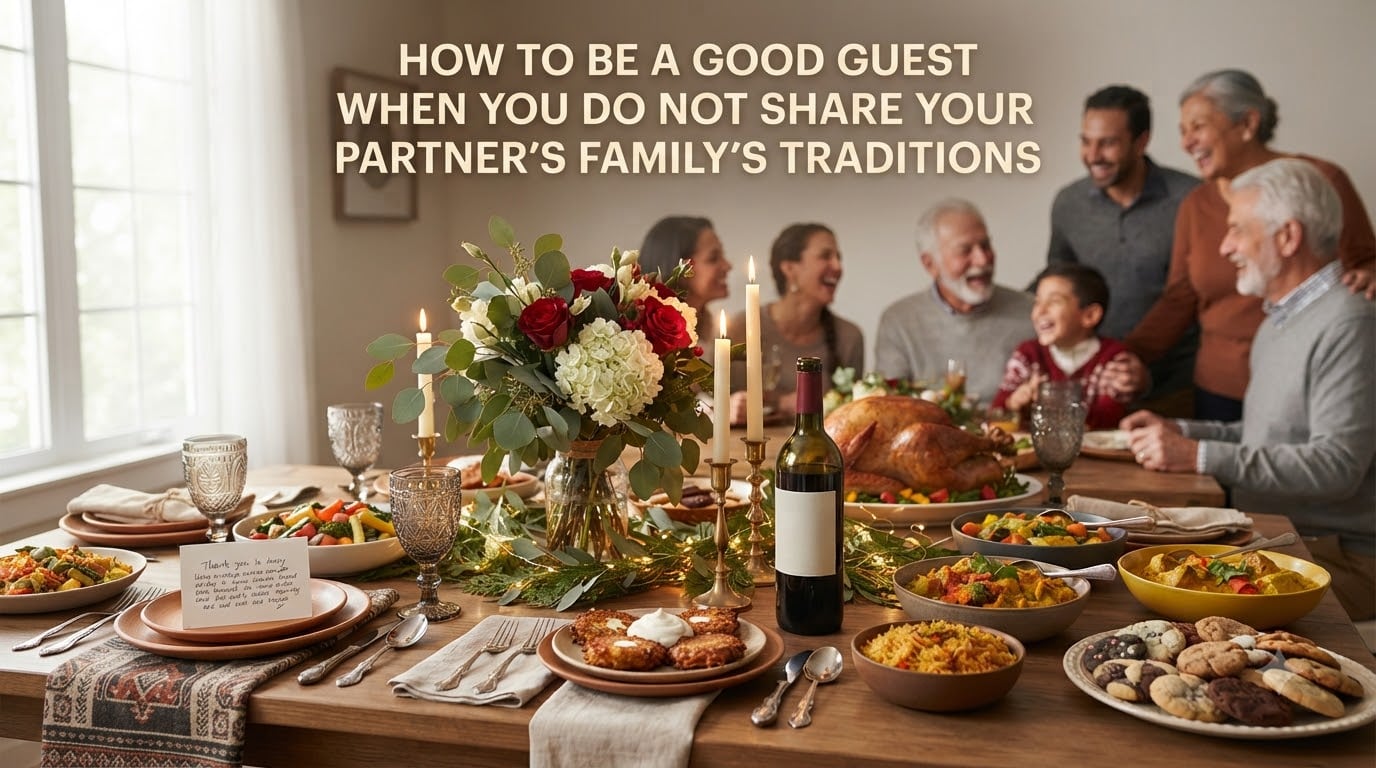
Sitting at a table where everyone is praying, lighting candles, or sharing stories from a holiday you never celebrated can feel strange. You may smile along, but inside you are wondering whether anyone can tell that you are not part of this world. If you have ever felt like an outsider in your partner’s family home, you are not alone.
I have sat on that couch. I have pretended to laugh at inside jokes I did not understand. I have eaten food I could not pronounce and answered questions I did not expect. Over time, I have learned that being a good guest in a home with traditions you do not share is less about performing perfectly and more about showing up with humility, curiosity, and respect. This guide shares what I wish someone had told me years ago about how to be a good guest when you do not share your partner’s family’s traditions.
Table of Contents
Why Navigating Different Family Traditions Feels So Hard
Family traditions carry deep emotional weight. For your partner, those customs represent safety, belonging, and identity. For you, the same customs can feel foreign, confusing, or even uncomfortable. That gap is real, and pretending it does not exist usually makes things worse.
Psychologists often describe this feeling as “outsidership.” You are watching something intimate unfold without a script to follow. Add unfamiliar food, different religious cues, and unspoken rules about when to speak or stay quiet, and it is easy to feel overwhelmed. Recognizing why this is hard removes some of the shame. The discomfort is normal, not a personal failing.
Research and Prepare Before You Arrive
The single best thing you can do as a guest is arrive prepared. Before your visit, ask your partner specific questions about their family’s traditions. What food will be served? Are there prayers or rituals you should know about? Is there a dress code? What topics are off-limits at the table?
Write down a few notes so you do not have to remember everything in the moment. Small details matter. Knowing that grandma expects everyone to hold hands before dinner, or that the family teases each other loudly as a sign of affection, helps you respond with confidence instead of awkward silence. Preparation turns an unfamiliar situation into a manageable one.
This step also signals something powerful to your partner. You are showing that you take their family seriously. That kind of effort builds trust long before you walk through the door.
Bring a Thoughtful Gift That Shows Respect
Never show up empty-handed. A small host or hostess gift is a near-universal signal of appreciation. You do not need to spend a lot. A nice bottle of wine, a box of good chocolates, fresh flowers, or a baked treat from a local bakery works well. The gift is not about the price. It is about saying, “I recognize the effort your family is making to welcome me.”
If you know the family well, you can tailor the gift. A specialty coffee for a caffeine lover, a scented candle for someone who loves their home, or a board game the whole family can enjoy shows that you have been paying attention. Avoid anything that could be read as a comment on their lifestyle, religion, or values. When in doubt, keep it neutral and gracious.
Present the gift early in the visit with a simple, “I brought this for you. Thank you for having me.” That single sentence can set a warm tone for the entire stay.
Participate Genuinely Without Losing Yourself
You do not have to adopt your partner’s family traditions as your own. You do, however, benefit from participating in them with an open heart. If they say grace before dinner, bow your head or hold still. If there is a holiday song, sing along even if you are off-key. If the family plays a game after dinner, ask to learn the rules and play.
Participation is a form of respect. It tells the family, “I see this matters to you, and I want to be part of it in this moment.” That does not mean you must agree with every belief or follow every practice in your own life. You can participate in a tradition without claiming it as yours.
There is a line, of course. If a tradition asks you to act against your own values, you have every right to step back. Excuse yourself with grace, talk to your partner privately afterward, and find a kind way to decline next time. Authenticity matters, and pretending to believe something you do not will eventually feel exhausting and dishonest.
Set and Respect Boundaries Gracefully
Boundaries go both ways. You need to set some, and you need to respect the ones the family has set. Start with your own. Decide in advance what you are and are not comfortable with. Loud kissing under the mistletoe, all-night drinking games, religious debates, comments about your weight, career, or marriage timeline. Decide what you will engage with and what you will gently sidestep.
Practicing simple phrases ahead of time helps. “I would rather not discuss that, but I would love to hear about your trip to Italy.” “I will pass on the second glass of wine, thank you.” Polite, firm, and redirecting. Boundaries delivered with warmth rarely cause conflict.
Respecting the family’s boundaries matters just as much. If grandma insists no shoes in the house, take them off. If the family eats at exactly 6 p.m., be at the table at 5:55. If uncle Howard does not want to discuss politics, do not push him. Reading the room and following the household’s rhythm is a quiet skill that seasoned guests always show.
Communicate Openly With Your Partner
Your partner is your anchor and your translator. Before, during, and after the visit, keep the conversation going. Share your concerns beforehand. Debrief privately during a walk or a bathroom break if something feels off. Talk honestly afterward about what worked and what did not.
This kind of communication builds a team. When the family sees the two of you handling tricky moments together, they often relax. They start to see you as part of the unit, not a stranger being evaluated. Couples who communicate well about family dynamics tend to navigate the hardest holidays with far less stress.
Be careful, though, not to put your partner in the middle of every conflict. If a family member says something hurtful, address it when you can, in a calm moment. Avoid forcing your partner to defend you in front of their parents. That rarely ends well and can breed resentment over time.
Common Mistakes to Avoid as a Guest
Even the most well-meaning guests slip up. Here are the missteps I see most often and the simplest way to avoid them.
Do not correct the family. If you disagree with a tradition or belief, save that conversation for a private moment with your partner. Public corrections rarely change minds and almost always create tension.
Do not compare their traditions to yours. Saying “in my family we do it this way” can sound dismissive. Lead with curiosity instead of comparison.
Do not disappear. Hiding in the guest room scrolling your phone signals disinterest. Even introverts should aim for one or two genuine conversations during the visit.
Do not overstay. The three-day rule is real. Even the warmest hosts need a break. Have a graceful exit planned and ready.
Do not gossip after you leave. What you said about the family will travel. Speak kindly, especially to your partner.
What to Do When Traditions Conflict Directly
Sometimes the conflict is not subtle. Maybe the family insists on attending a religious service you do not practice. Maybe a holiday ritual feels exclusionary. Maybe a relative makes repeated comments about your lifestyle. In these moments, having a plan helps.
Stay calm and breathe. Most conflict fades when you do not match its energy. Use a soft “I” statement: “I feel uncomfortable when that topic comes up. Could we talk about something else?” If the situation escalates, remove yourself politely. Excuse yourself to help in the kitchen, take a walk, or step outside.
Talk with your partner privately the same day, not weeks later. The sooner you process it together, the smaller the wound stays. Agree on a strategy for next time, whether that means setting a firmer boundary, arriving later, or limiting the visit length. Conflict does not mean the relationship is doomed. It means the adults in the family need better tools, and you can lead by example.
Follow-Up Etiquette After Your Visit
Good guesting does not end when you drive away. Send a thank-you note within two days of your visit. A handwritten card or a thoughtful text both work. Mention something specific from the stay to show you were paying attention. “Thank you for the beautiful dinner. I will always remember the story about your grandmother’s apple pie.”
Offer to host in return when you can. Inviting the family to your home, or at least your partner’s parents, balances the relationship and shows you are part of the wider circle, not just a visitor passing through.
Small follow-ups keep the connection warm. A quick message on a family birthday, a photo from the trip you promised to share, or a brief check-in call once a month signals that the visit mattered. These small gestures add up to long-term acceptance.
FAQs
What not to do as a houseguest?
Avoid showing up empty-handed, correcting the family’s traditions, overstaying your welcome, hiding in your room, or making comparisons to how your own family does things. Stay curious, contribute where helpful, and exit gracefully when the visit winds down.
How to be a good houseguest to boyfriend’s family?
Ask your partner what to expect, bring a thoughtful host gift, dress appropriately, offer to help with meals or cleanup, engage in conversation without forcing opinions, and send a thank-you note after the visit. Respect their routines and traditions without trying to change them.
What is the three day rule for house guests?
The three day rule suggests that a houseguest should not stay longer than three days without offering to help, contribute to the household, or shift the dynamic so the host does not feel burdened. After three days, it is gracious to take yourself out for part of the day, host your hosts, or extend your stay in a hotel.
How should you behave when you are a guest in someone’s house?
Arrive on time with a small gift, follow the household’s rules, ask before helping or using shared spaces, keep your space tidy, join in mealtimes and conversations, and leave the home cleaner than you found it. Always express gratitude before and after your stay.
Building Bridges, Not Breaking Them
Learning how to be a good guest when you do not share your partner’s family’s traditions is one of the most generous things you can do for your relationship. You are not betraying your own background by participating in someone else’s. You are widening your world. Every holiday meal, every awkward question, every inside joke you pick up adds a thread to the bridge between two families.
Be patient with yourself. You will not get it right every visit. Some gatherings will feel warm and easy. Others will leave you drained and unsure. Both kinds teach you something. Show up with humility, leave with gratitude, and keep showing up. Over time, the family that felt foreign can become a second home, and the traditions you never grew up with can become part of the story you and your partner are writing together.