
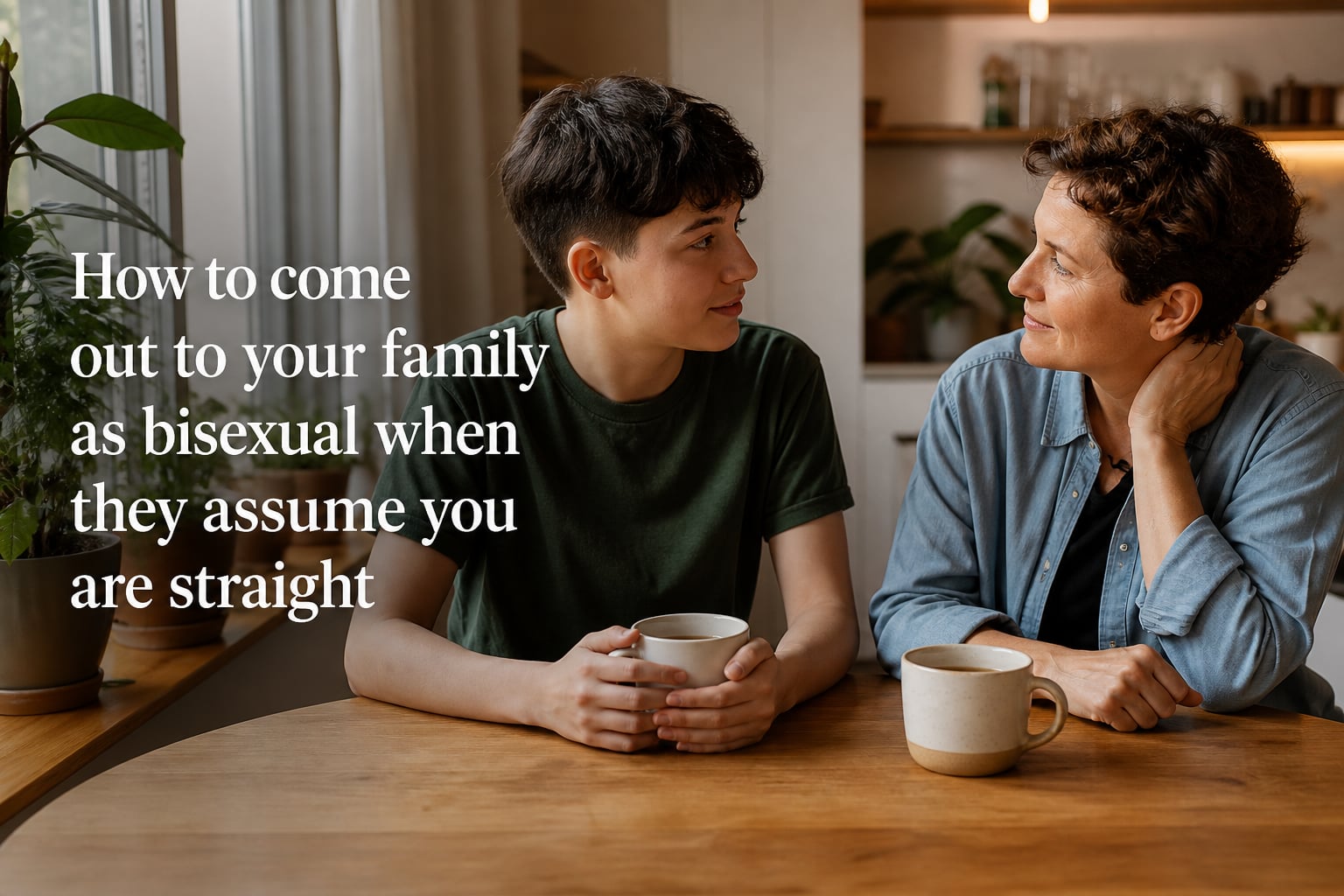
Coming out as bisexual to a family that has assumed you are straight is one of the most specific emotional challenges in the LGBTQ+ experience. It is different from coming out as gay or lesbian. People do not always see it coming, and many parents will not even believe it at first. I have worked with readers who have sat across from parents at kitchen tables, rehearsed the words in their heads for months, only to hear “but you dated that boy in college” or “are you sure this isn’t just a phase.”
If you are reading this, you probably already know what you feel. The question is not whether your identity is real. It is how to share that reality with people who might not be ready to see it. This guide walks through how to come out to your family as bisexual when they assume you are straight, with practical scripts, safety planning, and real responses to the comments you are most likely to hear.
Table of Contents
Understanding the ‘Straight Assumption’ Challenge
The straight assumption is what researchers call bisexual invisibility. It happens because our culture has a long habit of sorting people into two boxes, and anyone who has ever been in a relationship with someone of the opposite sex gets filed as straight by default. This is not just frustrating. It is a real obstacle to coming out.
When your family has watched you date, marry, or even just talk about people of the opposite sex, they have built a picture of who you are. Coming out as bisexual means asking them to redraw that picture. Some will do it quickly. Others will hold on to the old version for months or years.
What Bisexual Invisibility Looks Like in Families
Bisexual invisibility shows up in small, repeated ways. A mom introducing you as “my straight daughter.” A dad joking about “when you find the right guy.” A sibling casually saying “you can’t be bi, you’ve only ever dated men.” None of these comments are meant to hurt, but each one erases part of who you are.
Some bisexual people describe this as “passing as straight” without ever choosing to. You are not hiding. Your family is simply not seeing. That is why coming out as bisexual can feel like telling people something twice. Once when you actually came out, and again every time someone assumes you are straight in your daily life.
Why Family Members Default to ‘Straight’
Most parents do not assume their child is straight out of malice. They do it because heterosexual relationships are treated as the default in our culture. School dances, movies, family jokes, and casual conversations all assume opposite-sex attraction. Your parents are likely working from that same default.
For older generations, the words “bisexual” or “pansexual” may not even feel like familiar labels. Your mom might understand “gay” but struggle with “bi.” That does not mean she will not accept you. It means the language around your identity may be new to her, and she will need time to learn it just like you did.
Safety Assessment: Are You Ready to Come Out?
Before you plan a single sentence, you need to answer one question honestly: is this safe? Coming out is a personal decision, and you have the right to make it on your own terms. But you also deserve to be safe while you make it.
I know safety planning can feel clinical for something this emotional. Still, the bisexual people I have spoken with who had the smoothest coming outs were the ones who thought through what could go wrong before it did. They had a backup plan. They knew who they could call. They had somewhere to go if things fell apart.
Your Emotional Readiness
Ask yourself if you are coming out for yourself, or because someone is pressuring you. There is no deadline. There is no age where you are “supposed to” have come out. If you are not emotionally ready, it is okay to wait. Living authentically is the goal, and you can live authentically without telling your family everything today.
Your Physical Safety
Be honest about your household. If a parent has a history of violence, aggression, or throwing people out for smaller disagreements, coming out as bisexual may put you in real danger. In those cases, your safety matters more than their approval. Wait until you have somewhere safe to live, money you control, and a person you trust who can come get you if needed.
Financial Independence Considerations
Coming out and financial dependence on unaccepting parents is a stressful combination. I have heard from readers whose parents paid for college, car, or rent and used that money as leverage after they came out. If you are financially dependent on your family, consider waiting until you have at least six months of expenses saved, a job, or another stable housing option.
Your Backup Plan Checklist
Before you have the conversation, line these things up:
- A friend or family member who knows your situation and is ready to pick you up or call you.
- A safe place to stay for at least one night, in case you need to leave.
- Access to your own money, ID, and important documents.
- The phone number for a crisis or LGBTQ+ hotline saved in your phone.
- A therapist, counselor, or trusted mentor who knows you are planning this.
If you cannot check at least three of these boxes, it might be wise to wait. There is no shame in protecting yourself first.
How to Come Out to Your Family as Bisexual: Step-by-Step Preparation
Once you have decided you are ready and safe, the next step is preparation. Most people who feel good about their coming out experience did not wing it. They planned. They chose their moment. They knew what they wanted to say and what they wanted to ask for in return.
Step 1: Clarify Your Own Identity
Spend some time with the words you want to use. Do you prefer “bisexual,” “bi,” “queer,” “pansexual,” or something else? There is no wrong answer. The label you choose is yours. Knowing which word you prefer before the conversation helps you avoid getting tangled up in definitions when emotions are running high.
Step 2: Choose Who to Tell First
You do not have to come out to your whole family at once. Many bisexual people start with the sibling, cousin, aunt, or friend they trust most. Telling one supportive person first gives you an ally in the room when you talk to harder family members. It also lets you practice the conversation in a lower-stakes setting.
Step 3: Pick the Right Time and Place
The best coming out conversations happen in private, calm, and unhurried moments. Avoid holidays, birthdays, or big family events where emotions are already charged. A quiet afternoon at home, a walk in a park, or a slow dinner out can work. Make sure you have at least an hour of uninterrupted time and that neither of you has to rush off to work or pick up a sibling.
Step 4: Prepare What You Want to Say
You do not need to memorize a speech. You do need to know your opening line and your bottom line. Your opening line is how you will start. Your bottom line is the one thing you most want them to hear, even if they push back.
Step 5: Have Support Ready
Let at least one trusted person know when and where you plan to have the conversation. Ask them to be available by phone afterward. If you want, they can text you a check-in at a specific time so you have a natural reason to pause and breathe if things get intense.
Scripts and Conversation Templates for Bisexual Coming Out
Here are a few real scripts that bisexual people have used with their families. Adapt them to fit your voice. Use the words that feel like you. The point is not to copy these exactly. The point is to walk in with a plan.
Template 1: Direct and Clear
“I want to talk to you about something personal. I am bisexual. That means I am attracted to people of more than one gender. I have known this about myself for a while, and I wanted you to know because I love you and I want to be honest with you. I am still the same person you have always known.”
Template 2: Gentle and Educational
“I want to share something with you. I have been thinking about how to say this for a long time. I am bisexual. I know that word is sometimes confusing for people, so let me explain. Bisexual means I can be attracted to men, women, and people of other genders. This has always been true about me. I am telling you because I trust you, and I want to keep being close to you.”
Template 3: Written or Letter Format
Sometimes writing a letter is easier than saying the words out loud. A letter gives your parent time to read it, react privately, and come back to you when they are calmer. You can hand it to them in person or leave it for them to find.
“Dear Mom, I am bisexual. I have known for years and I have finally worked up the courage to tell you. This does not change who I am as your child. I still love the same things, believe in the same things, and want the same things out of life. I hope you can read this with an open heart. I am ready to answer any questions you have when you are ready to ask.”
What Not to Apologize For
Do not apologize for being who you are. Do not preface the conversation with “I am sorry to tell you this.” Do not beg your parents to be okay with it. You are sharing something true. If they need time, that is fair. But your identity is not something you need their permission for.
Handling ‘It’s Just a Phase’ and Disbelief Reactions
If your family assumes you are straight, the most common reaction to your coming out is disbelief. “Are you sure?” “Maybe you are just confused.” “This sounds like a phase.” I have heard these responses from readers across every age group and family type. They hurt, especially because they imply that you have not thought carefully about your own life.
Why ‘It’s a Phase’ Is So Common for Bisexual People
Bisexual erasure is built into our culture. Many parents grew up in a time when “bi” was treated as a stepping stone to being gay, or as a way for straight people to seem interesting. When you come out as bi, your parents may be reaching for the only framework they have, and that framework often includes doubt.
This is not your job to fix in one conversation. But understanding where their doubt comes from can make it easier to respond without matching their panic.
Scripts for Responding to ‘It’s Just a Phase’
“I understand why you might think that. I thought about it for a long time before I said it out loud. This is not new for me. It is just the first time I am telling you.”
“Whether or not you believe me, I am asking you to hear me. I am telling you something real about my life.”
“You might need time to get used to this. I am okay with that. I am not okay with you telling me it is not real.”
Scripts for Responding to ‘You Will Grow Out of It’
“This is not something I will grow out of. It is who I am. I have felt this way for as long as I can remember.”
“I am not asking you to understand it today. I am asking you to believe me when I tell you it is real.”
When to Disengage Versus Educate
You do not owe your parents an education session about bisexual identity. If the conversation becomes a debate about whether bisexuality is real, it is okay to say, “I can see this is a lot. Let’s take a break and talk again when we are both calmer.” You are allowed to protect your own emotional energy.
Handling Positive Reactions and Continuing the Conversation
Sometimes families surprise us. Some parents will hug you, cry happy tears, and ask what they can do to support you. If that happens, let yourself feel it. You earned this moment.
Even positive reactions come with their own questions. Your mom might ask who you are dating. Your dad might want to know if you have always known. A sibling might ask if they can tell their spouse. You are allowed to set boundaries on these questions, even in a kind conversation.
What Genuine Acceptance Looks Like
Genuine acceptance is not a one-time hug. It is the slow, ongoing work of using your correct pronouns, learning the right words, inviting your partner to family events, and standing up for you when other relatives say something hurtful. You can thank people for their initial reaction while still watching to see if the support lasts.
Setting Boundaries About Who Else to Tell
Decide in advance how much information you want shared with the rest of the family. Some parents will rush to tell everyone. You are allowed to say, “I would like to tell Grandma myself. Please give me time.” You are also allowed to keep your dating life private, even with accepting parents.
Building Your Support System Beyond Family
Even families that accept you beautifully cannot be your only support. Coming out as bisexual is a journey that lasts longer than one conversation. You will need friends, community, and resources that understand the specific challenges of being bi in a world that often pretends you do not exist.
Finding Bisexual-Specific Community
Look for bisexual meetups, online groups, and social spaces that are specifically for bi people. General LGBTQ+ groups are wonderful, but bi-specific spaces allow you to talk about bisexual invisibility without having to explain why it is different from being gay or lesbian. Reddit’s r/bisexual, BiNet USA, and local pride centers are good places to start.
Online and In-Person Resources
The Trevor Project, PFLAG, GLAAD, and the Bisexual Resource Center all have information tailored to bisexual people coming out to family. PFLAG in particular runs local chapters where you can bring a parent to a meeting and let them hear from other families who have been through this.
Therapists and Counselors
If you can access an LGBTQ+-affirming therapist, even for a few sessions, it can make a real difference. They can help you prepare for the conversation, process the aftermath, and figure out what to do if things do not go well. Many offer sliding scale fees if cost is a concern.
When Coming Out Goes Wrong: Crisis and Safety Plans
I wish every coming out story ended in a hug. They do not. Some parents react with anger, denial, or rejection. Some siblings stop speaking to you. Some families demand you go back into the closet or cut off financial support. If this happens to you, it is not your fault, and it does not mean your identity is wrong.
If You Are Kicked Out
If you are under 18 and kicked out, contact the Trevor Project (1-866-488-7386) or your local LGBTQ+ youth shelter immediately. Many cities have emergency housing specifically for queer youth. Do not stay in an unsafe home just to keep the peace.
If You Face Violence
If a family member becomes violent, leave. Call 911 if you are in immediate danger. Reach out to a friend, neighbor, or hotline. Your safety is more important than anyone’s comfort, including your parents’.
If You Need to Retreat Back Into the Closet
Sometimes the safest choice is to step back and wait. Going back into the closet is not a defeat. It is a survival strategy. You can live authentically in the parts of your life where it is safe and protect yourself in the parts where it is not. Many bisexual people manage dual visibility this way for years while they build the resources to live openly.
Crisis Hotlines and Immediate Help
- The Trevor Project (LGBTQ+ youth): 1-866-488-7386
- Trans Lifeline: 877-565-8860
- LGBT National Hotline: 1-888-843-4564
- PFLAG local chapters for parent and family support
- BiNet USA for bisexual-specific peer support
Frequently Asked Questions
How do you come out to your family as bisexual when they assume you’re straight?
Start by clarifying your own identity and choosing one supportive family member to tell first. Pick a calm, private moment and use a simple, honest script like ‘I am bisexual. I have known this for a while and I wanted you to know because I love you and I want to be honest.’ Give them time to process, but do not let them tell you it is a phase.
Can a person be bisexual and then turn straight?
No. Bisexuality is a stable sexual orientation, not a phase or a step toward being gay or straight. Some bisexual people end up in long-term relationships with one partner, but their attraction to more than one gender does not disappear. Whether or not a person is currently dating multiple genders, the orientation itself does not change.
What should I do when my parents say it is just a phase?
Respond calmly with something like, ‘I thought about this for a long time before I told you. This is not new for me, it is just the first time I am saying it out loud.’ Then give them time and space. You do not have to win the argument in one conversation. Set a boundary that you will not debate whether your identity is real, but you will answer questions when they are ready to listen.
Is it better to come out in person or in a letter?
Either can work. In person allows for immediate emotional connection but can be hard if you get nervous. A letter gives your family time to process privately before responding. Many bisexual people use a hybrid approach: write down the key points they want to say, then have the conversation with that letter in hand so they do not forget anything important.
What if I am financially dependent on my parents?
Wait until you have a stable income, savings for at least three to six months of expenses, and a safe place to stay if you need to leave. Coming out is your decision, but timing it when you are financially independent gives you more freedom to handle the outcome, whatever it is. If you are under 18, focus on safety planning first.
Final Thoughts on Coming Out as Bisexual to Family Who Assumes You Are Straight
How to come out to your family as bisexual when they assume you are straight is a question with no perfect answer. Every family is different. Every person is different. The best you can do is prepare honestly, protect your safety, speak your truth, and give the people you love the chance to grow with you.
Some families will surprise you. Some will need time. Some may never fully understand. None of those outcomes define you. Your bisexuality was real before you said it out loud, and it will remain real no matter how anyone else responds. You are not asking for permission. You are offering the people you love the gift of knowing you.
If you are still working up the courage, take your time. The conversation will be there when you are ready. And when you have it, you will not be alone. There is a whole community of bisexual people who have sat in that same chair, rehearsed those same words, and come out the other side.