
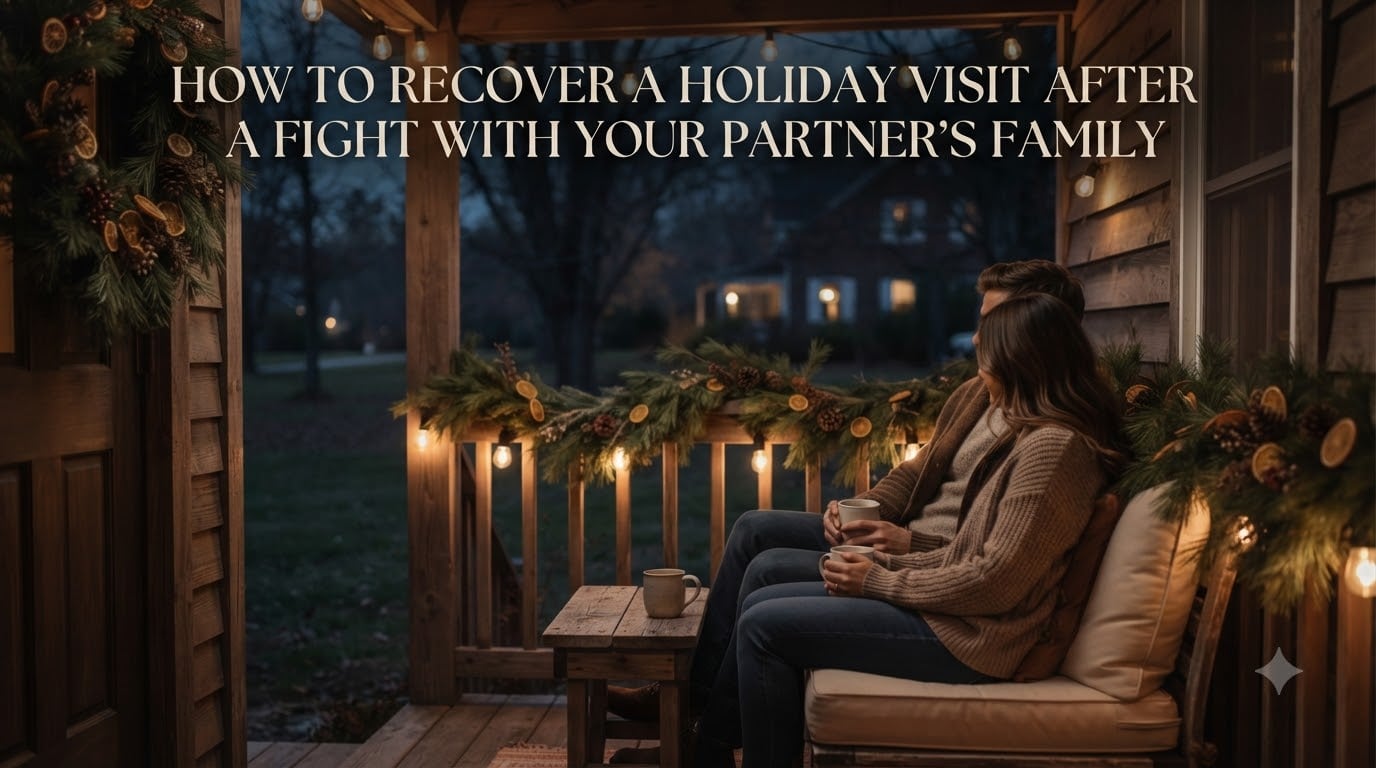
You walked into the in-laws’ house full of hope, and now you are replaying that one conversation in the kitchen. Maybe your partner’s mother made a comment about your job. Maybe politics came up at dinner. Maybe your sibling-in-law said something that cut deeper than they realized. The good news is that one bad night does not have to ruin the whole trip. I have walked through this exact moment, and I have helped friends talk through it after the fact, and the pattern is clear: recovery works when you follow a simple sequence.
This guide walks you through how to recover a holiday visit after a fight with your partner’s family, starting with the immediate hours and stretching into the rest of your stay. The goal is not to pretend the fight did not happen. The goal is to handle it well enough that both of you actually want to keep being in the same room tonight, tomorrow, and on the drive home.
Table of Contents
How to recover a holiday visit after a fight with your partner’s family: a 4-step framework
If you only have a minute, here is the short version. The recovery process is the same whether the fight was a small flare-up or a full-blown blowout. Run through these four steps in order, and you give yourself a real chance to salvage the visit.
- Cool down and create space. Step away for at least 30 minutes before trying to talk.
- Apologize sincerely. Acknowledge the specific behavior, not just the general vibe.
- Communicate openly with your partner. Have the real conversation behind closed doors, not in front of family.
- Recalibrate for the rest of the visit. Make small, intentional moves to reconnect and enjoy the time you have left.
I will walk through each step in detail below, including the exact scripts and timing that work in real life. By the end, you will have a clear plan for the next 24 hours and the rest of the trip.
Step 1: Cool down and create space to gain perspective
The first hour after a fight is the worst time to try to fix anything. Your nervous system is flooded, your partner is probably flooded too, and anything you say right now will be filtered through that fog. The most loving thing you can do for both of you is create space.
Take a walk around the block. Drive to the gas station for coffee. Sit on the back porch for 20 minutes. The medium does not matter, but the message does: I need a moment, and I will come back to you.
Why the 3-day rule works (and when it does not)
You have probably heard the “3 day rule after an argument” mentioned on Reddit or in your group chat. The idea is that you give each other roughly three days before you expect full emotional resolution. The reason it shows up so often is that it works as a pressure valve. It removes the expectation that you have to fix everything tonight.
That said, the 3-day rule is a ceiling, not a floor. Three days of ignoring each other while sharing a guest room is not healthy. A better version of the rule is this: take what space you need to regulate your emotions, then reach out within the day if you can. Most couples who describe the 3-day rule as helpful actually mean a few hours of breathing room, not three full days of silence.
What to do during the cool-down
Use the time away for self-regulation, not rehearsing your argument. I tell friends to pick one of these three moves during the break:
- Ten slow breaths, in through the nose, out through the mouth.
- Write down what you actually felt, in plain language, without editing for the audience.
- Drink a glass of water and walk until your shoulders drop.
Perspective comes back once your body calms down. You will know you are ready to talk when you can describe what happened without raising your voice or using the word “always.”
Step 2: Apologize sincerely without making excuses
A sincere apology is the single fastest way to reset the energy in a room. A bad apology is the single fastest way to make things worse. The difference is in the structure.
The apology that lands has three parts: what you did, why it was a problem, and what you will do differently. The apology that fails skips the first part and over-explains the third. “I am sorry if you were offended” is not an apology. It is a bid to be reassured without actually changing anything.
Scripts that work in real holidays
Here are three apology templates that have worked for friends and couples I have coached through this. Pick the one that fits the situation, fill in the blanks, and deliver it in person.
- “I snapped at you in front of your dad. That was unkind, and it put you in an awkward position. I am going to step out of conversations like that next time, and I am sorry for not doing it tonight.”
- “I made a comment about your sister’s cooking that came out harsher than I meant it. I can see why that hurt, and I will apologize to her before we leave.”
- “I have been tense since we got here, and I took it out on you. That is not fair to you. I want to actually enjoy the rest of this trip with you. Can we start the next hour fresh?”
Notice what each one has in common: a specific behavior, a name for the impact, and a forward move. That is the recipe. Keep it short, keep it real, and resist the urge to explain why you were tired, hungry, or triggered. Save that for the private conversation in Step 3.
When you should be the one to apologize first
The question of who should reach out first after a fight comes up constantly. Here is the honest answer: whoever sees their part first should reach out first. It does not have to be the person who “started” it. It does not have to be a tie. It only has to be genuine.
If you are not sure whether you had a part, ask yourself this question: did my behavior make this moment harder than it needed to be? If the answer is yes, you have a part. Apologize for your part, not the whole thing.
Step 3: Communicate openly with your partner behind closed doors
Once you have both cooled down and apologized, the next conversation is the one that actually matters. This is the conversation you have in your room, in the car, or on a long walk, with no family in earshot. It is the conversation where you tell the truth about what hurt, what you need, and what you are willing to do.
The point of this step is not to re-litigate the fight. It is to get on the same team before the next meal with the family.
Use the check-in, not the monologue
Trina Leckie, host of the breakup BOOST podcast, says the fastest way to recover from a fight is to ask one good question and then shut up. I have used this more times than I can count. The question is some version of: “What do you need from me right now?”
Then you listen. Not to argue, not to defend, not to fix. Just to hear. Active listening sounds simple but it is rare in real families. It means you repeat back what you heard, you ask a follow-up question, and you do not jump in with your own version until your partner feels finished.
Two questions to ask your partner
If you are not sure where to start, two questions cover most of the recovery conversation. Ask them one at a time, and let your partner answer in full before you respond.
- “What did you see happen that I might not have seen?”
- “How can I show up differently next time we are around your family?”
The first question invites your partner’s perspective instead of assuming yours is complete. The second makes the next visit something you can both plan for, instead of something you both dread.
What if your partner is conflict-avoidant
Some people shut down after a fight. They go quiet, they say “I am fine,” they disappear into their phone. If your partner is one of those people, you can still have the conversation, but you have to adjust the timing and the form. Try writing a short note instead of pushing for a face-to-face talk. Try suggesting a walk instead of a sit-down. Try asking one question at a time, across an afternoon, instead of trying to resolve everything in one sitting.
Connection is the goal, not a complete resolution in one conversation. The visit will end. The trip home will give you hours. The conversation can continue then.
Step 4: Recalibrate so you can actually enjoy the rest of the visit
Once you have apologized and talked, the next move is to actually show up differently for the rest of the visit. Words are cheap. The recalibration is what tells your partner, and your partner’s family, that the apology was real.
Recalibration is small, specific, and visible. It is not a grand gesture. It is a series of tiny choices that signal you are trying.
Five micro-moves that change the mood of a visit
- Offer to help with the next meal or the dishes without being asked.
- Sit next to your partner at the next family gathering, on purpose.
- Ask one family member a genuine question about their life at the next chance.
- Compliment the host on something specific, not generic, and say it in front of your partner.
- Plan one small thing to do with your partner alone, even if it is a 20-minute coffee run.
These are not bribes. They are not performances. They are the kind of small, earnest showing-up that rebuilds trust after a rupture. Every couple I have talked to through this says the same thing afterward: it was not the big conversation that fixed it. It was the small moment the next morning when one of them made coffee and sat down next to the other without asking for credit.
When you should plan a shorter visit next time
One honest recalibration is to admit that the visit itself was too long. Many family conflicts never happen if the visit is two days instead of seven. If you noticed this pattern, take it to the next planning conversation with your partner before the next holiday. It is a fair boundary, not a failure.
Warning signs that the conflict runs deeper than one bad night
Most holiday fights are recoverable. Some are not, and the difference is in what comes after. If you see any of these signs, the topic of recovery shifts from one bad night to a longer conversation, possibly with a professional involved.
- Your partner keeps bringing up the fight days later, with no movement toward resolution.
- One of you is using the fight as evidence for a larger case against the relationship.
- Family members take sides and start treating you differently for the rest of the visit.
- You or your partner start talking about the relationship in terms of “always” and “never” again.
- You feel dread, not just disappointment, at the thought of the next family visit.
If any of these are showing up, consider couples therapy before the next holiday. Couples therapy is not a last resort. It is a tool most couples wish they had used sooner. Even three or four sessions with a good therapist can give you a shared language for the next family visit and a clearer sense of what is actually going on between you.
Frequently asked questions about recovering after a holiday fight
How do you get back to normal after a fight with your partner?
Getting back to normal after a fight works best when you follow a clear sequence: cool down for at least 30 minutes, apologize for your specific part, have a private conversation with your partner about what each of you needs, and then make small visible efforts to reconnect. Normal does not mean pretending the fight did not happen. It means working through it well enough that neither of you is carrying the tension into the next meal or the next visit.
What is the 3 day rule after an argument?
The 3 day rule is a guideline that suggests giving each other about three days before expecting full emotional resolution after a fight. In practice, most couples find a few hours of breathing room is more useful than three full days, especially when you are sharing a guest room or still on the trip. Treat the 3 day rule as a ceiling on pressure, not a requirement for silence.
Should I reach out first after a fight with my partner’s family?
Whoever sees their own part in the fight first should reach out first. It does not have to be the person who started the argument. A genuine early apology, even a small one, often shortens the whole recovery and gives your partner permission to do the same. If you are not sure whether you had a part, ask yourself if your behavior made the moment harder than it needed to be.
How do you reconnect with your partner after a public argument?
Reconnecting after a public argument starts with a private conversation that acknowledges the public part. Tell your partner you are sorry they were put in an awkward position, ask how they are feeling, and then make a small gesture of togetherness in front of the family later, like sitting next to them at the next meal or planning a short activity together. The reconnection is less about the words and more about the visible signal that you are on the same team again.
When should a couple get therapy after a holiday fight?
Couples therapy is worth considering if the same fight keeps repeating across holidays, if one partner is using the fight to build a larger case against the relationship, if either of you feels dread instead of just disappointment about the next visit, or if the conflict is starting to bleed into how you feel about the relationship outside of family events. A few sessions with a couples therapist before the next holiday is usually enough to give you a shared language and a clearer plan.
Moving forward after the holidays end
The visit does not end when you pack the car. The conversation about what happened continues on the drive home, in the days after, and in the way you plan the next holiday. If you do the four steps in this guide, you give yourself a real shot at recovering from a holiday visit after a fight with your partner’s family without letting the bad night turn into a bad year.
Before the next holiday, sit down with your partner and talk about what you learned. Was the visit too long? Were there predictable triggers you can plan for next time? Are there boundaries you both want to set in advance, instead of in the middle of a tense evening? That conversation is the difference between repeating the cycle and actually breaking it.
One bad night does not have to define the trip or the relationship. Cool down, apologize, communicate, and recalibrate. You will be surprised how much of the visit you can still enjoy when you handle the hard part well.