
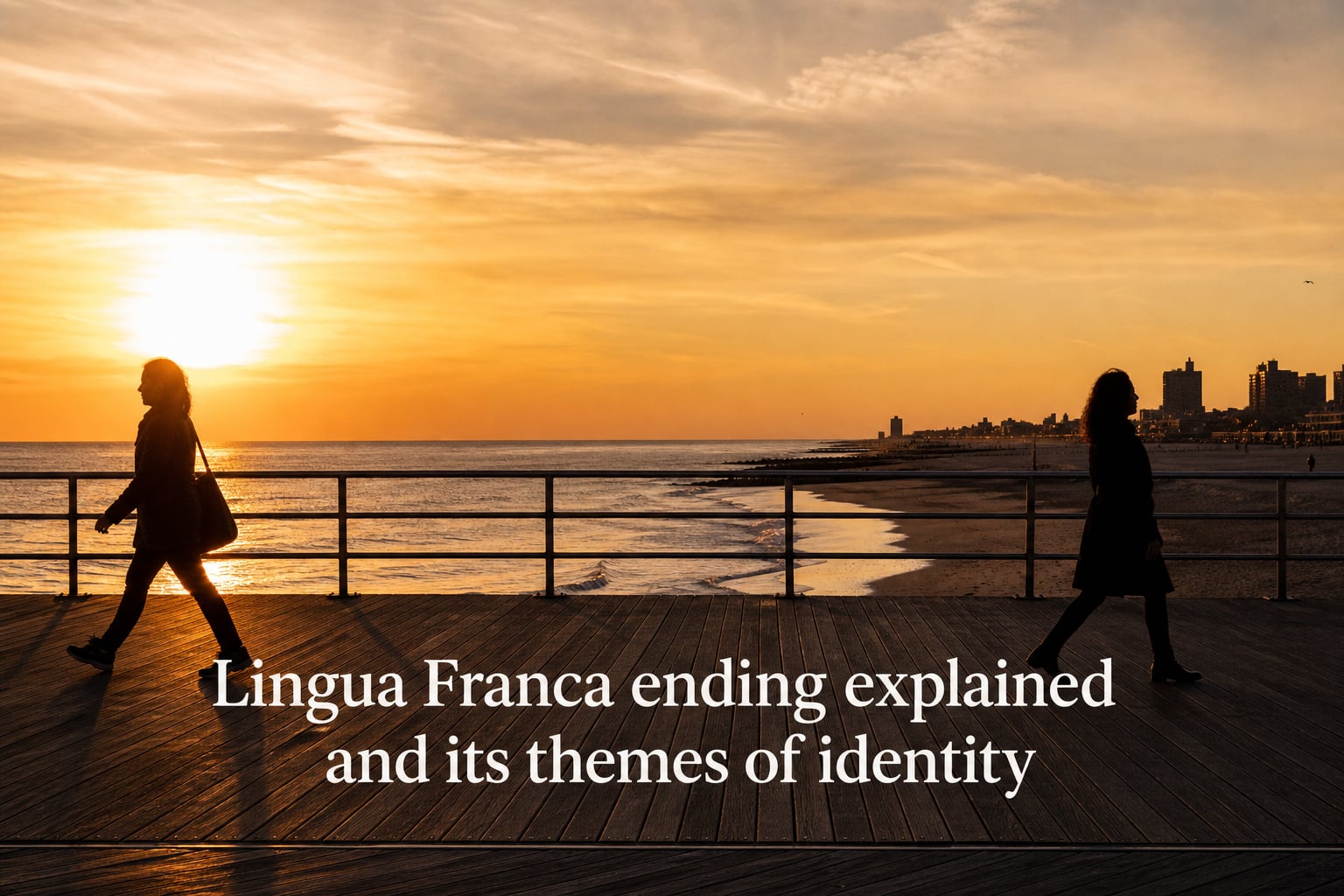
When Isabel Sandoval’s Lingua Franca premiered in 2019, it arrived like a quiet storm in independent cinema. The film tells the story of Olivia, an undocumented Filipina trans woman working as a caregiver in Brighton Beach, Brooklyn, navigating love, survival, and the constant threat of deportation. For anyone searching for a Lingua Franca ending explained, the answer is not a simple plot recap. The ending carries layers of meaning about identity, resilience, and what it means to choose authenticity over safety.
What makes this film so quietly powerful is how it refuses to give easy answers. Olivia’s final decision, the phone call with her mother, the open road ahead of her, none of it is wrapped up with a bow. Instead, Sandoval trusts the audience to sit with the discomfort and the hope intertwined in Olivia’s choice.
In this article, I will walk you through the Lingua Franca ending in detail, break down the film’s major themes of identity, and explore why this movie matters in the landscape of trans and immigrant cinema. Whether you just finished watching and felt confused, or you are studying the film for its cultural significance, this guide covers everything you need to understand what Sandoval accomplished.
Table of Contents
What Is Lingua Franca About? (Film Synopsis)
Lingua Franca follows Olivia, an undocumented Filipina trans woman living in Brighton Beach, Brooklyn. She works as a live-in caregiver for Olga, an elderly Russian-Jewish woman suffering from dementia. Olivia’s daily life is a careful balancing act between caregiving duties, navigating her gender identity, and living under the constant fear of deportation.
The central conflict emerges when Olivia explores a marriage of convenience to obtain a green card. Her situation grows more complicated when she meets Alex, Olga’s adult grandson. Alex is kind, attentive, and clearly drawn to Olivia. But he does not know she is trans, and Olivia must decide how much of herself she can reveal without risking everything.
The film moves at the pace of real life. Long, languid shots of Brighton Beach, the sounds of Russian and Filipino languages mixing in the air, and the intimate routines of caregiving all create a world that feels lived in rather than performed. Sandoval, who wrote, directed, and stars as Olivia, grounds every scene in emotional truth rather than melodrama.
This is not a film about spectacle. It is about the quiet violence of living undocumented, the tender exhaustion of care labor, and the courage it takes to exist as your full self when the world demands you stay hidden.
Main Characters and Cast
The film centers on a small, tightly drawn cast of characters, each representing a different facet of the immigrant and diaspora experience in Brooklyn.
Olivia (played by Isabel Sandoval) is the heart of the film. She is an undocumented Filipina trans woman working as a caregiver. Sandoval brings a lived-in authenticity to the role that no cisgender actor could replicate. Olivia is resourceful, vulnerable, guarded, and searching for a sense of belonging that keeps slipping through her fingers.
Olga (played by Lynn Cohen) is the elderly Russian-Jewish woman Olivia cares for. She has dementia, which means her grip on reality shifts from moment to moment. Through Olga, the film explores intergenerational care, the loneliness of aging, and the unlikely bonds that form between people from completely different worlds.
Alex (played by Eamon Farren) is Olga’s grandson. He returns to Brighton Beach to help care for his grandmother and becomes drawn to Olivia. Alex represents the possibility of love and acceptance, but also the danger of disclosure in a world that is not always safe for trans women.
The supporting cast includes members of the Brighton Beach community, real textures of Russian-Jewish and Filipino immigrant life that ground the film in a specific, recognizable place. These are not background extras. They are the living fabric of the neighborhood that shapes Olivia’s daily existence.
The Lingua Franca Ending Explained
If you came here for the Lingua Franca ending explained, this is the section you need. The final act of the film hinges on Olivia’s relationship with Alex and her pursuit of a green card through marriage. Let me break it down step by step.
Throughout the film, Olivia has been exploring a marriage of convenience with a man who can secure her legal status in the United States. This arrangement is transactional, a survival strategy rather than a romance. It represents the compromises that undocumented immigrants are forced to make every day.
Meanwhile, her connection with Alex deepens into something genuine. Alex does not know Olivia is trans, and the tension of this undisclosed truth builds throughout their relationship. Olivia is caught between the safety of the arranged marriage and the vulnerability of real love with someone who might not accept her full identity.
Then comes the turning point. Olivia makes a decision that many viewers found surprising and even counterintuitive. She turns down the marriage of convenience. She chooses not to secure her green card through a transactional arrangement, even though it is the safest path to legal status. This is the moment that defines the ending and the entire film.
Why does she make this choice? Because accepting the marriage would mean continuing to live a lie. Olivia has spent years hiding, performing, and shrinking herself to survive. The marriage of convenience is just another closet. By rejecting it, she is making a statement about what she values more than safety, her personhood.
Isabel Sandoval has spoken directly about this decision. She described Olivia’s choice as an act of resilience rather than defeat. In an interview, Sandoval explained that Olivia’s decision to turn down the marriage may seem impractical, but it reflects a deeper truth. The film ultimately ends on a note of resilience through Olivia’s character, showing that her identity and dignity matter more than the legal protection a sham marriage could provide.
The final scenes show Olivia on what appears to be a bus or in transit, leaving Brighton Beach behind. She calls her mother in the Philippines. This phone call is one of the most emotionally charged moments in the film. It is the first time we see Olivia reach out across the distance that defines her immigrant experience, connecting to the family and homeland she left behind.
The ending is intentionally open. We do not know if Olivia will be safe. We do not know if she and Alex will find their way to each other. We do not know if she will avoid deportation. What we do know is that Olivia has chosen herself. She has refused to let fear dictate the terms of her existence, even when the consequences could be devastating.
This ambiguity frustrates some viewers. On Reddit, discussions about the film often circle around the same questions. Is the ending hopeful or tragic? Is Olivia going to be okay? The beauty of Sandoval’s filmmaking is that she refuses to answer these questions for us. Instead, she asks us to sit with the same uncertainty that undocumented trans people live with every single day.
Lingua Franca Themes of Identity Explored
The Lingua Franca themes of identity are what elevate this film from a personal story to a broader cultural statement. Sandoval weaves together multiple strands of identity that rarely get this level of nuance in cinema.
Trans identity as lived experience, not spectacle. The film rejects the trauma-heavy storytelling that dominates so much trans representation in film and television. There is no violent reveal scene, no sensationalized disclosure moment. Olivia’s transness is simply one part of who she is, present in every frame but never reduced to a plot device. Sandoval has described this approach as the “trans female gaze,” a way of seeing trans women as complete people rather than subjects of curiosity.
Immigration and the undocumented experience. Olivia’s legal status shapes every decision she makes. The fear of ICE, the precarity of working without documentation, the impossible choices between safety and dignity, these are not background details. They are the structural reality that presses on every moment of her life. The film captures the specific anxiety of undocumented existence with a realism that few films achieve.
The intersection of trans and immigrant identities. This is where Lingua Franca truly stands apart. Most films about trans identity focus on one dimension. Most films about immigration focus on another. Sandoval shows what happens when these identities overlap, when you are navigating both gender transition and legal precarity at the same time. The result is a portrait of intersecting vulnerabilities that is rarely seen on screen.
Care labor and emotional labor. Olivia’s work as a caregiver is not incidental to the story. It is central. The film takes seriously the physical and emotional toll of caring for another person, especially someone like Olga whose dementia makes every interaction unpredictable. Olivia performs this labor with tenderness and exhaustion in equal measure, and the film never romanticizes or dismisses it.
The closet as an ongoing condition. One reviewer described the film as being about “closets after closets after closets.” Olivia is closeted as trans with Alex. She is closeted as undocumented with much of the world. Even within Filipino and LGBTQ+ communities, there are layers of identity she must negotiate. The film shows that coming out is not a one-time event but a continuous process of deciding who gets to see which parts of you.
Belonging and displacement. Brighton Beach itself becomes a character, a liminal space where Russian-Jewish and Filipino immigrant communities coexist without truly intersecting. Olivia moves through this world as someone who belongs everywhere and nowhere. The film captures the specific loneliness of diaspora life, the way home becomes something you carry rather than a place you occupy.
The Lingua Franca Title Metaphor Explained
The title Lingua Franca is not just a name. It is a metaphor that runs through the entire film. A lingua franca is a common language used between people who speak different native tongues. It is how communication happens across cultural and linguistic divides.
In the film, this concept operates on multiple levels. Literally, English serves as the lingua franca between Olivia, who speaks Tagalog, and the Russian-Jewish community of Brighton Beach. But the metaphor goes much deeper.
Love itself becomes a lingua franca. Olivia and Alex communicate across divides of culture, class, and life experience. Caregiving becomes a lingua franca, a way for Olivia and Olga to connect despite the vast differences in their backgrounds and the fog of dementia. The film suggests that human connection is the universal language we all search for, even when the words fail.
But there is a tension here. A lingua franca is also a compromise. It is the language you use when you cannot speak your mother tongue. It is functional but not native. This mirrors Olivia’s experience of navigating a world where she is always translating herself, always finding ways to be understood while never fully being seen. The title captures both the possibility of connection and the loss that comes with it.
Isabel Sandoval’s Vision and the Trans Female Gaze
Isabel Sandoval is not just the director of Lingua Franca. She also wrote the screenplay, produced the film, edited it, and stars as Olivia. This level of creative control is rare, and it is what gives the film its singular voice.
Sandoval has spoken about what she calls the “trans female gaze.” This is a way of seeing trans women not through the lens of cisgender curiosity or fetishization but through the eyes of trans women themselves. The camera in Lingua Franca looks at Olivia the way Sandoval sees herself and her community, with tenderness, complexity, and unflinching honesty.
The film was also influenced by the work of Wong Kar-wai. Reddit users and critics have noted the connection, describing Lingua Franca as “Wong Kar-wai mixed with social realism.” The lush cinematography, the patient pacing, and the attention to mood and atmosphere all echo films like In the Mood for Love. But Sandoval brings her own political and personal urgency to the style.
Sandoval has been clear that she did not want to make a film about trauma. She has pushed back against the trend of “trauma porn” in LGBTQ+ cinema, stories that wallow in suffering without offering hope or agency. Instead, she wanted to show Olivia as a full human being with desires, contradictions, humor, and resilience. This commitment to empathetic imagination is what makes the film feel different from so much trans representation that has come before.
The political context matters too. Lingua Franca was made during the Trump era, when immigration enforcement was escalating and trans rights were under sustained attack. The film does not preach about these issues. It simply shows what they feel like from the inside, through the daily life of one woman trying to survive with her dignity intact.
Critical Reception and Cultural Impact
Lingua Franca earned strong reviews from critics and developed a passionate following among viewers hungry for authentic trans storytelling. The film holds an 86% rating on Rotten Tomatoes, reflecting broad critical praise for Sandoval’s writing, direction, and performance.
The film was selected for the Venice Film Festival, a significant achievement for an independent film by a Filipina trans filmmaker. This recognition placed Sandoval among a small group of trans directors gaining visibility on the international festival circuit.
Ava DuVernay’s distribution company ARRAY acquired Lingua Franca, bringing it to Netflix and a wider audience. ARRAY focuses on amplifying films by and about people of color, and the acquisition signaled that Lingua Franca was being recognized as an important cultural work, not just a niche independent film.
The film was also nominated for a GLAAD Media Award, further cementing its place in the conversation about LGBTQ+ representation. For many viewers, especially trans women of color, the film filled a void in cinema. It offered a story that reflected their experiences with nuance and care rather than exploitation.
Critics consistently praised the film’s restraint. Roger Ebert’s review noted that Sandoval encompasses not just the issue of gender identity but also the immigrant experience, showing how these dimensions of identity interlock. The review highlighted the film’s ability to find emotional complexity in quiet moments rather than dramatic confrontations.
Some viewers found the ending abrupt or ambiguous, a complaint that surfaces regularly in Reddit threads and reviews. But this ambiguity is intentional and, I would argue, essential to the film’s power. Sandoval does not offer closure because closure is a luxury that Olivia does not have. The open ending asks the audience to extend the same empathetic imagination that Sandoval brings to her filmmaking.
FAQs
What happens at the end of the movie Lingua Franca?
At the end of Lingua Franca, Olivia turns down a marriage of convenience that would have secured her a green card. She chooses authenticity over safety, refusing to live another lie. The final scenes show her leaving Brighton Beach and calling her mother in the Philippines, an emotionally charged moment of connection across distance. The ending is intentionally open, leaving Olivia’s future uncertain.
Why did Olivia turn down the marriage?
Olivia turns down the marriage of convenience because accepting it would mean continuing to hide who she is. Director Isabel Sandoval has described this as an act of resilience. Olivia chooses her personhood and dignity over the legal safety a sham marriage could provide, even though the consequences could be severe.
What themes does Lingua Franca explore?
Lingua Franca explores trans identity, undocumented immigration, the intersection of these identities, care labor, the closet as an ongoing condition, belonging and displacement, and the search for authentic human connection. It also examines how people from different cultural and linguistic backgrounds find common ground.
What does the title Lingua Franca mean?
A lingua franca is a common language used between people who speak different native tongues. In the film, the metaphor works on multiple levels. English connects Olivia with the Russian-Jewish community of Brighton Beach. Love and caregiving serve as emotional lingua francas. The title also suggests the compromise of always translating yourself, never fully speaking your native language.
Is Lingua Franca based on a true story?
Lingua Franca is not based on a specific true story, but it draws heavily from director Isabel Sandoval’s own experiences as a Filipina trans woman. Sandoval wrote, directed, edited, and stars in the film, bringing personal authenticity to Olivia’s story.
Where can I watch Lingua Franca?
Lingua Franca was acquired by Ava DuVernay’s ARRAY distribution company and made available on Netflix. Availability may vary by region and over time, so check current streaming platforms for the most up-to-date information.
Final Thoughts on Lingua Franca and Its Legacy
Lingua Franca is a film that rewards patience and attention. The Lingua Franca ending explained here, Olivia’s rejection of a marriage of convenience and her decision to choose authenticity over safety, is the emotional and thematic core of the entire work. It is a quiet act of resistance, one that echoes far beyond the screen.
What stays with you after watching is not just the story but the way Sandoval tells it. Through the trans female gaze, through the specific textures of Brighton Beach, through the patience of her pacing and the tenderness of her camera, she creates a portrait of a woman who refuses to be reduced to any single label. The Lingua Franca themes of identity, immigration, care, and belonging feel as urgent in 2026 as they did when the film premiered.
If this analysis deepened your appreciation of the film, I encourage you to seek out more of Isabel Sandoval’s work and continue exploring the growing landscape of trans cinema made by trans filmmakers. The stories we need are already being told. We just need to listen.