
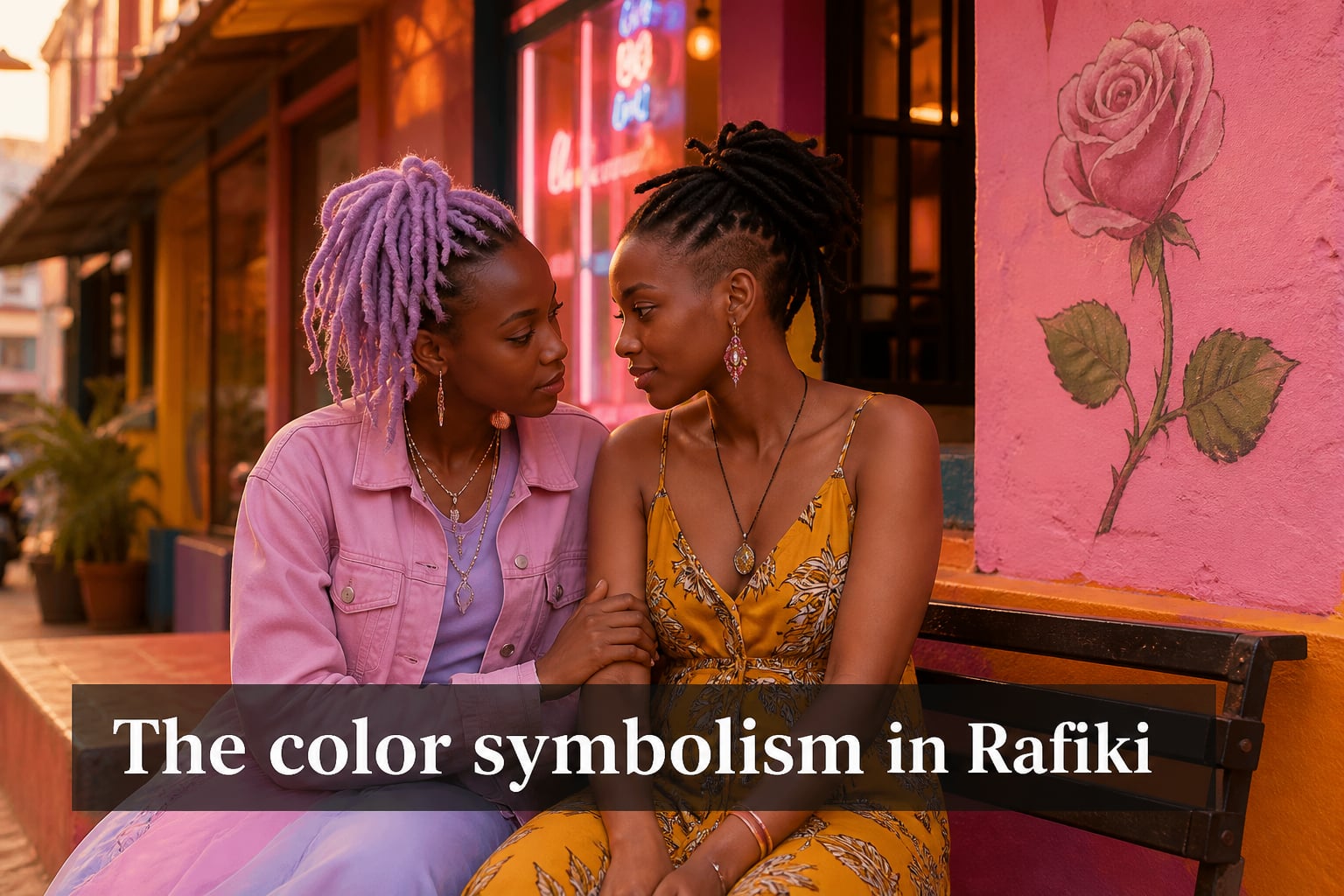
If you have ever watched Wanuri Kahiu’s Rafiki and felt your eyes drawn to every pink wall, every soft lilac strand, and every neon-soaked street corner, you were experiencing exactly what the director intended. The film is saturated with meaning, and the color symbolism in Rafiki is one of the most talked-about visual approaches in recent African cinema. I went back through the film several times and pulled together what every shade is doing on screen, and why it matters so much to the story.
Rafiki premiered at Cannes in 2026 and was banned in Kenya shortly after because of its queer love story. Director Wanuri Kahiu responded not by softening the film, but by leaning harder into color. The result is a movie where every pastel dress and bright orange wall carries a piece of the narrative. Below is a complete walkthrough of how color works in Rafiki, what it means, and where you can see it in action.
Table of Contents
What Is the Color Symbolism in Rafiki?
The color symbolism in Rafiki is the deliberate use of a vibrant, pastel, and neon color palette to communicate queer joy, intimacy, danger, and hope without relying on dialogue. Director Wanuri Kahiu and her cinematographer chose specific hues for each character, each setting, and each emotional beat, so that the audience feels the story’s temperature before a single line is spoken.
Three color families run through the entire film: soft pastels for private intimate moments between the two protagonists, vibrant neons for scenes of public queer expression, and the natural saturated tones of Nairobi itself. Together, these three palettes form a visual language that tells the love story of Kena and Ziki while also speaking to the wider cultural moment in Kenya.
Wanuri Kahiu and the Afrobubblegum Movement
You cannot fully understand the color choices in Rafiki without understanding the movement behind them. Wanuri Kahiu is one of the leading voices of the Afrobubblegum movement, an artistic philosophy she co-founded that celebrates African joy, fun, and beauty in storytelling rather than focusing only on suffering, conflict, or trauma.
Afrobubblegum art is intentionally bright, playful, and unapologetic. It treats African life as worthy of vibrant color, not just muted documentary tones. In a film like Rafiki, that philosophy shows up directly in the saturated pink storefronts, the hand-painted billboards, and the candy-colored dresses the characters wear. Kahiu has said in interviews that she wanted to show audiences the real, vivid Nairobi she grew up in, not a flattened version of it.
Nairobi as a Colorful Character
Nairobi is not just a backdrop in Rafiki. It functions almost as a third lead, and the color treatment of the city is a major part of the film’s emotional architecture. The walls, the storefronts, the matatus (public minibuses), and the street art are all painted in saturated pinks, oranges, yellows, and greens that announce the city as alive, layered, and full of personality.
This choice does two things at once. First, it pushes back against the visual clichés of Africa shown in Western cinema, where the continent is often filtered through desaturated or “gritty” tones. Second, it stages the love story inside a place that is already emotionally expressive, so that when Kena and Ziki fall in love, the city itself is celebrating with them. The film is full of bright pinks, bold greens, and warm yellows, and these tones surround the characters whether they are walking to school, riding through town, or sitting in a quiet courtyard.
Ziki’s Lilac Hair and the Language of Color
The single most discussed color choice in the film is Ziki’s lilac hair. In interviews, Wanuri Kahiu has explained that Ziki’s lilac hair is reflected in the way the screen is tinged with lilac in her scenes, so the audience literally sees the world through her color when she is on screen. This is not a passive decoration. It is a visual announcement that Ziki is a character who refuses to blend in.
Lilac sits between pink and purple. It carries softness, but it also carries a kind of defiance when it is worn as a hairstyle rather than as a background color. In the film, Ziki’s lilac marks her as someone who is comfortable standing out, who treats her identity as something to be displayed rather than hidden. When the screen itself takes on a lilac tint during her scenes, the color moves from being a costume choice to being a worldview.
Pastel Intimacy vs Vibrant Public Expression
One of the most consistent color strategies in Rafiki is the contrast between soft pastels and vibrant neon shades. Kahiu uses soft pastel colors in intimate moments between Kena and Ziki, and then shifts to vibrant neon shades in scenes of public queer expression. This contrast is not random. It tracks the difference between private safety and public visibility.
When the two girls are alone, talking on a bench, sharing earbuds, or leaning against each other, the world around them falls into soft pinks, gentle greens, and washed-out blues. The pastels feel protective, like a soft blanket. When the story moves to a hair salon, a street dance, or a community gathering, the colors turn into electric magenta, bright cyan, and full yellow. The neon tells the audience that the couple is now part of a larger queer community, and that community is loud, proud, and alive.
The Rose Metaphor: Bloom and Wilt
Kahiu has spoken openly about the rose metaphor at the heart of the film. In her own words, falling in love is when you giggle and blush the most, and she wanted that blush visible on screen. Roses run through the color story of the film, appearing in patterned dresses, painted on walls, and echoed in the soft pink tones that surround the central romance.
The rose metaphor works in two directions. A rose that is blooming is the visual language of love growing, attraction blooming, and the body responding to joy. A rose that is wilting is the visual language of love being denied, separated, or punished. The film moves between these two states through color, with vivid rose pinks during the blooming and faded, dusty tones as the relationship is tested by family pressure and community violence.
Color as Queer Joy and Resistance
The color choices in Rafiki are not just pretty. They are political. The film was banned in Kenya for “promoting homosexuality,” and Kahiu took the case to the Kenyan Film Classification Board and ultimately to court. In that context, a film that is filled with neon pinks, soft pastels, and defiant lilac becomes an act of visibility. Every bright color is a refusal to disappear.
Color in Rafiki is also a form of queer joy, a cinematic technique that centers pleasure, softness, and laughter rather than only trauma. The pastel pink of Kena’s bedroom, the candy-colored storefronts the couple passes on their walks, the bright stripes on Ziki’s jacket, these are all visual reinforcements of a story that insists on joy even in the face of social rejection. The color palette is, in its own quiet way, a form of hope and resistance.
Frequently Asked Questions About the Color Symbolism in Rafiki
What color is Rafiki?
Rafiki is a 2018 Kenyan film whose color palette is built around vibrant pinks, soft pastels, neon neons, and the signature lilac of Ziki’s hair. The film uses these colors deliberately to communicate emotion, intimacy, and queer joy throughout the story of Kena and Ziki in Nairobi.
Why was Rafiki banned?
Rafiki was banned in Kenya by the Kenya Film Classification Board shortly after its Cannes premiere because of its positive portrayal of a queer love story between two young women. The ban cited the country’s anti-homosexuality laws, and director Wanuri Kahiu challenged the decision in court. The film remains a landmark case in African queer cinema.
What does the Rafiki symbolize?
The name Rafiki means u0022friendu0022 in Swahili, and the film symbolizes friendship, chosen family, and the kind of love that persists even when it is denied a public place. The color symbolism supports this through lilac, rose, and pastel imagery that marks the central love story as something tender, defiant, and protected.
What does Ziki’s lilac hair mean?
Ziki’s lilac hair represents her refusal to conform and her comfort with being visibly different. Director Wanuri Kahiu has explained that the lilac of Ziki’s hair is reflected in the screen color around her, so the entire frame takes on a lilac tint during her scenes, marking her as a character who sees the world through her own color.
How does color show queer joy in Rafiki?
Color shows queer joy in Rafiki through soft pastels in intimate moments between Kena and Ziki and through vibrant neon shades in scenes of public queer community. The warm pinks, bright yellows, and electric blues in these scenes frame queer love as something celebratory and beautiful rather than something to be hidden.
Why is Rafiki so colorful?
Rafiki is so colorful because Wanuri Kahiu works within the Afrobubblegum movement, which celebrates African joy and beauty through saturated, playful imagery. The film uses that color to show the real, vivid Nairobi she grew up in, and to push back against the desaturated visual clichés often applied to African stories in Western cinema.
Final Thoughts on the Color Symbolism in Rafiki
The color symbolism in Rafiki is one of the most layered visual choices in modern queer cinema. From Ziki’s lilac hair to the soft pastels of the couple’s private moments, from the neon-soaked public scenes to the rose metaphor that runs through the entire film, Wanuri Kahiu uses color to do what dialogue alone cannot. She makes the love story visible even when the world around the characters is trying to make it invisible.
If you are studying visual storytelling, queer cinema, or African film, the color choices in Rafiki are worth slowing down for. Watch one scene with the sound off and just look at the palette. You will see a film that is arguing, in every pink and every lilac, that joy is a form of resistance, and that color is one of the most direct ways to put that argument on screen.