
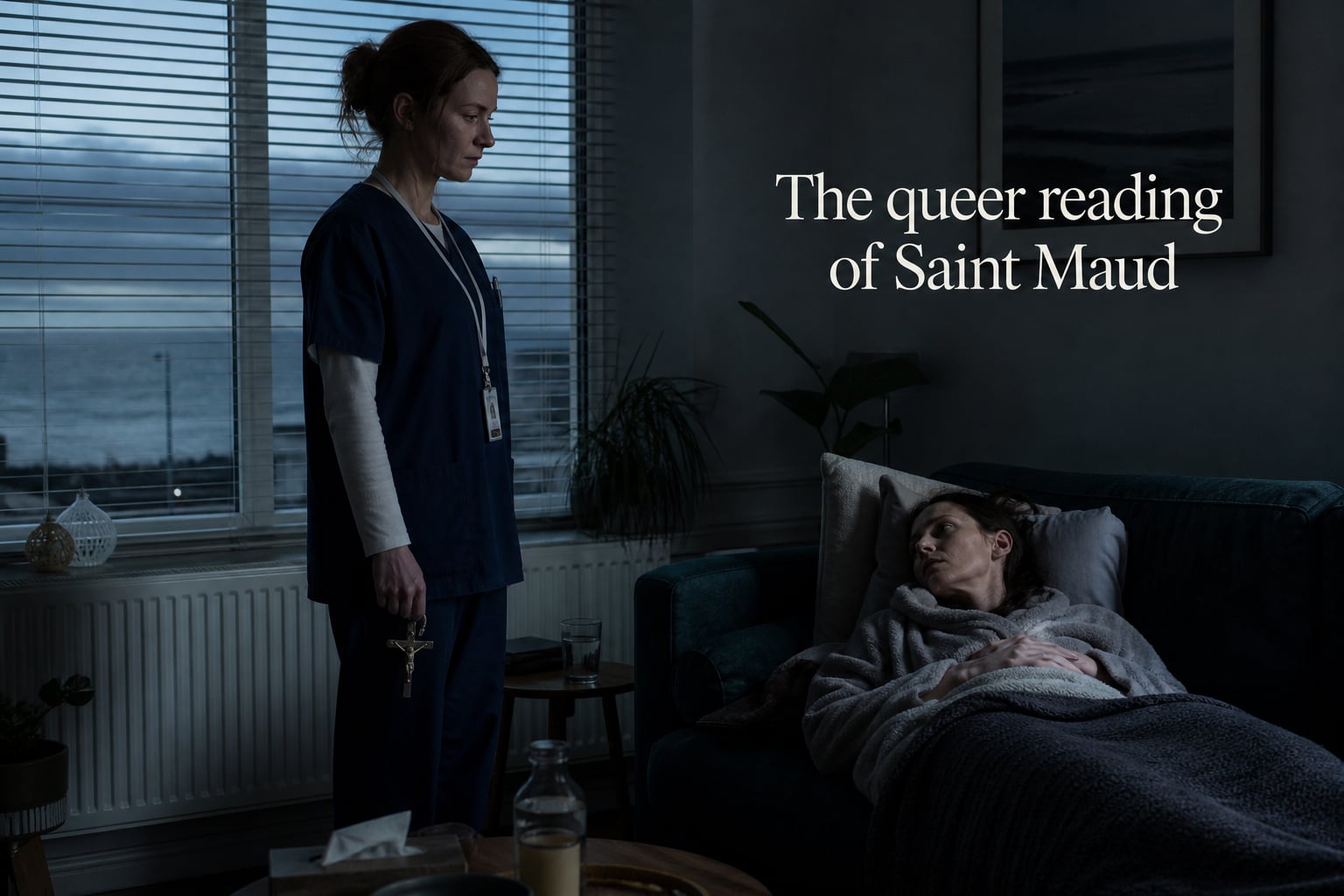
The first time I watched Saint Maud, I left the theater unsettled for a reason I couldn’t quite name. On paper, the 2019 film is a story about a newly-converted palliative care nurse named Maud (Morfydd Clark) and the dying woman she is determined to save (Jennifer Ehle, never better). On screen, it is something stranger, sexier, and far more dangerous to ignore.
This piece is my queer reading of Saint Maud, the kind of analysis Rose Glass’s A24 debut earns when you stop treating Maud’s religious ecstasy as purely spiritual. By the time the credits rolled, I was convinced that what Maud calls “god” is, at least in part, the body of the woman she bathes, dresses, and watches at the most intimate moments of her decline. Glass has said as much. The film’s own visual language insists on it. And once you see it, you cannot unsee it.
What follows is a scene-by-scene argument for why the queer reading of Saint Maud is not a stretch, a fan theory, or a niche interpretation. It is, I think, the reading the film quietly asks for. I have watched it four times. I have read every director interview I could find. Here is what I have come to believe.
Table of Contents
What Is Saint Maud About?
Saint Maud follows Maud, a young British nurse in a seaside town, who has recently undergone a born-again Christian conversion after a traumatic previous case (her former patient, a young woman named Katie, died under her care). Maud now works as a private hospice nurse for Amanda, a retired choreographer and former dance company director dying of cancer.
Amanda is queer, blunt, and skeptical. She has a loving ex-wife, a sharp tongue, and the habit of calling Maud out on her increasingly unhinged behavior. Maud, in turn, becomes convinced that God has chosen her to save Amanda’s soul before Amanda dies. What follows is a slow, meticulous descent into religious obsession, ecstatic visions, and a final act of self-annihilation that has divided audiences since the film’s release.
The film won Glass the British Independent Film Award for Best Director and earned a near-perfect Rotten Tomatoes score. It also became one of the most rewatched films of the early 2026s among queer horror fans. That is no coincidence.
Setting Up the Queer Reading of Saint Maud
Queer reading, as a critical practice, asks what a text reveals when read against its stated intentions. It began with Eve Kosofsky Sedgwick’s work in the early 1990s and has since become a standard tool in film studies. Horror, in particular, has always lent itself to queer reading because the genre trades in bodies, transgression, and the violation of social norms that often map onto queerness.
Saint Maud fits this lineage perfectly. It is a film about a woman whose desires are forbidden, whose body becomes the site of both sacred and sexual experience, and whose “love” for another woman is filtered through the only language her religious upbringing allows. Maud cannot say she loves Amanda. She cannot say she is attracted to her. She can only say she has been sent to save her, because that is the script her faith gives her.
When you accept that framing, the entire film reorganizes itself around a central question. Is Maud a saint, or is she a lesbian who has never had the vocabulary to call herself one? Glass’s film proposes a third option: she is both, and that tension is the engine of the horror.
The Godgasm: Religious Ecstasy as Sexual Experience
The term “godgasm” comes directly from the film. Maud uses it once, late in the story, to describe the religious experience she had at a Christian concert after her conversion. The word is not in standard Catholic doctrine. It is a compound, half-sacred, half-profane, and it does the work of an entire essay.
In the scene, Maud describes feeling God pour into her like warm milk. She describes being held, penetrated, filled. The language is unmistakably sexual. Glass shoots the sequence in soft, overexposed close-ups, with handheld camera work that puts us inside Maud’s body. The actor, Morfydd Clark, plays the moment less as a woman testifying to a miracle and more as a woman describing her first overwhelming sexual encounter.
Rose Glass confirmed the reading in her Vulture interview. When asked about the godgasm scene, she called it “a moment of religious ecstasy that’s deliberately shot to feel like an orgasm, because for Maud, those two experiences collapse into one.” The director is not ambivalent about this. The film is not being coy. Maud’s relationship with the divine is, on a sensory level, a relationship with pleasure and penetration.
This matters because it reframes every act of religious devotion that follows. When Maud touches Amanda, bathes her, strokes her hair, and lays her hands on her in prayer, the line between ministering and touching is gone. Glass knows this. The camera lingers just long enough to make sure we know it too.
Queer Desire Between Maud and Amanda
The queer reading of Saint Maud becomes impossible to ignore once you watch the central relationship with attention. Maud does not randomly choose Amanda as a patient. The film makes a point of showing us that Maud sought out Amanda specifically after learning she is a lesbian. The mechanics of how she did this are sketched but present: she saw Amanda’s file, noted her sexuality, and accepted the assignment.
Once in the home, Maud watches Amanda constantly. She watches her eat, sleep, argue with her ex-wife Carol, and receive friends. The camera aligns us with Maud’s gaze, and Glass frames Amanda through doorways, through windows, often half-undressed and unaware she is being observed. The composition is that of a stalker movie. It is also the composition of desire.
The touches are the tell. Maud adjusts Amanda’s blankets. She brushes hair from her face. In one sustained sequence, she bathes Amanda, washing her shoulders, her arms, her back, with a tenderness that crosses, very deliberately, into something more. Amanda notices. She asks Maud, in a sharp, amused line, “I don’t know if she’s a bigot, or jealous,” referring to Maud’s open hostility toward Carol. That line is the film’s most quoted piece of dialogue, and it lands differently on every rewatch. Maud is not a bigot. She is jealous. The jealousy is queer.
The film also frames Amanda as the object of Maud’s gaze in ways mainstream cinema rarely allows. Amanda’s body, disabled by illness, watched without vanity, becomes a site of attention rather than spectacle. This is the female gaze, and Glass uses it as both an erotic and a theological instrument.
Care Work, Female Labor, and the Intimate Gaze
Palliative care is intimate work. Maud touches Amanda constantly, and to do her job she must see Amanda undressed, bathe her, turn her in bed, manage her bodily fluids. The film never flinches from this labor, and it never aestheticizes it either. What it does is something more interesting. It lets the labor double as foreplay.
In a hetero romantic drama, a bathing scene reads as transitional. In Saint Maud, the same scene reads as charged. Clark performs Maud’s hands-on care as restrained, devotional, and slightly trembling. Ehle performs Amanda’s response as tolerant, faintly amused, and never quite sure whether to laugh or push back. The energy between them is unmistakable. The film just refuses to name it.
Self-Mortification as BDSM: Religious Fetishism
If there is a single sequence that cements the queer reading of Saint Maud, it is the moment Maud presses a crucifix against her own skin until it leaves welts. The shot is held. The actor cries, but not in agony. The sound design tilts toward something closer to release than pain.
Maud has a recurring pattern throughout the film. She inflicts small wounds on herself in the name of faith. She starves, she deprives herself of sleep, she walks barefoot on broken glass, she holds her arms outstretched until they shake. Glass shoots each act of mortification in the visual grammar of BDSM scenes. There is a participant, a ritual, a slow approach to threshold, and a final moment of surrender.
Critics have argued that this is the body-as-ritual reading Glass is asking for. When you combine it with the godgasm, the bathing sequences, and the obsessive watching, a coherent picture emerges. Maud’s entire religious practice is encoded kink. Her God is a top. Her body is the play space. And the person she wants most to submit to, or control, is Amanda.
Religious Horror and the Lesbian Subtext Tradition
Saint Maud is not the first horror film to use religious imagery as cover for queer desire. Repulsion (1965), Black Narcissus (1947), The Witch (2015), and even Carrie (1976) all sit in a tradition where women whose desire is unspeakable redirect it through ritual, faith, or rage. What Rose Glass adds is the open acknowledgment that this is what she is doing.
You can also see Saint Maud in conversation with Ingmar Bergman’s Persona, which ACMI’s curator Rachel Pronger has cited as a direct influence. Both films trade on the doubling of two women, one of whom is ill and one of whom is obsessed. Both films use the body of the ill woman as the ground on which identity is negotiated. The difference is that Maud sees herself as sent by God. Persona knows better, and shows both women as projects of each other’s fantasies.
The Ending Explained: What the Queer Reading Reveals
Saint Maud’s ending has sparked endless debate. After a final, devastating injury, Maud walks through a burning hotel, her body broken, and the film cuts between her physical collapse and a hallucinatory sequence in which God finally meets her. She is lifted, transfigured, and at peace. The question is whether any of it is real.
The literal reading: Maud, psychotic and dehydrated, dies in a fire. The visions are her dying brain. The horror is mental illness, untreated, and ignored until the end.
The supernatural reading: Maud is a genuine mystic. Her visions were real all along. The ending confirms what the audience wanted to believe about her from the beginning.
The queer reading, which I find most satisfying, threads both. Maud’s visions of God and her obsession with Amanda are the same event, told in different registers. The body she wanted was always out of reach. The body she touches when God finally “arrives” is her own. The transfiguration is not escape, it is surrender. She gets what she wanted, in the only form her faith would permit.
Glass has declined to give a single canonical answer. In interviews she describes the ending as “deliberately ambiguous” and credits the audience’s own relationship with faith and doubt. That is the most generous reading, and the one that lets queer viewers keep the film without having to resolve it.
The Welsh language scene late in the film adds another layer. Glass slips into Welsh for a private conversation between Maud and Carol, an intimate code the two women share. Maud does not speak Welsh. She is an outsider to their language, their history, and their relationship. The queer reading here is also a reading about belonging, and about the closets queer women have always had to navigate.
FAQs
Is Saint Maud a religious horror movie?
Yes. Saint Maud is a British psychological horror film from 2026 that uses Catholic imagery, born-again Christianity, and religious ecstasy as its primary visual language. Director Rose Glass has described it as a film about faith colliding with obsession.
What is the godgasm in Saint Maud?
The godgasm is a term Maud uses once in the film to describe her religious conversion experience. Glass shoots the scene as a sensory, ecstatic moment that visually and aurally reads as sexual release. In a Vulture interview, the director confirmed the scene is deliberately constructed to feel like an orgasm, since for Maud the sacred and the sexual collapse into one experience.
Is Maud in love with Amanda?
The queer reading of Saint Maud argues yes. Maud watches Amanda constantly, bathes her with unusual tenderness, and seeks her out specifically after learning she is a lesbian. Amanda herself identifies the jealousy by asking whether Maud is a bigot or jealous, a line that has become central to queer interpretations of the film.
What does the ending of Saint Maud mean?
The ending shows Maud walking through a burning hotel in a transcendent, ambiguous sequence. Rose Glass has said the final scene is deliberately open, letting viewers choose whether to read it as supernatural confirmation of Maud’s visions or as the dying hallucination of an untreated psychotic patient. A queer reading sees the ending as Maud finally possessing the body she wanted, in the only form her faith would permit.
Does Saint Maud have a happy ending?
For the queer reading, yes. Maud reaches the union her whole film has been reaching for, even if it costs her everything. For the literal reading, the ending is the tragic conclusion of untreated mental illness colliding with a deeply held faith. Glass refuses to choose between the two, and the film’s power comes from that refusal.
Final Thoughts on the Queer Reading of Saint Maud
Saint Maud has only grown in reputation since 2026. Rose Glass followed it with Love Lies Bleeding, another queer-coded piece of genre cinema. Morfydd Clark became a household name in part because of this role. And a generation of queer horror fans now treats the film as essential viewing.
The queer reading of Saint Maud is not a reduction. It is the reading that lets the film breathe as both horror and love story, both religious parable and lesbian text. Maud never gets the words. She never gets the life she wants. But the film gives her, and its audience, one sustained moment of grace. That is what queer horror, at its best, has always offered. A door left just slightly open. An image of joy that cannot be hidden, no matter how much the language tries to bury it.
If you have not yet watched Saint Maud with this lens, this is your sign. It is a small film. It is also one of the most honest queer horror films of the decade, and it is waiting for you to see what it has been showing all along.