
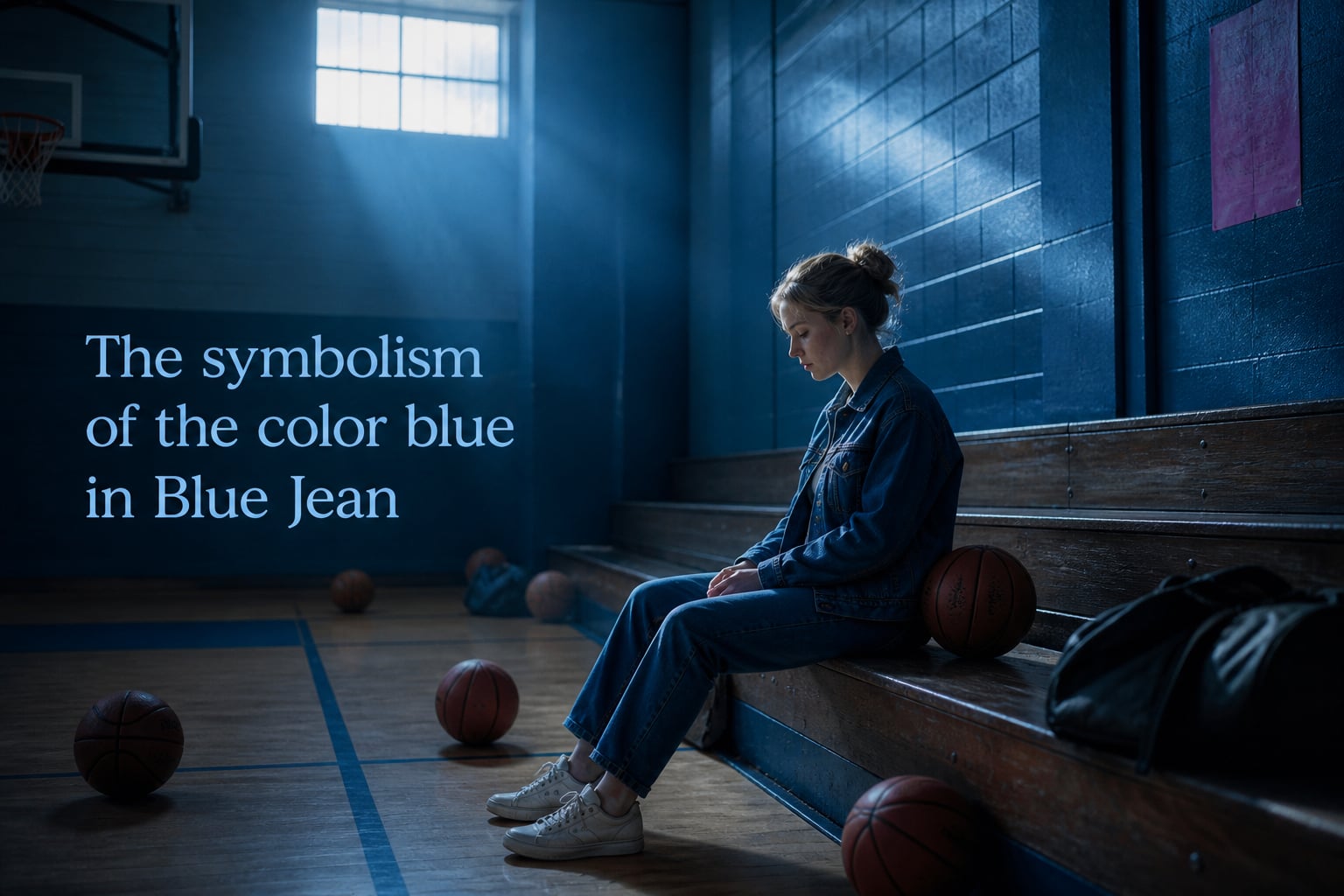
The symbolism of the color blue in Blue Jean is not a background detail. It is the emotional and thematic engine of the entire film. Georgia Oakley’s 2022 debut feature, set in 1988 Newcastle during the Thatcher era, uses a dominant blue palette to immerse viewers in the cold, isolated world of Jean, a lesbian PE teacher forced to live a double life. Every frame washes the audience in blue hues, from the gym where Jean works to the clothes she wears, signaling repression before a single line of dialogue lands.
What makes the blue in this film so powerful is how it functions on multiple levels at once. It represents Jean’s closeted existence, the political climate of Section 28, and the emotional distance she maintains from everyone around her. When the film introduces pink as a contrasting color, the entire visual language shifts. That contrast tells a story about gender expectations, societal pressure, and the dangerous space between safety and authenticity.
Our team has analyzed the color theory, cinematography techniques, and historical context behind this remarkable film. Here is what the blue in Blue Jean actually means, how it was built, and why it matters for anyone who cares about visual storytelling in queer cinema.
Table of Contents
The Symbolism of the Color Blue in Blue Jean: What the Palette Means
In Blue Jean, blue is the color of concealment. It represents the walls Jean has built around her true self, the cold distance between her public identity and her private reality. The film does not just use blue as decoration. It uses blue as a storytelling device that works on you before you have processed what you are looking at.
Cinematographer Victor Seguin and director Georgia Oakley made a deliberate choice to bathe nearly every scene in shades of blue. From steel blue grays to deeply saturated indigo tones, the palette creates a constant atmospheric chill. Jean’s world feels cold, controlled, and tightly sealed. The blue communicates emotional temperature. You feel the repression physically.
Roger Ebert’s review of the film described this as immersion in “cold, isolated feelings.” That phrase captures the essence of what the blue does. It does not signal safety or calm. It signals a person living in a permanent state of low-grade freeze. Jean cannot relax into her surroundings because her surroundings are not safe for who she really is.
The blue also carries a sense of melancholy that runs beneath every scene. Even in moments of joy, like the scenes at the lesbian bar where Jean can briefly be herself, the blue never fully disappears. This tells us that the threat of exposure is always present. The closet follows Jean everywhere, and the color palette refuses to let the audience forget it.
One of the most striking aspects of the blue symbolism is how it shifts in intensity. When Jean is in her professional environment, at school, the blue feels rigid and oppressive. When she is with her partner or in the bar, the blue softens slightly but never warms. This gradient of blue mirrors the degree of safety Jean feels in any given moment.
Blue Versus Pink: The Color Contrast That Drives the Story
The blue in Blue Jean does not exist in isolation. It gains meaning through its constant contrast with pink, the second most prominent color in the film. This is where the symbolism deepens from personal emotion into social commentary.
Pink in the film represents enforced femininity and gender conformity. It appears in the spaces associated with heterosexual norms and societal expectations. When pink enters a frame, it signals the pressure Jean faces to perform a version of womanhood that fits the approved mold. The contrast between blue and pink becomes a visual map of the tension between Jean’s hidden identity and the identity society demands.
Film analysts have noted that this blue-pink contrast functions as a kind of color coding for gender roles. Blue marks the spaces where Jean can breathe, however slightly. Pink marks the spaces where she must perform, hide, or risk exposure. The two colors rarely blend. They sit in opposition, creating a visual tension that mirrors Jean’s internal conflict.
The most fascinating technical element of this contrast is what color theorists call the distinction between fixed and moving colors. Fixed colors are locked into the environment. The blue of the school walls, the pink of certain costumes. These do not change. They represent the immovable structures of society that Jean cannot alter.
Moving colors are more fluid. They shift with characters, lighting, and emotional states. When Jean’s world shifts, the balance of blue and pink shifts with it. This technique allows the film to communicate changes in Jean’s emotional state without relying on dialogue. The color itself tells you when the ground beneath her is shifting.
This blue-pink dynamic also speaks to a broader cinematic tradition of using color contrast to explore identity. But Blue Jean applies it with unusual specificity to the queer experience under political oppression. The colors are not abstract. They are tied to real legislation, real fear, and real consequences.
Victor Seguin’s Cinematography: How the Blue Was Built
The blue world of Blue Jean did not happen by accident. French cinematographer Victor Seguin constructed it with remarkable technical precision, using every tool available to a filmmaker working in the period piece format.
Seguin shot the film on 16mm stock, a choice that gives the entire film a grainy, textured quality. The 16mm format contributes to the blue palette because it responds to cool lighting in a way that digital sensors do not. The grain adds a layer of physical reality to the blue tones, making them feel lived-in rather than artificially imposed.
The lighting design reinforces the blue at every turn. Seguin used cool-toned practical lights and gelled sources to push scenes toward blue even in environments that might naturally read as neutral. School hallways, living rooms, and bars all received a blue wash that varied in intensity depending on the emotional needs of the scene.
Costume design and set dressing worked in concert with the cinematography. Jean’s wardrobe leans heavily into blue and blue-gray tones, making her visually merge with her environment. She becomes part of the blue world rather than a person standing apart from it. This visual blending reinforces the idea that the repression is not something happening to Jean from outside. It has become part of her.
The Artesfuse review of the film praised this work specifically, noting the “understated yet glorious” shift in color during the film’s climax and denouement. That shift is Seguin’s signature achievement. He built a blue world so thoroughly that any deviation from it carries enormous dramatic weight.
Section 28: The Historical Reality Behind the Blue World
To understand why the blue palette feels so heavy, you need to understand what was happening in Britain in 1988. Section 28 was a piece of legislation passed by Margaret Thatcher’s government that prohibited local authorities and schools from “promoting homosexuality” or teaching about its acceptability.
The effect of Section 28 was devastating for LGBTQ people, especially teachers like Jean. It created a legal framework in which simply being open about your identity at work could cost you your job. Schools were told they could not present same-sex relationships as normal or valid. For a lesbian PE teacher, this meant living under constant surveillance and threat.
The blue world of Blue Jean is a direct visual translation of what Section 28 felt like. Cold, isolating, and inescapable. The legislation did not just restrict behavior. It restricted emotional expression. It told queer people that their very existence was unspeakable in public spaces.
This is why the blue never lifts completely, even in scenes where Jean is technically safe. Section 28 was not something you could leave behind at the end of the day. It followed you into your home, your relationships, and your sense of self. The color palette makes that political reality visceral.
The film’s setting in 1988 Newcastle adds another layer. This is not cosmopolitan London. The industrial northeast of England in the late 1980s was not known for its queer visibility. The blue palette captures that regional isolation as well as the political one.
Jean’s Double Life: Blue as Emotional Armor
Jean, played with extraordinary restraint by Rosy McEwen, lives in two worlds. Her professional life at the school is rigid, monitored, and blue. Her private life with her partner and at the lesbian bar offers glimpses of freedom, but even those spaces carry the blue tint of constant vigilance.
The blue functions as emotional armor for Jean. It is the visual equivalent of the careful blankness she maintains at work. She has learned to compress herself into a version that will not attract attention, and the blue palette mirrors that compression. The color tells us that even when Jean is not actively hiding, the habit of hiding has shaped her entire presence.
The arrival of a new student, Lois, threatens to collapse the two worlds. Lois recognizes Jean at the bar, and suddenly the boundary between Jean’s blue professional world and her private life begins to dissolve. The film tracks this dissolution through shifts in the color palette, as the controlled blue starts to crack under the pressure.
Viv, Jean’s partner, exists in a slightly different visual register. She is more open, more willing to risk visibility. The contrast between Jean and Viv is communicated partly through subtle differences in how they occupy the blue space around them. Jean merges with it. Viv pushes against it.
This character-level color work is what separates Blue Jean from films that use color symbolically in a more superficial way. The blue is not just a mood. It is a character trait expressed visually.
Why the Title Blue Jean Matters: The Garment as Symbol
No competitor analysis we reviewed thoroughly explores why the film is called Blue Jean. But the title carries symbolic weight that connects directly to the color theory at work in the film.
Blue jeans are a garment associated with working-class identity, casualness, and a kind of everyday freedom. They are the most universal piece of clothing in modern Western culture. Everyone wears them. They signal nothing unusual.
In the context of the film, the title suggests the tension between visibility and invisibility. Jean, like a pair of blue jeans, is meant to blend in. She is supposed to be unremarkable, ordinary, part of the background. The blue of her name is the blue of forced normalcy.
But blue jeans are also associated with rebellion. James Dean, Marlon Brando, counterculture movements. The garment carries a double meaning, just as Jean’s life does. She is simultaneously the most ordinary person in the room and someone living an extraordinary act of resistance simply by existing honestly.
The title also suggests something worn and familiar. Blue jeans fade over time. They become softer, more comfortable, but also more visibly used. Jean’s double life has worn her down in ways the blue palette makes visible.
Soundtrack and Color: When Blue Monday Meets a Blue World
The film’s use of New Order’s “Blue Monday” is not a coincidence in a film built on blue symbolism. The song, released in 1983, became an anthem of alternative culture and carried its own associations with melancholy and emotional distance.
Placing “Blue Monday” within a blue-saturated visual world creates a synesthetic effect. The audience absorbs the symbolism through both eyes and ears simultaneously. The color and the music reinforce each other, deepening the sense of beautiful sadness that permeates Jean’s world.
This soundtrack-color integration is one of the most underexplored aspects of the film in existing criticism. The film does not just look blue. It sounds blue. That multi-sensory approach is part of what makes the symbolism so effective at bypassing your analytical mind and landing directly in your emotional register.
FAQs
What does the color blue symbolize in film?
In Blue Jean specifically, the color blue symbolizes repression, emotional isolation, and the cold reality of living a closeted existence. More broadly in film, blue often represents melancholy, distance, calm, or coldness. Georgia Oakley and cinematographer Victor Seguin use blue to immerse viewers in the feeling of Section 28-era Britain, where queer identity had to be hidden. The blue palette makes the audience feel the chill of political oppression before they consciously process it.
What inspired the film Blue Jean?
Director Georgia Oakley was inspired by the history of Section 28, the 1988 British legislation that banned the promotion of homosexuality in schools. The film draws on real experiences of LGBTQ teachers who lived double lives under this law. Oakley wanted to capture the specific emotional reality of being a queer person in late-1980s Britain, when legislation made your very identity unspeakable in public institutions.
What do blue jeans symbolize?
In the context of the film’s title, blue jeans symbolize the tension between blending in and standing out. Blue jeans are the most universal, ordinary garment in Western culture, representing forced normalcy and the expectation that Jean should be unremarkable. But they also carry associations with rebellion and counterculture. This double meaning mirrors Jean’s double life as both an ordinary teacher and someone living an act of quiet resistance.
How did Blue Jean end?
Without revealing major spoilers, Blue Jean ends with Jean confronting the consequences of her two worlds colliding. The film’s climax involves the tension between her professional identity and her private life reaching a breaking point after a student discovers her at a lesbian bar. The ending carries ambiguity rather than neat resolution, reflecting the reality that Section 28 did not offer clean endings for the people it affected.
Conclusion: Why the Blue in Blue Jean Stays With You
The symbolism of the color blue in Blue Jean works because it never asks for your attention. It simply fills the screen and does its work on your nervous system. By the time you realize how cold the film feels, you have already absorbed the emotional reality of Jean’s world. That is the mark of color symbolism done at the highest level.
What Georgia Oakley and Victor Seguin achieved with this palette is a visual language that communicates political oppression through temperature. The blue is Section 28 made visible. It is the closet rendered as color. It is the distance between who Jean is and who she is allowed to be, expressed in wavelengths of light.
The film holds a 96 percent rating on Rotten Tomatoes and won the BAFTA for Outstanding Debut, and the color work is central to that critical recognition. For anyone studying how filmmakers use color to tell stories, Blue Jean is essential viewing. Watch it with the color theory in mind, and you will see how every frame has been engineered to make you feel what Jean cannot say.