
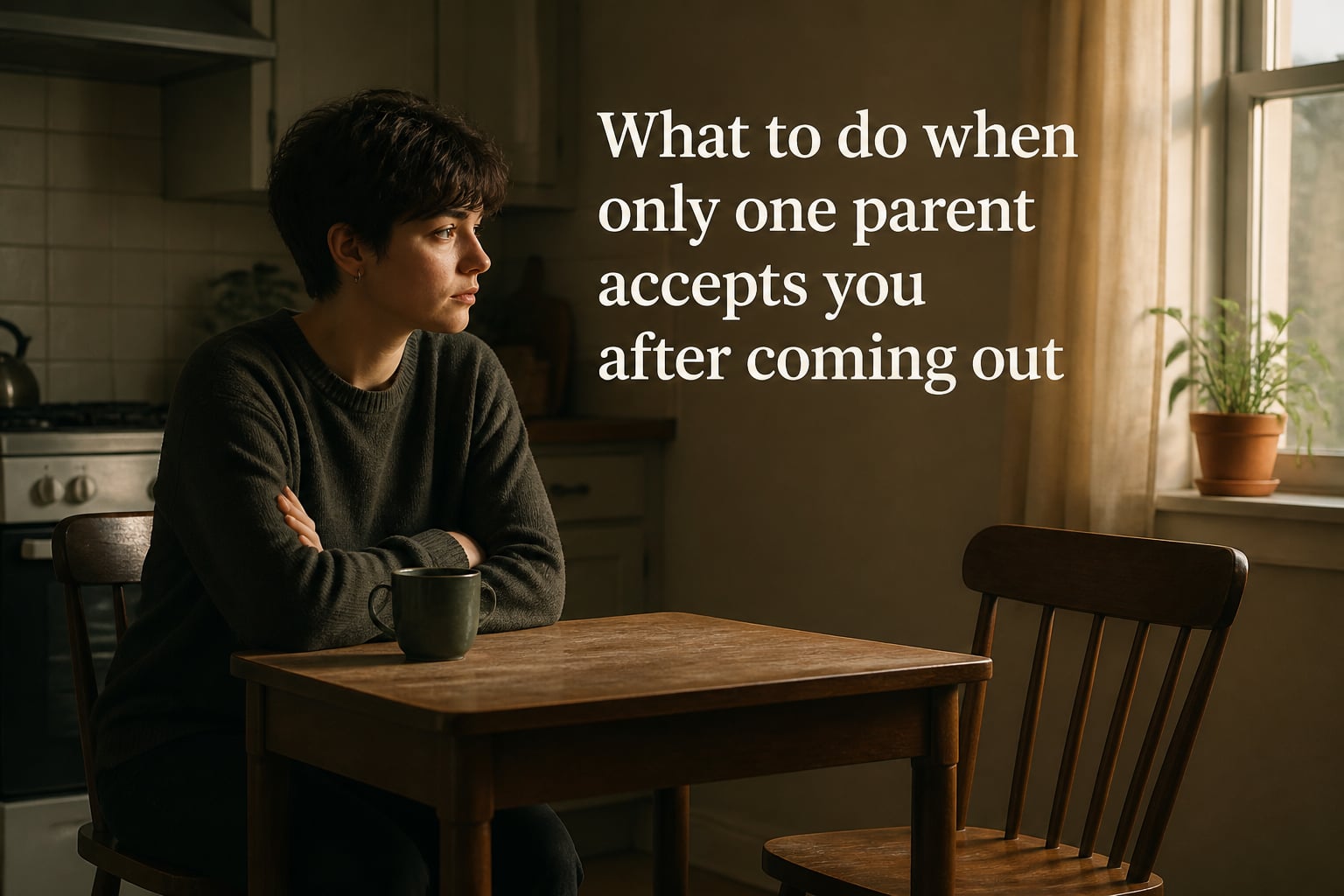
Coming out is rarely a single moment. It’s an unfolding that changes shape as it moves through the people you love. When only one parent accepts you after coming out, the mixed reaction can feel more confusing than a clear yes or a clear no.
I’ve talked with readers who’ve sat in kitchens with one parent hugging them while the other walked out of the room. The question that always comes up is the same: what do I do with this split?
This guide is here for that moment. I’ll walk through the emotional weight of partial acceptance, how to communicate with the non-accepting parent, and how to build the kind of support network that holds you when biology falls short.
Table of Contents
Understanding Why Only One Parent Accepts You After Coming Out
Partial family acceptance usually comes down to exposure, history, and belief systems that developed separately inside each parent.
One parent may have already suspected your identity, or may have a close friend, sibling, or coworker who is LGBTQ+. That lived exposure softens the surprise. The other parent may be drawing on faith traditions, cultural scripts, or fear that has nothing to do with you personally.
Families are not monolithic. Two people can raise you in the same house for two decades and still hold completely different views about gender, sexuality, and change. That’s why “coming out to parents” often looks like two separate conversations, not one.
If your parents are divorced, this can be even sharper. The parent you live with, or the one you’ve always been closer to, may turn out to be the one who struggles most. There is no reliable formula, and that’s part of what makes the first weeks so disorienting.
Acknowledging the Emotional Weight of Partial Acceptance
Most guides skip the part where you simply have to feel what you’re feeling. I won’t skip it.
When only one parent accepts you after coming out, you often carry two emotions at once: gratitude for the parent who said yes, and grief for the parent who didn’t. Some readers describe this as more painful than outright rejection, because at least rejection is honest. Tolerance can feel like a door that’s open but never warm.
Forum users often describe what therapists call silent estrangement. Your family is still around, but your identity becomes unspeakable. Dinner conversations skip your partner. Holidays feel like performances. You learn to edit yourself in rooms where you used to be yourself.
That grief is real. You are mourning a version of the relationship you thought you’d have, and that loss deserves space. Give yourself permission to feel it without rushing toward acceptance of the new normal.
A reader told me she cried in her car for twenty minutes after a family dinner where her mother referred to her girlfriend as her “friend.” That reaction wasn’t weakness. It was honest. The goal isn’t to never feel it. The goal is to not let it become the only thing you feel.
How to Cope in the First Weeks After Coming Out
The first weeks are when you need a plan more than you need perspective.
Here are the moves that helped the readers I talked with, and that therapists tend to recommend for early post-coming-out adjustment:
Lean hard on the accepting parent, but in healthy ways. Ask for specific support, like a weekly check-in call or a no-questions-asked safe space to vent.
Write before you react. A private journal, voice memos, or unsent letters give the big emotions somewhere to land without damaging relationships.
Protect your sleep, food, and movement. Grief and rejection spike cortisol. Your body needs the basics even when your mind is spinning.
Don’t make permanent decisions. Wait at least a few months before deciding to cut off, go fully public, or move across the country. Reactions shift over time.
Identify one trusted person outside your family. A friend, mentor, counselor, or chosen family member who knows the full picture.
Most importantly, give yourself the grace to have good days and bad days in the same week. Partial acceptance isn’t a single event you process once. It’s a recurring situation you learn to navigate.
Communicating With the Non-Accepting Parent
Only one of the top guides on this topic even addresses this directly, and it’s the question most readers actually have: how do I talk to the parent who didn’t accept me?
First, accept that you cannot control their response. You can only control whether the door stays open.
If you decide to engage, here are the principles that work better than confrontation:
Lead with what you want, not what they did wrong. “I’d like you to know me fully” lands better than “You hurt me when you said…”
Keep first conversations short. Thirty minutes is plenty. You can always add another conversation later.
Name one specific thing you need. “Please use my correct name” or “Please don’t bring this up at Thanksgiving” gives them something concrete to respond to.
Expect a learning curve. Many parents misgender, use wrong terms, or slip up for years. Correcting calmly is more effective than exploding.
Know your exit line. If a conversation turns hostile, you can say, “I want to keep talking, but not like this. I’m going to go, and I love you.” Then actually go.
If the non-accepting parent is unwilling to even discuss your identity, the most loving thing you can do for both of you is pause the conversation. You can reopen it in six months. You can reopen it in five years. You don’t owe anyone a debate about your own existence.
Building a Support Network Beyond Family
When family acceptance is partial, your chosen family stops being a nice idea and becomes a survival strategy.
The LGBTQ+ community has always understood this. Chosen family is the network of friends, mentors, exes, coworkers, and community members who show up, who know your real name, and who treat your identity as ordinary rather than remarkable.
Building that network can look like:
Joining a local LGBTQ+ center for drop-in groups, book clubs, or game nights.
Finding one peer who has been through it. Peer support groups, both online and in person, normalize what you’re going through.
Investing in friendships that feel reciprocal, not just the people you perform around.
Connecting with affirming faith communities if religion matters to you and your family tradition is causing pain.
Working with an LGBTQ+-affirming therapist who understands minority stress and family rejection dynamics.
Your chosen family doesn’t replace your biological family. It supplements them. And it gives you somewhere to bring a partner to dinner where no one has to edit themselves.
Setting Healthy Boundaries With Both Parents
Boundaries are how you love people you don’t fully trust right now.
With the non-accepting parent, boundaries might mean limiting visits, leaving when certain topics come up, or declining invitations to events where you’d be put in an unsafe position. These are not punishments. They are self-preservation.
With the accepting parent, boundaries matter too. They may want to over-correct, argue on your behalf, or pressure the other parent into changing. Ask them clearly: I need you to listen, not to fix it for me. That single sentence can save years of frustration.
During holidays, talk to both parents in advance about what topics are off-limits. Decide in advance how you’ll handle a slip-up. Decide in advance what your exit looks like. Going in with a plan keeps you from being ambushed by someone else’s reaction.
Long-Term Mental Health Strategies
This is the section most guides skip, and it’s the one that matters five years from now.
Partial family acceptance is a chronic stressor, not a single event. You need a maintenance plan the way someone with a chronic illness needs a treatment plan. That plan usually includes some combination of therapy, community, identity-affirming practices, and honest friendships.
Watch for warning signs that stress is becoming something more serious: trouble sleeping for weeks at a time, withdrawal from people you used to enjoy, increased substance use, panic attacks, or persistent hopelessness. These are signals to reach out for professional support, not signs of personal failure.
Identity affirmation helps too. Read books by queer authors. Watch films that show your life as ordinary rather than tragic. Spend time with people who make your queerness boring in the best possible way.
Over time, many parents do come around, especially when they see their child thriving. Others don’t, and you build a beautiful life anyway. Both outcomes are possible. The point is to keep living while you wait.
FAQs
How do you deal with parents who say they accept you but don’t talk about your identity?
This is called performative or silent acceptance, and it can hurt more than outright rejection. Name what you need directly: ask them to treat your partner the way they would treat any other partner. If the pattern doesn’t change, reduce the emotional energy you spend in those relationships and invest more in people who treat your identity as normal.
Should I come out to my parents if I think one won’t accept me?
You are not obligated to come out to anyone, ever, especially if safety, housing, or financial stability is at stake. If you do choose to come out to one parent and not the other, that’s a valid and common approach. Many people come out gradually over years, one conversation at a time.
How long does it take a non-accepting parent to come around?
There is no reliable timeline. Some parents shift in months. Others take years, and some never do. Research from PFLAG and family acceptance projects shows that ongoing, low-pressure contact combined with visible happiness and stability is more effective than confrontation. Patience is not the same as passivity, but your mental health matters more than any parent’s timeline.
What should I do if my accepting parent pressures me to fix things with the other parent?
Set a clear boundary early. Try saying: I need you to support me without trying to fix the relationship. That work has to happen between me and them. Most well-meaning parents will back off once they understand that their mediation is adding stress instead of reducing it.
Moving Forward When Only One Parent Accepts You
Knowing what to do when only one parent accepts you after coming out isn’t about finding a magic phrase that fixes everything. It’s about building a life where you don’t depend on a single relationship for your sense of worth or safety.
Take it one week at a time. Build your chosen family. Set the boundaries you need. And give yourself credit for surviving something genuinely hard.