
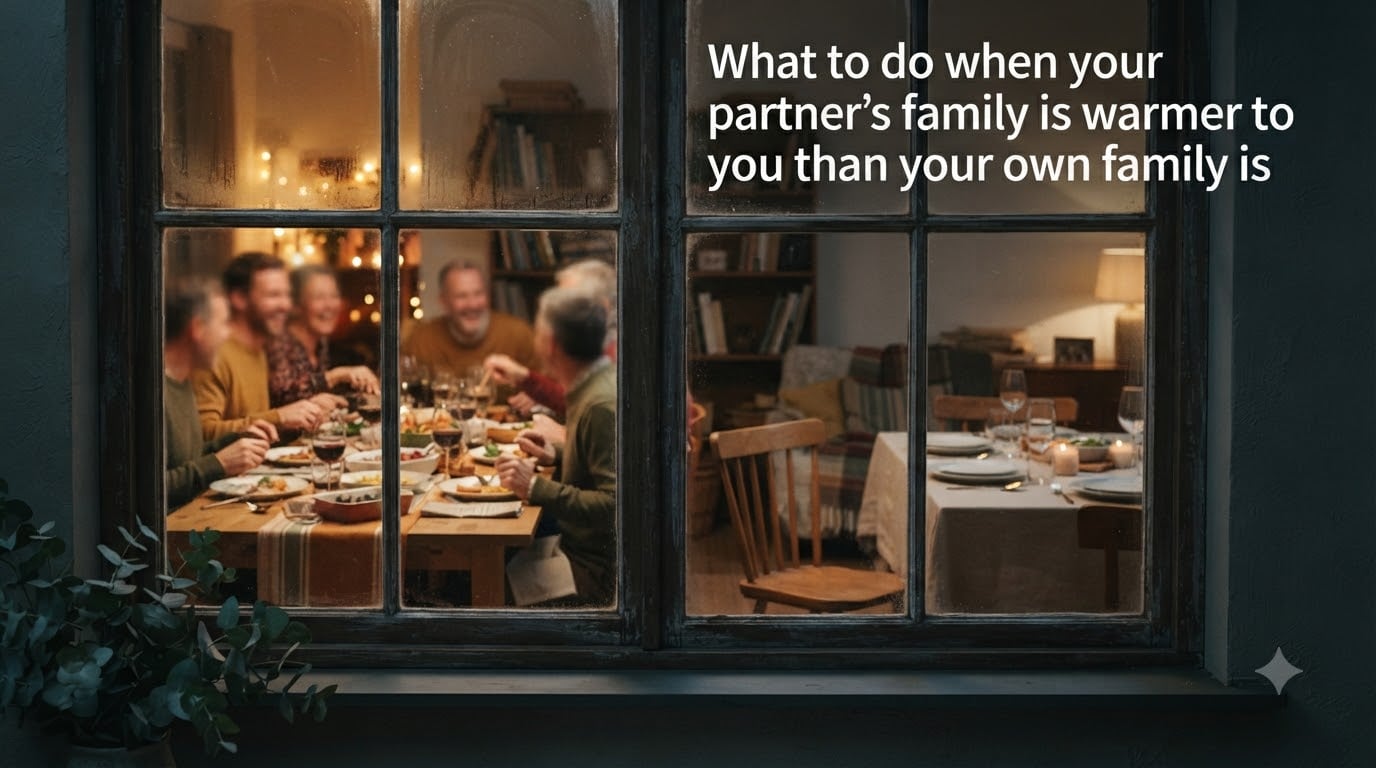
You’re sitting at your partner’s parents’ house on a Sunday afternoon, laughing at a story your partner’s mom is telling, and it hits you: I feel more at home here than I do at my own family’s house.
Then comes the guilt, sharp and immediate. You were raised to love your family. You were taught to value your roots. And now you find yourself looking forward to dinners at your partner’s parents’ place more than holidays with your own.
I want to tell you something important right up front: this feeling is more common than you think. You are not a bad son or daughter. You are not betraying anyone. You are a human being responding to warmth, and there are real, compassionate reasons this is happening to you.
In this guide, I’ll walk you through why you feel closer to your partner’s family than your own, how to handle the guilt that comes with it, how to talk to your partner about it, and how to navigate both families without losing yourself in the process.
Table of Contents
Why It Happens: Understanding the Family Warmth Gap
Family warmth is not automatic. It is taught, modeled, and practiced over decades. When you feel closer to your partner’s family than your own family, it usually means one or more things are happening beneath the surface.
Your family of origin may use different love languages. Some families express care through acts of service, quiet presence, or practical help rather than through hugs, verbal affirmations, or emotional check-ins. Both styles are valid, but your nervous system often responds most strongly to the style you did not grow up with.
Your partner’s family may have healthier emotional habits. They might ask deeper questions at dinner. They might remember small details you mentioned weeks ago. They might say “I love you” out loud. When you’ve never experienced that consistently, it can feel almost intoxicating.
Distance, time, and unresolved tension also play roles. If you moved away, if there was a difficult period with your parents, or if your family of origin struggles to talk about feelings, your partner’s family can start to feel like the version of home you always wanted.
None of this means your family is bad. It means warmth is unevenly distributed in most families, and you happened to land in a relationship where the warmth landed elsewhere.
Signs You Feel Closer to Your Partner’s Family Than Your Own
Here are some of the most common signs that you are experiencing this dynamic. See how many resonate with you.
- You look forward to visits with your partner’s family more than visits with your own.
- You feel physically relaxed at your partner’s parents’ house but tense at yours.
- You share personal news with your partner’s family before sharing it with your own.
- You feel guilty about how much you enjoy time with your in-laws.
- You catch yourself wishing your own parents were more like your partner’s.
- You feel like you can be your full self around your partner’s family but hold back around yours.
- You sometimes feel sad leaving your partner’s family after a visit.
Recognizing these patterns is not about assigning blame. It is about understanding where your heart has found safety, and why.
How to Cope with the Guilt of Liking Your Partner’s Family More
Guilt here usually shows up because we confuse preference with loyalty. We tell ourselves that enjoying our partner’s family means we are rejecting our own. That is simply not true.
Here are five strategies that have helped me and many people I’ve spoken with work through this exact feeling.
1. Separate the feeling from the story
You are allowed to enjoy where you enjoy. The thought “I like being at my partner’s family’s house” is a neutral observation, not a moral failing. Try noticing the guilt when it shows up, then gently reminding yourself that preference is not betrayal.
2. Get curious about the guilt instead of fighting it
Ask the guilt where it learned its rules. Often it traces back to messages from childhood about loyalty, family obligation, or “blood is thicker than water.” Recognizing these as old programming, not present truth, loosens the guilt’s grip.
3. Practice gratitude for your own family in their own language
Your family may love you fiercely in ways that do not look like warmth. Maybe they show up when things go wrong. Maybe they sacrifice quietly. Looking for love in their language, instead of comparing it to your partner’s family’s language, can reduce resentment and guilt at the same time.
4. Stop keeping score
Comparing how much warmth your family gives versus your partner’s family gives is a trap. Every family is operating with its own history, patterns, and limitations. Scoring them against each other only deepens the gap.
5. Consider therapy if the guilt feels paralyzing
If the guilt is interfering with your sleep, your relationship, or your ability to enjoy time with your partner’s family, a therapist can help you untangle it. This is exactly the kind of thing therapy is good at.
Talking to Your Partner About These Feelings
One of the hardest parts of this experience is the silence around it. Many people carry this alone because they assume their partner will read it as criticism of their family, or as a claim that their partner’s family is “better.”
Talking honestly, though, can actually bring you closer. Here is how to start the conversation.
- Lead with your own feelings, not judgments about either family. Try: “I’ve been feeling guilty lately because I feel so comfortable at your parents’ house.”
- Make it about processing, not asking them to fix anything. You are not looking for them to mediate. You are looking to be heard.
- Be clear that you are not putting their family on a pedestal. Naming this upfront removes a common fear.
- Ask what their experience of both families is. You may be surprised how much they relate.
- Give them time. Some partners need a few conversations before they can engage with the topic fully.
If your partner dismisses the conversation or turns it into a chance to bash your family, that’s worth paying attention to on its own. A good partner will listen to your inner world even when it is complicated.
Setting Boundaries with Both Families
Boundaries are not walls. They are simply the edges you put around your time, energy, and emotional capacity so that relationships stay healthy on both sides.
Start by balancing the calendar without keeping score. If your partner’s family hosts a gathering and your family hosts one the same month, show up to both with genuine presence, even if one feels easier than the other.
Practice being honest about your limits. You do not have to spend every holiday at either family’s house. You can split time, rotate years, or create new traditions together. Choosing one option over another is not a verdict on who loves you more.
Protect your private time as a couple. Make space for holidays or weekends that belong to just you and your partner. This prevents both families from interpreting your availability as a measure of affection.
When either family oversteps, name it kindly and quickly. A simple “We won’t be able to make it that weekend, but we’d love to visit the following one” is usually enough. Avoiding the boundary only builds resentment.
Can You Bridge the Gap with Your Own Family?
Sometimes the honest answer is yes, and sometimes the honest answer is “only a little.” Either way, there are gentle ways to try.
Start with one small, intentional reach-out. Send your mom a text asking about her day. Call your dad for no reason. Suggest a low-pressure activity like grabbing coffee. Do not expect immediate transformation. Warmth can be rebuilt, but it usually rebuilds slowly.
Be honest about what you can and cannot change. Some families will not become warmer no matter what you do, and that is a grief worth feeling rather than a failure to fix.
Keep trying without abandoning yourself. You can keep showing up for your family of origin while also allowing your heart to feel at home in other places. Both can be true at the same time.
Frequently Asked Questions
Is it normal to feel more comfortable with your partner’s family than your own?
Yes, this is more common than most people realize. Many adults feel a deeper sense of belonging with their partner’s family because warmth is often unevenly distributed across families. Your nervous system responds to where it feels safe, not to where it feels obligated.
Who comes first, your family or your spouse?
There is no universal rule here, but most healthy relationships prioritize the partnership while maintaining meaningful ties to both families. A useful question is: who can you be emotionally honest with right now? Often that answer will guide you naturally.
What to do when your partner’s family is warmer to you than your own family is?
Start by validating the feeling rather than judging it. Communicate openly with your partner, set gentle boundaries with both families, and give yourself permission to feel at home where you actually feel at home. If guilt becomes overwhelming, working with a therapist can help.
Moving Forward Without the Guilt
You are allowed to feel at home where you feel at home. The fact that your partner’s family is warmer to you than your own family is does not make you disloyal. It makes you human, responding to warmth the way human beings do.
Tend to both relationships with honesty and patience. Keep showing up for your family of origin in ways they can receive. Keep being grateful for the warmth your partner’s family offers. And keep talking to your partner about the in-between feelings, because those conversations are where real intimacy lives.
If you remember nothing else from this guide, remember this: preferring where you feel safe has always been an act of self-knowledge, never an act of betrayal.