
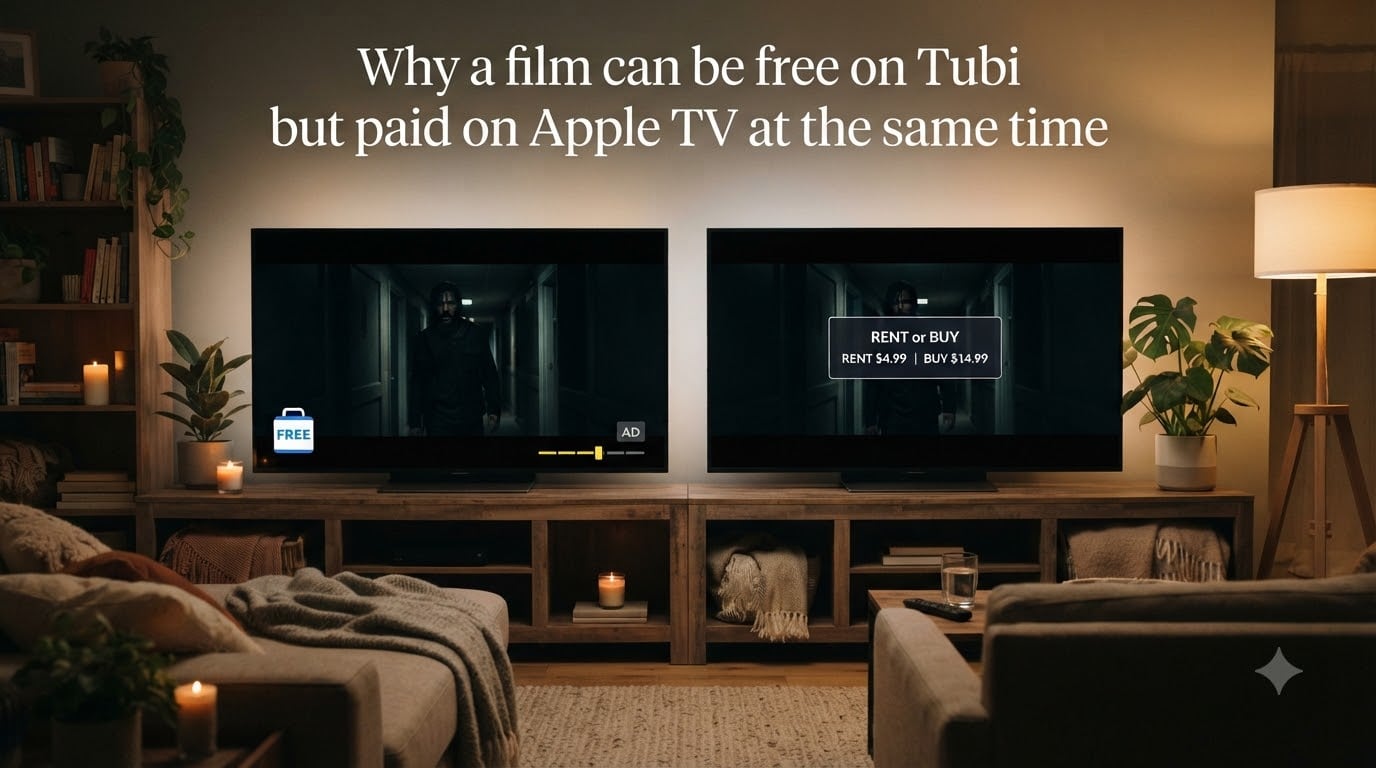
Here is the short answer: the same film can be free on Tubi but paid on Apple TV because the two services run on opposite business models, and they each paid for that movie in totally different ways.
Tubi is what the industry calls an AVOD service, which stands for Ad-Supported Video-on-Demand. You do not pay Tubi a dime, but you watch commercials while you watch the movie, and the advertisers pay Tubi instead. Apple TV operates more like a digital video store. Most of the films on it are bought or rented through the iTunes Store, and a smaller set sits behind the Apple TV+ subscription. Same movie, totally different funding pipeline.
I dug into the licensing deals, the ad-revenue math, and the confusion between the Apple TV app and the Apple TV+ subscription so you do not have to. By the end of this guide you will understand exactly why one film is free somewhere and paid somewhere else, and how to pick the right service for whatever you want to watch.
Table of Contents
How Tubi and Apple TV Make Money in Completely Different Ways
The price difference comes down to one fact: Tubi and Apple TV get paid in opposite directions. Once you see that, the rest clicks into place.
Tubi’s Ad-Supported Video-on-Demand (AVOD) Model
Tubi earns money by inserting advertisements into the movies and shows it streams. You might see four or five ad breaks per feature film, plus short pre-roll spots before the content starts. Brands pay Tubi for those impressions, and Tubi keeps most of the revenue after sharing a slice with the studio that owns the film.
Fox acquired Tubi in 2020 for roughly $440 million, which gives Tubi a deep catalog of Fox-owned studio films at almost no acquisition cost. That ownership matters because Fox does not need to charge itself licensing fees to host its own movies. Tubi also licenses films from other studios like NBCUniversal, Warner Bros, and indie distributors, but those deals tend to involve either a small flat fee or a revenue share instead of a subscription paywall.
Apple TV’s Transactional and Subscription Hybrid
Apple TV is technically two things glued together. Apple TV+ is a subscription service that gives you access to Apple Originals like Ted Lasso, Severance, and CODA. Most other films on the Apple TV app are sold or rented a la carte through the iTunes Store, which works like Amazon Video or Google Play Movies used to work.
So when you open the Apple TV app and see a movie you want to watch, you are usually looking at a separate purchase or rental. Apple pays the studio a wholesale price for the digital rights, then resells the film to you at a markup. Some films are bundled inside the Apple TV+ subscription, but those are usually Apple-produced titles or titles Apple paid a premium to lock in.
Why the Same Film Has Different Prices on Different Platforms
Studios do not sell the digital rights to a film once. They sell the same film to many buyers at once, and each buyer decides what to do with it.
Content Licensing Deals Are Sold Separately to Each Platform
When a studio finishes a movie, its distribution team auctions off the streaming rights by territory, by time window, and by exclusivity level. Tubi might license a film for the U.S. only, with non-exclusive rights, for three years. Netflix might pick up the same film for global rights in a different window. Apple might buy or rent the film through iTunes completely independently of either deal.
Each license has its own price tag. That is why you will see a 2018 thriller available free with ads on Tubi, available to rent for $3.99 on Apple TV, and unavailable entirely on Netflix because Netflix never bought that window.
Who Pays the Studio and How That Affects Your Price
Tubi typically pays the studio a small one-time fee or a revenue share based on ad performance. The studio makes less than it would through a paid subscription service, but it makes something on titles that otherwise would sit in a vault gathering dust.
Apple takes the opposite approach. Apple pays the studio upfront or through a per-rental cut, then charges you enough to make a profit. Newer films and prestige titles cost more for Apple to acquire, so those prices show up at $14.99 to buy or $5.99 to rent. Older films drop to $4.99 to buy or $3.99 to rent as their commercial value declines.
Apple TV App vs Apple TV+: The Confusion That Makes It Worse
Most of the frustration around paid movies on Apple TV comes from one simple naming problem. The Apple TV app and the Apple TV+ subscription are not the same thing.
The App Is Free, the Subscription Is for Apple Originals
The Apple TV app is a free storefront that anyone with an Apple ID can download. It is the place where Apple aggregates everything you might want to watch: Apple TV+ originals, third-party subscriptions you have linked, and iTunes Store purchases and rentals.
Apple TV+ is the monthly subscription that unlocks Apple-produced shows and movies. An Apple Support Community thread summed it up the way I would: paying for Apple TV+ is more like paying for a New York Times subscription than buying access to a newsstand. The subscription covers the publisher’s own content, not every newspaper on the rack.
What ‘Buying’ or ‘Renting’ a Movie on Apple TV Actually Means
Buying a movie through the iTunes Store gives you a permanent digital copy tied to your Apple ID. You can download it, stream it offline, and re-watch it on any Apple device signed in to your account. You are not buying a file though, you are buying a license to stream it from Apple’s servers.
Renting gives you 48 hours to finish the film once you press play, or 30 days to start watching after purchase. Rentals disappear when the window closes, even if you downloaded the file. Neither purchase nor rental is covered by your Apple TV+ subscription fee.
Why Studios Willingly License Movies to Tubi for Free
This is the part most readers find counterintuitive. If a studio can sell a film to Apple, why give it to Tubi without charging the viewer anything?
The answer is revenue timing and shelf life. A studio makes most of its money on a film during theatrical release and the early home video window. Five years later, the film has minimal resale value on paid platforms. Most viewers have already seen it or have lost interest. Leaving the film in a vault earns the studio exactly $0 forever.
Licensing the same film to Tubi for a small fee or ad-revenue share converts a dormant asset into a recurring income stream. Tubi also keeps the film in front of viewers who might later buy a sequel, soundtrack, or newer release from the same studio. Tubi’s relationship with Fox gives it a structural advantage here, because Fox can keep its own deep library on the platform essentially for free.
Tubi vs Apple TV vs Netflix: Business Model Comparison
Here is a side-by-side look at how each major service makes money, which directly shapes what you pay at the screen.
| Service | Model | Cost to You | Main Library | Content Source |
|---|---|---|---|---|
| Tubi | AVOD | Free with ads | Older catalog titles, hidden gems | Fox, NBCUniversal, Warner Bros, indies |
| Apple TV+ | SVOD | Monthly subscription | Apple Originals, select exclusives | Apple Studios, premium licensed titles |
| Apple TV app | Transactional | Per purchase or rental | New releases through catalog | iTunes Store inventory |
| Netflix | SVOD | Monthly subscription | Mixed originals and licensed content | Netflix Studios plus licensed studios |
The cheapest option depends on what you want to watch. Tubi wins for free background entertainment, Apple TV+ wins if you care about prestige originals, and the Apple TV app wins if you specifically want a new release to keep forever.
How to Decide Which Platform to Use for Your Next Movie
You do not have to choose a single service forever. Smart viewers rotate based on what they want to watch, when, and how permanently.
When Tubi Is the Right Choice
Tubi is the right pick when you want to spend zero dollars and do not mind sitting through a few ads. The catalog skews older, which is actually a strength if you love cult horror, 90s thrillers, and forgotten studio productions. Tubi also picked up rights to major sports events in recent years, including NFL games and FIFA World Cup matches.
I use Tubi whenever I am in the mood for a comfort rewatch or want to dig into a film I missed the first time around. You will not find yesterday’s Marvel release there, but you will find dozens of perfectly good mid-budget thrillers from 2008 to 2019.
When Apple TV Makes More Sense
Apple TV becomes the smart move the moment you want a brand new release, a 4K HDR film with Dolby Atmos audio, or a permanent digital copy of a movie you love. Renting on Apple TV is typically cheaper than a single movie ticket, and the library is excellent for family-friendly and prestige titles.
Apple TV+ is a separate decision. If you watch three or more Apple Originals a month and value lossless 4K streaming with no ads, the subscription pays for itself quickly. If you mostly watch older films, stick with Tubi or the iTunes rental path.
Tips for Maximizing Free Content Access
Always check Tubi before paying for anything. There is a good chance the film you are about to rent is already streaming free with ads on Tubi, especially if it is more than two years old.
Layer free trials strategically. Apple TV+ offers a 7-day free trial, and Apple frequently extends it to a month or longer during device purchases. Use those windows to binge specific Apple Originals you actually want to watch, then cancel before the trial ends if the value drops.
Combine Tubi with Pluto TV and the free tier of Amazon Freevee for the maximum amount of no-cost content. The three services license from different studios, so their free catalogs only partly overlap.
Frequently Asked Questions
Is Tubi free if you have Apple TV?
No, having an Apple TV device or even an Apple TV+ subscription does not unlock Tubi or change Tubi’s pricing. Tubi is a separate free streaming service funded entirely by ads, and you can access it on any device with the Tubi app installed.
Why do I have to pay for movies on Apple TV when I have a subscription?
Apple TV+ is a subscription that covers only Apple Originals and a small set of premium exclusives. Most other films on the Apple TV app are sold or rented through the iTunes Store, which is a separate transaction your Apple TV+ subscription does not cover.
Do I actually own the movies I buy on Apple TV?
You own a perpetual license to stream the movie through Apple’s servers, not a copyright to the film itself. The movie stays in your iTunes library linked to your Apple ID and can be re-downloaded on any Apple device signed in to your account, but Apple can revoke access if a license lapses, which is rare.
Why is everything on Tubi free?
Nothing on Tubi is truly free. You pay by watching ads. Tubi sells ad space to brands and shares revenue with the studios whose content it streams, which lets it offer the catalog at no cost to you.
How can Tubi be free but other services can’t?
Tubi runs on an ad-supported model while services like Netflix and Disney+ run on subscription revenue. Ad inventory can fund content the same way subscription fees do, but Tubi needs to monetize each viewer through ads, so it works best for older catalog titles rather than the newest releases.
Is Tubi safe?
Tubi is a legitimate, Fox-owned streaming service available on major app stores. The ads are standard video ads similar to what you would see on broadcast television, and Tubi does not require a credit card or account creation to start watching.
Final Thoughts on Tubi and Apple TV Pricing
Here is the core point one more time: a film can be free on Tubi but paid on Apple TV at the same time because the two services operate on completely different business models, pay studios differently, and own the user relationship differently. Tubi sells your attention to advertisers, so the movie itself is free. Apple sells you the movie directly, so the price is whatever the market will bear for that license.
You do not have to pick a side. Use Tubi for free background viewing and hidden gems, and use Apple TV when you want a brand new release or a permanent digital copy. Once you understand how each service makes money, the pricing stops feeling random and starts feeling predictable.