
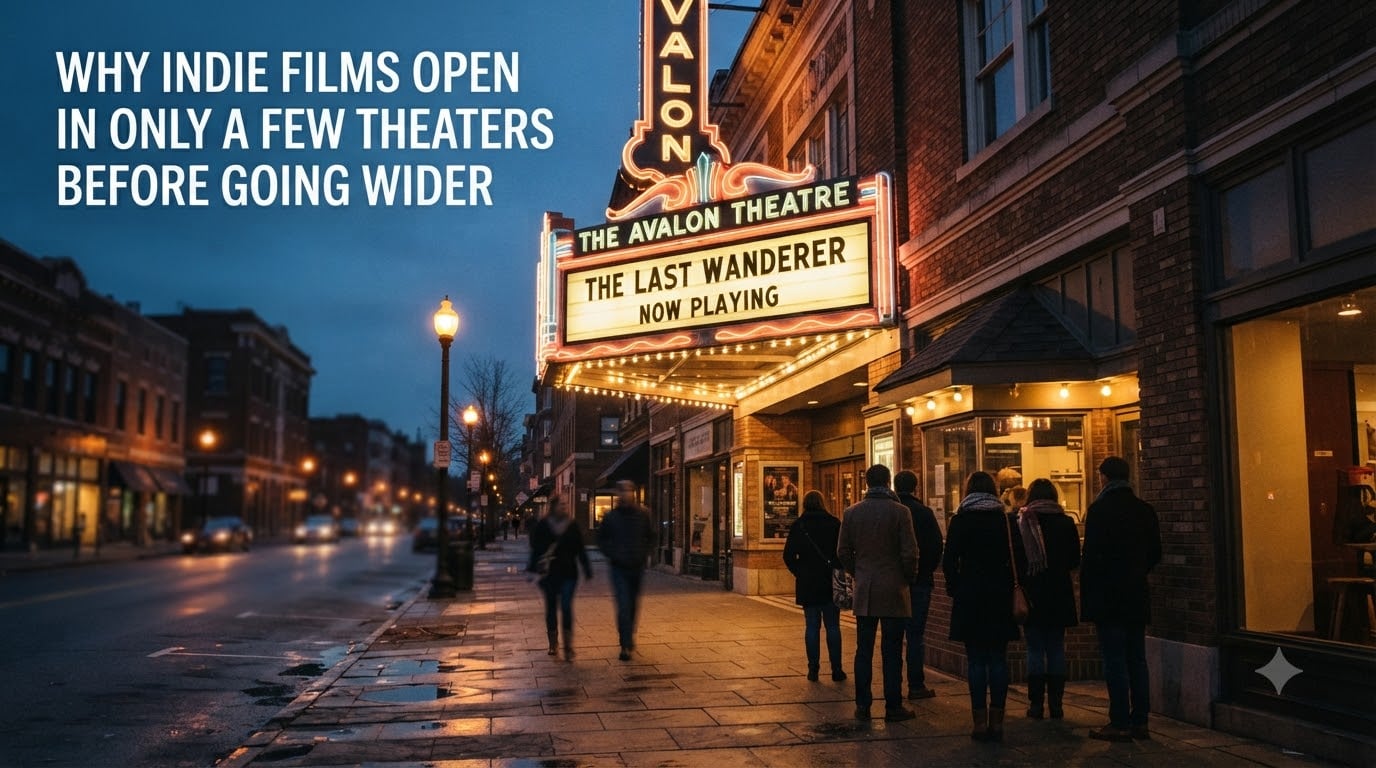
Indie films open in only a few theaters before going wider because limited release is how independent producers manage risk, build word of mouth, and earn the data they need to expand. A platform launch on 5 to 50 screens lets a small distributor test demand, court critics, and qualify for awards without betting the entire budget on day one. Wide release is the prize that limited release makes possible.
I have spent the last year talking to indie producers, distributors, and bookers about this exact playbook. What I learned is that the choice is rarely emotional. It is a measured business plan built around a single metric: per-screen average. Let me walk you through how the strategy works in 2026, where it came from, and how the streaming era has changed the math but not the logic.
Table of Contents
What limited release means and why indie films use it
Limited release is a distribution strategy in which a film debuts in a small number of theaters (commonly 5 to 50) before expanding based on demand. Wide release, by contrast, means 2,000 or more screens on opening weekend and is reserved almost exclusively for studio tentpoles with nine-figure marketing budgets.
Indie films land in limited release for three practical reasons. They lack the P&A (prints and advertising) cash to support a wide opening. They need to demonstrate audience demand before any theater chain will book them at scale. And they want a controlled environment in which critics, festival audiences, and early adopters can spread the word. The strategy is older than Sundance, but Sundance turned it into a repeatable formula in the 1990s, and it has shaped indie film releases ever since.
Financial risk management drives the limited release decision
An indie film rarely has more than a few million dollars in total budget, and the marketing spend is often under $1 million. By comparison, a studio wide release can require $30 million to $50 million just in opening-weekend media spend. If an indie opens on 2,000 screens and the audience does not show up, the losses can sink the entire company behind the film.
Limited release contains that exposure. A 10-screen opening costs a fraction of a 2,000-screen opening in booking fees, print trafficking, publicist hours, and travel for the filmmakers. If the film underperforms, the loss is bounded. If it overperforms, the distributor has room to pour more fuel on the fire. It is the same logic an early-stage startup uses when launching to a small beta before going broad.
Per-screen average is the metric that proves an indie film works
The number that theatre bookers care about most is per-screen average (PSA), sometimes called per-theater average. It is opening weekend gross divided by the number of screens. A $5 million opening on 3,000 screens produces a PSA of about $1,667. A $200,000 opening on 10 screens produces a PSA of $20,000.
Distributors use that ratio to show chains that the audience is dense, engaged, and underserved. Art-house exhibitors and even mainstream multiplexes will add screens when they see a PSA above $5,000 in major markets. The number that triggers aggressive expansion is even higher. Industry veterans often cite a PSA at least 2.5 times the national average as the green light to double the footprint (this is what insiders call the 2.5 rule).
Word of mouth and the role of film festivals
Limited release creates the conditions where word of mouth can actually compound. A 5-screen opening in New York, Los Angeles, and Austin gives the film a fighting chance to land on critic year-end lists, earn a Rotten Tomatoes Certified Fresh score, and generate social conversation among cinephiles. None of that scales on day one the way it does for a Marvel movie, but it scales slowly in a way that is cheaper and more durable.
Film festivals are the launchpad for almost every successful limited release. Sundance, Toronto, SXSW, Telluride, and Tribeca feed the pipeline. A buzzy premiere at Sundance can lock a distributor before the film even screens publicly. A standing ovation at TIFF can trigger a bidding war. By the time the film hits theaters in November, there is already an audience waiting to be served.
The theater booking process and how indie films get screens
Behind every limited opening is a distributor pitching every chain and indie theater they can reach. The pitch usually includes the festival reviews, the trailer, the cast, the director’s track record, and most importantly the per-screen data from comparable comps. Bookers at chains like AMC, Regal, Marcus, Alamo Drafthouse, and Landmark use that data to decide how many screens to allocate and in which cities.
The first cities are usually New York and Los Angeles because that is where critics live and where awards-season voters live. Chicago, Austin, San Francisco, Boston, and Seattle come next, then college towns and arthouse strongholds. The booking agents typically ask for a four-week commitment, renewable based on performance, so the indie distributor is essentially negotiating a four-week audition for every theater they get.
Awards qualifying runs and the timetable for expansion
Many indie films open late in the calendar year specifically to qualify for Academy Awards and other major prizes. The Academy requires a minimum seven-day theatrical run in a Los Angeles County theater for eligibility. That requirement, simple as it sounds, dictates the entire indie release calendar.
Films that screen at Telluride and Toronto in early September typically hit limited release in October or November. They spend a few weeks building buzz and collecting guild and critic prizes. Then in January, after nominations are announced, the same films expand to hundreds or thousands of screens. The films that turn wide are the ones that translate festival heat into voter recognition, and the films that stay limited are the ones that do not.
How indie films expand from few theaters to wide release
The expansion from limited to wide is the most exciting part of the strategy, and it follows a clear tiered pattern. A film typically opens on 5 to 10 screens, expands to 50 to 200 screens in week two or three if the per-screen average justifies it, then to 500 to 1,000 in week four, and finally to 2,000 or more in the post-nominees window in January.
Two rules-of-thumb drive the timing. The 2.5 rule (described above) flags when a distributor has earned the right to scale. The 20 minute rule is a guide from the booking world: a film should not run more than 20 minutes per showtime longer than its targeted runtime, or exhibitors will slot fewer daily showings and the audience will erode. Both rules push distributors toward controlled, data-driven expansion rather than a single opening day gamble.
A real example helps. The indie film Faith of Angels opened on 31 screens in Utah with Purdie Distribution as its partner. Within weeks, the team expanded to over 300 theaters in the Mountain West and beyond, all driven by per-screen averages well above the national average for the opening weeks. That is the playbook working exactly as designed.
How the streaming era has changed (and not changed) limited release
The rise of Netflix, Amazon, Apple TV+, and ad-supported streamers has created a parallel path for indie films that do not catch fire theatrically. A film can open limited, perform modestly, and still find a wide audience on a platform six to twelve weeks later. That parallel path has reduced the financial risk of going theatrical at all, and it has kept the indie film ecosystem alive.
What has not changed is the value of the limited theatrical run as marketing fuel. A review in the New York Times still moves the needle for streaming discovery. A theatrical premiere still drives festival buzz, awards eligibility, and the kind of credibility that helps a streamer market a film in 2026. Limited release is now both an audience-test and a marketing asset, not one or the other.
FAQs
What is the 2.5 rule for movies?
The 2.5 rule is an industry guideline that suggests a film is ready to expand its theatrical footprint when its per-screen average grosses at least 2.5 times the national theatrical average for the same weekend. Distributors use it to decide when to add screens, and bookers use it as a green light that the audience is dense enough to justify more showtimes.
What is the 20 minute rule for movies?
The 20 minute rule refers to a booking guideline that a film’s total runtime (including credits and trailers) should not exceed the listed showtime interval by more than about 20 minutes. When films run long, exhibitors schedule fewer daily showings, which depresses the per-screen average and slows expansion.
How do indie movies get into theaters?
Indie movies get into theaters through distributors who pitch bookers using festival reviews, comparable comps, cast strength, and per-screen data. Many indie films premiere at Sundance, Toronto, SXSW, or Telluride, build buzz there, and then open in 5 to 50 theaters across major markets before expanding based on demand.
Why do indie films open in only a few theaters before going wider?
Indie films open in only a few theaters before going wider to manage financial risk, build word of mouth, qualify for awards, and prove per-screen demand. Limited release lets small distributors test audience response, attract critic attention, and earn the data needed to expand confidently.
Do indie films ever skip theaters and go straight to streaming?
Yes, some indie films skip theaters entirely and debut on Netflix, Amazon, Apple TV+, or ad-supported streamers. That path is common for documentaries, genre pieces, and lower-budget dramas. Theatrical release remains valuable for awards, critic coverage, and audience discovery, even when a streaming deal is already in place.
Final thoughts on the indie film release strategy
Limited release is the indie film industry’s answer to a structural problem. Studios spend their way to wide release on day one. Indies earn their way to wide release over weeks or months by turning per-screen averages, festival buzz, critic attention, and word of mouth into expanding demand.
If you love independent film, the next time you see one on a single screen at your local art-house, buy a ticket and tell a friend. You are part of the strategy. That decision is the data point distributors use to justify a wider opening, and it is how films like Lady Bird, Moonlight, Nomadland, and American Fiction climbed from 4 screens to 1,500 in just a few months.