
Every aspiring filmmaker I have talked to shares the same dream at some point. They picture their name flashing on a screen at Sundance. They imagine walking a red carpet at Cannes or Tribeca, surrounded by industry executives and distributors ready to hand them a deal.
I get it. Those festivals carry weight, prestige, and the kind of exposure that can launch a career overnight. But here is the truth that took me years to learn: for beginners, chasing the prestigious festival dream first is often the fastest way to get discouraged, burned out, and broke.
Local film festivals for beginners offer something the big-name events simply cannot replicate. They provide an accessible, welcoming, and genuinely useful entry point into the world of independent cinema. The intimidation factor disappears. The costs make sense. The connections you make actually stick.
Let me walk you through exactly why your first film festival experience should probably happen within driving distance of your own home, not on a mountain in Park City or a beach in the south of France.
Table of Contents
Why Local Film Festivals Can Matter More Than Prestigious Ones for Beginners
Local film festivals can matter more than prestigious ones for beginners because they offer lower barriers to entry, more accessible networking, genuine audience feedback, and a welcoming atmosphere that builds confidence rather than testing it. While Sundance, Cannes, and Tribeca focus on industry deals and celebrity premieres, regional festivals focus on filmmakers and film lovers connecting in a meaningful way.
Think about what a beginner actually needs. You need experience attending festivals. You need to understand how screenings work, how Q&A sessions flow, and how filmmakers talk about their craft. You need to meet other people at your level who are figuring things out too. None of that requires a badge that costs hundreds of dollars or a hotel room in a ski town during peak season.
Local festivals deliver all of it for a fraction of the cost and none of the anxiety. One filmmaker on the r/FilmFestivals subreddit put it perfectly: chances are there are at least three or four film festivals within an hour of your home. Go to all of them. If you cannot afford a pass, volunteer.
That advice captures the spirit of regional film festivals better than anything I could write. They exist to welcome people in, not to gatekeep.
Lower Barriers to Entry
The most obvious advantage of local festivals comes down to money and access. Submission fees for prestigious festivals can run anywhere from $40 to $100 per film, and the acceptance rate at top-tier events is brutal. Sundance receives over 14,000 submissions annually and programs roughly 100 feature films. That is less than a one percent acceptance rate.
Regional and local festivals, by contrast, often charge $10 to $30 for submissions and accept a much higher percentage of the films they receive. For a beginner filmmaker working with a limited budget, that difference is enormous. You can submit your short film to five local festivals for what one Sundance submission costs.
Then there is the travel factor. Attending Sundance means flights, lodging in Park City during peak season, meals, and a festival badge that can cost over $500. Attending a local festival means gas money and maybe a day parking fee. The total cost difference can easily exceed $2,000.
That financial gap matters because it determines who actually gets to participate. Beginners on tight budgets, students, and people from smaller cities get priced out of prestigious festivals before they even start. Local festivals keep the door open.
Accessibility and a Welcoming Atmosphere
Prestige festival culture can feel impenetrable from the outside. The red carpets, the press lines, the industry-only events, the celebrities, the sense that everyone important already knows everyone else important. For a first-time attendee, that environment breeds a specific kind of anxiety. You feel like you do not belong.
I have heard this from dozens of beginner filmmakers and attendees. They arrive at a major festival excited and leave feeling like they spent three days standing on the outside of a glass wall, watching other people connect. The intimidation is real, and it stops people from coming back.
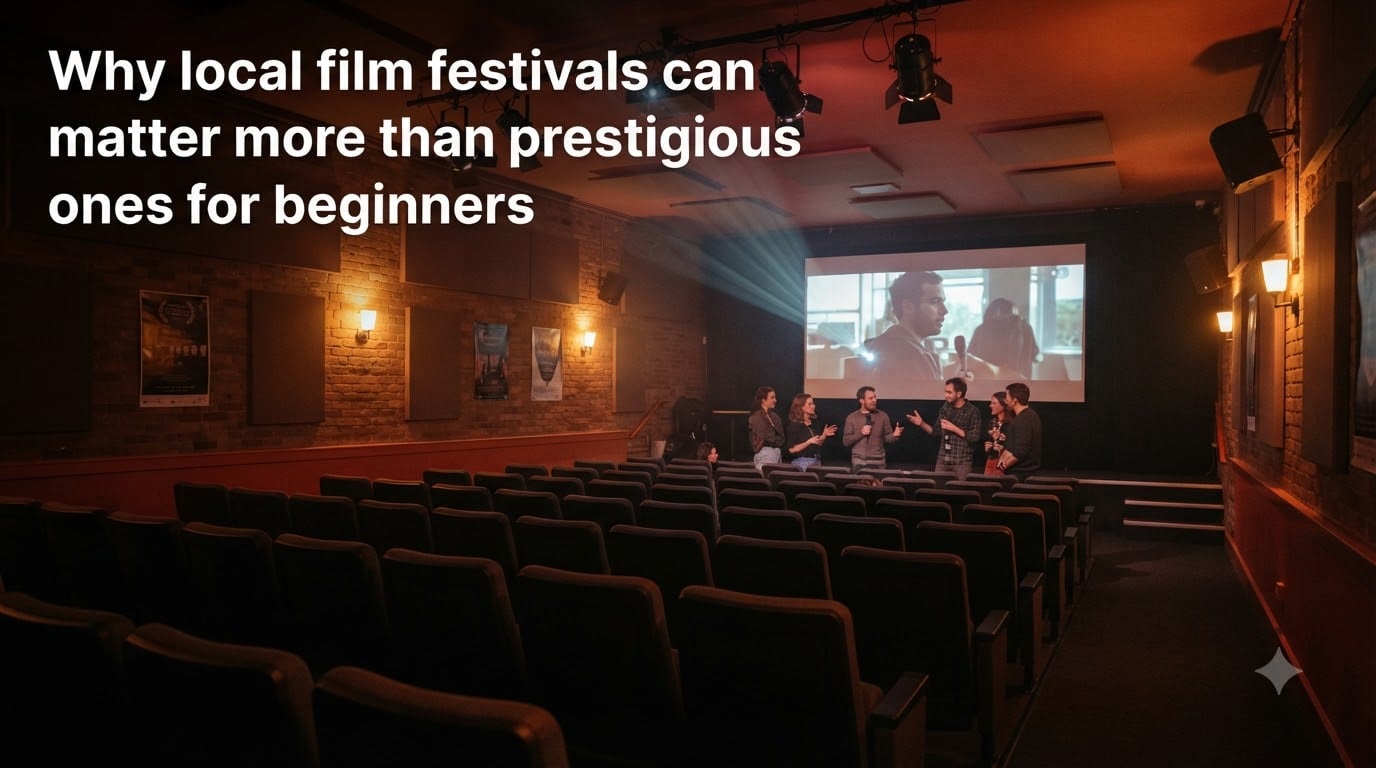
Local festivals flip that dynamic entirely. The vibe is community-first. Filmmakers hang out in the lobby between screenings. Festival organizers know attendees by name by day two. Audience members chat with directors in the popcorn line. Nobody is checking your credentials or asking who you are represented by.
This welcoming atmosphere is not just more pleasant. It is more productive. When you are not spending all your energy trying to look like you belong, you can actually focus on learning, watching films, and having real conversations with people who share your interests.
Real Audience Feedback Instead of Industry-Only Screens
One of the most undervalued benefits of local film festivals is the quality of audience feedback. At a prestigious festival, most screenings are packed with industry professionals, distributors, critics, and buyers. The reactions you get are filtered through a commercial lens. People are evaluating whether your film can make money.
At a local festival, the audience is made up of real movie lovers. They are your neighbors, local college students, retirees who love independent cinema, and fellow filmmakers. When they laugh, gasp, or go quiet during your film, that reaction is genuine. It tells you whether your storytelling actually works for human beings.
The Q&A sessions at local festivals are also dramatically more accessible. At Sundance, Q&A sessions are often moderated, time-limited, and focused on the filmmaking process in broad terms. At a regional festival, audience members walk up to the microphone and ask anything. You get questions about your casting choices, your editing decisions, your soundtrack, your influences. It is direct, unfiltered, and incredibly useful for a beginner trying to understand how their work lands.
That kind of feedback loop is how you actually improve. You cannot buy it. You can only get it by putting your work in front of real audiences in rooms where conversation is encouraged.
Community Building and Lasting Connections
Networking at prestigious festivals often feels transactional. People scan the room for someone more important to talk to. Business cards get exchanged and forgotten. The sheer size of the event makes it hard to form any real connection in a few days.
Local festivals are small enough that you actually meet the same people repeatedly over the course of a weekend. You sit next to the same filmmaker at three screenings. You grab coffee with the festival programmer who liked your short. You trade contact info with a local composer looking for projects. These are the kinds of connections that turn into collaborations.
The r/FilmFestivals community consistently highlights this point. Filmmakers report that their most valuable professional relationships came from small regional festivals, not from the one time they attended a major event. The intimacy of the setting creates trust, and trust creates creative partnerships.
There is also something powerful about building a local film scene. When you attend and support festivals in your area, you contribute to a creative ecosystem that can sustain your work for years. Local filmmakers recommend each other for projects, share equipment, crew on each other’s sets, and champion each other’s films. That network starts at the local festival.
Learning Opportunities for First-Time Filmmakers
Many regional festivals run workshops, panel discussions, and hands-on sessions alongside their screening programs. These are designed for exactly the audience that shows up: beginners, students, and emerging creators looking to learn.
I have sat in on sessions at small festivals covering topics like how to pitch a project, how to navigate FilmFreeway submissions, how to color grade on a budget, and how to negotiate a distribution deal. The presenters are often working filmmakers and industry professionals who live in the region and want to give back to their local community. They are approachable, generous with their time, and genuinely interested in helping newcomers.
At prestigious festivals, comparable panels exist but they are often pitched at a higher level, assume more industry knowledge, and are attended by hundreds of people in massive auditoriums. The chance to ask a follow-up question or introduce yourself to the speaker afterward is slim.
At a local festival with 80 people in the room, that same conversation happens naturally. You walk up to the panelist after the session, ask your question, and suddenly you have a mentor contact. That kind of access is routine at regional festivals and almost impossible at the big ones.
Local vs Prestigious Film Festivals: A Direct Comparison
To make the differences concrete, here is how local and prestigious festivals stack up across the factors that matter most to beginners.
Submission cost: Local festivals typically charge $10 to $30 per submission. Prestigious festivals charge $40 to $100 or more. For a beginner submitting multiple films or applying to several festivals, this adds up fast.
Acceptance rates: Top-tier festivals like Sundance accept less than one percent of submissions. Regional festivals often accept 10 to 25 percent of submissions, giving beginners a real shot at screening their work.
Attendance cost: A local festival might cost you gas money, a $10 day pass, and lunch. A prestigious festival involves flights, hotel stays during peak season, badges running $300 to $800, and meals in expensive cities. The total can easily exceed $2,000 for a long weekend.
Atmosphere: Local festivals feel like a community gathering. Prestigious festivals feel like an industry trade show mixed with a celebrity event. Both have value, but only one is welcoming to someone attending their first festival.
Networking quality: Local festivals offer repeated, intimate interactions with the same group over a weekend. Prestigious festivals offer breadth but shallow interactions across thousands of attendees. For building lasting relationships, small wins.
Feedback value: Local festivals give you real audience reactions and accessible Q&A sessions. Prestigious festivals give you industry-focused feedback filtered through commercial concerns. Beginners need the former before they can make sense of the latter.
Learning access: Local workshops and panels are designed for beginners and feature approachable local professionals. Prestigious festival panels assume industry knowledge and offer little one-on-one access.
None of this means prestigious festivals are bad. They serve a different purpose at a different stage of a filmmaker’s journey. The strategy that works is starting local, building confidence and connections, and then leveling up to bigger festivals when you have a stronger film and a clearer understanding of how the festival world works.
How to Get the Most Out of Local Film Festivals
If you are convinced and ready to attend your first local festival, here is a practical guide to making the experience count.
1. Find festivals near you on FilmFreeway. Search by location and filter for festivals within a two-hour drive. You will likely find more options than you expect, including genre-specific festivals, short film showcases, and community cinema events.
2. Go as an attendee first. Before you submit a film, attend a festival as a regular audience member. Watch how screenings run, observe the Q&A format, and get a feel for the atmosphere. You will learn what the festival values and whether it is a good fit for your work.
3. Volunteer if you cannot afford a pass. Nearly every local festival relies on volunteers, and volunteering gets you inside for free. You will meet organizers, filmmakers, and other volunteers. It is one of the best back doors into the festival community.
4. Introduce yourself to everyone. Local festivals are small enough that being friendly is a strategy, not a burden. Tell people you are a beginner. Ask what they are working on. Sit next to someone new at every screening. The connections you make in casual conversation are often the most valuable ones.
5. Stay for the Q&A sessions. This is where the real learning happens. Listen to the questions audiences ask filmmakers. Pay attention to how directors talk about their process. If you have your own film screening someday, this is exactly the kind of feedback you will want to handle well.
6. Bring business cards or have a quick intro ready. You do not need anything fancy. A simple card with your name, email, and a link to your work is enough. When someone asks what you do, have a 15-second answer prepared.
7. Follow up after the festival. Send a quick email or message to the people you connected with. Reference something specific from your conversation. Most people do not follow up, so this one step puts you ahead of the majority.
8. Submit your film when you are ready. Once you understand the festival’s tone and programming, you will know whether your work fits. Submit with confidence, knowing you have already built a relationship with the community.
FAQs
Can normal people go to Sundance Film Festival?
Yes, Sundance is open to the public and anyone can buy tickets or passes. However, tickets sell out quickly, lodging in Park City is expensive during the festival, and many high-demand screenings are reserved for industry badge holders. For beginners, attending Sundance is possible but costly and competitive compared to local alternatives.
What are the benefits of film festivals?
Film festivals give filmmakers legitimacy, audience feedback, networking opportunities, potential distribution interest, and a theatrical premiere. For attendees, festivals offer access to films before wide release, Qu0026amp;A sessions with directors, workshops, and a sense of community. Local festivals deliver these benefits at a fraction of the cost of prestigious events.
Which film festival is the most prestigious?
Cannes is widely considered the most prestigious film festival in the world, followed by Venice and Berlin. Together with Toronto and Sundance, these make up the top tier of global film festivals. Cannes focuses on international art cinema and industry deal-making, while Sundance is the premier destination for American independent film.
Is it hard to get into prestigious film festivals as a beginner?
Yes. Top festivals like Sundance receive over 14,000 submissions and program fewer than 100 features, meaning acceptance rates are below one percent. Beginners face long odds, high submission fees, and intense competition. Starting with local and regional festivals gives you a much better chance of screening your work and building the track record that makes bigger festivals take notice.
Start Where You Are
Understanding why local film festivals can matter more than prestigious ones for beginners comes down to one core idea: the best festival for you is the one you can actually attend, afford, and participate in fully. Prestige is not a shortcut to growth. Experience is.
Local festivals give you everything you need at the start of your journey: accessible costs, welcoming people, real audience feedback, hands-on learning, and connections that last. They build the confidence and the track record that eventually make bigger festivals realistic.
So search FilmFreeway for festivals near you this month. Buy a day pass. Volunteer if money is tight. Sit in the front row. Ask questions at the Q&A. Introduce yourself to the person next to you. Your film festival journey does not need to start on a red carpet. It just needs to start.