
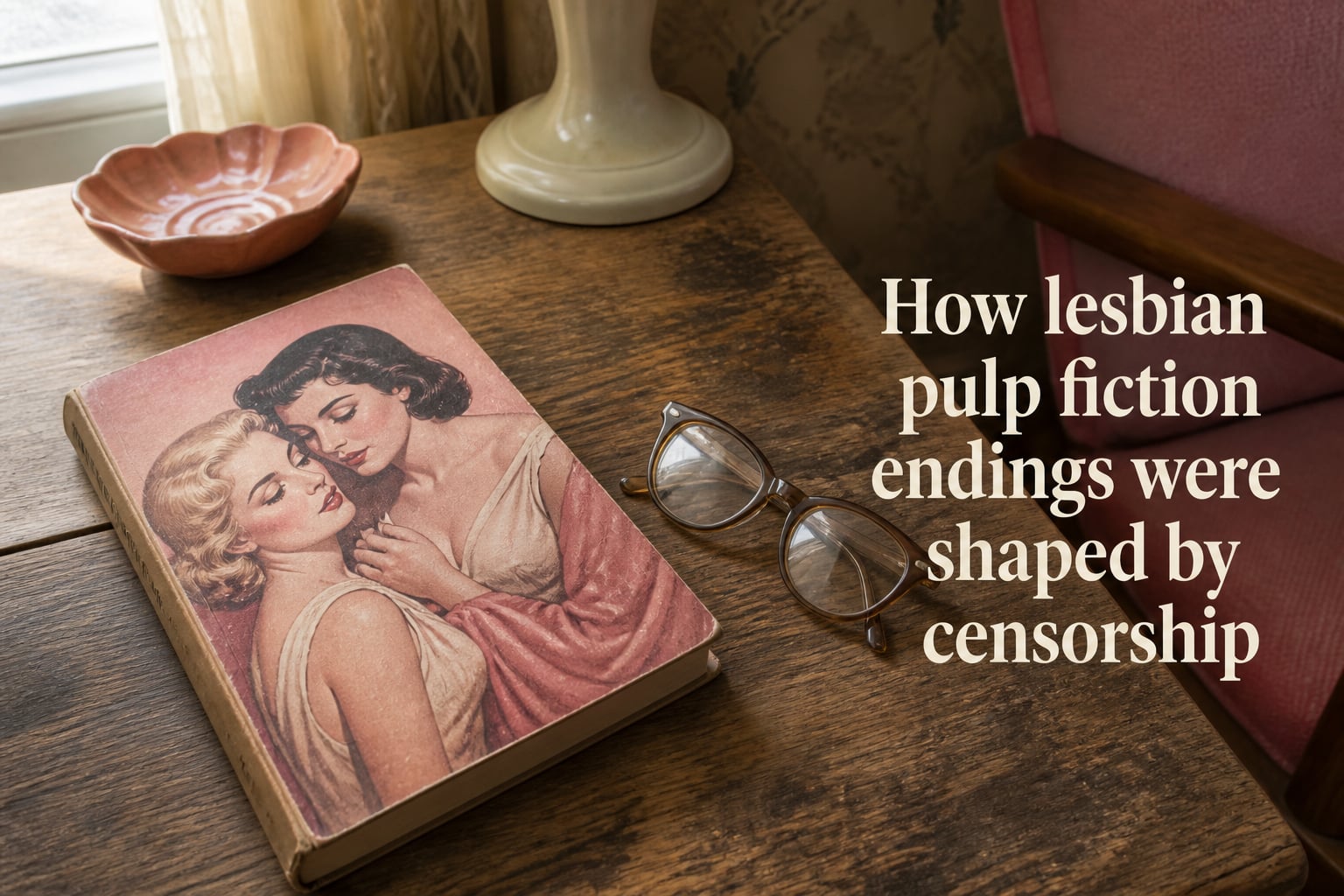
Lesbian pulp fiction was a 1950s paperback phenomenon whose endings were dictated less by the writers than by a tangle of federal obscenity law, postal regulations, and editor demands. By the close of nearly every lesbian pulp novel, the queer character either died, descended into madness, or returned to a man. That punishing formula was not artistic preference. It was a legal shield. Understanding how lesbian pulp fiction endings were shaped by censorship means looking at the publishers, the courts, and the readers who quietly bent those endings to mean something else entirely.
Table of Contents
What Lesbian Pulp Fiction Was and When It Flourished
Lesbian pulp fiction was a wave of mass-market paperbacks published between roughly 1950 and 1965 that featured lesbian characters, themes, or relationships. The books were cheap, disposable, and printed on the rough wood-pulp paper that gave the genre its name. A 25-cent paperback in 1952 was a different object from a hardcover literary novel, both physically and legally. The paper crumbled within a decade. The pages yellowed. And the books were meant to be read and discarded, which, paradoxically, is what saved them when queer readers passed them hand to hand through the late twentieth century.
The genre grew out of the post-World War II paperback boom. Returning soldiers had trained a generation to read portable books. New printing technology made short print runs affordable. And paperback originals, books never released in hardback, sat in a different legal category than bound editions, which is part of why so many lesbian titles were published only in pulp form. The economic logic pulled writers toward endings that satisfied prosecutors, not readers.
By 1955, an estimated 3,000 paperback titles were in circulation in the United States, and lesbian plots had become a recognizable, if stigmatized, niche. Fawcett Gold Medal Books, Ace, Beacon, and Midwood all published dozens of titles. Women wrote most of them under male or gender-ambiguous pseudonyms, which is itself part of how lesbian pulp fiction endings were shaped by censorship: the names on the covers were a defensive choice as much as a marketing one.
The Punishing Formula: How Censorship Shaped Endings
Most lesbian pulp novels followed what historians now call the punishing formula. By the final chapter, the queer character faced one of three fates:
Death, often by suicide, illness, or violence.
Insanity, frequently ending with commitment to a mental institution.
Forced return to heterosexuality, including marriage to a man the character did not love.
This pattern was not coincidence. Editors at houses like Gold Medal Books told authors, sometimes in writing, that the lesbian character could not be shown finding happiness with another woman. A sympathetic resolution between two women would invite an obscenity prosecution. A tragic ending, by contrast, let the publisher argue that the book condemned rather than celebrated homosexuality. The unhappy ending was a defense attorney’s exhibit.
What makes the formula so striking is how readers responded to it. Many lesbian readers, starved for any representation at all, learned to read against the grain. Joan Nestle, who co-founded the Lesbian Herstory Archives in Brooklyn, called these books survival books. The characters died on the page, but the kiss before the death, the lingering glance, the stolen night together, those moments were what readers kept. This double reading is part of how lesbian pulp fiction endings were shaped by censorship, because the censorship gave the books their tragic frame, and readers gave that frame its real meaning.
Publisher Censorship Mechanisms That Dictated Endings
Three overlapping pressures forced the punishing formula onto every writer who wanted to sell a lesbian paperback in the 1950s. They were publisher self-censorship, federal postal law, and state obscenity statutes. Each shaped how lesbian pulp fiction endings were shaped by censorship in slightly different ways.
Publisher self-censorship was the most direct mechanism. Editors at Fawcett Gold Medal Books, the dominant paperback house of the era, gave authors explicit written guidance. When the house recruited 23-year-old Marijane Meaker in 1952 to write what became Spring Fire, editor Dick Carroll instructed her in plain language: the lesbian element had to be punished, not rewarded. Authors who wanted their books to ship understood that any deviation risked rejection, and rejection meant no advance, no distribution, no audience.
Federal postal law added a second layer. Under the Comstock Act of 1873, still enforceable in the 1950s, the U.S. Post Office could refuse to mail materials deemed obscene. For a publisher in New York selling to readers in Kansas, denying the use of the mail was effectively a national sales ban. The postmaster general had real authority, and he used it. Customs officials seized imported books at the border. Distributors refused to carry titles flagged by postal inspectors. Every editor knew that a happy lesbian ending could pull a book off the racks.
State obscenity statutes made individual prosecutors even more dangerous. After the U.S. Supreme Court’s 1957 decision in Roth v. United States, obscenity was defined as material whose dominant appeal was prurient interest and that lacked serious literary value. That definition was vague enough that a district attorney in Memphis or Boston could argue that a sympathetic lesbian novel met the test, even if the same book had passed review in New York. The threat was not conviction so much as the cost of defending against it. Trials consumed money and time that small paperback houses could not spare.
The economic incentives lined up neatly with the legal ones. Tragic endings cost nothing extra to write. They generated no extra legal exposure. They satisfied the wholesaler, the post office, and the local prosecutor all at once. Happy endings, by contrast, raised costs without raising prices. That is why even authors who personally disagreed with the formula accepted it. The economics of how lesbian pulp fiction endings were shaped by censorship were as powerful as the law itself.
Spring Fire: The Pivotal Example of Censored Endings
No single book illustrates how lesbian pulp fiction endings were shaped by censorship better than Spring Fire (1952), written by Marijane Meaker under the pen name Vin Packer. It was the first paperback original to make lesbian desire its central plot, and it sold 1.5 million copies in its first years, an extraordinary number for a 25-cent pulp.
Meaker was a recent college graduate when Gold Medal Books editor Dick Carroll approached her. He had read a novel she had written under another name, and he wanted a lesbian book, fast. The terms were explicit: no happy ending. The lesbian character would have to be punished. Meaker, who later identified as lesbian herself, accepted the assignment because it was a paycheck and a printing. She gave Carroll exactly what he asked for.
The novel is set in a women’s college dormitory. Two roommates, sorority president Leda and the lonely, beautiful new student Mitch, fall into an emotional and physical relationship. The relationship is forbidden by the rules of the school and by the rules of the publishing world. The ending follows the formula almost beat by beat: Mitch is caught kissing Leda, is expelled, returns to a distant and loveless home, and shoots herself. Leda, shaken, returns to her fraternity boyfriend and the social order she had briefly stepped outside of.
Spring Fire satisfied censors because the relationship ends in death and social collapse. It also became the most widely read lesbian novel in America because readers passed it from hand to hand, ignoring Mitch’s corpse and remembering everything that came before. That tension, between the ending censors required and the story readers found between the lines, is the defining feature of how lesbian pulp fiction endings were shaped by censorship. The book is the cleanest proof that the formula could be obeyed on the page and still produce the opposite effect in the reader.
Notable Exceptions: The Price of Salt and Ann Bannon
Two writers stand out for pushing against the punishing formula, and they did it in opposite ways. The first was Patricia Highsmith, whose 1952 novel The Price of Salt was published under the pseudonym Claire Morgan by Coward-McCann. It was a literary hardcover, not a pulp paperback, and it ended with the two women driving toward a life together. The book was a quiet bombshell, less a defiance of the formula than a refusal to use the genre’s machinery at all.
Highsmith understood exactly what she was doing. She wrote to a friend that she was tired of the obligatory suicide at the end of lesbian novels. She wanted at least one book where the women made it. The Price of Salt sold well and was ignored by mainstream critics, who did not want to defend a happy lesbian ending in print. It was reissued in 1990 under Highsmith’s own name as Carol, and the 2015 film adaptation brought its story to a new generation.
Ann Bannon worked the opposite side of the genre. From 1957 to 1962, she wrote five Beebo Brinker novels for Gold Medal Books, pulp paperbacks sold for 35 cents with the punishing formula built into their contracts. Her endings were technically compliant. Beebo’s lover often leaves or dies. But Bannon built the books around queer community, lesbian bars in Greenwich Village, and the inner lives of butch and femme women who had no interest in returning to men. Readers loved the books precisely because the formula was visibly worn thin on every page.
Bannon later said she wrote the books she wished she could have read as a young lesbian in the 1950s. She knew the ending had to be unhappy. She also knew she could fill the two hundred pages before it with the kind of life queer women actually lived. The exceptions are part of how lesbian pulp fiction endings were shaped by censorship: they showed how much could be smuggled past the formula by writers who understood exactly where the line was drawn.
How Censorship Eased by the Mid-1960s
The punishing formula did not collapse all at once. It eroded over fifteen years, pulled apart by court decisions, cultural shifts, and a new generation of writers who stopped pretending that punishment was inevitable. The shift is the final chapter of how lesbian pulp fiction endings were shaped by censorship.
The first cracks were legal. The 1957 Roth v. United States decision gave obscenity a constitutional definition, and courts grew more careful about applying it to literature. The obscenity trial of Allen Ginsberg’s Howl in San Francisco ended in a 1957 acquittal on First Amendment grounds, a signal that juries would not automatically convict works that disturbed them. In 1959, the Supreme Court narrowed obscenity law further, requiring that a work be utterly without redeeming social value to fall outside the First Amendment. The bar was rising. Paperback publishers noticed.
By the early 1960s, paperback editors were testing the old rules. Ann Bannon’s Beebo Brinker novels ended with their characters still grieving, but the focus had shifted away from punishment toward queer community life. Other writers began dropping the obligatory suicide. The novels of March Hastings, Claire Morgan, and a new wave of openly queer authors showed readers who survived, who built families of choice, who went on. The 1964 release of the movie The Leather Boys and the 1965 publication of last-gasp pulp titles with more ambiguous endings marked the close of the strict formula era.
The gay liberation movement that followed Stonewall in 1969 changed the readership itself. Women who had once read these books in secret at kitchen tables began to find one another in bookstores, in bars, in print. Barbara Grier’s 1965 lesbian literature catalog and the founding of Naiad Press in 1973 opened space for novels that no longer had to perform their own condemnation. By the late 1970s, the punishing formula was effectively dead in mainstream lesbian publishing.
The endings changed first because the writers stopped accepting the contract. That is the last and most important lesson of how lesbian pulp fiction endings were shaped by censorship. The law did not soften overnight. Editors did not suddenly grow brave. A generation of readers decided that the books they had been given, even the tragic ones, even the punishing ones, were worth keeping. Once readers decided that, the formula had nowhere left to hide.
FAQs
Why did lesbian pulp novels have such tragic endings?
Tragic endings were a legal defense. Editors at houses like Gold Medal Books required them so the publisher could argue that the book condemned homosexuality rather than celebrated it. A happy ending between two women could trigger an obscenity prosecution or postal seizure, so writers accepted the punishing formula as the price of being printed at all.
What was the first lesbian pulp fiction novel?
Spring Fire (1952) by Marijane Meaker, writing as Vin Packer, was the first paperback original built around a lesbian plot. It sold 1.5 million copies and established the punishing formula of expulsion, suicide, and return to heterosexual respectability that most later lesbian pulps followed.
Which lesbian pulp novels had happy endings?
Very few in the 1950s. The clearest exception is Patricia Highsmith’s The Price of Salt (1952), published under the name Claire Morgan, which ended with the two women driving toward a life together. Ann Bannon’s Beebo Brinker novels (1957-1962) stayed inside the formula technically but built their worlds around queer community survival rather than punishment.
How did readers respond to tragic endings in lesbian pulp?
Readers, mostly women, read against the grain. They passed the books hand to hand, hid them, and focused on the moments of connection between the characters rather than the deaths at the end. Joan Nestle of the Lesbian Herstory Archives called these survival books, because the formula’s frame was visible but the real story happened before the final chapter.
Final Thoughts
Looking back, the punishing formula looks less like a literary convention than like a contract imposed by a frightened publishing industry on writers who needed to be paid. The deaths and madhouses and forced marriages were never what readers came for. They were what the law demanded be on the page so that everything between them could exist at all. That is the deeper story of how lesbian pulp fiction endings were shaped by censorship: not that the books were bad, but that they were written under conditions where even a kiss had to be paid for with a corpse.
What survived the censorship was the readers. The women who bought Spring Fire in 1952 and passed it to a friend, the readers who kept Ann Bannon’s paperbacks in shoeboxes for thirty years, the collectors who saved crumbling pulps long enough for libraries to acquire them. The endings were dictated. The lives that grew up around the books were not. That is the ending the censors never managed to write.