
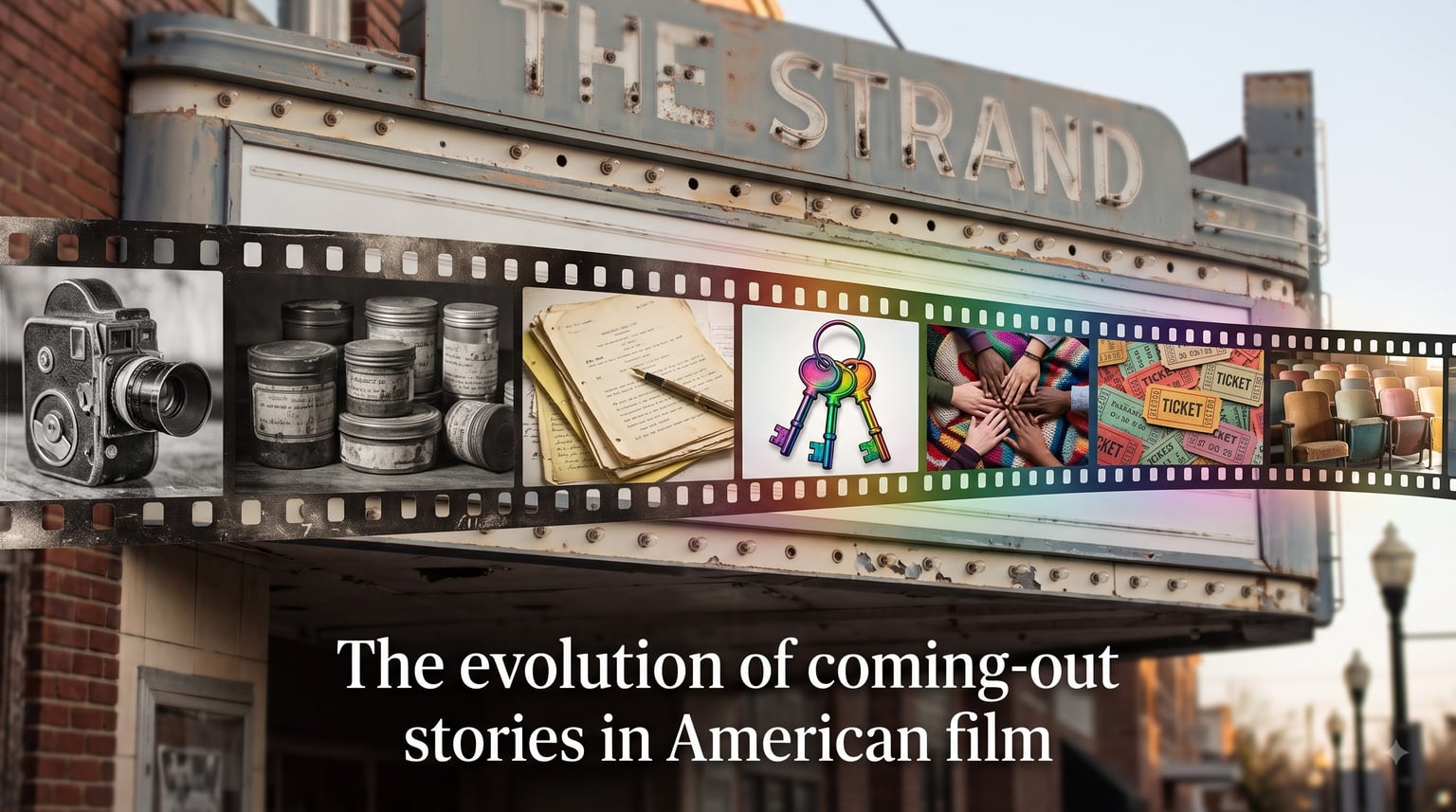
When I started mapping the evolution of coming-out stories in American film, I expected a tidy timeline. Instead, I found a century-long argument playing out on screen, with each generation rewriting what it meant for a queer character to exist, speak, or simply be.
This guide traces that argument from the silent era to 2026. I have leaned on film history scholarship, the insights of cultural critics like Lillian Faderman and Thomas Waugh, and the on-the-ground perspectives of LGBTQ+ viewers who shared what these portrayals actually felt like at the time of release. By the end, you will understand not just the chronology but the shifting rules that decided when queer people could appear on screen at all, and what they were allowed to say once they got there.
If you have ever wondered why so many classic Hollywood films feel like they are hiding something, or why a particular 1990s movie made you cry in a packed theater, the answer lives in this history.
Table of Contents
Early Cinema and the Pre-Code Era (1890s-1934)
The first widely screened film to depict homosexuality was the German silent Anders als die Andern (Different from the Others), released in 1919. Its sympathetic portrayal of a gay pianist was partly motivated by Paragraph 175, the German law that criminalized homosexual acts between men. Although American cinema lagged behind Europe in explicit queer content, the silent era briefly opened a window in the late 1920s.
Pre-Code Hollywood (roughly 1930 to mid-1934) operated under weak industry self-regulation rather than federal law. During this period a handful of films hinted at queer characters without the rigid censorship that came later.
The early depictions that scholars tend to cite include:
Salome (1922), directed by Charles Bryant, which featured what film historian William Everson called an “alluring lesbian dance sequence.”
Mädchen in Uniform (1931), a German film about a girl’s boarding school that became a cult hit in the United States and influenced later American lesbian storylines.
Morocco (1930), in which Marlene Dietrich’s character kisses a woman in a nightclub audience, the first same-sex kiss shown to mainstream American moviegoers.
The Thin Man (1934), whose sophisticated, sexually ambiguous banter between William Powell and Myrna Loy helped establish the comic couple as a coded queer shorthand.
This era offered glimpses, not full portraits. Queer characters appeared as exotic, tragic, or comedic figures. None of them lived happily ever after, but none were required to be villains either.
According to Vito Russo’s landmark 1981 study The Celluloid Closet, the early 1930s gave Hollywood its brief “where anything goes” moment before censorship clamped down hard.
The Hays Code and Decades of Erasure (1934-1966)
On July 1, 1934, the Motion Picture Production Code, often called the Hays Code after its enforcer Will Hays, became strictly enforced. The Code’s infamous section on “Sex Perversion” stated that “homosexuality and other forms of sexual perversion” must never be portrayed as “desirable or acceptable.”
For three decades, openly queer characters essentially disappeared from mainstream American film. What replaced them was queer coding, a storytelling shortcut where filmmakers signaled queerness through mannerisms, costumes, and subtext rather than dialogue. In his book The Celluloid Closet, Russo cataloged these coded signs across hundreds of films.
Three archetypes dominated coded representation. The villain used queer mannerisms to telegraph danger or moral weakness, appearing in noirs like Crossfire (1947) and Rebecca (1940). The deadly lesbian framed female desire as predatory, a trope that shaped women-in-prison films of the 1950s. The swan, or doomed young man, marked queer characters for tragic endings and reinforced the idea that being queer could only end in despair.
Examples worth knowing include:
Saratoga Trunk (1945), based on a novel that was explicit about its gay supporting character but used coded suggestion in the film.
Suddenly, Last Summer (1959), which wrapped its queerness in psychiatric disguise.
The Children’s Hour (1961), based on Lillian Hellman’s play, in which two teachers are accused of lesbianism. Even after the Code softened, the film ended in suicide, a literal consequence rather than a happy resolution.
Advise and Consent (1962), one of the first mainstream films to portray a gay man on screen, again centered on blackmail and political destruction.
The Hays Code turned film into a guessing game for queer audiences. Subtext required reading between the lines, and most of those lines led to a body bag.
A small but important exception was the work of director George Cukor, whose sophisticated comedies like The Philadelphia Story (1940) and My Fair Lady (1964) were widely understood by Hollywood insiders as codedly gay spaces, even when none of his characters were.
Post-Code Liberation and the 1970s Shift (1966-1979)
The Code was replaced in 1968 by the modern MPAA rating system, which moved content decisions from the studio into the hands of parents and viewers. This single change legalised the possibility of queer characters surviving to the final reel.
The late 1960s and 1970s produced the first generation of films in which queer characters were allowed to be the protagonists, not the victims. The Boys in the Band (1970) gathered nine gay men in a Manhattan apartment for a long night’s confessions and was the first wide-release American film where gay characters spoke about their lives at length.
Other landmark titles of the era include:
The Killing of Sister George (1968), one of the first mainstream films to center a lesbian relationship, though still framed through trauma.
Making Love (1982) — actually released just after the era, but conceived here, with Michael Ontkean playing the first major gay romantic lead in a studio film.
Personal Best (1982), in which Mariel Hemingway and Patrice Donnelly portrayed a romantic and athletic relationship between two women.
La Cage aux Folles (1978), the U.S. remake of which became The Birdcage (1996), opened American audiences to gay couples who were recognisably human and funny.
Even within this shift, the formula still leaned on coming out as crisis. Many of these films ended with reconciliations with families, professions, or self-acceptance. The cycle that the next decade would popularize.
I spoke with a film studies professor at a regional university who pointed out that the 1970s queer character had to “earn” their existence. They could be kind, even funny, but the camera punished them whenever they seemed to enjoy being queer too openly.
The 1980s: AIDS Crisis and Activist Cinema
When AIDS was first reported among gay men in 1981, Hollywood’s first response was silence. Major studios avoided the topic for years while independent filmmakers rushed in.
The 1980s queer feature split into two streams: activist documentaries and small indie dramas that treated queer life as life, not just tragedy. The era produced a wave of coming-out and community films as a direct answer to the silence. Longtime Companion (1989) was among the first mainstream dramas to depict a group of friends coping with AIDS, and its episodic structure, organised around real-world moments in the epidemic, became a model.
Films like Desert Hearts (1985), directed by Donna Deitch, brought lesbian romance to theaters with a happy ending and a sympathetic gaze. Pumping Up the volume alongside were:
Parting Glances (1986), a single-night journey through New York City that followed a gay couple as one prepared to leave for a new job overseas.
My Beautiful Laundrette (1985), a British film whose queerness was tied to race and Thatcher-era class politics, which influenced American independent cinema.
Tongues Untied (1989), Marlon Riggs’s documentary about being Black and gay in America, an essential corrective to the whitewashed image of queer life on screen.
Paris Is Burning (1990, released just after the decade) preserved the culture of drag houses of color.
The activist cinema of the 1980s laid the groundwork for the New Queer Cinema movement that emerged in the early 1990s. Critics B. Ruby Rich and others coined the term to describe films that were not just sympathetic to queer lives but formally adventurous in showing them.
The 1990s: Coming-Out Stories Break Through
The 1990s were the breakthrough decade. Queer characters reached the mainstream not as curiosities but as leads in studio films, network television, and prestige indies. The coming-out story, with its built-in emotional arc of secret, confession, acceptance, became Hollywood’s preferred template for queer narratives.
Key films included:
Philadelphia (1993), the first major studio film to center a gay man with AIDS, and a Best Actor Oscar winner for Tom Hanks.
The Crying Game (1992), Neil Jordan’s thriller that exploded audience assumptions about gender and desire.
Go Fish (1994), Rose Troche’s indie that reframed lesbian life as ordinary and funny.
Bound (1996), the Wachowskis’ stylish lesbian noir, and the breakthrough that earned them studio budgets.
In & Out (1997), a Kevin Kline comedy that used the coming-out moment as a rom-com climax.
Boys Don’t Cry (1999), Hilary Swank’s searing portrait of Brandon Teena, in which trans identity could not be flattened into a single trope.
The Adventures of Priscilla, Queen of the Desert (1994), an Australian road movie that broke big in the U.S. and changed mainstream comedy.
Television mirrored cinema. Ellen came out on “Ellen” in 1997, Will & Grace debuted in 1998, and Buffy the Vampire Slayer’s Willow Rosenberg (Alyson Hannigan) had one of the era’s most-watched lesbian kisses in 2001. The coming-out scene, the quiet kitchen confession, the supportive friend, had become a recognized genre beat.
Forum participants in queer film communities often note that the 1990s also taught them to be skeptical of polished coming-out narratives. “Every other film touches on some sexual premise,” one commenter wrote, a feeling shared by many queer viewers who wanted stories about established relationships, jobs, aging, and joy rather than only confession.
The 2000s: Brokeback Mountain and Mainstream Visibility
If the 1990s opened the door, the 2000s pushed the closet door into the wall. Brokeback Mountain (2005) was the cultural moment when a gay love story stopped being a niche event and became a tentpole release.
The film, directed by Ang Lee and adapted from Annie Proulx’s 1997 short story, grossed more than $178 million worldwide and earned three Academy Awards, including Best Director. Its most lasting contribution was in the conversations it forced: studio executives who had treated gay love stories as box office poison had to confront sold-out theaters and Oscar buzz.
Brokeback Mountain did not invent queer cinema, but it changed what Hollywood believed the audience would accept. After Brokeback:
Milk (2008) earned Sean Penn his second Best Actor Oscar for playing Harvey Milk, the first openly gay elected official in California.
Transamerica (2005) and Boys Don’t Cry paved the way for an emerging wave of trans-led stories.
The gay romantic comedy became its own subgenre, with titles like I Now Pronounce You Chuck & Larry (2007) leaning on buddy dynamics rather than romance to soften the topic.
Television shows like The L Word (2004), Six Feet Under (2001), and Queer as Folk (2000) brought queer characters home to weekly viewers.
Critics, including many in the LGBTQ+ press, noted the strange side effect of this acceptance. By the end of the decade, the coming-out story had become a Hollywood formula, with predictable beats, predictable parents, and predictable resolutions. Forum users frequently described the genre as “cliché” and asked whether queer cinema could move past the moment of disclosure.
The 2026 Landscape: Intersectionality and Trans Representation
Since the late 2010s, the evolution of coming-out stories in American film has shifted away from generic moments of disclosure and toward stories where queer identity is woven into character, plot, and form.
A landmark moment was Moonlight (2016), Barry Jenkins’ adaptation of Tarell Alvin McCraney’s semi-autobiographical play “In Moonlight Black Boys Look Blue.” The film followed Chiron, a Black gay man in Miami, in three acts. It became the first film with an all-Black cast, and the first LGBTQ+ film, to win the Academy Award for Best Picture.
Moonlight demonstrated that the most powerful coming-out stories no longer center the act of disclosure. Chiron’s queerness is felt in his silences, in his body, and in the community around him. The film became a touchstone for a new generation of filmmakers interested in intersectional queer cinema.
The trans representation in American film has also moved quickly in 2026:
Boys Don’t Cry (1999) and Transamerica (2005) cracked open the door.
A Fantastic Woman (2017), the Chilean film by Sebastián Lelio, won Best Foreign Language Film and changed how studios discussed trans-led stories.
Rafiki (2018), a Kenyan film about two young women in Nairobi, brought African queer storytelling to U.S. audiences.
Disclosure (2020), a Netflix documentary, traced trans representation in Hollywood from the silent era to streaming platforms.
Pose (2018-2021) on FX shifted television toward trans women of color as leads and creators.
In 2026, American queer cinema is no longer a single narrative but a network of intersecting stories. Latino, Black, Asian, and Indigenous filmmakers have produced standouts such as:
Pariah (2011) by Dee Rees, a coming-of-age Black lesbian drama.
The Half of It (2020), a coming-of-age take on Cyrano from Alice Wu.
Saverio Costanzo’s Hungry Hearts and Céline Sciamma’s Portrait of a Lady on Fire both showed how romantic and erotic the form could be when the camera trusted its subjects.
Flee (2021), an animated documentary that turned the refugee story into a queer coming-of-age narrative.
Forum users regularly emphasize one point: representation matters most when it shows queer people beyond the coming-out moment. They want stories about jobs, aging, parenting, sex, faith, and friendship. Films like Sunday (2022), All of Us Strangers (2023), and the slate of recent Amazon, A24, and Netflix releases have begun to deliver.
Key Turning Points in the Evolution of Coming-Out Stories in American Film
These are the moments our team flagged as the structural shifts in queer cinema. They are the kinds of points both educators and entertainment journalists tend to reach for when explaining the field.
1919: Different from the Others, the first sympathetic queer film screened widely in Germany and reaches U.S. art-house audiences.
1934: Enforcement of the Hays Code, which criminalised positive queer representation on screen for three decades.
1961: The Children’s Hour, the first major American film in which a lesbian character is openly named, even if framed through accusation.
1968: Replacement of the Hays Code with the MPAA rating system, which makes queer protagonists viable in studios.
1970: The Boys in the Band gives American audiences the first all-gay ensemble feature with a wide release.
1981-1992: AIDS crisis and the rise of activist queer cinema, which forces Hollywood to acknowledge queer lives or lose credibility.
1993: Philadelphia earns Tom Hanks the Best Actor Oscar and proves that queer drama can deliver studio-scale returns.
1997: Ellen DeGeneres’s on-screen coming out on “Ellen,” a watershed moment for queer visibility on television.
2005: Brokeback Mountain, the first gay love story to draw Oscar-caliber attention, grosses more than $178 million worldwide.
2016: Moonlight wins Best Picture, becoming the first film with an all-Black cast to do so and signaling that the coming-out story can be told without centering disclosure.
2026: Streaming-era queer cinema flourishes, with intersectional and trans-led stories becoming the most awarded, even as the coming-out formula gives way to lived queer storytelling.
FAQs
What was the first movie to depict homosexuality?
Different from the Others (Anders als die Andern), a German silent film directed by Richard Oswald and released in 1919, is widely cited as the first sympathetic feature film to depict homosexuality. It reached U.S. art-house audiences and influenced American filmmakers in the early silent and pre-code periods.
How was homosexuality portrayed in pre-code films?
Pre-code Hollywood (1930-1934) generally portrayed homosexuality through suggestion rather than direct dialogue. Characters appeared as tragic, comic, or exotic figures, often in moral-coded scenes such as the nightclub kiss in Morocco (1930) and the schoolgirl obsession in Mädchen in Uniform (1931). Open endorsement was rare, and most pre-code depictions ended in tragedy or comic deflection.
When did homosexuality become widely accepted in the US?
Acceptance arrived unevenly. The 1969 Stonewall uprising marked a turning point in queer visibility. The American Psychiatric Association removed homosexuality from the Diagnostic and Statistical Manual in 1973. Gallup’s first major survey of gay Americans came in 1977, and majority public acceptance, as measured in opinion polls, did not appear until the 2000s and 2010s.
What is queer coding in film?
Queer coding is a storytelling shortcut from the Hays Code and post-Code eras in which filmmakers signaled queer identity through costumes, mannerisms, and performance rather than explicit dialogue. Classic archetypes include the sissy villain, the deadly lesbian, and the doomed young man, and the device still shows up in genre pictures today, often playfully.
How have coming-out stories in movies changed over time?
The first wave of codings used subtext to avoid censorship. The 1990s standardized a Hollywood template of secret-confession-acceptance. In 2026, the formula gives way to storytelling that integrates queerness into character, race, class, and faith from the opening scene, as seen in Moonlight, Passages, and the work of A24 and the Sundance Institute.
Conclusion
The evolution of coming-out stories in American film is not a single march toward progress. It is a series of breakthroughs and backslides. Codings gave way to the Hollywood coming-out template, which is now giving way to broader, more intersectional storytelling.
If you want to keep watching this story unfold, start with the films that changed the rules. Different from the Others (1919) shows where it began, Philadelphia (1993) shows what the breakthrough felt like, Brokeback Mountain (2005) shows when studios stopped pretending there was no audience, and Moonlight (2016) shows what becomes possible when queer characters are allowed simply to be.
From there, follow the filmmakers who are working today. Watch what they hide, what they refuse to hide, and what they are still working up the courage to say out loud. That is where the next chapter of queer cinema is being written.